ASFV genome sequencing

               Etienne de Villiers
       International Livestock Research Institute


ASFV CSIRO-AusAID workshop, 20th-21 July 2011, Nairobi
African Swine Fever Virus

• African swine fever (ASF) virus
   – an acute, highly contagious and often fatal disease of
     domestic pigs
   – a large cytoplasmic virus of the family Asfaviridae
   – linear double-stranded DNA genome (170-190 kbp)
• To identify the putative genetic basis for the
  differences in virulence, and potential diagnostic
  antigens, we are comparing the genome sequence of
  non-pathogenic and pathogenic ASF virus isolates.
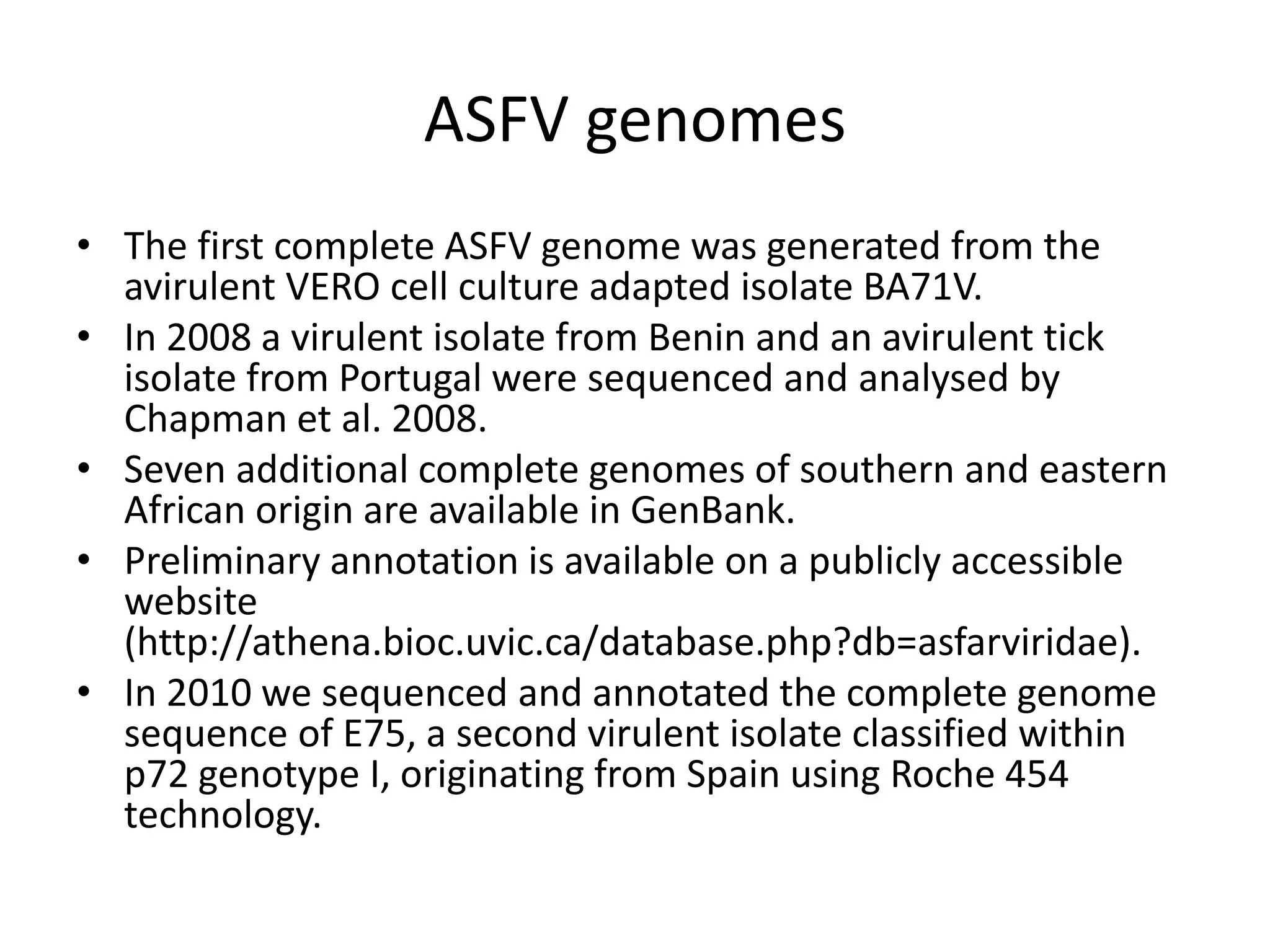
ASFV genomes
• The first complete ASFV genome was generated from the
  avirulent VERO cell culture adapted isolate BA71V.
• In 2008 a virulent isolate from Benin and an avirulent tick
  isolate from Portugal were sequenced and analysed by
  Chapman et al. 2008.
• Seven additional complete genomes of southern and eastern
  African origin are available in GenBank.
• Preliminary annotation is available on a publicly accessible
  website
  (http://athena.bioc.uvic.ca/database.php?db=asfarviridae).
• In 2010 we sequenced and annotated the complete genome
  sequence of E75, a second virulent isolate classified within
  p72 genotype I, originating from Spain using Roche 454
  technology.
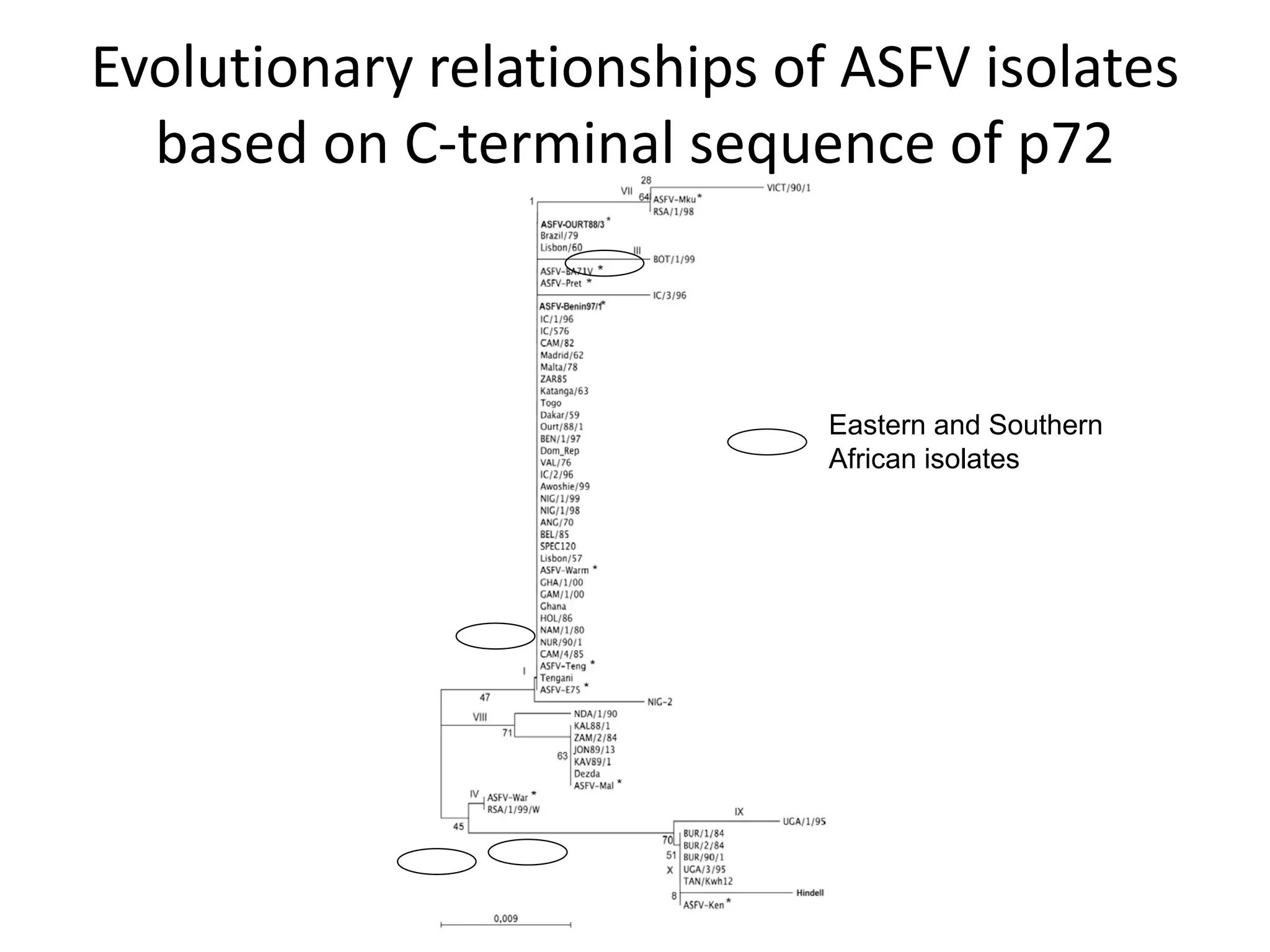
Evolutionary relationships of ASFV isolates
  based on C-terminal sequence of p72


                             Eastern and Southern
                             African isolates
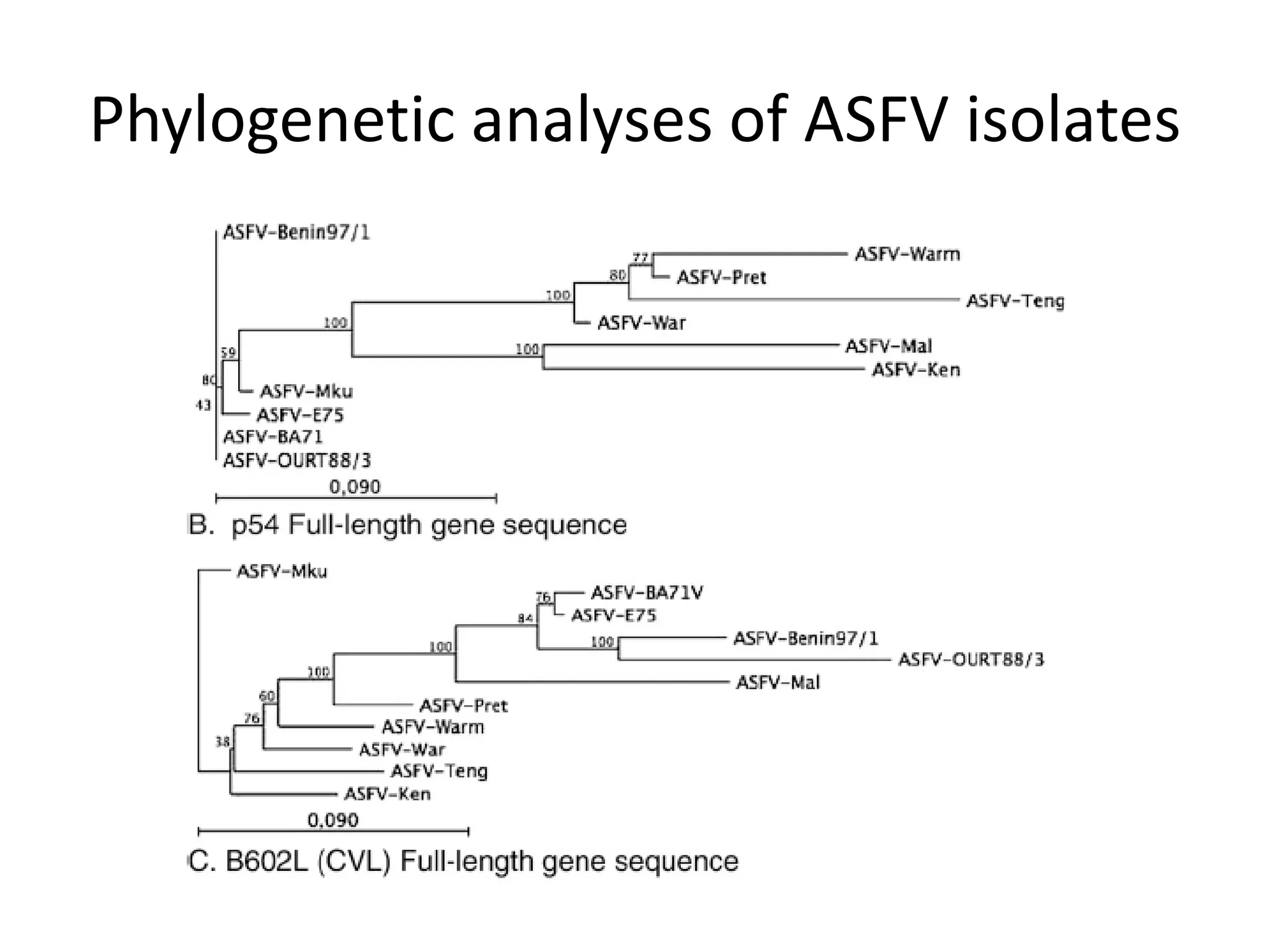
Phylogenetic analyses of ASFV isolates
Comparative genome analysis of Southern African
  (A) and West African-European (B) genomes
Identification of core set of orthologous genes

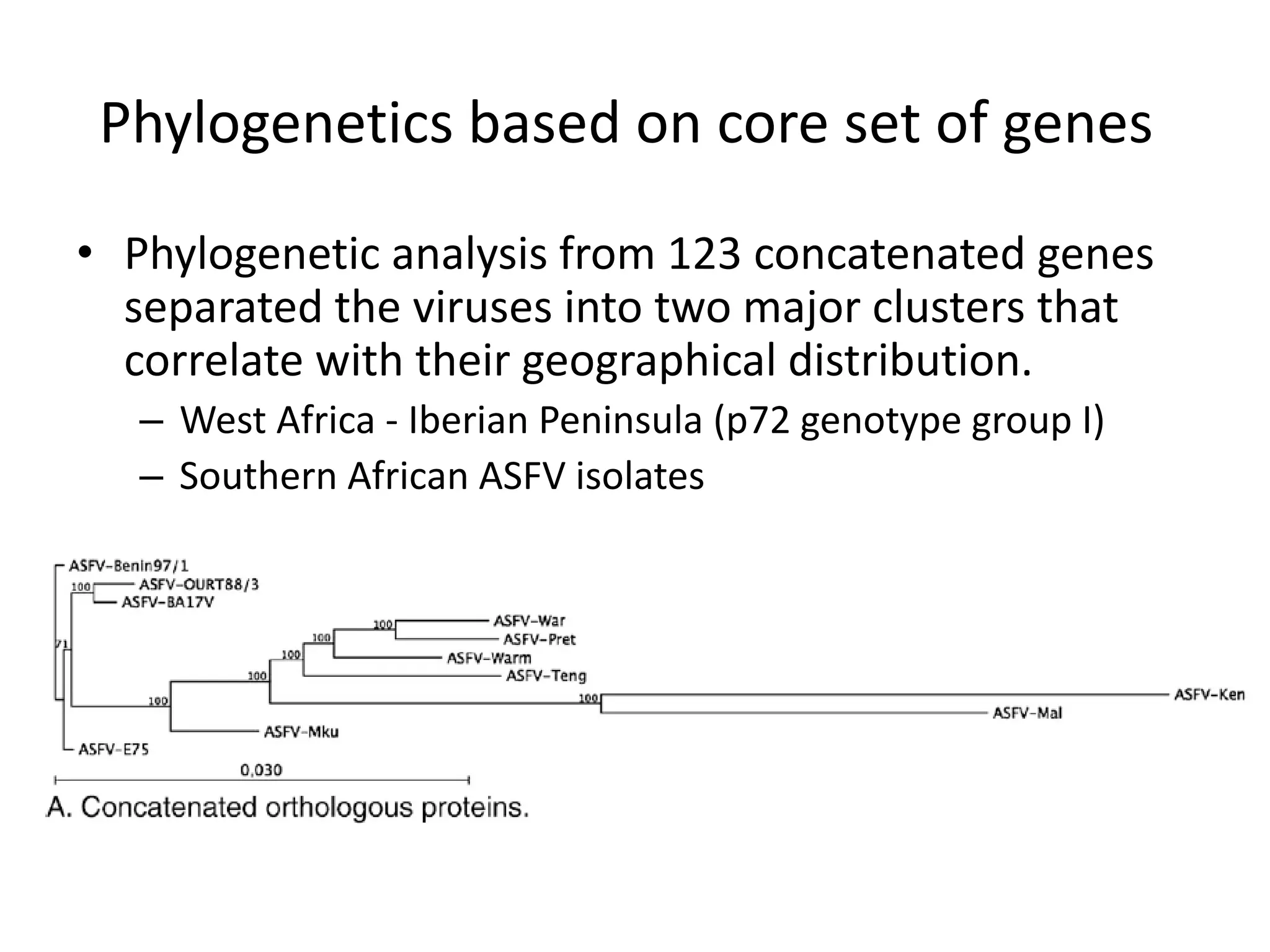
• Several studies have shown that a concatenated
  multi gene approach can resolve ambiguities in
  phylogenetic reconstructions based on single genes.
• The amino acid sequences of the core set of
  orthologous genes from each of the 11 ASFV isolates
  were concatenated into a single pseudo-sequence.
• A neighbor-joining phylogenetic tree was
  constructed from a multiple amino acid sequence
  alignment of the concatenated sequences.
Phylogenetics based on core set of genes
• Phylogenetic analysis from 123 concatenated genes
  separated the viruses into two major clusters that
  correlate with their geographical distribution.
   – West Africa - Iberian Peninsula (p72 genotype group I)
   – Southern African ASFV isolates
Positive selection
• Investigated positive selection at the individual
  amino acid sites.
• The most stringent model for positive selection, M8,
  identified eighteen genes under positive selection.
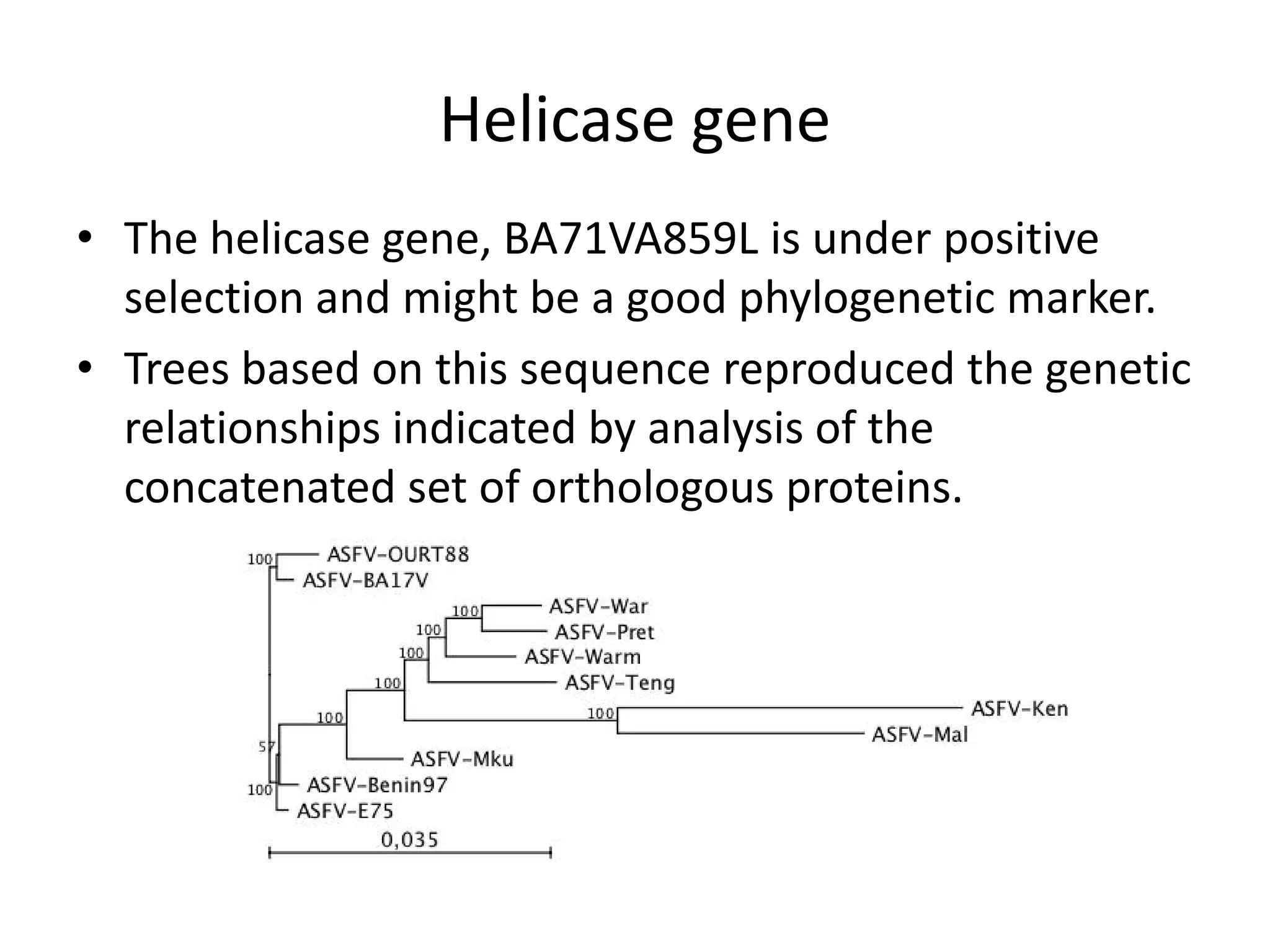
Helicase gene
• The helicase gene, BA71VA859L is under positive
  selection and might be a good phylogenetic marker.
• Trees based on this sequence reproduced the genetic
  relationships indicated by analysis of the
  concatenated set of orthologous proteins.
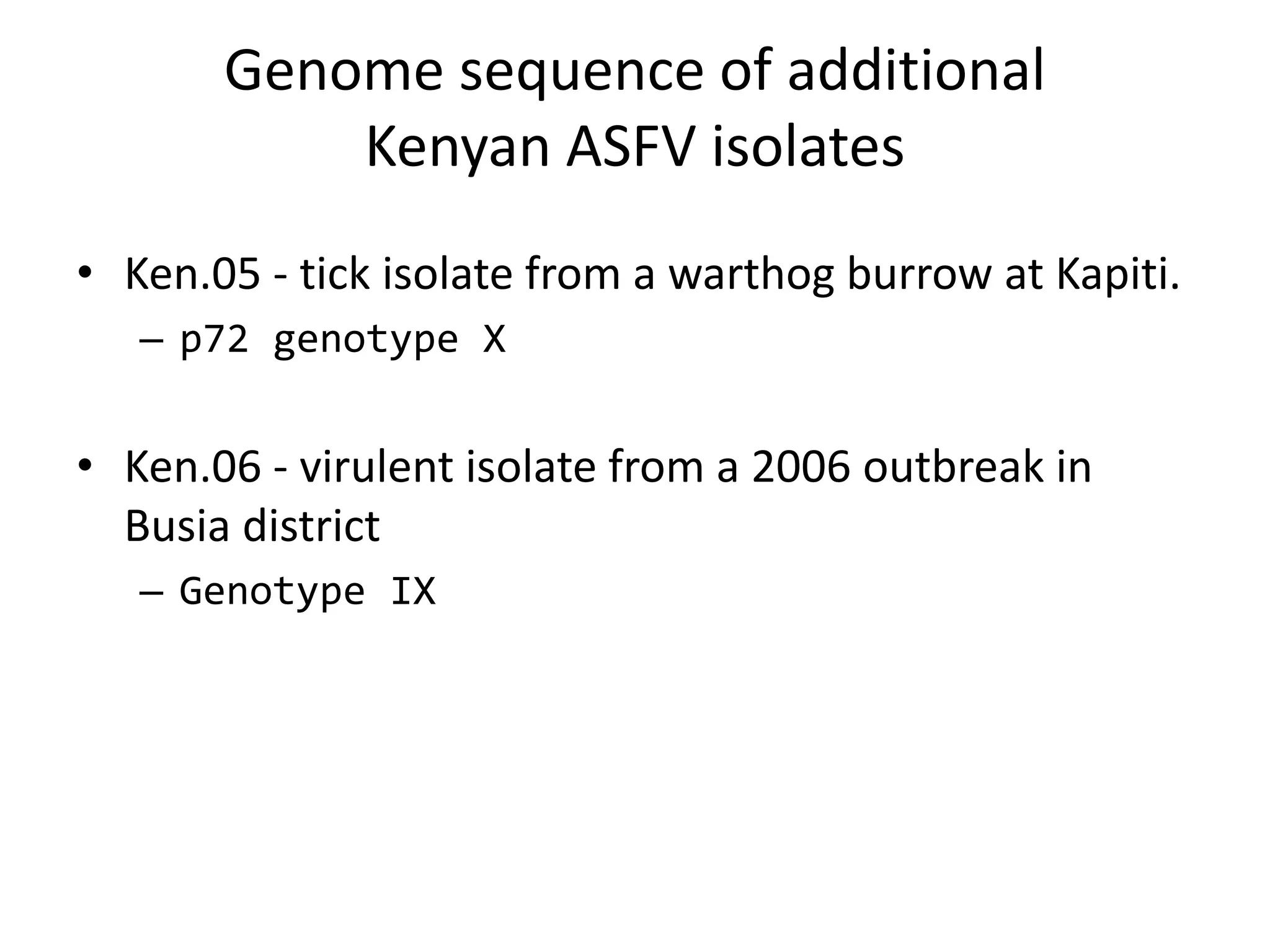
Genome sequence of additional
           Kenyan ASFV isolates
• Ken.05 - tick isolate from a warthog burrow at Kapiti.
   – p72 genotype X


• Ken.06 - virulent isolate from a 2006 outbreak in
  Busia district
   – Genotype IX
Ken.05 assembly
• Performed mapped assembly of Roche 454 data to
  ASFV-Kenya genome
   – numMappedReads = 4959, 7.31%
   – numberOfContigs = 45
   – numberOfBases = 185832
• Gap closure is ongoing
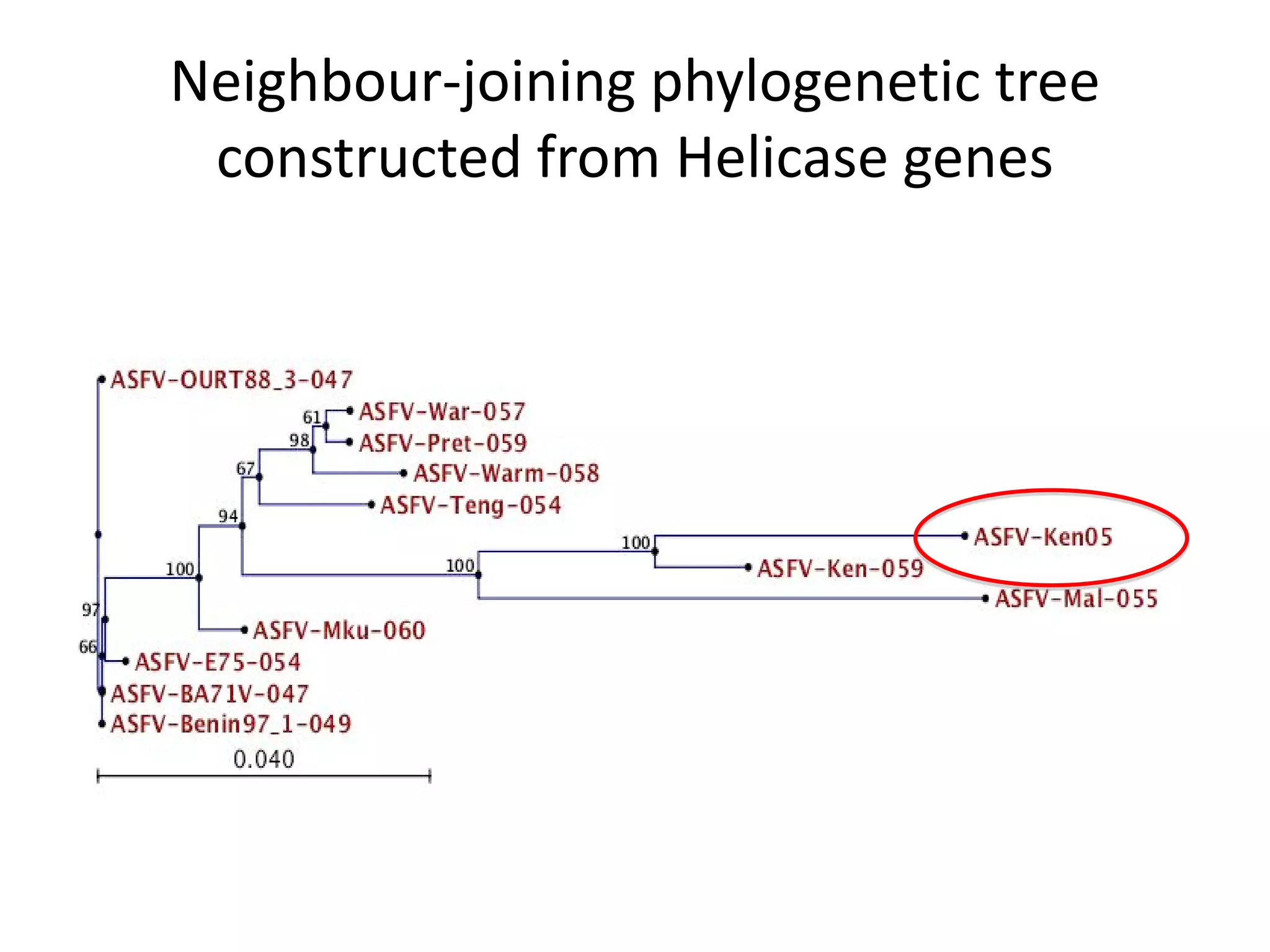
Neighbour-joining phylogenetic tree
 constructed from Helicase genes
Ken.06 assembly
• Performed mapped assembly of Roche 454 data to
  ASFV-Kenya genome
  – numMappedReads = 1452, 2.00%
  – numberOfContigs = 156
  – numberOfBases = 154118
Genome sequence of additional
           Kenyan ASFV isolates


• Gap closure of both Ken.05 and Ken.06 are ongoing.
Acknowledgments
• ILRI
   – Richard Bishop
• CISA–INIA
   – Carmina Gallardo
   – Marisa Arias
   – Raquel Martin
• University of Victoria
   – Melissa da Silva
   – Chris Upton
• Inqaba Biotec

ASFV genome sequencing

  • 1.
    ASFV genome sequencing Etienne de Villiers International Livestock Research Institute ASFV CSIRO-AusAID workshop, 20th-21 July 2011, Nairobi
  • 2.
    African Swine FeverVirus • African swine fever (ASF) virus – an acute, highly contagious and often fatal disease of domestic pigs – a large cytoplasmic virus of the family Asfaviridae – linear double-stranded DNA genome (170-190 kbp) • To identify the putative genetic basis for the differences in virulence, and potential diagnostic antigens, we are comparing the genome sequence of non-pathogenic and pathogenic ASF virus isolates.
  • 3.
    ASFV genomes • Thefirst complete ASFV genome was generated from the avirulent VERO cell culture adapted isolate BA71V. • In 2008 a virulent isolate from Benin and an avirulent tick isolate from Portugal were sequenced and analysed by Chapman et al. 2008. • Seven additional complete genomes of southern and eastern African origin are available in GenBank. • Preliminary annotation is available on a publicly accessible website (http://athena.bioc.uvic.ca/database.php?db=asfarviridae). • In 2010 we sequenced and annotated the complete genome sequence of E75, a second virulent isolate classified within p72 genotype I, originating from Spain using Roche 454 technology.
  • 4.
    Evolutionary relationships ofASFV isolates based on C-terminal sequence of p72 Eastern and Southern African isolates
  • 5.
  • 6.
    Comparative genome analysisof Southern African (A) and West African-European (B) genomes
  • 7.
    Identification of coreset of orthologous genes • Several studies have shown that a concatenated multi gene approach can resolve ambiguities in phylogenetic reconstructions based on single genes. • The amino acid sequences of the core set of orthologous genes from each of the 11 ASFV isolates were concatenated into a single pseudo-sequence. • A neighbor-joining phylogenetic tree was constructed from a multiple amino acid sequence alignment of the concatenated sequences.
  • 8.
    Phylogenetics based oncore set of genes • Phylogenetic analysis from 123 concatenated genes separated the viruses into two major clusters that correlate with their geographical distribution. – West Africa - Iberian Peninsula (p72 genotype group I) – Southern African ASFV isolates
  • 9.
    Positive selection • Investigatedpositive selection at the individual amino acid sites. • The most stringent model for positive selection, M8, identified eighteen genes under positive selection.
  • 10.
    Helicase gene • Thehelicase gene, BA71VA859L is under positive selection and might be a good phylogenetic marker. • Trees based on this sequence reproduced the genetic relationships indicated by analysis of the concatenated set of orthologous proteins.
  • 11.
    Genome sequence ofadditional Kenyan ASFV isolates • Ken.05 - tick isolate from a warthog burrow at Kapiti. – p72 genotype X • Ken.06 - virulent isolate from a 2006 outbreak in Busia district – Genotype IX
  • 12.
    Ken.05 assembly • Performedmapped assembly of Roche 454 data to ASFV-Kenya genome – numMappedReads = 4959, 7.31% – numberOfContigs = 45 – numberOfBases = 185832 • Gap closure is ongoing
  • 13.
    Neighbour-joining phylogenetic tree constructed from Helicase genes
  • 14.
    Ken.06 assembly • Performedmapped assembly of Roche 454 data to ASFV-Kenya genome – numMappedReads = 1452, 2.00% – numberOfContigs = 156 – numberOfBases = 154118
  • 15.
    Genome sequence ofadditional Kenyan ASFV isolates • Gap closure of both Ken.05 and Ken.06 are ongoing.
  • 16.
    Acknowledgments • ILRI – Richard Bishop • CISA–INIA – Carmina Gallardo – Marisa Arias – Raquel Martin • University of Victoria – Melissa da Silva – Chris Upton • Inqaba Biotec