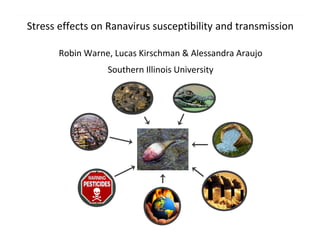
Stress effects on Ranavirus susceptibility and transmission
Robin Warne, Lucas Kirschman & Alessandra Araujo
Southern Illinois University
Extrinsic stressors
Nutrition
Competition
Predation
Pollutants
Climate change
Phenotype
Reproduction
Growth
Development
Stress response
Disease susceptibility
Disease transmission
Environmental stressors are ubiquitous
… as are their effects on disease expression?
Hypothalamus
Pituitary
Interrenal
CRF
ACTH
CORT (-) ?
Stressors, Glucocorticoids & Disease Transmission
Stress Coping Style
Glucocorticoids
Passive Aggressive
Exploratorybehavior
Foodintake
Transmission(β)
Glucocorticoids
Contaminants Stressor Intensity
•Stressor effects on transmission
unclear
– Altered behavior
– Infectivity
Stressor effects on susceptibility & transmission
• Density dependent transmission
• = Transmission coefficient
• S = Susceptible individuals
• I = Infected Individuals
• = Force of infection
• Underlying assumptions of the
transmission coefficient
– Contact rate increases in proportion
to population density
– Assumed to be equally applicable to
all members of the population
•Environmental stressors can
increase disease susceptibility
•Stressor effects on transmission
unclear
– Altered behavior
– Infectivity
0.8
1
1.2
1.4
1.6
1.8
2
2.2
2.4
2.6
0 1 2 3 4 5 6 7
CORTng/gBW
Days of Infection
Control
Infected
Warne, Crespi, & Brunner (2011) Functional Ecology
Ranavirus, CORT & Developmental Interactions
• Ranavirus infection elevates
whole body CORT
– Stress response
– Or CORT mediating immune
response
• Infection significantly increased
developmental rate
• Infection significantly decreased
body condition
• Prometamorphic tadpoles (GS
35-40) had highest mortality
– HPI mediated trade-offs
– Immune system development
Timing of stress exposure may also affect disease
Baseline
ImmuneFunction
Duration of Stressor
Minutes-Hours Hours-Days Days-Weeks Weeks-Months
(-)
(+)
Adapted from Martin (2009), General and
Comparative Endocrinology, Vol. 163
Inflammatory cytokines
Acute response
Immunosuppression - negative feedback
Predation
Competition
Thermal shock
Pollution
Habitat change
Warne, Crespi, & Brunner (2011)
Stress & Immunology
• Wood frog tadpoles exposed to exogenous CORT
– Acute = six hours prior to infection
– Chronic = three days prior to and during infection
– Metyrapone = CORT synthesis blocker
• Then exposed to cultured Ranavirus (104 PFU)
• Livers and spleens dissected at day 2 & 4 post-exposure
• Livers analyzed for viral load via qPCR
• Spleens analyzed for lymphocyte proliferation by PH3-
mitotic marker immunohistochemistry staining
Survival Methods
• Following CORT exposure the tadpoles were exposed to Ranavirus at an LD 50 dose (102.5
PFU)
• Animals which reached GS 46 were considered to have survived infection
Acute & chronic CORT effects on Ranavirus infection
Survival varied significantly by
treatment (χ2 =19.93, df=4,
p<0.0005, log-rank test)
0
0.1
0.2
0.3
0.4
0.5
0.6
0.7
0.8
0.9
1
Acute CORT Chronic
CORT
Metyrapone Positive
Control
Negative
Control
Survival
Treatment
Survival at LD-50 dose
CORT effects on surviving Ranavirus exposure
CORT expression varies across a population
• Low CORT profiles of tadpoles associated:
• Greater size & development
• More aggressive accessing of food
Stress effects on transmission
Are Large or small focals better disease
spreaders?
• Focals infected with lethal virus dose
• 24 hour transmission in tub of 9
susceptible tadpoles
• UV filter to inactivate free virions
• Ubiquitous environmental stressors
undoubtedly alter disease
susceptibility
Environmental stressors are ubiquitous
… as are their effects on disease expression?
• Transmission capacity likely not equivalent across individuals
• Stressors affect individuals differently
• How do individual stress profiles influence not only susceptibility, but
transmission and recovery
• How do stressors like pollutants
contribute to patterns of disease
emergence and outbreaks?
• ….. beyond susceptibility
Research Funding
SIUC New Faculty Start Up Grant
OSPA Seed Grant
Thanks To
Lucas Kirschman
Alessandra Araujo
Seth LaGrange
Tom Egdorf
Jackie Adams
Kelley Fritz
Acknowledgements

Warne

  • 1.
    Stress effects onRanavirus susceptibility and transmission Robin Warne, Lucas Kirschman & Alessandra Araujo Southern Illinois University
  • 2.
    Extrinsic stressors Nutrition Competition Predation Pollutants Climate change Phenotype Reproduction Growth Development Stressresponse Disease susceptibility Disease transmission Environmental stressors are ubiquitous … as are their effects on disease expression? Hypothalamus Pituitary Interrenal CRF ACTH CORT (-) ?
  • 3.
    Stressors, Glucocorticoids &Disease Transmission Stress Coping Style Glucocorticoids Passive Aggressive Exploratorybehavior Foodintake Transmission(β) Glucocorticoids Contaminants Stressor Intensity •Stressor effects on transmission unclear – Altered behavior – Infectivity
  • 4.
    Stressor effects onsusceptibility & transmission • Density dependent transmission • = Transmission coefficient • S = Susceptible individuals • I = Infected Individuals • = Force of infection • Underlying assumptions of the transmission coefficient – Contact rate increases in proportion to population density – Assumed to be equally applicable to all members of the population •Environmental stressors can increase disease susceptibility •Stressor effects on transmission unclear – Altered behavior – Infectivity
  • 5.
    0.8 1 1.2 1.4 1.6 1.8 2 2.2 2.4 2.6 0 1 23 4 5 6 7 CORTng/gBW Days of Infection Control Infected Warne, Crespi, & Brunner (2011) Functional Ecology Ranavirus, CORT & Developmental Interactions • Ranavirus infection elevates whole body CORT – Stress response – Or CORT mediating immune response • Infection significantly increased developmental rate • Infection significantly decreased body condition • Prometamorphic tadpoles (GS 35-40) had highest mortality – HPI mediated trade-offs – Immune system development
  • 6.
    Timing of stressexposure may also affect disease Baseline ImmuneFunction Duration of Stressor Minutes-Hours Hours-Days Days-Weeks Weeks-Months (-) (+) Adapted from Martin (2009), General and Comparative Endocrinology, Vol. 163 Inflammatory cytokines Acute response Immunosuppression - negative feedback Predation Competition Thermal shock Pollution Habitat change
  • 7.
    Warne, Crespi, &Brunner (2011) Stress & Immunology • Wood frog tadpoles exposed to exogenous CORT – Acute = six hours prior to infection – Chronic = three days prior to and during infection – Metyrapone = CORT synthesis blocker • Then exposed to cultured Ranavirus (104 PFU) • Livers and spleens dissected at day 2 & 4 post-exposure • Livers analyzed for viral load via qPCR • Spleens analyzed for lymphocyte proliferation by PH3- mitotic marker immunohistochemistry staining Survival Methods • Following CORT exposure the tadpoles were exposed to Ranavirus at an LD 50 dose (102.5 PFU) • Animals which reached GS 46 were considered to have survived infection Acute & chronic CORT effects on Ranavirus infection
  • 8.
    Survival varied significantlyby treatment (χ2 =19.93, df=4, p<0.0005, log-rank test) 0 0.1 0.2 0.3 0.4 0.5 0.6 0.7 0.8 0.9 1 Acute CORT Chronic CORT Metyrapone Positive Control Negative Control Survival Treatment Survival at LD-50 dose CORT effects on surviving Ranavirus exposure
  • 9.
    CORT expression variesacross a population • Low CORT profiles of tadpoles associated: • Greater size & development • More aggressive accessing of food Stress effects on transmission Are Large or small focals better disease spreaders? • Focals infected with lethal virus dose • 24 hour transmission in tub of 9 susceptible tadpoles • UV filter to inactivate free virions
  • 10.
    • Ubiquitous environmentalstressors undoubtedly alter disease susceptibility Environmental stressors are ubiquitous … as are their effects on disease expression? • Transmission capacity likely not equivalent across individuals • Stressors affect individuals differently • How do individual stress profiles influence not only susceptibility, but transmission and recovery • How do stressors like pollutants contribute to patterns of disease emergence and outbreaks? • ….. beyond susceptibility
  • 11.
    Research Funding SIUC NewFaculty Start Up Grant OSPA Seed Grant Thanks To Lucas Kirschman Alessandra Araujo Seth LaGrange Tom Egdorf Jackie Adams Kelley Fritz Acknowledgements