Ecology and Epidemiology of Ranaviruses:
Mechanisms Contributing to Outbreaks
University of Tennessee
Center for Wildlife Health
Department of Forestry, Wildlife and Fisheries
Matthew J. Gray
M. Niemiller
Presentation Contributors
M. Brand, University of Tennessee
R. Brenes, University of Tennessee
J. Chaney, University of Tennessee
J. Earl, NSF NIMBioS
N. Hilzinger, University of Tennessee
J. Hoverman, Purdue University
R. Huether, University of Tennessee
A. Kouba, Memphis Zoo
D. Miller, University of Tennessee
P. Reilly, University of Tennessee
S. Roon, Oregon State University
B. Sutton, Clemson University
J. Tucker, Humboldt University
T. Waltzek, University of Florida
B. Wilkes, University of Tennessee
Unpublished Data
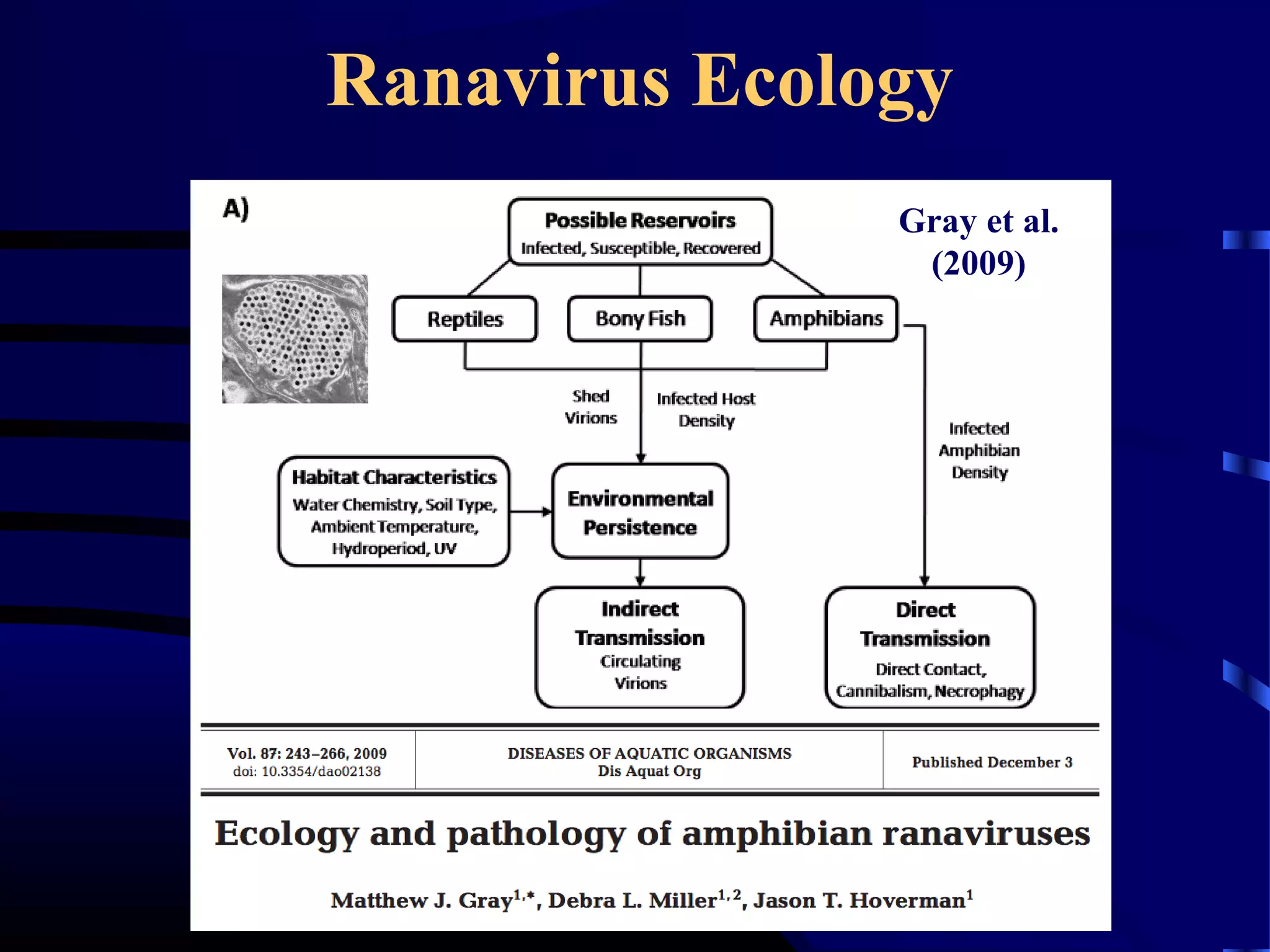
Ranavirus Ecology
Gray et al. (2009)
Gray et al.
(2009)
Global Distribution of
Ranavirus Cases: Amphibians
All Latitudes, All Elevations
14 Families: Alytidae, Ranidae, Hylidae, Bufonidae, Leptodactylidae, Dendrobatidae,
Discoglossidae, Myobatrachidae, Rhacophoridae, Scaphiopodidae,
Ambystomatidae, Salamandridae, Hynobiidae, Cryptobranchidae
5 Continents: 1992
Miller et al.
(2011)
>70 Species
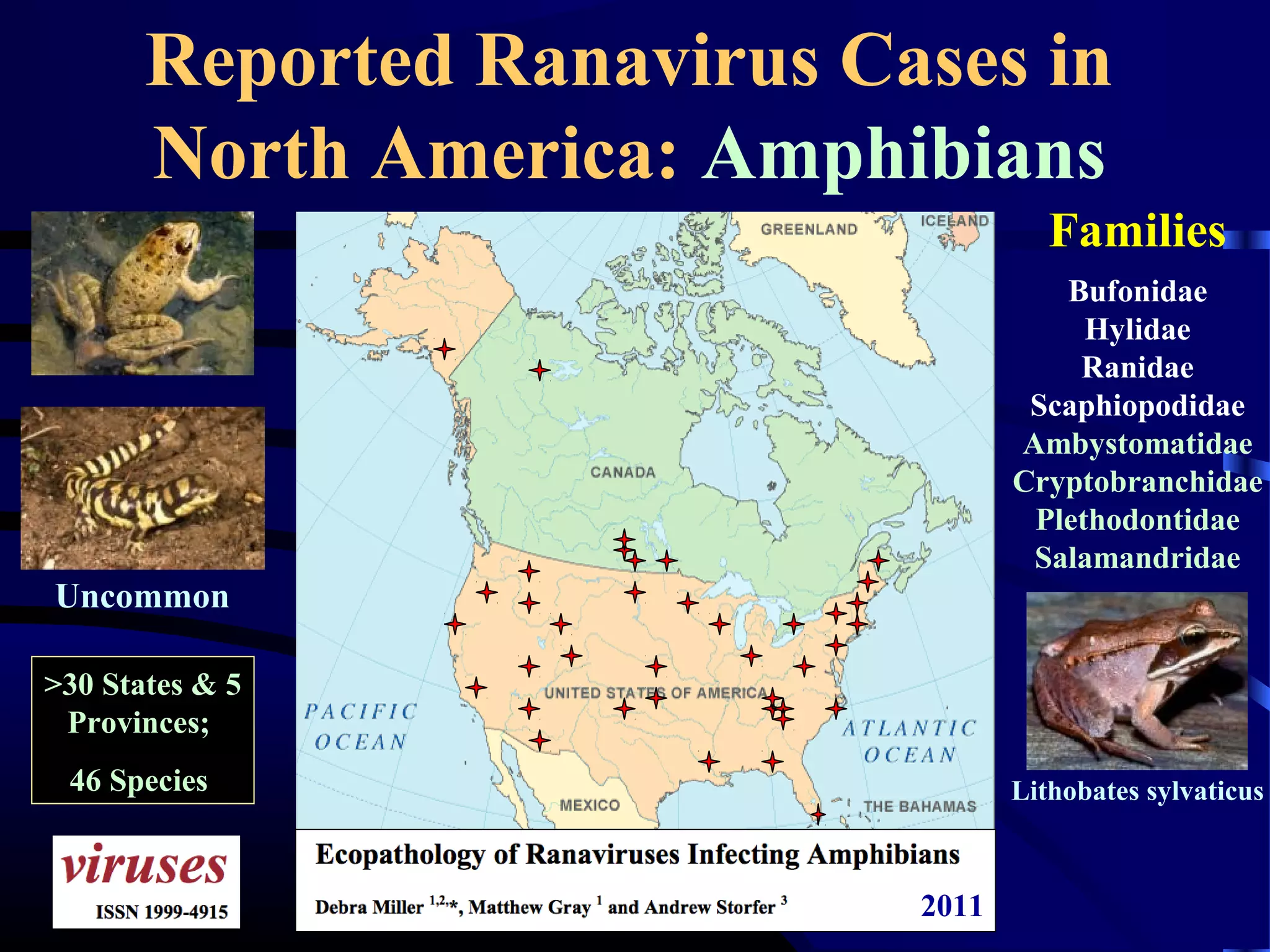
Reported Ranavirus Cases in
North America: Amphibians
>30 States & 5
Provinces;
46 Species
Families
Bufonidae
Hylidae
Ranidae
Scaphiopodidae
Ambystomatidae
Cryptobranchidae
Plethodontidae
Salamandridae
Norman Wells,
NWT
Uncommon
Lithobates sylvaticus
2011
Cases of FV3-like Ranaviral
Disease in Reptiles
Over >95% homology with
1000-bp region of MCP
Gopherus polyphemus, Testudo hermanni, Terrapene carolina
carolina, Trionyx sinensis, Uroplatus fimbriatus, and
Chondropython viridis
(Westhouse et al. 1996; Marschang et al. 1999, 2005; Hyatt et al. 2002; DeVoe et al. 2004;
Huang et al. 2009; Allender et al. 2006, 2011; Johnson et al. 2007, 2008, 2011)
At least 14 reptile species Marschang (2011)
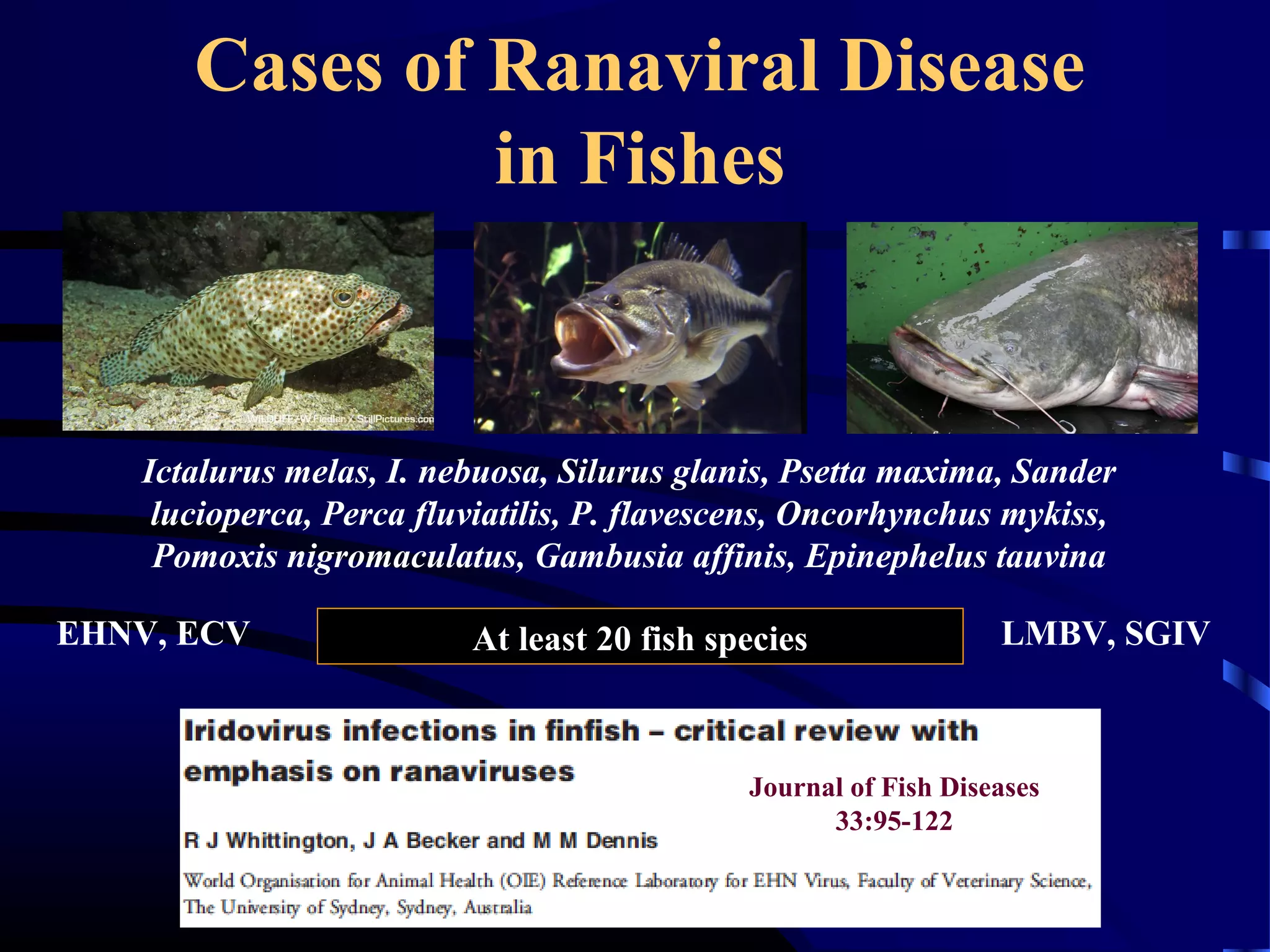
Cases of Ranaviral Disease
in Fishes
Ictalurus melas, I. nebuosa, Silurus glanis, Psetta maxima, Sander
lucioperca, Perca fluviatilis, P. flavescens, Oncorhynchus mykiss,
Pomoxis nigromaculatus, Gambusia affinis, Epinephelus tauvina
Journal of Fish Diseases
33:95-122
At least 20 fish speciesEHNV, ECV LMBV, SGIV
Species Challenges
FV3-like Ranaviruses
Single-species FV3-like Challenges
Amphibians
Percentmortality
0
10
20
30
40
50
60
70
80
90
100
FV3
RI
Hoverman et al. (2011): 19 Species Tested
High Moderate
Low
Single-species FV3-like Challenges
Amphibians
Ambystomatidae Ranidae
Brenes (2013)
15 Additional
Species
Life History and Phylogeny
Amphibians
P = 0.354 • Fast development hatching time*
• Low aquatic index
• Breeding habitat (temporal)*
• Breeding time (spring)
• Distance: Population & Isolate
Brenes (2013)
All Three Isolates
Smoky Mountains Isolate
No Phylogenetic Signal
35 spp
Co-evolution
High Correlation
(r = 0.88) between
Infection Prevalence
and Percent
Mortality
Single-species FV3-like Challenges
Chelonians
Mississippi
Map Turtle
Control Turtle Fish Amph
Soft-shelled Turtle
Brenes (2013)
Terrapene carolina, T. ornata, Elseya latisternum, Emydura krefftii , Trachemys scripta
Water bath exposure sufficient for transmission
with some species.
Greatest infection and morbidity with IP
infection or oral inoculation.
Ariel (1997), Johnson et al. (2007), Allender (2012), Gray et al. (unpubl. data)
Single-species
FV3-like & ATV Challenges
Fishes
Amelurus melas, Esox luscious,
Sander lucioperca,
Micropterus salmoides
Cyprinus carpio, Carassius auratus,
Lepomis cyanellus
Scaphirhynchus albus
No Transmission:
Low Transmission:
High Mortality:
Jancovich et al. (2001), Bang Jensen et al. (2011a)
Gobbo et al. (2010), Bang Jensen et al. (2009, 2011b), Picco et al. (2010)
Waltzek et al. (unpubl. data)
Single-species FV3-like Challenges
Fishes
Channel catfish
Control Turtle Fish Amph
Mosquito fish
Control Turtle Fish Amph
No Transmission: tilapia, bluegill and fathead minnow
Brenes (2013)
Reservoirs or Amplification Hosts?
FV3-like Ranaviruses
Low Mortality
(Subclinical)
Low Mortality
(Subclinical)
Low – High Mortality
(Subclinical & Clinical)
Reservoir
Reservoir or
Amplification
Reservoir
Can Interclass Transmission Occur?
Bandin & Dopazo (2011)
Evidence from the Wild
13 February
2012
26 of 31 Box
Turtles Die
from
Ranaviral
Disease
Larval
anurans and
salamanders
dead too
Farnsworth
and Seigel,
Towson U.
2008 – 2011
North Branch
Stream Valley
State Park
Evidence of Interclass Transmission
Bayley et al. (2013)
Pike-perch Iridovirus Common Frog
Tadpoles
Frog Virus 3
Pike
Pike-perch
Black Bullhead
Bang Jensen 2009, 2011;
Gobbo et al. 2010
Pallid
Transmission to Anurans
Gray et al. (unpubl. data)
85% 80% 95%
(35 – 70%) (5%) (95%)
5%
Gray Bull Wood
Transmission to Turtles
35%
45%
5%
Brenes Presentation
Gray et al. (unpubl. data)
Superspreaders
and Amplifying Species
Paull et al. (2012)
Frontiers in
Ecology and the
Environment
10:75-82
2012
Superspreading Individuals Amplification Species
Disease Hotspots
Susceptibility Contact RateShedding Rate Contact
Host Community Contact RatePersistence Dispersal
•Green et al. (2002)
•Petranka et al.
(2003)
•Harp and
Petranka (2006)
•Gahl and
Calhoun (2010)
•Uyeharaet al.
(2010)
•Brunner et al.
(2011)
Ranavirus Superspreaders
Reilly, Gray, & Miller (unpubl. data)
6 hrs cohabitation
3-day 103
PFU/mL
n = 10 tadpoles/tub
20/80 Rule: Superspreading
Exposure Order Matters
Brenes (2013)
Only Wood Frogs
Only Chorus Frogs
Only Spotted Salamanders
Control
n = 5 pools/trt
10 larvae/spp
Inoculated in Lab
103
PFU/mL FV3
60 days
Exposure
Treatments
Design
Wood Frogs 100%
43%
12%
Chorus Frogs
Spotted Salam
72%
3%
Wood Frogs
Spotted Salam
24%
18%
Chorus Frogs
Wood Frogs
Chorus Frogs 44%
Spotted Salam 6%
52%
16%
40%
Appalachian Community
Ecosystem Effects?
Disease-induced Trophic Cascades
Community Composition Matters
Brenes (2013)
Only Gopher Frogs
Only Chorus Frogs
Only Southern Toad
Control
n = 5 pools/trt
10 larvae/spp
Inoculated in Lab
103
PFU/mL FV3
60 days
Exposure
Treatments
Design
Gopher Frogs 100%
52%
34%
Chorus Frogs
Southern Toad
70%
58%
Gopher Frog
Southern Toad
32%
80%
Chorus Frogs
Gopher Frog
Chorus Frogs 78%
Southern Toad 76%
62%
62%
68%
Gulf Coastal Plain,
USA
Evidence of
Environmental Persistence
(Nazir et al. 2012)
•Soil: 13-22 d
•Soil: 30-48 d
(1) FV3, FV3-like
•PW (unsterile): 22-34 d
•PW (unsterile): 58-72 d
20 C =
4 C =
(T-90 Values)
Impacts of Stressors
Gray et al. (2009)
*
**
**
**
χ2
3 = 40.1 ; p<0.001
Hatchling – 3X > Embryo
Larval – 4X > Embryo
Metamorph – 5X > Embryo
Impacts of Development
Across Seven Species
ML Estimate:
Egg membrane
may act as a
protective barrier
Haislip et al. (2011)
Tree frog Chorus frog Wood frog Green frog
b
c
b
c
a
b
b
b
b
Kerby et al. (2011)
Anax increased
susceptibility to ATV
(A. tigrinum)
Competing Temperature Hypotheses
• Virus Replication Hypothesis
– Ranavirus replication increases with temperature
up to 32 C
– Caveat: Immune function in ectotherms also
increases with temperature
• Temperature Induced Stress Hypothesis
– Early Spring Breeding Species:
• Stressed by Warm Temp
– Summer Breeding Species:
• Stressed by Cold Temp
High Pathogenicity at Higher Temperatures
Pathogenicity is Species-specific and Related to Typical Water
Temperature Experienced During Tadpole Development
Bayley et al. (2013)
Impacts of Genetic Isolation
Pearman and
Garner (2005)
Factors Contributing to Emergence
Other Possible Stressors: Pesticide Mixtures, Nitrogenous Waste,
Endocrine Disruptors, Acidification, Global Warming, Heavy Metals
Pathogen Pollution:
Anthropogenic introduction of novel strains to naïve populations
(Cunningham et al. 2003)
•Fishing Bait
•Ranaculture Facilities
•Biological Supply Companies
•International Food & Pet Trade
•Contaminated FomitesPicco et al. (2007) Schloegel et al. (2009)
Anthropogenic Stressors:
1) Herbicide (Atrazine)
Forson & Storfer (2006); Gray et al. (2007); Greer et
al. (2008); Kerby et al. (2011)
ATV SusceptibilityA. tigrinum
2) Cattle Land Use: Prevalence Green Frogs and Tiger
Salamanders
Insecticide (Carbaryl)
Percentmortality
0
10
20
30
40
50
60
70
80
90
100
FV3
RI
Ranaculture isolate 2X more lethal than FV3
Risk of Pathogen Pollution
Majji et al. (2006), Storfer et al. (2007), Mazzoni et al. (2009), Hoverman et al. (2011)
Are Ranaviruses
Capable of Causing
Local Extirpations and
Species Declines?
0
50
100
150
200
250
1960
1963
1966
1969
1972
1975
1978
1981
1984
1987
1990
1993
1996
NumberofPopulations
Collins & Crump
(2009)
Muths et al.
(2006)
Traditional Theory
(Anderson and May 1979)
Extirpation is possible if:
Frequency Dependent
All Conditions
Met with
Ranavirus-
Host System
Evidence of Declines
Dr. Amber Teacher
Southeastern England
Animal
Conservation
13:514-522
1996/97 and 2008
Ranavirus (+)
populations
81% Median
Reduction A. Teacher
A. Teacher
Teacher et al.
2010
81%
Evidence of Re-occuring Die-offs
Dr. Jim Petranka
Tulula Wetland Complex, NC
Rescue Effect
Biological Conservation
138:371-380
Wetlands
23:278-2901998-2006
Recruitment at most
wetlands failed due
to ranavirus
Persistence Possible
from Source
Populations
Extinction Probability in 1000 years
Earl and Gray (unpubl. data)
Haislip et al. (2011)
Keith Berven
Female Population Size
Earl and Gray (unpubl. data)
Death of
Pre-metamorphic Stages
Matters!
Evidence of Rare Species Effects
Sutton, Gray, Miller & Kouba
Endangered Dusky Gopher Frog
Evidence of Rare Species Effects
Chaney, Gray, Miller & Kouba
Threatened Boreal Toad
Tadpoles Metamorphs
2 – 5 d
5 – 7 d
Commonality of Being Uncommon
Southeastern United States
Federally Listed:
Species of Concern:
Rana capito sevosa, Ambystoma cingulatum,
Phaeognathus hubrichti, Ambystoma bishopi
113 Species and 25 Genera Total
1) Alabama = 14 species (11 genera)
2) Arkansas = 25 species (12 genera)
3) Florida = 19 species (12 genera)
4) Georgia = 22 species (15 genera)
5) Kentucky = 22 species (11 genera)
6) Louisiana = 15 species (10 genera)
7) Mississippi = 18 species (12 genera)
8) North Carolina = 41 species (15 genera)
9) South Carolina = 19 species (13 genera)
10) Tennessee = 26 species (14 genera)
50% U.S.
If uncommon species are highly susceptible,
ranaviruses could have a significant impact
on amphibian communities.
Take Home Messages
Should we be Concerned?
•Ranavirus Die-offs have Global Distribution
•Ranavirus Prevalence can be High
•Ranaviruses Infect Multiple Amphibian Species with
Different Susceptibilities
•Community Composition Matters
•Interclass Transmission is Possible – Abundant Reservoirs
•Ranavirus Persistence is Long
•High Transmission: Breeding and for Schooling Spp.
•Anthropogenic Stressors and Pathogen Pollution
contribute to Ranavirus Emergence
Epidemiological Theory AND Initial Simulations Supports
the Premise that Ranaviruses Could Cause Local
Population Extirpations and Contribute to Species Declines
Host-Pathogen Community
Aeromonas
hydrophila
Ranaviruses
Batrachochytrium
dendrobatidis
Alveolates
Complex Epidemiology
Spatially Structured Breeding Sites
I(t)ijkl S(t)ijkl
IM(t)ijkl
EM(t)ijkl
i = species
j = age class
k = pathogen
l = wetland
P(Nt)il < 0
S(t|k)ijklI(t|k)ijkl
Metacommunity of
Hosts & Pathogens
Questions??
mgray11@utk.edu
865-974-2740
Photo:
N. Wheelwright
Ecology and Epidemiology of Ranaviruses

Ecology and Epidemiology of Ranaviruses

  • 1.
    Ecology and Epidemiologyof Ranaviruses: Mechanisms Contributing to Outbreaks University of Tennessee Center for Wildlife Health Department of Forestry, Wildlife and Fisheries Matthew J. Gray M. Niemiller
  • 2.
    Presentation Contributors M. Brand,University of Tennessee R. Brenes, University of Tennessee J. Chaney, University of Tennessee J. Earl, NSF NIMBioS N. Hilzinger, University of Tennessee J. Hoverman, Purdue University R. Huether, University of Tennessee A. Kouba, Memphis Zoo D. Miller, University of Tennessee P. Reilly, University of Tennessee S. Roon, Oregon State University B. Sutton, Clemson University J. Tucker, Humboldt University T. Waltzek, University of Florida B. Wilkes, University of Tennessee Unpublished Data
  • 3.
    Ranavirus Ecology Gray etal. (2009) Gray et al. (2009)
  • 4.
    Global Distribution of RanavirusCases: Amphibians All Latitudes, All Elevations 14 Families: Alytidae, Ranidae, Hylidae, Bufonidae, Leptodactylidae, Dendrobatidae, Discoglossidae, Myobatrachidae, Rhacophoridae, Scaphiopodidae, Ambystomatidae, Salamandridae, Hynobiidae, Cryptobranchidae 5 Continents: 1992 Miller et al. (2011) >70 Species
  • 5.
    Reported Ranavirus Casesin North America: Amphibians >30 States & 5 Provinces; 46 Species Families Bufonidae Hylidae Ranidae Scaphiopodidae Ambystomatidae Cryptobranchidae Plethodontidae Salamandridae Norman Wells, NWT Uncommon Lithobates sylvaticus 2011
  • 6.
    Cases of FV3-likeRanaviral Disease in Reptiles Over >95% homology with 1000-bp region of MCP Gopherus polyphemus, Testudo hermanni, Terrapene carolina carolina, Trionyx sinensis, Uroplatus fimbriatus, and Chondropython viridis (Westhouse et al. 1996; Marschang et al. 1999, 2005; Hyatt et al. 2002; DeVoe et al. 2004; Huang et al. 2009; Allender et al. 2006, 2011; Johnson et al. 2007, 2008, 2011) At least 14 reptile species Marschang (2011)
  • 7.
    Cases of RanaviralDisease in Fishes Ictalurus melas, I. nebuosa, Silurus glanis, Psetta maxima, Sander lucioperca, Perca fluviatilis, P. flavescens, Oncorhynchus mykiss, Pomoxis nigromaculatus, Gambusia affinis, Epinephelus tauvina Journal of Fish Diseases 33:95-122 At least 20 fish speciesEHNV, ECV LMBV, SGIV
  • 8.
  • 9.
  • 10.
    Single-species FV3-like Challenges Amphibians AmbystomatidaeRanidae Brenes (2013) 15 Additional Species
  • 11.
    Life History andPhylogeny Amphibians P = 0.354 • Fast development hatching time* • Low aquatic index • Breeding habitat (temporal)* • Breeding time (spring) • Distance: Population & Isolate Brenes (2013) All Three Isolates Smoky Mountains Isolate No Phylogenetic Signal 35 spp Co-evolution High Correlation (r = 0.88) between Infection Prevalence and Percent Mortality
  • 12.
    Single-species FV3-like Challenges Chelonians Mississippi MapTurtle Control Turtle Fish Amph Soft-shelled Turtle Brenes (2013) Terrapene carolina, T. ornata, Elseya latisternum, Emydura krefftii , Trachemys scripta Water bath exposure sufficient for transmission with some species. Greatest infection and morbidity with IP infection or oral inoculation. Ariel (1997), Johnson et al. (2007), Allender (2012), Gray et al. (unpubl. data)
  • 13.
    Single-species FV3-like & ATVChallenges Fishes Amelurus melas, Esox luscious, Sander lucioperca, Micropterus salmoides Cyprinus carpio, Carassius auratus, Lepomis cyanellus Scaphirhynchus albus No Transmission: Low Transmission: High Mortality: Jancovich et al. (2001), Bang Jensen et al. (2011a) Gobbo et al. (2010), Bang Jensen et al. (2009, 2011b), Picco et al. (2010) Waltzek et al. (unpubl. data)
  • 14.
    Single-species FV3-like Challenges Fishes Channelcatfish Control Turtle Fish Amph Mosquito fish Control Turtle Fish Amph No Transmission: tilapia, bluegill and fathead minnow Brenes (2013)
  • 15.
    Reservoirs or AmplificationHosts? FV3-like Ranaviruses Low Mortality (Subclinical) Low Mortality (Subclinical) Low – High Mortality (Subclinical & Clinical) Reservoir Reservoir or Amplification Reservoir
  • 16.
    Can Interclass TransmissionOccur? Bandin & Dopazo (2011)
  • 17.
    Evidence from theWild 13 February 2012 26 of 31 Box Turtles Die from Ranaviral Disease Larval anurans and salamanders dead too Farnsworth and Seigel, Towson U. 2008 – 2011 North Branch Stream Valley State Park
  • 18.
    Evidence of InterclassTransmission Bayley et al. (2013) Pike-perch Iridovirus Common Frog Tadpoles Frog Virus 3 Pike Pike-perch Black Bullhead Bang Jensen 2009, 2011; Gobbo et al. 2010
  • 19.
    Pallid Transmission to Anurans Grayet al. (unpubl. data) 85% 80% 95% (35 – 70%) (5%) (95%) 5% Gray Bull Wood
  • 20.
    Transmission to Turtles 35% 45% 5% BrenesPresentation Gray et al. (unpubl. data)
  • 21.
    Superspreaders and Amplifying Species Paullet al. (2012) Frontiers in Ecology and the Environment 10:75-82 2012 Superspreading Individuals Amplification Species Disease Hotspots Susceptibility Contact RateShedding Rate Contact Host Community Contact RatePersistence Dispersal •Green et al. (2002) •Petranka et al. (2003) •Harp and Petranka (2006) •Gahl and Calhoun (2010) •Uyeharaet al. (2010) •Brunner et al. (2011)
  • 22.
    Ranavirus Superspreaders Reilly, Gray,& Miller (unpubl. data) 6 hrs cohabitation 3-day 103 PFU/mL n = 10 tadpoles/tub 20/80 Rule: Superspreading
  • 23.
    Exposure Order Matters Brenes(2013) Only Wood Frogs Only Chorus Frogs Only Spotted Salamanders Control n = 5 pools/trt 10 larvae/spp Inoculated in Lab 103 PFU/mL FV3 60 days Exposure Treatments Design Wood Frogs 100% 43% 12% Chorus Frogs Spotted Salam 72% 3% Wood Frogs Spotted Salam 24% 18% Chorus Frogs Wood Frogs Chorus Frogs 44% Spotted Salam 6% 52% 16% 40% Appalachian Community Ecosystem Effects? Disease-induced Trophic Cascades
  • 24.
    Community Composition Matters Brenes(2013) Only Gopher Frogs Only Chorus Frogs Only Southern Toad Control n = 5 pools/trt 10 larvae/spp Inoculated in Lab 103 PFU/mL FV3 60 days Exposure Treatments Design Gopher Frogs 100% 52% 34% Chorus Frogs Southern Toad 70% 58% Gopher Frog Southern Toad 32% 80% Chorus Frogs Gopher Frog Chorus Frogs 78% Southern Toad 76% 62% 62% 68% Gulf Coastal Plain, USA
  • 25.
    Evidence of Environmental Persistence (Naziret al. 2012) •Soil: 13-22 d •Soil: 30-48 d (1) FV3, FV3-like •PW (unsterile): 22-34 d •PW (unsterile): 58-72 d 20 C = 4 C = (T-90 Values)
  • 26.
  • 27.
    * ** ** ** χ2 3 = 40.1; p<0.001 Hatchling – 3X > Embryo Larval – 4X > Embryo Metamorph – 5X > Embryo Impacts of Development Across Seven Species ML Estimate: Egg membrane may act as a protective barrier Haislip et al. (2011)
  • 28.
    Tree frog Chorusfrog Wood frog Green frog b c b c a b b b b Kerby et al. (2011) Anax increased susceptibility to ATV (A. tigrinum)
  • 29.
    Competing Temperature Hypotheses •Virus Replication Hypothesis – Ranavirus replication increases with temperature up to 32 C – Caveat: Immune function in ectotherms also increases with temperature • Temperature Induced Stress Hypothesis – Early Spring Breeding Species: • Stressed by Warm Temp – Summer Breeding Species: • Stressed by Cold Temp High Pathogenicity at Higher Temperatures Pathogenicity is Species-specific and Related to Typical Water Temperature Experienced During Tadpole Development Bayley et al. (2013)
  • 30.
    Impacts of GeneticIsolation Pearman and Garner (2005)
  • 31.
    Factors Contributing toEmergence Other Possible Stressors: Pesticide Mixtures, Nitrogenous Waste, Endocrine Disruptors, Acidification, Global Warming, Heavy Metals Pathogen Pollution: Anthropogenic introduction of novel strains to naïve populations (Cunningham et al. 2003) •Fishing Bait •Ranaculture Facilities •Biological Supply Companies •International Food & Pet Trade •Contaminated FomitesPicco et al. (2007) Schloegel et al. (2009) Anthropogenic Stressors: 1) Herbicide (Atrazine) Forson & Storfer (2006); Gray et al. (2007); Greer et al. (2008); Kerby et al. (2011) ATV SusceptibilityA. tigrinum 2) Cattle Land Use: Prevalence Green Frogs and Tiger Salamanders Insecticide (Carbaryl)
  • 32.
    Percentmortality 0 10 20 30 40 50 60 70 80 90 100 FV3 RI Ranaculture isolate 2Xmore lethal than FV3 Risk of Pathogen Pollution Majji et al. (2006), Storfer et al. (2007), Mazzoni et al. (2009), Hoverman et al. (2011)
  • 33.
    Are Ranaviruses Capable ofCausing Local Extirpations and Species Declines? 0 50 100 150 200 250 1960 1963 1966 1969 1972 1975 1978 1981 1984 1987 1990 1993 1996 NumberofPopulations Collins & Crump (2009) Muths et al. (2006)
  • 34.
    Traditional Theory (Anderson andMay 1979) Extirpation is possible if: Frequency Dependent All Conditions Met with Ranavirus- Host System
  • 35.
    Evidence of Declines Dr.Amber Teacher Southeastern England Animal Conservation 13:514-522 1996/97 and 2008 Ranavirus (+) populations 81% Median Reduction A. Teacher A. Teacher Teacher et al. 2010 81%
  • 36.
    Evidence of Re-occuringDie-offs Dr. Jim Petranka Tulula Wetland Complex, NC Rescue Effect Biological Conservation 138:371-380 Wetlands 23:278-2901998-2006 Recruitment at most wetlands failed due to ranavirus Persistence Possible from Source Populations
  • 37.
    Extinction Probability in1000 years Earl and Gray (unpubl. data) Haislip et al. (2011) Keith Berven
  • 38.
    Female Population Size Earland Gray (unpubl. data) Death of Pre-metamorphic Stages Matters!
  • 39.
    Evidence of RareSpecies Effects Sutton, Gray, Miller & Kouba Endangered Dusky Gopher Frog
  • 40.
    Evidence of RareSpecies Effects Chaney, Gray, Miller & Kouba Threatened Boreal Toad Tadpoles Metamorphs 2 – 5 d 5 – 7 d
  • 41.
    Commonality of BeingUncommon Southeastern United States Federally Listed: Species of Concern: Rana capito sevosa, Ambystoma cingulatum, Phaeognathus hubrichti, Ambystoma bishopi 113 Species and 25 Genera Total 1) Alabama = 14 species (11 genera) 2) Arkansas = 25 species (12 genera) 3) Florida = 19 species (12 genera) 4) Georgia = 22 species (15 genera) 5) Kentucky = 22 species (11 genera) 6) Louisiana = 15 species (10 genera) 7) Mississippi = 18 species (12 genera) 8) North Carolina = 41 species (15 genera) 9) South Carolina = 19 species (13 genera) 10) Tennessee = 26 species (14 genera) 50% U.S. If uncommon species are highly susceptible, ranaviruses could have a significant impact on amphibian communities.
  • 42.
    Take Home Messages Shouldwe be Concerned? •Ranavirus Die-offs have Global Distribution •Ranavirus Prevalence can be High •Ranaviruses Infect Multiple Amphibian Species with Different Susceptibilities •Community Composition Matters •Interclass Transmission is Possible – Abundant Reservoirs •Ranavirus Persistence is Long •High Transmission: Breeding and for Schooling Spp. •Anthropogenic Stressors and Pathogen Pollution contribute to Ranavirus Emergence Epidemiological Theory AND Initial Simulations Supports the Premise that Ranaviruses Could Cause Local Population Extirpations and Contribute to Species Declines
  • 43.
    Host-Pathogen Community Aeromonas hydrophila Ranaviruses Batrachochytrium dendrobatidis Alveolates Complex Epidemiology SpatiallyStructured Breeding Sites I(t)ijkl S(t)ijkl IM(t)ijkl EM(t)ijkl i = species j = age class k = pathogen l = wetland P(Nt)il < 0 S(t|k)ijklI(t|k)ijkl Metacommunity of Hosts & Pathogens
  • 44.