Basic Techniques of
Dental Local Anesthesia
By:
Mohammed Kareem Radhi
Introduction
Many dental procedures, such as tooth extraction, are both painful and prolonged and should be
performed without pain by using a local anesthesia.
Local anesthesia has been defined as loss of sensation in a circumscribed area of the body caused
by inhibition of the conduction process in the peripheral nerves.
An important feature of local anesthesia is that it produces this loss of sensation without inducing
loss of consciousness. In this one major area, local anesthesia differs dramatically from general
anesthesia.
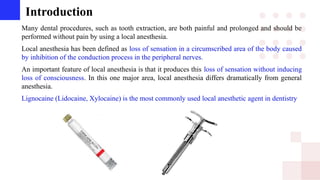
Lignocaine (Lidocaine, Xylocaine) is the most commonly used local anesthetic agent in dentistry
Surgical anatomy in local anesthesia
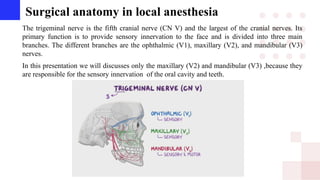
The trigeminal nerve is the fifth cranial nerve (CN V) and the largest of the cranial nerves. Its
primary function is to provide sensory innervation to the face and is divided into three main
branches. The different branches are the ophthalmic (V1), maxillary (V2), and mandibular (V3)
nerves.
In this presentation we will discusses only the maxillary (V2) and mandibular (V3) ,because they
are responsible for the sensory innervation of the oral cavity and teeth.
Maxillary Division (V2)
Branches originating within the pterygopalatine fossa
● The nasopalatine nerve
provide sensation to the palatal mucosa in the region of the
premaxilla.
● The greater palatine nerve
usually located about 1 cm toward the palatal midline, just distal
to the second molar supplying sensory innervation to the palatal
soft tissues and bone as far anterior as the first premolar, where it
communicates with terminal fibers of the nasopalatine nerve.
● The posterior superior alveolar
providing sensory innervation to the mucous membrane of the
sinus, alveoli, periodontal ligaments, and pulpal tissues of the
maxillary third, second, and first molars (with the exception [in
28% of patients] of the mesiobuccal root of the first molar).
Maxillary Division (V2)
Branches originating within the infraorbital
canal
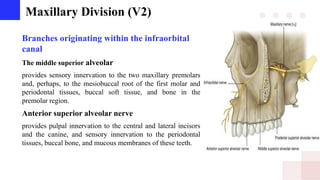
The middle superior alveolar
provides sensory innervation to the two maxillary premolars
and, perhaps, to the mesiobuccal root of the first molar and
periodontal tissues, buccal soft tissue, and bone in the
premolar region.
Anterior superior alveolar nerve
provides pulpal innervation to the central and lateral incisors
and the canine, and sensory innervation to the periodontal
tissues, buccal bone, and mucous membranes of these teeth.
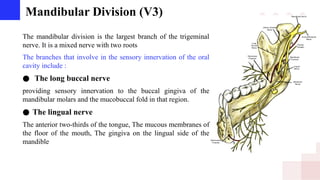
Mandibular Division (V3)
The mandibular division is the largest branch of the trigeminal
nerve. It is a mixed nerve with two roots
The branches that involve in the sensory innervation of the oral
cavity include :
● The long buccal nerve
providing sensory innervation to the buccal gingiva of the
mandibular molars and the mucobuccal fold in that region.
● The lingual nerve
The anterior two-thirds of the tongue, The mucous membranes of
the floor of the mouth, The gingiva on the lingual side of the
mandible
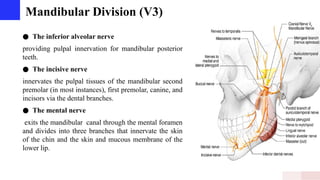
Mandibular Division (V3)
● The inferior alveolar nerve
providing pulpal innervation for mandibular posterior
teeth.
● The incisive nerve
innervates the pulpal tissues of the mandibular second
premolar (in most instances), first premolar, canine, and
incisors via the dental branches.
● The mental nerve
exits the mandibular canal through the mental foramen
and divides into three branches that innervate the skin
of the chin and the skin and mucous membrane of the
lower lip.
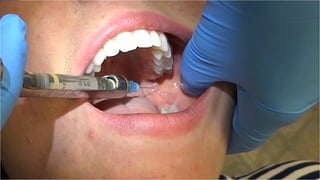
Basic Techniques of Dental Local Anesthesia
A variety of techniques used in administration and deposition of local anesthesia:
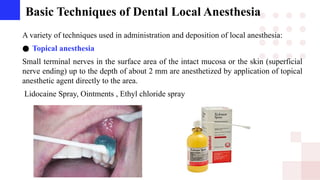
● Topical anesthesia
Small terminal nerves in the surface area of the intact mucosa or the skin (superficial
nerve ending) up to the depth of about 2 mm are anesthetized by application of topical
anesthetic agent directly to the area.
Lidocaine Spray, Ointments , Ethyl chloride spray
Basic Techniques of Dental Local Anesthesia
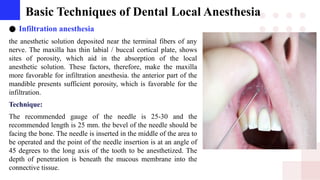
● Infiltration anesthesia
the anesthetic solution deposited near the terminal fibers of any
nerve. The maxilla has thin labial / buccal cortical plate, shows
sites of porosity, which aid in the absorption of the local
anesthetic solution. These factors, therefore, make the maxilla
more favorable for infiltration anesthesia. the anterior part of the
mandible presents sufficient porosity, which is favorable for the
infiltration.
Technique:
The recommended gauge of the needle is 25-30 and the
recommended length is 25 mm. the bevel of the needle should be
facing the bone. The needle is inserted in the middle of the area to
be operated and the point of the needle insertion is at an angle of
45 degrees to the long axis of the tooth to be anesthetized. The
depth of penetration is beneath the mucous membrane into the
connective tissue.
Basic Techniques of Dental Local Anesthesia
This technique may require more than one needle insertions depending on the extent of the area to be anesthetized, care
should be taken to avoid injury to the tissue in the following ways:
1. Avoid injecting the solution too rapidly.
2. Avoid injecting too large volume of the local anesthetic solution.
3. Avoid injecting too superficially.
These situations will result in injury to the tissue in the form of pain at the time of injection, or persistent post – injection
pain.
Types of infiltration anesthesia
1. Sub-mucous injection: the solution deposited just beneath the mucous membrane;. This technique is unlikely to
produce anesthesia of the dental pulp it is often employed to anesthetize the long buccal nerve prior to the extraction of
mandibular molars or for soft tissue surgery.
2. Supra-periosteal injection: in some sites, such as maxilla, the outer cortical plate of alveolar bone is thin and perforated
by tiny vascular canals. In these areas when the anesthetic solution is deposited outside the periosteum. By this means,
anesthesia of the dental pulp can be obtained by injecting near the tooth apex. The supra-periosteal injection is the
technique most frequently used in dentistry.
3. Sub-periosteal injection: the solution is deposited between the periosteum and the cortical plate. This technique is
painful since the periosteum is firmly attached to the cortical plate.
Basic Techniques of Dental Local Anesthesia
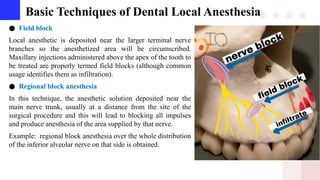
● Field block
Local anesthetic is deposited near the larger terminal nerve
branches so the anesthetized area will be circumscribed.
Maxillary injections administered above the apex of the tooth to
be treated are properly termed field blocks (although common
usage identifies them as infiltration).
● Regional block anesthesia
In this technique, the anesthetic solution deposited near the
main nerve trunk, usually at a distance from the site of the
surgical procedure and this will lead to blocking all impulses
and produce anesthesia of the area supplied by that nerve.
Example: regional block anesthesia over the whole distribution
of the inferior alveolar nerve on that side is obtained.
Local anesthesia in the maxilla
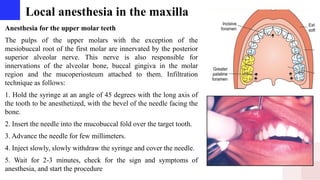
Anesthesia for the upper molar teeth
The pulps of the upper molars with the exception of the
mesiobuccal root of the first molar are innervated by the posterior
superior alveolar nerve. This nerve is also responsible for
innervations of the alveolar bone, buccal gingiva in the molar
region and the mucoperiosteum attached to them. Infiltration
technique as follows:
1. Hold the syringe at an angle of 45 degrees with the long axis of
the tooth to be anesthetized, with the bevel of the needle facing the
bone.
2. Insert the needle into the mucobuccal fold over the target tooth.
3. Advance the needle for few millimeters.
4. Inject slowly, slowly withdraw the syringe and cover the needle.
5. Wait for 2-3 minutes, check for the sign and symptoms of
anesthesia, and start the procedure
Local anesthesia in the maxilla
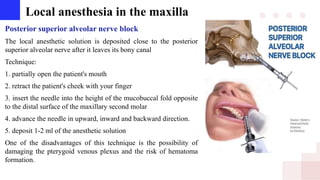
Posterior superior alveolar nerve block
The local anesthetic solution is deposited close to the posterior
superior alveolar nerve after it leaves its bony canal
Technique:
1. partially open the patient's mouth
2. retract the patient's cheek with your finger
3. insert the needle into the height of the mucobuccal fold opposite
to the distal surface of the maxillary second molar
4. advance the needle in upward, inward and backward direction.
5. deposit 1-2 ml of the anesthetic solution
One of the disadvantages of this technique is the possibility of
damaging the pterygoid venous plexus and the risk of hematoma
formation.
Local anesthesia in the maxilla
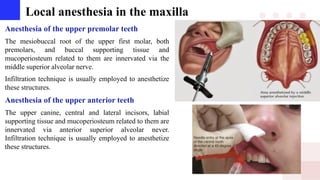
Anesthesia of the upper premolar teeth
The mesiobuccal root of the upper first molar, both
premolars, and buccal supporting tissue and
mucoperiosteum related to them are innervated via the
middle superior alveolar nerve.
Infiltration technique is usually employed to anesthetize
these structures.
Anesthesia of the upper anterior teeth
The upper canine, central and lateral incisors, labial
supporting tissue and mucoperiosteum related to them are
innervated via anterior superior alveolar never.
Infiltration technique is usually employed to anesthetize
these structures.
Local anesthesia in the maxilla
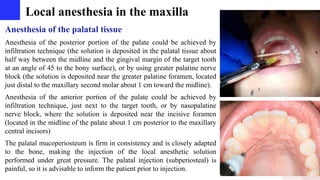
Anesthesia of the palatal tissue
Anesthesia of the posterior portion of the palate could be achieved by
infiltration technique (the solution is deposited in the palatal tissue about
half way between the midline and the gingival margin of the target tooth
at an angle of 45 to the bony surface), or by using greater palatine nerve
block (the solution is deposited near the greater palatine foramen, located
just distal to the maxillary second molar about 1 cm toward the midline).
Anesthesia of the anterior portion of the palate could be achieved by
infiltration technique, just next to the target tooth, or by nasopalatine
nerve block, where the solution is deposited near the incisive foramen
(located in the midline of the palate about 1 cm posterior to the maxillary
central incisors)
The palatal mucoperiosteum is firm in consistency and is closely adapted
to the bone, making the injection of the local anesthetic solution
performed under great pressure. The palatal injection (subperiosteal) is
painful, so it is advisable to inform the patient prior to injection.
Local anesthesia in the maxilla
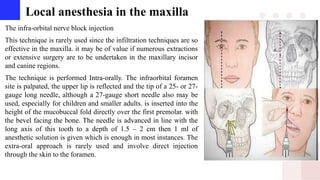
The infra-orbital nerve block injection
This technique is rarely used since the infiltration techniques are so
effective in the maxilla. it may be of value if numerous extractions
or extensive surgery are to be undertaken in the maxillary incisor
and canine regions.
The technique is performed Intra-orally. The infraorbital foramen
site is palpated, the upper lip is reflected and the tip of a 25- or 27-
gauge long needle, although a 27-gauge short needle also may be
used, especially for children and smaller adults. is inserted into the
height of the mucobuccal fold directly over the first premolar. with
the bevel facing the bone. The needle is advanced in line with the
long axis of this tooth to a depth of 1.5 – 2 cm then 1 ml of
anesthetic solution is given which is enough in most instances. The
extra-oral approach is rarely used and involve direct injection
through the skin to the foramen.
Local anesthesia in the maxilla
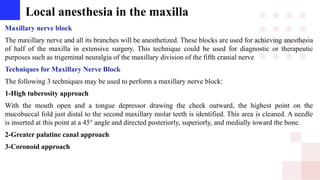
Maxillary nerve block
The maxillary nerve and all its branches will be anesthetized. These blocks are used for achieving anesthesia
of half of the maxilla in extensive surgery. This technique could be used for diagnostic or therapeutic
purposes such as trigeminal neuralgia of the maxillary division of the fifth cranial nerve
Techniques for Maxillary Nerve Block
The following 3 techniques may be used to perform a maxillary nerve block:
1-High tuberosity approach
With the mouth open and a tongue depressor drawing the cheek outward, the highest point on the
mucobuccal fold just distal to the second maxillary molar teeth is identified. This area is cleaned. A needle
is inserted at this point at a 45° angle and directed posteriorly, superiorly, and medially toward the bone.
2-Greater palatine canal approach
3-Coronoid approach
Local anesthesia in the mandible
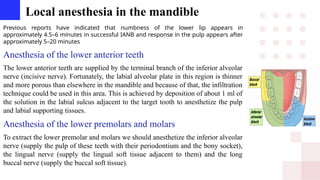
Previous reports have indicated that numbness of the lower lip appears in
approximately 4.5–6 minutes in successful IANB and response in the pulp appears after
approximately 5–20 minutes
Anesthesia of the lower anterior teeth
The lower anterior teeth are supplied by the terminal branch of the inferior alveolar
nerve (incisive nerve). Fortunately, the labial alveolar plate in this region is thinner
and more porous than elsewhere in the mandible and because of that, the infiltration
technique could be used in this area. This is achieved by deposition of about 1 ml of
the solution in the labial sulcus adjacent to the target tooth to anesthetize the pulp
and labial supporting tissues.
Anesthesia of the lower premolars and molars
To extract the lower premolar and molars we should anesthetize the inferior alveolar
nerve (supply the pulp of these teeth with their periodontium and the bony socket),
the lingual nerve (supply the lingual soft tissue adjacent to them) and the long
buccal nerve (supply the buccal soft tissue).
Local anesthesia in the mandible
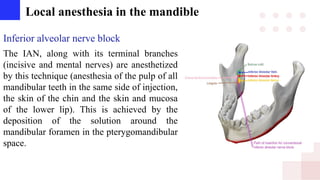
Inferior alveolar nerve block
The IAN, along with its terminal branches
(incisive and mental nerves) are anesthetized
by this technique (anesthesia of the pulp of all
mandibular teeth in the same side of injection,
the skin of the chin and the skin and mucosa
of the lower lip). This is achieved by the
deposition of the solution around the
mandibular foramen in the pterygomandibular
space.
Local anesthesia in the mandible
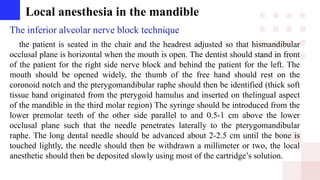
The inferior alveolar nerve block technique
the patient is seated in the chair and the headrest adjusted so that hismandibular
occlusal plane is horizontal when the mouth is open. The dentist should stand in front
of the patient for the right side nerve block and behind the patient for the left. The
mouth should be opened widely, the thumb of the free hand should rest on the
coronoid notch and the pterygomandibular raphe should then be identified (thick soft
tissue band originated from the pterygoid hamulus and inserted on thelingual aspect
of the mandible in the third molar region) The syringe should be introduced from the
lower premolar teeth of the other side parallel to and 0.5-1 cm above the lower
occlusal plane such that the needle penetrates laterally to the pterygomandibular
raphe. The long dental needle should be advanced about 2-2.5 cm until the bone is
touched lightly, the needle should then be withdrawn a millimeter or two, the local
anesthetic should then be deposited slowly using most of the cartridge’s solution.
Local anesthesia in the mandible
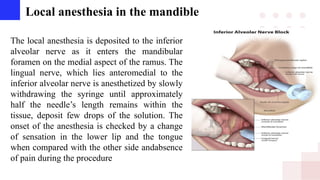
The local anesthesia is deposited to the inferior
alveolar nerve as it enters the mandibular
foramen on the medial aspect of the ramus. The
lingual nerve, which lies anteromedial to the
inferior alveolar nerve is anesthetized by slowly
withdrawing the syringe until approximately
half the needle’s length remains within the
tissue, deposit few drops of the solution. The
onset of the anesthesia is checked by a change
of sensation in the lower lip and the tongue
when compared with the other side andabsence
of pain during the procedure
Local anesthesia in the mandible
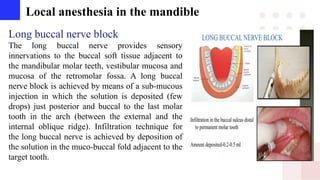
Long buccal nerve block
The long buccal nerve provides sensory
innervations to the buccal soft tissue adjacent to
the mandibular molar teeth, vestibular mucosa and
mucosa of the retromolar fossa. A long buccal
nerve block is achieved by means of a sub-mucous
injection in which the solution is deposited (few
drops) just posterior and buccal to the last molar
tooth in the arch (between the external and the
internal oblique ridge). Infiltration technique for
the long buccal nerve is achieved by deposition of
the solution in the muco-buccal fold adjacent to the
target tooth.
Local anesthesia in the mandible
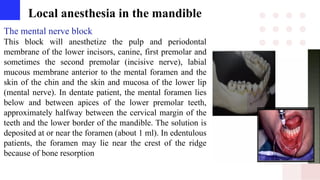
The mental nerve block
This block will anesthetize the pulp and periodontal
membrane of the lower incisors, canine, first premolar and
sometimes the second premolar (incisive nerve), labial
mucous membrane anterior to the mental foramen and the
skin of the chin and the skin and mucosa of the lower lip
(mental nerve). In dentate patient, the mental foramen lies
below and between apices of the lower premolar teeth,
approximately halfway between the cervical margin of the
teeth and the lower border of the mandible. The solution is
deposited at or near the foramen (about 1 ml). In edentulous
patients, the foramen may lie near the crest of the ridge
because of bone resorption
Local anesthesia in the mandible
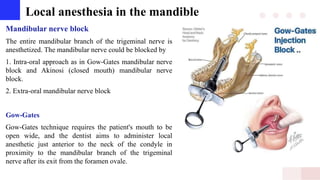
Mandibular nerve block
The entire mandibular branch of the trigeminal nerve is
anesthetized. The mandibular nerve could be blocked by
1. Intra-oral approach as in Gow-Gates mandibular nerve
block and Akinosi (closed mouth) mandibular nerve
block.
2. Extra-oral mandibular nerve block
Gow-Gates
Gow-Gates technique requires the patient's mouth to be
open wide, and the dentist aims to administer local
anesthetic just anterior to the neck of the condyle in
proximity to the mandibular branch of the trigeminal
nerve after its exit from the foramen ovale.
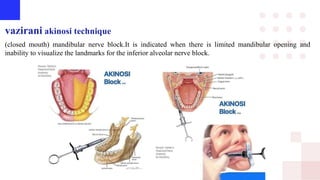
vazirani akinosi technique
(closed mouth) mandibular nerve block.It is indicated when there is limited mandibular opening and
inability to visualize the landmarks for the inferior alveolar nerve block.
Supplementary Injections
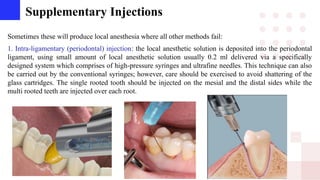
Sometimes these will produce local anesthesia where all other methods fail:
1. Intra-ligamentary (periodontal) injection: the local anesthetic solution is deposited into the periodontal
ligament, using small amount of local anesthetic solution usually 0.2 ml delivered via a specifically
designed system which comprises of high-pressure syringes and ultrafine needles. This technique can also
be carried out by the conventional syringes; however, care should be exercised to avoid shattering of the
glass cartridges. The single rooted tooth should be injected on the mesial and the distal sides while the
multi rooted teeth are injected over each root.
Supplementary Injections
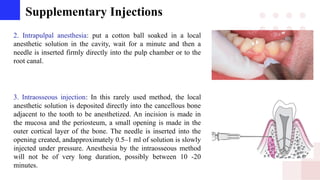
2. Intrapulpal anesthesia: put a cotton ball soaked in a local
anesthetic solution in the cavity, wait for a minute and then a
needle is inserted firmly directly into the pulp chamber or to the
root canal.
3. Intraosseous injection: In this rarely used method, the local
anesthetic solution is deposited directly into the cancellous bone
adjacent to the tooth to be anesthetized. An incision is made in
the mucosa and the periosteum, a small opening is made in the
outer cortical layer of the bone. The needle is inserted into the
opening created, andapproximately 0.5–1 ml of solution is slowly
injected under pressure. Anesthesia by the intraosseous method
will not be of very long duration, possibly between 10 -20
minutes.
Thanks!
References
● Handbook of Local Anesthesia , Stanley F. Malamed, DDS,
SEVENTH EDITION

basic techniques of dental local anesthesia.pptx

  • 1.
    Basic Techniques of DentalLocal Anesthesia By: Mohammed Kareem Radhi
  • 2.
    Introduction Many dental procedures,such as tooth extraction, are both painful and prolonged and should be performed without pain by using a local anesthesia. Local anesthesia has been defined as loss of sensation in a circumscribed area of the body caused by inhibition of the conduction process in the peripheral nerves. An important feature of local anesthesia is that it produces this loss of sensation without inducing loss of consciousness. In this one major area, local anesthesia differs dramatically from general anesthesia. Lignocaine (Lidocaine, Xylocaine) is the most commonly used local anesthetic agent in dentistry
  • 3.
    Surgical anatomy inlocal anesthesia The trigeminal nerve is the fifth cranial nerve (CN V) and the largest of the cranial nerves. Its primary function is to provide sensory innervation to the face and is divided into three main branches. The different branches are the ophthalmic (V1), maxillary (V2), and mandibular (V3) nerves. In this presentation we will discusses only the maxillary (V2) and mandibular (V3) ,because they are responsible for the sensory innervation of the oral cavity and teeth.
  • 4.
    Maxillary Division (V2) Branchesoriginating within the pterygopalatine fossa ● The nasopalatine nerve provide sensation to the palatal mucosa in the region of the premaxilla. ● The greater palatine nerve usually located about 1 cm toward the palatal midline, just distal to the second molar supplying sensory innervation to the palatal soft tissues and bone as far anterior as the first premolar, where it communicates with terminal fibers of the nasopalatine nerve. ● The posterior superior alveolar providing sensory innervation to the mucous membrane of the sinus, alveoli, periodontal ligaments, and pulpal tissues of the maxillary third, second, and first molars (with the exception [in 28% of patients] of the mesiobuccal root of the first molar).
  • 5.
    Maxillary Division (V2) Branchesoriginating within the infraorbital canal The middle superior alveolar provides sensory innervation to the two maxillary premolars and, perhaps, to the mesiobuccal root of the first molar and periodontal tissues, buccal soft tissue, and bone in the premolar region. Anterior superior alveolar nerve provides pulpal innervation to the central and lateral incisors and the canine, and sensory innervation to the periodontal tissues, buccal bone, and mucous membranes of these teeth.
  • 6.
    Mandibular Division (V3) Themandibular division is the largest branch of the trigeminal nerve. It is a mixed nerve with two roots The branches that involve in the sensory innervation of the oral cavity include : ● The long buccal nerve providing sensory innervation to the buccal gingiva of the mandibular molars and the mucobuccal fold in that region. ● The lingual nerve The anterior two-thirds of the tongue, The mucous membranes of the floor of the mouth, The gingiva on the lingual side of the mandible
  • 7.
    Mandibular Division (V3) ●The inferior alveolar nerve providing pulpal innervation for mandibular posterior teeth. ● The incisive nerve innervates the pulpal tissues of the mandibular second premolar (in most instances), first premolar, canine, and incisors via the dental branches. ● The mental nerve exits the mandibular canal through the mental foramen and divides into three branches that innervate the skin of the chin and the skin and mucous membrane of the lower lip.
  • 8.
    Basic Techniques ofDental Local Anesthesia A variety of techniques used in administration and deposition of local anesthesia: ● Topical anesthesia Small terminal nerves in the surface area of the intact mucosa or the skin (superficial nerve ending) up to the depth of about 2 mm are anesthetized by application of topical anesthetic agent directly to the area. Lidocaine Spray, Ointments , Ethyl chloride spray
  • 9.
    Basic Techniques ofDental Local Anesthesia ● Infiltration anesthesia the anesthetic solution deposited near the terminal fibers of any nerve. The maxilla has thin labial / buccal cortical plate, shows sites of porosity, which aid in the absorption of the local anesthetic solution. These factors, therefore, make the maxilla more favorable for infiltration anesthesia. the anterior part of the mandible presents sufficient porosity, which is favorable for the infiltration. Technique: The recommended gauge of the needle is 25-30 and the recommended length is 25 mm. the bevel of the needle should be facing the bone. The needle is inserted in the middle of the area to be operated and the point of the needle insertion is at an angle of 45 degrees to the long axis of the tooth to be anesthetized. The depth of penetration is beneath the mucous membrane into the connective tissue.
  • 10.
    Basic Techniques ofDental Local Anesthesia This technique may require more than one needle insertions depending on the extent of the area to be anesthetized, care should be taken to avoid injury to the tissue in the following ways: 1. Avoid injecting the solution too rapidly. 2. Avoid injecting too large volume of the local anesthetic solution. 3. Avoid injecting too superficially. These situations will result in injury to the tissue in the form of pain at the time of injection, or persistent post – injection pain. Types of infiltration anesthesia 1. Sub-mucous injection: the solution deposited just beneath the mucous membrane;. This technique is unlikely to produce anesthesia of the dental pulp it is often employed to anesthetize the long buccal nerve prior to the extraction of mandibular molars or for soft tissue surgery. 2. Supra-periosteal injection: in some sites, such as maxilla, the outer cortical plate of alveolar bone is thin and perforated by tiny vascular canals. In these areas when the anesthetic solution is deposited outside the periosteum. By this means, anesthesia of the dental pulp can be obtained by injecting near the tooth apex. The supra-periosteal injection is the technique most frequently used in dentistry. 3. Sub-periosteal injection: the solution is deposited between the periosteum and the cortical plate. This technique is painful since the periosteum is firmly attached to the cortical plate.
  • 11.
    Basic Techniques ofDental Local Anesthesia ● Field block Local anesthetic is deposited near the larger terminal nerve branches so the anesthetized area will be circumscribed. Maxillary injections administered above the apex of the tooth to be treated are properly termed field blocks (although common usage identifies them as infiltration). ● Regional block anesthesia In this technique, the anesthetic solution deposited near the main nerve trunk, usually at a distance from the site of the surgical procedure and this will lead to blocking all impulses and produce anesthesia of the area supplied by that nerve. Example: regional block anesthesia over the whole distribution of the inferior alveolar nerve on that side is obtained.
  • 12.
    Local anesthesia inthe maxilla Anesthesia for the upper molar teeth The pulps of the upper molars with the exception of the mesiobuccal root of the first molar are innervated by the posterior superior alveolar nerve. This nerve is also responsible for innervations of the alveolar bone, buccal gingiva in the molar region and the mucoperiosteum attached to them. Infiltration technique as follows: 1. Hold the syringe at an angle of 45 degrees with the long axis of the tooth to be anesthetized, with the bevel of the needle facing the bone. 2. Insert the needle into the mucobuccal fold over the target tooth. 3. Advance the needle for few millimeters. 4. Inject slowly, slowly withdraw the syringe and cover the needle. 5. Wait for 2-3 minutes, check for the sign and symptoms of anesthesia, and start the procedure
  • 13.
    Local anesthesia inthe maxilla Posterior superior alveolar nerve block The local anesthetic solution is deposited close to the posterior superior alveolar nerve after it leaves its bony canal Technique: 1. partially open the patient's mouth 2. retract the patient's cheek with your finger 3. insert the needle into the height of the mucobuccal fold opposite to the distal surface of the maxillary second molar 4. advance the needle in upward, inward and backward direction. 5. deposit 1-2 ml of the anesthetic solution One of the disadvantages of this technique is the possibility of damaging the pterygoid venous plexus and the risk of hematoma formation.
  • 14.
    Local anesthesia inthe maxilla Anesthesia of the upper premolar teeth The mesiobuccal root of the upper first molar, both premolars, and buccal supporting tissue and mucoperiosteum related to them are innervated via the middle superior alveolar nerve. Infiltration technique is usually employed to anesthetize these structures. Anesthesia of the upper anterior teeth The upper canine, central and lateral incisors, labial supporting tissue and mucoperiosteum related to them are innervated via anterior superior alveolar never. Infiltration technique is usually employed to anesthetize these structures.
  • 15.
    Local anesthesia inthe maxilla Anesthesia of the palatal tissue Anesthesia of the posterior portion of the palate could be achieved by infiltration technique (the solution is deposited in the palatal tissue about half way between the midline and the gingival margin of the target tooth at an angle of 45 to the bony surface), or by using greater palatine nerve block (the solution is deposited near the greater palatine foramen, located just distal to the maxillary second molar about 1 cm toward the midline). Anesthesia of the anterior portion of the palate could be achieved by infiltration technique, just next to the target tooth, or by nasopalatine nerve block, where the solution is deposited near the incisive foramen (located in the midline of the palate about 1 cm posterior to the maxillary central incisors) The palatal mucoperiosteum is firm in consistency and is closely adapted to the bone, making the injection of the local anesthetic solution performed under great pressure. The palatal injection (subperiosteal) is painful, so it is advisable to inform the patient prior to injection.
  • 16.
    Local anesthesia inthe maxilla The infra-orbital nerve block injection This technique is rarely used since the infiltration techniques are so effective in the maxilla. it may be of value if numerous extractions or extensive surgery are to be undertaken in the maxillary incisor and canine regions. The technique is performed Intra-orally. The infraorbital foramen site is palpated, the upper lip is reflected and the tip of a 25- or 27- gauge long needle, although a 27-gauge short needle also may be used, especially for children and smaller adults. is inserted into the height of the mucobuccal fold directly over the first premolar. with the bevel facing the bone. The needle is advanced in line with the long axis of this tooth to a depth of 1.5 – 2 cm then 1 ml of anesthetic solution is given which is enough in most instances. The extra-oral approach is rarely used and involve direct injection through the skin to the foramen.
  • 17.
    Local anesthesia inthe maxilla Maxillary nerve block The maxillary nerve and all its branches will be anesthetized. These blocks are used for achieving anesthesia of half of the maxilla in extensive surgery. This technique could be used for diagnostic or therapeutic purposes such as trigeminal neuralgia of the maxillary division of the fifth cranial nerve Techniques for Maxillary Nerve Block The following 3 techniques may be used to perform a maxillary nerve block: 1-High tuberosity approach With the mouth open and a tongue depressor drawing the cheek outward, the highest point on the mucobuccal fold just distal to the second maxillary molar teeth is identified. This area is cleaned. A needle is inserted at this point at a 45° angle and directed posteriorly, superiorly, and medially toward the bone. 2-Greater palatine canal approach 3-Coronoid approach
  • 18.
    Local anesthesia inthe mandible Previous reports have indicated that numbness of the lower lip appears in approximately 4.5–6 minutes in successful IANB and response in the pulp appears after approximately 5–20 minutes Anesthesia of the lower anterior teeth The lower anterior teeth are supplied by the terminal branch of the inferior alveolar nerve (incisive nerve). Fortunately, the labial alveolar plate in this region is thinner and more porous than elsewhere in the mandible and because of that, the infiltration technique could be used in this area. This is achieved by deposition of about 1 ml of the solution in the labial sulcus adjacent to the target tooth to anesthetize the pulp and labial supporting tissues. Anesthesia of the lower premolars and molars To extract the lower premolar and molars we should anesthetize the inferior alveolar nerve (supply the pulp of these teeth with their periodontium and the bony socket), the lingual nerve (supply the lingual soft tissue adjacent to them) and the long buccal nerve (supply the buccal soft tissue).
  • 19.
    Local anesthesia inthe mandible Inferior alveolar nerve block The IAN, along with its terminal branches (incisive and mental nerves) are anesthetized by this technique (anesthesia of the pulp of all mandibular teeth in the same side of injection, the skin of the chin and the skin and mucosa of the lower lip). This is achieved by the deposition of the solution around the mandibular foramen in the pterygomandibular space.
  • 20.
    Local anesthesia inthe mandible The inferior alveolar nerve block technique the patient is seated in the chair and the headrest adjusted so that hismandibular occlusal plane is horizontal when the mouth is open. The dentist should stand in front of the patient for the right side nerve block and behind the patient for the left. The mouth should be opened widely, the thumb of the free hand should rest on the coronoid notch and the pterygomandibular raphe should then be identified (thick soft tissue band originated from the pterygoid hamulus and inserted on thelingual aspect of the mandible in the third molar region) The syringe should be introduced from the lower premolar teeth of the other side parallel to and 0.5-1 cm above the lower occlusal plane such that the needle penetrates laterally to the pterygomandibular raphe. The long dental needle should be advanced about 2-2.5 cm until the bone is touched lightly, the needle should then be withdrawn a millimeter or two, the local anesthetic should then be deposited slowly using most of the cartridge’s solution.
  • 21.
    Local anesthesia inthe mandible The local anesthesia is deposited to the inferior alveolar nerve as it enters the mandibular foramen on the medial aspect of the ramus. The lingual nerve, which lies anteromedial to the inferior alveolar nerve is anesthetized by slowly withdrawing the syringe until approximately half the needle’s length remains within the tissue, deposit few drops of the solution. The onset of the anesthesia is checked by a change of sensation in the lower lip and the tongue when compared with the other side andabsence of pain during the procedure
  • 23.
    Local anesthesia inthe mandible Long buccal nerve block The long buccal nerve provides sensory innervations to the buccal soft tissue adjacent to the mandibular molar teeth, vestibular mucosa and mucosa of the retromolar fossa. A long buccal nerve block is achieved by means of a sub-mucous injection in which the solution is deposited (few drops) just posterior and buccal to the last molar tooth in the arch (between the external and the internal oblique ridge). Infiltration technique for the long buccal nerve is achieved by deposition of the solution in the muco-buccal fold adjacent to the target tooth.
  • 24.
    Local anesthesia inthe mandible The mental nerve block This block will anesthetize the pulp and periodontal membrane of the lower incisors, canine, first premolar and sometimes the second premolar (incisive nerve), labial mucous membrane anterior to the mental foramen and the skin of the chin and the skin and mucosa of the lower lip (mental nerve). In dentate patient, the mental foramen lies below and between apices of the lower premolar teeth, approximately halfway between the cervical margin of the teeth and the lower border of the mandible. The solution is deposited at or near the foramen (about 1 ml). In edentulous patients, the foramen may lie near the crest of the ridge because of bone resorption
  • 25.
    Local anesthesia inthe mandible Mandibular nerve block The entire mandibular branch of the trigeminal nerve is anesthetized. The mandibular nerve could be blocked by 1. Intra-oral approach as in Gow-Gates mandibular nerve block and Akinosi (closed mouth) mandibular nerve block. 2. Extra-oral mandibular nerve block Gow-Gates Gow-Gates technique requires the patient's mouth to be open wide, and the dentist aims to administer local anesthetic just anterior to the neck of the condyle in proximity to the mandibular branch of the trigeminal nerve after its exit from the foramen ovale.
  • 26.
    vazirani akinosi technique (closedmouth) mandibular nerve block.It is indicated when there is limited mandibular opening and inability to visualize the landmarks for the inferior alveolar nerve block.
  • 27.
    Supplementary Injections Sometimes thesewill produce local anesthesia where all other methods fail: 1. Intra-ligamentary (periodontal) injection: the local anesthetic solution is deposited into the periodontal ligament, using small amount of local anesthetic solution usually 0.2 ml delivered via a specifically designed system which comprises of high-pressure syringes and ultrafine needles. This technique can also be carried out by the conventional syringes; however, care should be exercised to avoid shattering of the glass cartridges. The single rooted tooth should be injected on the mesial and the distal sides while the multi rooted teeth are injected over each root.
  • 28.
    Supplementary Injections 2. Intrapulpalanesthesia: put a cotton ball soaked in a local anesthetic solution in the cavity, wait for a minute and then a needle is inserted firmly directly into the pulp chamber or to the root canal. 3. Intraosseous injection: In this rarely used method, the local anesthetic solution is deposited directly into the cancellous bone adjacent to the tooth to be anesthetized. An incision is made in the mucosa and the periosteum, a small opening is made in the outer cortical layer of the bone. The needle is inserted into the opening created, andapproximately 0.5–1 ml of solution is slowly injected under pressure. Anesthesia by the intraosseous method will not be of very long duration, possibly between 10 -20 minutes.
  • 29.
  • 30.
    References ● Handbook ofLocal Anesthesia , Stanley F. Malamed, DDS, SEVENTH EDITION