Structure of a Thesis
Viv Grigg
By PresenterMedia.com
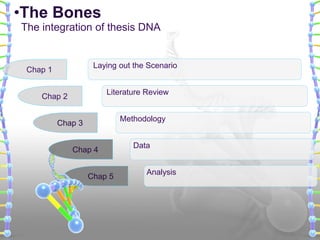
Chap 5
Literature Review
Methodology
•The Bones
The integration of thesis DNA
Laying out the Scenario
Data
Analysis
Chap 1
Chap 2
Chap 3
Chap 4
Chap 6
Literature Review
Methodology
•Flesh & Bones
Introduction: Laying out the Scenario
Theological Data
Analysis/Missiological Implications
Chap 1
Chap 2
Chap 3
Chap 4
Chap 5
Anthropological Data
Step 2: Domain
Analysis = Taxonomy
Box
Lines and
nodes(Mind map)
Outline
• Contextual Ethnography: Define Context and Focus
•Chapter 6: Data Analysis: all Logic
• What is second level
• What is third level
• What is purely illustrative
•What is top level
Box
Lines and Nodes
• Participant Observation
• Field Notes
• Descriptive Observations
• All ethnographic analyses begin by identifying the
problem,
• identifying the cause, and
• listing possible solutions
•Process of Developing a Cultural
Domain Analysis = Taxonomy
X is Kinds
of
Part
of
Result
of
Reason
for
A place
of
doing
Used
for
Way to
do
A step
in
An
Attribut
e of
Act
Place
Object
Activity
Relationsh
ip
Time
Actors
Feelings
•Process of Developing a Cultural
Domain Analysis = Taxonomy
• Focus down on a few items
• (5?)
• or one (5 around one theme).
• Broaden the entire analysis
•Broad and Narrow
• Focused observations
• Selective observations within the focus
• Eliminate a lot of extra material
• Are your interviews definitive or will you use them as illustrative.
• Definitive: Write out the whole as case studies – short analysis for
each, then a longer analytical chapter.
• Illustrative: Write out a long analysis and use portions from the
transcriptions as mini-case studies of 1-2 paragraphs
• Cut the waffle factor: focus
•Cut your workload
• Create charts
• Always Fig. 1: Title (Use word so it automatically develops a list of
figs.
• Always Fig 1: Description that links each part of the figure to the
other
• Always in the text refer to the figure
• A figure or chart takes about 3 hours but communicates a lot in a
short space
• Tabulate your data
•A Picture is worth a thousand
words
Its not complicated.
It shows a
relationship.
Its visually pleasing
1. What are the kinds of
questions you know of?
•Conversational Questions
1. Descriptive questions: Can you
describe what you do when you light
incense every day?
2. Contrast and similarity questions. Why
do you put your god here and they all
put their gods up there? What is the
difference between worship and
seeking to avoid the spirit from harming
you?
3. A triadic contrast: of these three styles
of fundraising which is most Indian in
style?
4. Card sorting = computer column sorting:
1298 churches in Auckland each with 3-
5 types of community engagement.
Writing these in columns is like putting
on cards then sorting and shuffling till
some macro –leel concept of
engagement begins to fall out, then
beneath those some secondary levels.
•Conversational Questions
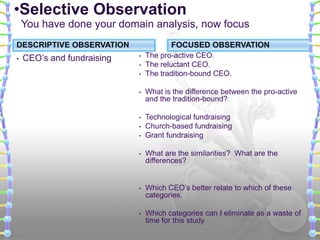
DESCRIPTIVE OBSERVATION
• CEO’s and fundraising • The pro-active CEO.
• The reluctant CEO.
• The tradition-bound CEO.
• What is the difference between the pro-active
and the tradition-bound?
• Technological fundraising
• Church-based fundraising
• Grant fundraising
• What are the similarities? What are the
differences?
• Which CEO’s better relate to which of these
categories.
• Which categories can I eliminate as a waste of
time for this study
FOCUSED OBSERVATION
•Selective Observation
You have done your domain analysis, now focus
Research
Question
• Hypothetical
analysis of
the question
Exploration
of cases
Hypothesis
confirmed • End
•Qualitative Data analysis
Plan it before you get it or it will get you!!
Collect
Code
Collect
Modify Codes
Sub-categorize
Connect
Generate Theory
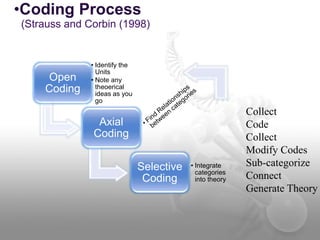
Open
Coding
• Identify the
Units
• Note any
theoerical
ideas as you
go
Axial
Coding
Selective
Coding
• Integrate
categories
into theory
•Coding Process
(Strauss and Corbin (1998)
Collect
Code
Collect
Modify Codes
Sub-categorize
Connect
Generate Theory
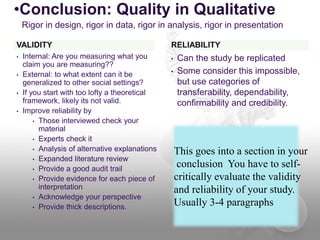
VALIDITY
• Internal: Are you measuring what you
claim you are measuring??
• External: to what extent can it be
generalized to other social settings?
• If you start with too lofty a theoretical
framework, likely its not valid.
• Improve reliability by
• Those interviewed check your
material
• Experts check it
• Analysis of alternative explanations
• Expanded literature review
• Provide a good audit trail
• Provide evidence for each piece of
interpretation
• Acknowledge your perspective
• Provide thick descriptions.
• Can the study be replicated
• Some consider this impossible,
but use categories of
transferability, dependability,
confirmability and credibility.
RELIABILITY
•Conclusion: Quality in Qualitative
Rigor in design, rigor in data, rigor in analysis, rigor in presentation
This goes into a section in your
conclusion You have to self-
critically evaluate the validity
and reliability of your study.
Usually 3-4 paragraphs
TABLE OF CONTENTS
• Use the H1, H2, H3 styles in
Word. Simplest to use what they
give you unless you are a
graphics artist.
• Then use the Insert/Table of
Contents and chose your style
etc.
• Set this up early and do one run
through, then one after you have
it half done then leave it till
towards the end, else you will
find yourself going over and over
it.
• Do the same for the figures.
That means that you need to put
a label above each figure using
the Insert Caption.
LIST OF FIGURES
•Before Everything: Plan your write
up before your analysis
TITLE PAGE
Title, name, school, program,
date, supervisor
Apparent
Objectivity
• Realize that
you are not
objective
Imposition of
your worldview
on the
research
Screening of
the Data
• In your
introduction
• In your
conclusion
•Reflectivity
You are not invisible. • Multiple Investigators
• Reflective journal,
• your schedule,
• log of methodological decisions,
• personal diary reflections
• Pre and Post research analysis of
This goes into a section in yo
introduction on your assump
and how you identified and de
with your biases
Usually 3-4 paragraphs
FIND THE PROGRESSIONS
• Who produced the documents
• Why?
• Is it germaine to the person?
• Is it part of a flow of discussion
• Who ar the conversationalists
• What year does it fit into the
progression?
• Ethics in how you use their
material?
• Anthropology
• Tribal Cultures
• Folk Religions
• Urban Anthropology (Peasants
in the Cities)
• Urban Folk Religion
• Missiological Reflections on this
(International Society of
Missiology)
• Anthropological Reflections on
this.
FIND THE SUBFIELDS IN THE
DISCIPLINE
•Refine your literature review
• Non-academic causes.
• Psychologically, you have finished your thesis, so it is hard to
write another chapter.
• You are exhausted after two years work
• You are bored with the topic because the interesting discoveries
have been made
• BUT
• It is not technically difficult
• It is a short chapter.
• Often “Feel” conclusions are hard to write.
•Conclusion-a-phobia
Its not complicated.Its short. Its motivational writing.
FOR GRADING/EXAMINATION
• Its the LAST piece the examiner
reads.
• They may have read it over
weeks
• Bits and pieces
• This piece integrates it all
in a few minutes
• A good conclusion will provide
you with the energy to publish
your thesis when you come back
to recap your findings…after
your post-thesis rest
FOR LONGER TERM CAREER
•Importance
Increase your grade by half a grade
1. Claiming findings that
you have not proven
2. Introducing new data
3. Hiding weaknesses or
limitations in your thesis.
(Use a self critique, but
don’t go overboard)
4. Avoid too long
(repetitive) or
5. too short (nothing to say)
•The Five Avoids
• One paragraph restating
what you researched and
your original contribution
• Then break into sections
• One section on what you
research and how you did it
• One section on main findings
• One section on possible
areas of future research
• Motivational pitch about
application of your findings
• Final summary paragraph –
motivational and integrative.
•Sample 6 Paragraph Conclusion
Structure
• Must:
• Make a clear and concise statemen
of your contribution to knowledge
• Aspire to:
• Show links between key ideas across
the chapters
• Show your commitment and aspiration
to academic research
• Leave a positive impression with the
examiners
•The “1 Must” and “3 Ideals”
• 300 words or less
• Summarizes research topic in context,
approach, main issues, outcomes
• Based on the 5th version of your
conclusion
• Do not do on the last day. I nearly failed
three students last year because the
abstract was nonsense done lying in bed
while watching Bollywood or Hollywood in
an overnighter. Do first version in week 6
and rewrite 5 times
•Now to Your Abstract!
• Not a single
unnecessary
word
• Use numbers
• No citations
• 1-2 paragraphs
• Don’t repeat
title
• What was it you studied in what context?
• Why is this important
• What did you discover?
• What was your methodological approach
• How does this imply change processes
•Abstract
On Cover page
Concise
Readable
Quantitative
• David E Gray
“Analysing and
Presenting Qualitative
Data”. In Doing
Research in the Real
World. 3rd edn
• James Spradley.1980 ”Making a
Domain Analysis” in Participant
Observation. Holt Reinehart and
Wonston
•References

TUL 670-7, MATUL Thesis Structure

  • 1.
    Structure of aThesis Viv Grigg By PresenterMedia.com
  • 2.
    Chap 5 Literature Review Methodology •TheBones The integration of thesis DNA Laying out the Scenario Data Analysis Chap 1 Chap 2 Chap 3 Chap 4
  • 3.
    Chap 6 Literature Review Methodology •Flesh& Bones Introduction: Laying out the Scenario Theological Data Analysis/Missiological Implications Chap 1 Chap 2 Chap 3 Chap 4 Chap 5 Anthropological Data
  • 4.
    Step 2: Domain Analysis= Taxonomy Box Lines and nodes(Mind map) Outline • Contextual Ethnography: Define Context and Focus •Chapter 6: Data Analysis: all Logic
  • 5.
    • What issecond level • What is third level • What is purely illustrative •What is top level Box Lines and Nodes
  • 6.
    • Participant Observation •Field Notes • Descriptive Observations • All ethnographic analyses begin by identifying the problem, • identifying the cause, and • listing possible solutions •Process of Developing a Cultural Domain Analysis = Taxonomy
  • 7.
    X is Kinds of Part of Result of Reason for Aplace of doing Used for Way to do A step in An Attribut e of Act Place Object Activity Relationsh ip Time Actors Feelings •Process of Developing a Cultural Domain Analysis = Taxonomy
  • 8.
    • Focus downon a few items • (5?) • or one (5 around one theme). • Broaden the entire analysis •Broad and Narrow
  • 9.
    • Focused observations •Selective observations within the focus • Eliminate a lot of extra material • Are your interviews definitive or will you use them as illustrative. • Definitive: Write out the whole as case studies – short analysis for each, then a longer analytical chapter. • Illustrative: Write out a long analysis and use portions from the transcriptions as mini-case studies of 1-2 paragraphs • Cut the waffle factor: focus •Cut your workload
  • 10.
    • Create charts •Always Fig. 1: Title (Use word so it automatically develops a list of figs. • Always Fig 1: Description that links each part of the figure to the other • Always in the text refer to the figure • A figure or chart takes about 3 hours but communicates a lot in a short space • Tabulate your data •A Picture is worth a thousand words Its not complicated. It shows a relationship. Its visually pleasing
  • 11.
    1. What arethe kinds of questions you know of? •Conversational Questions
  • 12.
    1. Descriptive questions:Can you describe what you do when you light incense every day? 2. Contrast and similarity questions. Why do you put your god here and they all put their gods up there? What is the difference between worship and seeking to avoid the spirit from harming you? 3. A triadic contrast: of these three styles of fundraising which is most Indian in style? 4. Card sorting = computer column sorting: 1298 churches in Auckland each with 3- 5 types of community engagement. Writing these in columns is like putting on cards then sorting and shuffling till some macro –leel concept of engagement begins to fall out, then beneath those some secondary levels. •Conversational Questions
  • 13.
    DESCRIPTIVE OBSERVATION • CEO’sand fundraising • The pro-active CEO. • The reluctant CEO. • The tradition-bound CEO. • What is the difference between the pro-active and the tradition-bound? • Technological fundraising • Church-based fundraising • Grant fundraising • What are the similarities? What are the differences? • Which CEO’s better relate to which of these categories. • Which categories can I eliminate as a waste of time for this study FOCUSED OBSERVATION •Selective Observation You have done your domain analysis, now focus
  • 14.
    Research Question • Hypothetical analysis of thequestion Exploration of cases Hypothesis confirmed • End •Qualitative Data analysis Plan it before you get it or it will get you!! Collect Code Collect Modify Codes Sub-categorize Connect Generate Theory
  • 15.
    Open Coding • Identify the Units •Note any theoerical ideas as you go Axial Coding Selective Coding • Integrate categories into theory •Coding Process (Strauss and Corbin (1998) Collect Code Collect Modify Codes Sub-categorize Connect Generate Theory
  • 16.
    VALIDITY • Internal: Areyou measuring what you claim you are measuring?? • External: to what extent can it be generalized to other social settings? • If you start with too lofty a theoretical framework, likely its not valid. • Improve reliability by • Those interviewed check your material • Experts check it • Analysis of alternative explanations • Expanded literature review • Provide a good audit trail • Provide evidence for each piece of interpretation • Acknowledge your perspective • Provide thick descriptions. • Can the study be replicated • Some consider this impossible, but use categories of transferability, dependability, confirmability and credibility. RELIABILITY •Conclusion: Quality in Qualitative Rigor in design, rigor in data, rigor in analysis, rigor in presentation This goes into a section in your conclusion You have to self- critically evaluate the validity and reliability of your study. Usually 3-4 paragraphs
  • 17.
    TABLE OF CONTENTS •Use the H1, H2, H3 styles in Word. Simplest to use what they give you unless you are a graphics artist. • Then use the Insert/Table of Contents and chose your style etc. • Set this up early and do one run through, then one after you have it half done then leave it till towards the end, else you will find yourself going over and over it. • Do the same for the figures. That means that you need to put a label above each figure using the Insert Caption. LIST OF FIGURES •Before Everything: Plan your write up before your analysis TITLE PAGE Title, name, school, program, date, supervisor
  • 18.
    Apparent Objectivity • Realize that youare not objective Imposition of your worldview on the research Screening of the Data • In your introduction • In your conclusion •Reflectivity You are not invisible. • Multiple Investigators • Reflective journal, • your schedule, • log of methodological decisions, • personal diary reflections • Pre and Post research analysis of This goes into a section in yo introduction on your assump and how you identified and de with your biases Usually 3-4 paragraphs
  • 19.
    FIND THE PROGRESSIONS •Who produced the documents • Why? • Is it germaine to the person? • Is it part of a flow of discussion • Who ar the conversationalists • What year does it fit into the progression? • Ethics in how you use their material? • Anthropology • Tribal Cultures • Folk Religions • Urban Anthropology (Peasants in the Cities) • Urban Folk Religion • Missiological Reflections on this (International Society of Missiology) • Anthropological Reflections on this. FIND THE SUBFIELDS IN THE DISCIPLINE •Refine your literature review
  • 20.
    • Non-academic causes. •Psychologically, you have finished your thesis, so it is hard to write another chapter. • You are exhausted after two years work • You are bored with the topic because the interesting discoveries have been made • BUT • It is not technically difficult • It is a short chapter. • Often “Feel” conclusions are hard to write. •Conclusion-a-phobia Its not complicated.Its short. Its motivational writing.
  • 21.
    FOR GRADING/EXAMINATION • Itsthe LAST piece the examiner reads. • They may have read it over weeks • Bits and pieces • This piece integrates it all in a few minutes • A good conclusion will provide you with the energy to publish your thesis when you come back to recap your findings…after your post-thesis rest FOR LONGER TERM CAREER •Importance Increase your grade by half a grade
  • 22.
    1. Claiming findingsthat you have not proven 2. Introducing new data 3. Hiding weaknesses or limitations in your thesis. (Use a self critique, but don’t go overboard) 4. Avoid too long (repetitive) or 5. too short (nothing to say) •The Five Avoids
  • 23.
    • One paragraphrestating what you researched and your original contribution • Then break into sections • One section on what you research and how you did it • One section on main findings • One section on possible areas of future research • Motivational pitch about application of your findings • Final summary paragraph – motivational and integrative. •Sample 6 Paragraph Conclusion Structure
  • 24.
    • Must: • Makea clear and concise statemen of your contribution to knowledge • Aspire to: • Show links between key ideas across the chapters • Show your commitment and aspiration to academic research • Leave a positive impression with the examiners •The “1 Must” and “3 Ideals”
  • 25.
    • 300 wordsor less • Summarizes research topic in context, approach, main issues, outcomes • Based on the 5th version of your conclusion • Do not do on the last day. I nearly failed three students last year because the abstract was nonsense done lying in bed while watching Bollywood or Hollywood in an overnighter. Do first version in week 6 and rewrite 5 times •Now to Your Abstract!
  • 26.
    • Not asingle unnecessary word • Use numbers • No citations • 1-2 paragraphs • Don’t repeat title • What was it you studied in what context? • Why is this important • What did you discover? • What was your methodological approach • How does this imply change processes •Abstract On Cover page Concise Readable Quantitative
  • 27.
    • David EGray “Analysing and Presenting Qualitative Data”. In Doing Research in the Real World. 3rd edn • James Spradley.1980 ”Making a Domain Analysis” in Participant Observation. Holt Reinehart and Wonston •References