GUIDELINES AND STANDARDS
FOR REPORTING
QUALITATIVE RESEARCH (SRQR)
Summarized by Dr. Maribel R. Gaite
Core Questions
 What are some general guidelines and tips for writing a
qualitative study?
 What are the essential components in the structure of a
qualitative thesis or dissertation proposal and final paper, and
qualitative journal article?
 How should the interpretation of the results be reported in a
qualitative journal article based on the qualitative design
used?
Remember:
• There is no one qualitative method, but rather a number of
research approaches which fall under the umbrella of ‘qualitative
methods’. The various social science disciplines tend to have
different conventions on best practice in qualitative research.
• However there are some general guidance for the writing and
assessment of papers which present qualitative data (either
alone or in combination with quantitative methods).
• General principles of good practice for all research will also
apply.
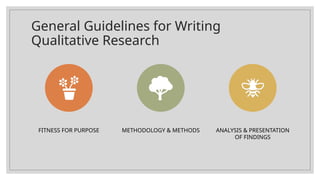
General Guidelines for Writing
Qualitative Research
FITNESS FOR PURPOSE METHODOLOGY & METHODS ANALYSIS & PRESENTATION
OF FINDINGS
Fitness for purpose
Are the methods of the research appropriate to the
nature of the question(s) being asked, i.e.:
• Does the research seek to understand social processes
or social structures &/or to illuminate subjective
experiences or meanings?
• Are the settings, groups or individuals being examined
of a type which cannot be pre-selected, or the possible
outcomes not specified (or hypothesized) in advance?
Methodology and methods
• All papers must include a dedicated
methods section which specifies, as
appropriate, the sample recruitment
strategy, sample size, and analytical
strategy.
Principles of selection
• Qualitative research is often based on or includes
non-probability sampling. The unit(s) of research
may include one or a combination of people,
events, institutions, samples of natural behavior,
conversations, written and visual material, etc.
• The selection of these should be theoretically
justified e.g. it should be made clear how
respondents were selected.
Principles of selection
• There should be a rationale for the sources of the
data (e.g respondents/participants, settings,
documents)
• Consideration should be given to whether the
sources of data (e.g people, organizations,
documents) were unusual in some important way.
• Any limitations of the data should be discussed
(such as non response, refusal to take part).
The research process
In most papers there should be consideration of
• The access process
• How data were collected and recorded
• Who collected the data
• When the data were collected
• How the research was explained to
respondents/participants
Research ethics
• Details of formal ethical approval (i.e. IRB, Research Ethics
Committee) should be stated in the main body of the paper. If
authors were not required to obtain ethical approval (as is the case in
some countries) or unable to obtain attain ethical approval (as
sometimes occurs in resource-poor settings) they should explain
this.
• Anonymize this information as appropriate in the manuscript, and
give the information when asked during submission.
• Procedures for securing informed consent should be provided.
• Any ethical concerns that arose during the research should be
discussed.
Analysis
• The process of analysis should be made as transparent as
possible (notwithstanding the conceptual and theoretical
creativity that typically characterizes qualitative research).
• How was the analysis conducted?
• How were themes, concepts and categories generated
from the data?
• Whether analysis was computer assisted (and, if so, how)?
• Who was involved in the analysis and in what manner?
Analysis
Assurance of analytic rigor. For example
• Steps taken to guard against selectivity in the use of data
• Triangulation
• Inter-rater reliability
• Member and expert checking
• The researcher’s own position should clearly be stated.
For example, have they examined their own role,
possible bias, and influence on the research (reflexivity)?
Presentation of Findings
Consideration of Context. The research should be clearly
contextualized.
• Relevant information about the settings and
respondents/participants should be supplied.
• The phenomena under study should be integrated into
their social context (rather than being abstracted or de-
contextualized).
• Any particular/unique influences should be identified and
discussed.
Presentation of Findings
Presentation of data. Quotations, field notes, and other data where
appropriate should be identified in a way which enables the reader to
judge the range of evidence being used.
• Distinctions between the data and their interpretation should be clear.
• The iteration between data and explanations of the data (theory
generation) should be clear.
• Sufficient original evidence should be presented to satisfy the reader
of the relationship between the evidence and the conclusions (validity).
• There should be adequate consideration of cases or evidence which
might refute the conclusions.
Qualitative Research Report
PARTS ESSENTIAL CONTENT STANDARDS FOR
REPORTING
General Writing Tips (Bazeley, 2017)
 If you keep notes/reflections/conclusions etc. under topic
headings during analysis (regardless of source or method
used), your analysis and your writing are likely to become
integrated.
 What was your purpose?
 What question(s) were you asking?
 What is the take home message for the reader for this
publication?
 How does it fit into the overall context of the study?
 What data do you have to support this message?
Framing Substantive Writing
• Focus on the message, not on the method
• Consider the audience
• Needs a clear and progressive structure
– What does the reader already need to know to
understand this point?
– What do they need to know now to understand what’s
coming next?
– (What are the conventions within your discipline?)
(Bazeley, 2017)
Title
• Concise description of the nature and topic of
the study
• Identifying the study as qualitative or
indicating the approach (e.g., ethnography,
grounded theory) or data collection methods
(e.g., interview, focus group) is recommended.
Abstract
Summary of key elements of the study using
the abstract format of the intended
publication; typically includes background,
purpose, methods, results, and conclusions
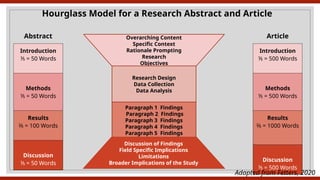
Hourglass Model for a Research Abstract and Article
Abstract
Introduction
⅕ = 50 Words
Methods
⅕ = 50 Words
Results
⅖ = 100 Words
Discussion
⅕ = 50 Words
Article
Introduction
⅕ = 500 Words
Methods
⅕ = 500 Words
Results
⅖ = 1000 Words
Discussion
⅕ = 500 Words
Overarching Content
Specific Context
Rationale Prompting
Research
Objectives
Research Design
Data Collection
Data Analysis
Paragraph 1 Findings
Paragraph 2 Findings
Paragraph 3 Findings
Paragraph 4 Findings
Paragraph 5 Findings
Discussion of Findings
Field Specific Implications
Limitations
Broader Implications of the Study
Adapted from Fetters, 2020
Introduction
Description and significance of the
problem/phenomenon studied;
Review of relevant theory and empirical work;
problem statement
Purpose of the study and specific objectives or
questions
Methods
Qualitative approach and research paradigm.
Qualitative approach (e.g., ethnography, grounded
theory, case study, phenomenology, narrative
research) and guiding theory if appropriate;
identifying the research paradigm (e.g.,
postpositivist, constructivist/ interpretivist) is also
recommended; rationale
Methods
• The rationale should briefly discuss the justification
for choosing that theory, approach, method, or
technique rather than other options available, the
assumptions and limitations implicit in those choices,
and how those choices influence study conclusions
and transferability.
• As appropriate, the rationale for several items might
be discussed together
Methods
Qualitative approach and research paradigm.
Qualitative approach (e.g., ethnography, grounded
theory, case study, phenomenology, narrative
research) and guiding theory if appropriate;
identifying the research paradigm (e.g.,
postpositivist, constructivist/ interpretivist) is also
recommended; rationale
Methods
Researcher characteristics and reflexivity.
Researchers’ characteristics that may influence the
research, including personal attributes,
qualifications/experience, relationship with
participants, assumptions, and/or presuppositions;
potential or actual interaction between researchers’
characteristics and the research questions, approach,
methods, results, and/or transferability
Context
Setting/site and salient contextual elements
and characteristics; rationale
Sampling Strategy
How and why research participants, documents, or
events were selected; criteria for deciding when no
further sampling was necessary (e.g., sampling
saturation); rationale
Ethical issues pertaining to human
subjects
Documentation of approval by an appropriate
ethics review board and participant consent, or
explanation for lack thereof; other confidentiality
and data security issues
Data Collection Methods
Types of data collected; details of data collection
procedures including (as appropriate) start and
stop dates of data collection and analysis,
iterative process, triangulation of
sources/methods, and modification of procedures
in response to evolving study findings; rationale
Data collection instruments and
technologies
Description of instruments (e.g., interview guides,
questionnaires) and devices (e.g., audio recorders)
used for data collection; if/how the instrument(s)
changed over the course of the study
Units of Study
Number and relevant characteristics of
participants, documents, or events included in the
study; level of participation (could be reported in
results)
Data processing
Methods for processing data prior to and during
analysis, including transcription, data entry, data
management and security, verification of data
integrity, data coding, and anonymization/
deidentification of excerpts
Data analysis
Process by which inferences, themes, etc., were
identified and developed, including the researchers
involved in data analysis; usually references a
specific paradigm or approach; rationale
Techniques to enhance
trustworthiness
Techniques to enhance trustworthiness and
credibility of data analysis (e.g., member
checking, audit trail, triangulation); rationale
Results/Findings
• Synthesis and interpretation. Main findings (e.g.,
interpretations, inferences, and themes); might
include development of a theory or model, or
integration with prior research or theory
• Links to empirical data. Evidence (e.g., quotes, field
notes, text excerpts, photographs) to substantiate
analytic findings
Discussion
Integration with prior work, implications, transferability,
and contribution(s) to the field. Short summary of main
findings; explanation of how findings and conclusions
connect to, support, elaborate on, or challenge
conclusions of earlier scholarship; discussion of scope of
application/ generalizability; identification of unique
contribution(s) to scholarship in a discipline or field
Limitations
Trustworthiness and limitations of findings
Conflicts of interest
Potential sources of influence or perceived
influence on study conduct and conclusions; how
these were managed
Funding
Sources of funding and other support; role of
funders in data collection, interpretation, and
reporting
The worst thing you write
is better than the best
thing you have not
written.
- Anonymous
References
O’Brien, Bridget C. PhD; Harris, Ilene B. PhD; Beckman, Thomas J. MD; Reed, Darcy
A. MD, MPH; Cook, David A. MD, MHPE Standards for Reporting Qualitative
Research, Academic Medicine: September 2014 - Volume 89 - Issue 9 - p 1245-1251
DOI: 10.1097/ACM.0000000000000388
https://www.journals.elsevier.com/social-science-and-medicine/policies/guidelines-
for-qualitative-papers
Bazeley, P. (2017). Writing mixed methods research articles and theses. Research
Support P/L and Western Sydney University. retrieved from
www.researchsupport.com.au
Fetters, M. D., Curry, L. A., & Creswell, J. W. (2013). Achieving integration in mixed
methods designs-principles and practices. Health services research, 48(6 Pt 2),
2134–2156. https://doi.org/10.1111/1475-6773.12117

Standards for Reporting Qualitative Research.pptx

  • 1.
    GUIDELINES AND STANDARDS FORREPORTING QUALITATIVE RESEARCH (SRQR) Summarized by Dr. Maribel R. Gaite
  • 3.
    Core Questions  Whatare some general guidelines and tips for writing a qualitative study?  What are the essential components in the structure of a qualitative thesis or dissertation proposal and final paper, and qualitative journal article?  How should the interpretation of the results be reported in a qualitative journal article based on the qualitative design used?
  • 5.
    Remember: • There isno one qualitative method, but rather a number of research approaches which fall under the umbrella of ‘qualitative methods’. The various social science disciplines tend to have different conventions on best practice in qualitative research. • However there are some general guidance for the writing and assessment of papers which present qualitative data (either alone or in combination with quantitative methods). • General principles of good practice for all research will also apply.
  • 6.
    General Guidelines forWriting Qualitative Research FITNESS FOR PURPOSE METHODOLOGY & METHODS ANALYSIS & PRESENTATION OF FINDINGS
  • 7.
    Fitness for purpose Arethe methods of the research appropriate to the nature of the question(s) being asked, i.e.: • Does the research seek to understand social processes or social structures &/or to illuminate subjective experiences or meanings? • Are the settings, groups or individuals being examined of a type which cannot be pre-selected, or the possible outcomes not specified (or hypothesized) in advance?
  • 8.
    Methodology and methods •All papers must include a dedicated methods section which specifies, as appropriate, the sample recruitment strategy, sample size, and analytical strategy.
  • 9.
    Principles of selection •Qualitative research is often based on or includes non-probability sampling. The unit(s) of research may include one or a combination of people, events, institutions, samples of natural behavior, conversations, written and visual material, etc. • The selection of these should be theoretically justified e.g. it should be made clear how respondents were selected.
  • 10.
    Principles of selection •There should be a rationale for the sources of the data (e.g respondents/participants, settings, documents) • Consideration should be given to whether the sources of data (e.g people, organizations, documents) were unusual in some important way. • Any limitations of the data should be discussed (such as non response, refusal to take part).
  • 11.
    The research process Inmost papers there should be consideration of • The access process • How data were collected and recorded • Who collected the data • When the data were collected • How the research was explained to respondents/participants
  • 12.
    Research ethics • Detailsof formal ethical approval (i.e. IRB, Research Ethics Committee) should be stated in the main body of the paper. If authors were not required to obtain ethical approval (as is the case in some countries) or unable to obtain attain ethical approval (as sometimes occurs in resource-poor settings) they should explain this. • Anonymize this information as appropriate in the manuscript, and give the information when asked during submission. • Procedures for securing informed consent should be provided. • Any ethical concerns that arose during the research should be discussed.
  • 13.
    Analysis • The processof analysis should be made as transparent as possible (notwithstanding the conceptual and theoretical creativity that typically characterizes qualitative research). • How was the analysis conducted? • How were themes, concepts and categories generated from the data? • Whether analysis was computer assisted (and, if so, how)? • Who was involved in the analysis and in what manner?
  • 14.
    Analysis Assurance of analyticrigor. For example • Steps taken to guard against selectivity in the use of data • Triangulation • Inter-rater reliability • Member and expert checking • The researcher’s own position should clearly be stated. For example, have they examined their own role, possible bias, and influence on the research (reflexivity)?
  • 15.
    Presentation of Findings Considerationof Context. The research should be clearly contextualized. • Relevant information about the settings and respondents/participants should be supplied. • The phenomena under study should be integrated into their social context (rather than being abstracted or de- contextualized). • Any particular/unique influences should be identified and discussed.
  • 16.
    Presentation of Findings Presentationof data. Quotations, field notes, and other data where appropriate should be identified in a way which enables the reader to judge the range of evidence being used. • Distinctions between the data and their interpretation should be clear. • The iteration between data and explanations of the data (theory generation) should be clear. • Sufficient original evidence should be presented to satisfy the reader of the relationship between the evidence and the conclusions (validity). • There should be adequate consideration of cases or evidence which might refute the conclusions.
  • 17.
    Qualitative Research Report PARTSESSENTIAL CONTENT STANDARDS FOR REPORTING
  • 19.
    General Writing Tips(Bazeley, 2017)  If you keep notes/reflections/conclusions etc. under topic headings during analysis (regardless of source or method used), your analysis and your writing are likely to become integrated.  What was your purpose?  What question(s) were you asking?  What is the take home message for the reader for this publication?  How does it fit into the overall context of the study?  What data do you have to support this message?
  • 20.
    Framing Substantive Writing •Focus on the message, not on the method • Consider the audience • Needs a clear and progressive structure – What does the reader already need to know to understand this point? – What do they need to know now to understand what’s coming next? – (What are the conventions within your discipline?) (Bazeley, 2017)
  • 21.
    Title • Concise descriptionof the nature and topic of the study • Identifying the study as qualitative or indicating the approach (e.g., ethnography, grounded theory) or data collection methods (e.g., interview, focus group) is recommended.
  • 22.
    Abstract Summary of keyelements of the study using the abstract format of the intended publication; typically includes background, purpose, methods, results, and conclusions
  • 23.
    Hourglass Model fora Research Abstract and Article Abstract Introduction ⅕ = 50 Words Methods ⅕ = 50 Words Results ⅖ = 100 Words Discussion ⅕ = 50 Words Article Introduction ⅕ = 500 Words Methods ⅕ = 500 Words Results ⅖ = 1000 Words Discussion ⅕ = 500 Words Overarching Content Specific Context Rationale Prompting Research Objectives Research Design Data Collection Data Analysis Paragraph 1 Findings Paragraph 2 Findings Paragraph 3 Findings Paragraph 4 Findings Paragraph 5 Findings Discussion of Findings Field Specific Implications Limitations Broader Implications of the Study Adapted from Fetters, 2020
  • 24.
    Introduction Description and significanceof the problem/phenomenon studied; Review of relevant theory and empirical work; problem statement Purpose of the study and specific objectives or questions
  • 25.
    Methods Qualitative approach andresearch paradigm. Qualitative approach (e.g., ethnography, grounded theory, case study, phenomenology, narrative research) and guiding theory if appropriate; identifying the research paradigm (e.g., postpositivist, constructivist/ interpretivist) is also recommended; rationale
  • 26.
    Methods • The rationaleshould briefly discuss the justification for choosing that theory, approach, method, or technique rather than other options available, the assumptions and limitations implicit in those choices, and how those choices influence study conclusions and transferability. • As appropriate, the rationale for several items might be discussed together
  • 27.
    Methods Qualitative approach andresearch paradigm. Qualitative approach (e.g., ethnography, grounded theory, case study, phenomenology, narrative research) and guiding theory if appropriate; identifying the research paradigm (e.g., postpositivist, constructivist/ interpretivist) is also recommended; rationale
  • 28.
    Methods Researcher characteristics andreflexivity. Researchers’ characteristics that may influence the research, including personal attributes, qualifications/experience, relationship with participants, assumptions, and/or presuppositions; potential or actual interaction between researchers’ characteristics and the research questions, approach, methods, results, and/or transferability
  • 29.
    Context Setting/site and salientcontextual elements and characteristics; rationale
  • 30.
    Sampling Strategy How andwhy research participants, documents, or events were selected; criteria for deciding when no further sampling was necessary (e.g., sampling saturation); rationale
  • 31.
    Ethical issues pertainingto human subjects Documentation of approval by an appropriate ethics review board and participant consent, or explanation for lack thereof; other confidentiality and data security issues
  • 32.
    Data Collection Methods Typesof data collected; details of data collection procedures including (as appropriate) start and stop dates of data collection and analysis, iterative process, triangulation of sources/methods, and modification of procedures in response to evolving study findings; rationale
  • 33.
    Data collection instrumentsand technologies Description of instruments (e.g., interview guides, questionnaires) and devices (e.g., audio recorders) used for data collection; if/how the instrument(s) changed over the course of the study
  • 34.
    Units of Study Numberand relevant characteristics of participants, documents, or events included in the study; level of participation (could be reported in results)
  • 35.
    Data processing Methods forprocessing data prior to and during analysis, including transcription, data entry, data management and security, verification of data integrity, data coding, and anonymization/ deidentification of excerpts
  • 36.
    Data analysis Process bywhich inferences, themes, etc., were identified and developed, including the researchers involved in data analysis; usually references a specific paradigm or approach; rationale
  • 37.
    Techniques to enhance trustworthiness Techniquesto enhance trustworthiness and credibility of data analysis (e.g., member checking, audit trail, triangulation); rationale
  • 38.
    Results/Findings • Synthesis andinterpretation. Main findings (e.g., interpretations, inferences, and themes); might include development of a theory or model, or integration with prior research or theory • Links to empirical data. Evidence (e.g., quotes, field notes, text excerpts, photographs) to substantiate analytic findings
  • 39.
    Discussion Integration with priorwork, implications, transferability, and contribution(s) to the field. Short summary of main findings; explanation of how findings and conclusions connect to, support, elaborate on, or challenge conclusions of earlier scholarship; discussion of scope of application/ generalizability; identification of unique contribution(s) to scholarship in a discipline or field
  • 40.
  • 41.
    Conflicts of interest Potentialsources of influence or perceived influence on study conduct and conclusions; how these were managed
  • 42.
    Funding Sources of fundingand other support; role of funders in data collection, interpretation, and reporting
  • 43.
    The worst thingyou write is better than the best thing you have not written. - Anonymous
  • 44.
    References O’Brien, Bridget C.PhD; Harris, Ilene B. PhD; Beckman, Thomas J. MD; Reed, Darcy A. MD, MPH; Cook, David A. MD, MHPE Standards for Reporting Qualitative Research, Academic Medicine: September 2014 - Volume 89 - Issue 9 - p 1245-1251 DOI: 10.1097/ACM.0000000000000388 https://www.journals.elsevier.com/social-science-and-medicine/policies/guidelines- for-qualitative-papers Bazeley, P. (2017). Writing mixed methods research articles and theses. Research Support P/L and Western Sydney University. retrieved from www.researchsupport.com.au Fetters, M. D., Curry, L. A., & Creswell, J. W. (2013). Achieving integration in mixed methods designs-principles and practices. Health services research, 48(6 Pt 2), 2134–2156. https://doi.org/10.1111/1475-6773.12117