Four Methodologies for
Examination of Conscience
 The Ignatian Examen
 John Wesley’s Self Examination Questions
 Renovare Questions of Examen
 The 12 Steps of Alcoholics Anonymous
(other slide presentation)
The Ignatian Examen of
Consciousness
 The Examen is a prayer practice articulated by Ignatius of
Loyola in the 16th century. It is, in short, a way of listening to
our own lives and of discerning therein the presence and
absence of God. It is rooted in the belief that God is
constantly revealing himself to us in our experience-- the
scripture of our life—and desires to speak to us through our
deepest feelings and yearnings (what he called consolation
and desolation). Consolation is whatever helps us to connect
in love to ourselves, others, God and the universe; desolation
is whatever blocks that connection. Ignatius urges us to take
time at least once each day to pause and reflect on our
experience.
Some Presuppositions in Doing the
Examen
 1. God’s creating is a continual sharing of Trinitarian life
with all creation "that all may be one, as Thou, Father in me,
and I in Thee, that they may be one in us." (John 17:21).
 2. Thus present in creation and human history, God guides
us toward the full attainment of this life with God and one
another in unity and peace, justice and love.
 3. We humans can discern the direction of God’s active
guidance in our own daily history, and can collaborate with
God to promote its realization in action.
Presuppositions
 4. The sign of God’s guidance is: what
produces unity and peace among people
and what instills feelings of peace, love,
and integrity in us. By contrast, what
produces dissension and hostility in
society and selfishness and vengeance in
us is a sign of the presence and activity
of evil. (See Galatians 5:13-26)
Steps in Making the Examen
 1. We begin by quieting ourselves. Become aware of God’s
goodness, the gifts of life and love. Be thankful. Recall that
without faith, the eye of love, the human world seems too
evil for God to be good, for a good God to exist.
 2. Pray for the grace to see clearly, to understand accurately,
and to respond generously to the guidance God is giving us
in our daily history.
Steps
 3. Review in memory the history of the day (week, month,
etc.) in order to be shown concrete instances of the presence
and guidance of God and, perhaps, of the activity and
influence of evil. These can be detected by paying attention
to strong feelings we experienced that may have
accompanied or arisen from situations and encounters.
 4. Evaluate these instances in which we have either
collaborated with God or yielded to the influence of evil in
some way. Express gratitude and regret.
 5. Plan and decide how to collaborate more effectively with
God and how, with God’s assistance, to avoid or overcome
the influence of evil in the future.
John Wesley’s Self-Examination
Questions
 John Wesley gave these nearly two dozen questions to
members of his discipleship groups more than 200 years ago.
The questions may have their origin in the spiritual
accountability group started by Wesley when he was a
student at Oxford -- a group that detractors called "The Holy
Club."
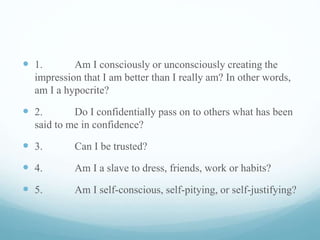
 1. Am I consciously or unconsciously creating the
impression that I am better than I really am? In other words,
am I a hypocrite?
 2. Do I confidentially pass on to others what has been
said to me in confidence?
 3. Can I be trusted?
 4. Am I a slave to dress, friends, work or habits?
 5. Am I self-conscious, self-pitying, or self-justifying?
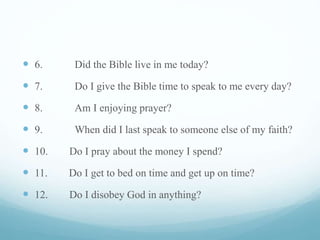
 6. Did the Bible live in me today?
 7. Do I give the Bible time to speak to me every day?
 8. Am I enjoying prayer?
 9. When did I last speak to someone else of my faith?
 10. Do I pray about the money I spend?
 11. Do I get to bed on time and get up on time?
 12. Do I disobey God in anything?
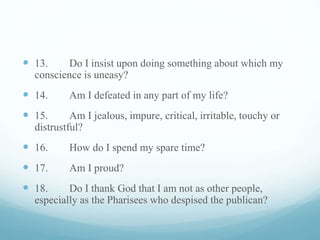
 13. Do I insist upon doing something about which my
conscience is uneasy?
 14. Am I defeated in any part of my life?
 15. Am I jealous, impure, critical, irritable, touchy or
distrustful?
 16. How do I spend my spare time?
 17. Am I proud?
 18. Do I thank God that I am not as other people,
especially as the Pharisees who despised the publican?
 19. Is there anyone whom I fear, dislike, disown,
criticize, hold any resentment toward or disregard? If so,
what am I doing about it?
 20. Do I grumble or complain constantly?
 21. Is Christ real to me?
Renovare Questions of Examen
 RENOVARÉ Questions of Examen are designed for use
within Spiritual Formation Groups. These are described by
Renovare as “small fellowships that exist for mutual support,
mutual encouragement, and mutual accountability as we
participate in our transformation into Christlikeness.
Collective Examen
 Drawing their format from small group models that span the
centuries—from the Benedictines in the 4th Century to
Methodism in the 17th Century to Alcoholics Anonymous in
the 20th Century—participants in these gatherings of
between two and seven people ask one another in various
forms the old question, "How is it with your soul?" And this
is how members of these groups help one another in their life
for Christ.”
Renovare Process
Group members first covenant to
Confidentiality. They then proceed to
Questions of Examen based on six
Christian traditions. At some point
during each meeting individuals make
plans for how they intend to partner with
God in the growth of their souls before
the next meeting.
 See http://www.renovare.org/journey_spiritual_formation_groups_order.htm
Contemplative: The Prayer-Filled
Life
 In what ways has God made his presence known to you since
our last meeting? What experiences of prayer, meditation and
spiritual reading has God given you? What difficulties or
frustrations have you encountered? What joys and delights?
Holiness: The Virtuous Life
 What temptations have you faced since our last meeting?
How did you respond? Which spiritual disciplines has God
used to lead you further into holiness of heart and life?
Charismatic: The Spirit-Empowered
Life
 Have you sensed any influence or work of the Holy Spirit
since our last meeting? What spiritual gifts has the Spirited
enabled you to exercise? What was the outcome? What fruit
of the Spirit would you like to see increase in your life? What
disciplines might be useful in this effort?
Social Justice: The
Compassionate Life
 What opportunities has God given you to serve others since
our last meeting? How did you respond? Have you
encountered any injustice to or oppression of others? Have
you been able to work for justice and shalom?
Evangelical: The Word-
Centered Life
 Has God provided an opportunity for you to share your faith
with someone since our last meeting? How did you respond?
In what ways have you encountered Christ in your reading of
the Scriptures? How has the Bible shaped the way you think
and live?
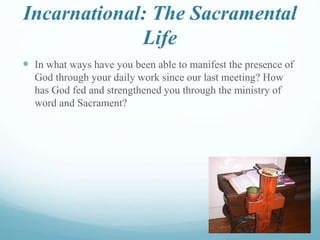
Incarnational: The Sacramental
Life
 In what ways have you been able to manifest the presence of
God through your daily work since our last meeting? How
has God fed and strengthened you through the ministry of
word and Sacrament?

Four Methodologies for Examination of COnscience

  • 1.
    Four Methodologies for Examinationof Conscience  The Ignatian Examen  John Wesley’s Self Examination Questions  Renovare Questions of Examen  The 12 Steps of Alcoholics Anonymous (other slide presentation)
  • 2.
    The Ignatian Examenof Consciousness  The Examen is a prayer practice articulated by Ignatius of Loyola in the 16th century. It is, in short, a way of listening to our own lives and of discerning therein the presence and absence of God. It is rooted in the belief that God is constantly revealing himself to us in our experience-- the scripture of our life—and desires to speak to us through our deepest feelings and yearnings (what he called consolation and desolation). Consolation is whatever helps us to connect in love to ourselves, others, God and the universe; desolation is whatever blocks that connection. Ignatius urges us to take time at least once each day to pause and reflect on our experience.
  • 3.
    Some Presuppositions inDoing the Examen  1. God’s creating is a continual sharing of Trinitarian life with all creation "that all may be one, as Thou, Father in me, and I in Thee, that they may be one in us." (John 17:21).  2. Thus present in creation and human history, God guides us toward the full attainment of this life with God and one another in unity and peace, justice and love.  3. We humans can discern the direction of God’s active guidance in our own daily history, and can collaborate with God to promote its realization in action.
  • 4.
    Presuppositions  4. Thesign of God’s guidance is: what produces unity and peace among people and what instills feelings of peace, love, and integrity in us. By contrast, what produces dissension and hostility in society and selfishness and vengeance in us is a sign of the presence and activity of evil. (See Galatians 5:13-26)
  • 5.
    Steps in Makingthe Examen  1. We begin by quieting ourselves. Become aware of God’s goodness, the gifts of life and love. Be thankful. Recall that without faith, the eye of love, the human world seems too evil for God to be good, for a good God to exist.  2. Pray for the grace to see clearly, to understand accurately, and to respond generously to the guidance God is giving us in our daily history.
  • 6.
    Steps  3. Reviewin memory the history of the day (week, month, etc.) in order to be shown concrete instances of the presence and guidance of God and, perhaps, of the activity and influence of evil. These can be detected by paying attention to strong feelings we experienced that may have accompanied or arisen from situations and encounters.  4. Evaluate these instances in which we have either collaborated with God or yielded to the influence of evil in some way. Express gratitude and regret.
  • 7.
     5. Planand decide how to collaborate more effectively with God and how, with God’s assistance, to avoid or overcome the influence of evil in the future.
  • 8.
    John Wesley’s Self-Examination Questions John Wesley gave these nearly two dozen questions to members of his discipleship groups more than 200 years ago. The questions may have their origin in the spiritual accountability group started by Wesley when he was a student at Oxford -- a group that detractors called "The Holy Club."
  • 9.
     1. AmI consciously or unconsciously creating the impression that I am better than I really am? In other words, am I a hypocrite?  2. Do I confidentially pass on to others what has been said to me in confidence?  3. Can I be trusted?  4. Am I a slave to dress, friends, work or habits?  5. Am I self-conscious, self-pitying, or self-justifying?
  • 10.
     6. Didthe Bible live in me today?  7. Do I give the Bible time to speak to me every day?  8. Am I enjoying prayer?  9. When did I last speak to someone else of my faith?  10. Do I pray about the money I spend?  11. Do I get to bed on time and get up on time?  12. Do I disobey God in anything?
  • 11.
     13. DoI insist upon doing something about which my conscience is uneasy?  14. Am I defeated in any part of my life?  15. Am I jealous, impure, critical, irritable, touchy or distrustful?  16. How do I spend my spare time?  17. Am I proud?  18. Do I thank God that I am not as other people, especially as the Pharisees who despised the publican?
  • 12.
     19. Isthere anyone whom I fear, dislike, disown, criticize, hold any resentment toward or disregard? If so, what am I doing about it?  20. Do I grumble or complain constantly?  21. Is Christ real to me?
  • 13.
    Renovare Questions ofExamen  RENOVARÉ Questions of Examen are designed for use within Spiritual Formation Groups. These are described by Renovare as “small fellowships that exist for mutual support, mutual encouragement, and mutual accountability as we participate in our transformation into Christlikeness.
  • 14.
    Collective Examen  Drawingtheir format from small group models that span the centuries—from the Benedictines in the 4th Century to Methodism in the 17th Century to Alcoholics Anonymous in the 20th Century—participants in these gatherings of between two and seven people ask one another in various forms the old question, "How is it with your soul?" And this is how members of these groups help one another in their life for Christ.”
  • 15.
    Renovare Process Group membersfirst covenant to Confidentiality. They then proceed to Questions of Examen based on six Christian traditions. At some point during each meeting individuals make plans for how they intend to partner with God in the growth of their souls before the next meeting.  See http://www.renovare.org/journey_spiritual_formation_groups_order.htm
  • 16.
    Contemplative: The Prayer-Filled Life In what ways has God made his presence known to you since our last meeting? What experiences of prayer, meditation and spiritual reading has God given you? What difficulties or frustrations have you encountered? What joys and delights?
  • 17.
    Holiness: The VirtuousLife  What temptations have you faced since our last meeting? How did you respond? Which spiritual disciplines has God used to lead you further into holiness of heart and life?
  • 18.
    Charismatic: The Spirit-Empowered Life Have you sensed any influence or work of the Holy Spirit since our last meeting? What spiritual gifts has the Spirited enabled you to exercise? What was the outcome? What fruit of the Spirit would you like to see increase in your life? What disciplines might be useful in this effort?
  • 19.
    Social Justice: The CompassionateLife  What opportunities has God given you to serve others since our last meeting? How did you respond? Have you encountered any injustice to or oppression of others? Have you been able to work for justice and shalom?
  • 20.
    Evangelical: The Word- CenteredLife  Has God provided an opportunity for you to share your faith with someone since our last meeting? How did you respond? In what ways have you encountered Christ in your reading of the Scriptures? How has the Bible shaped the way you think and live?
  • 21.
    Incarnational: The Sacramental Life In what ways have you been able to manifest the presence of God through your daily work since our last meeting? How has God fed and strengthened you through the ministry of word and Sacrament?