Academic writing
Manchester School of Art researcher
development programme
16 November 2016
1
1.What is academic writing?
2.Problems of writing
academically
3.Reading academic writing
2
academic
Relating to education or scholarship
Not of practical relevance
3
• Reflective
• Critical
• Dialogical
• Theoretical
4
It’s like research:
• A systematic investigation
• Intentional
• Acquire new knowledge
• Justified
• Communicated
5
• Has a thesis or proposition (to be
proved)
• Takes a stance (informative, questioning,
critical)
• Refers to a context
• Has methods
• Follows certain conventions eg
references
• For a particular audience
• A contribution to knowledge
6
Writing otherwise
or
creative non-fiction
or
creative criticism
7
Writing otherwise as an academic
i.e. not fiction, memoir or autobiography:
Exploration and experiment
What else might you want to say about your
subject?
Subjectivity
Style – more poetic, more personal
In dialogue, collaborative
Mixing of visual and text
Different subject matter
8
9
Why is it so hard?
• Anxiety
• Not knowing
• Exposing
• Authority
• Disappointment
• Shameful (humiliating)
• Loss
10
Pleasures
• New thoughts
• Eureka!
• Making a new form
• Recognition
• Authority
• Satisfaction
11
Investment (me)
and
Detachment (not-me)
12
How much critical [academic] writing is done in
the early hours, fuelled by the promise of next-
day delivery? How much is done through the
course of a quiet day as our attention moves
variously in the vicinity of the materials at hand?
And how much happens piecemeal over weeks
and months, perhaps longer, as the words of
another turn their way round and about our days
and nights?
Benson, S. and Connors, C (eds) (2014) Creative Criticism. An Anthology and Guide.
Edinburgh University Press. p.35 13
Bammer, A. and Boetcher Joeres, R-E. (eds) (2015), The Future of
Scholarly Writing. Critical Interventions. New York: Palgrave
Macmillan
Barwick, N. (2003), Mad desire and feverish melancholy: reflections
on the psychodynamics of writing and presenting. British Journal of
Psychotherapy 20 (1), 59-71
Benson, S. and Connors, C (eds) (2014) Creative Criticism. An
Anthology and Guide. Edinburgh University Press
Butler, J. (1990/2007), Gender Trouble. London and New York:
Routledge
Stacey, J. and Wolff, J. (2013), Writing Otherwise: Experiments in
Cultural Criticism. Manchester University Press
Walsh, J. (2014), Interrupting the frame: reflective practice in the
classroom and the consulting room. Pedagogy, Culture and Society,
22 (1), 9-19 14
Read these first pages from academic
books.
How do you react to the text?
In what way is the text ‘academic’?
What voice(s) is the writer using?
15
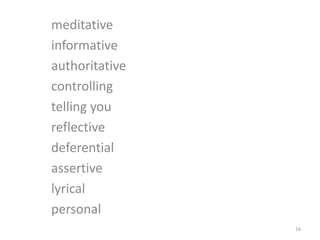
meditative
informative
authoritative
controlling
telling you
reflective
deferential
assertive
lyrical
personal
16
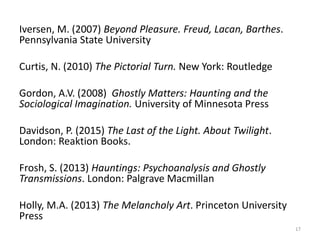
Iversen, M. (2007) Beyond Pleasure. Freud, Lacan, Barthes.
Pennsylvania State University
Curtis, N. (2010) The Pictorial Turn. New York: Routledge
Gordon, A.V. (2008) Ghostly Matters: Haunting and the
Sociological Imagination. University of Minnesota Press
Davidson, P. (2015) The Last of the Light. About Twilight.
London: Reaktion Books.
Frosh, S. (2013) Hauntings: Psychoanalysis and Ghostly
Transmissions. London: Palgrave Macmillan
Holly, M.A. (2013) The Melancholy Art. Princeton University
Press
17

Academic writing - RDP 161116

  • 1.
    Academic writing Manchester Schoolof Art researcher development programme 16 November 2016 1
  • 2.
    1.What is academicwriting? 2.Problems of writing academically 3.Reading academic writing 2
  • 3.
    academic Relating to educationor scholarship Not of practical relevance 3
  • 4.
    • Reflective • Critical •Dialogical • Theoretical 4
  • 5.
    It’s like research: •A systematic investigation • Intentional • Acquire new knowledge • Justified • Communicated 5
  • 6.
    • Has athesis or proposition (to be proved) • Takes a stance (informative, questioning, critical) • Refers to a context • Has methods • Follows certain conventions eg references • For a particular audience • A contribution to knowledge 6
  • 7.
  • 8.
    Writing otherwise asan academic i.e. not fiction, memoir or autobiography: Exploration and experiment What else might you want to say about your subject? Subjectivity Style – more poetic, more personal In dialogue, collaborative Mixing of visual and text Different subject matter 8
  • 9.
  • 10.
    Why is itso hard? • Anxiety • Not knowing • Exposing • Authority • Disappointment • Shameful (humiliating) • Loss 10
  • 11.
    Pleasures • New thoughts •Eureka! • Making a new form • Recognition • Authority • Satisfaction 11
  • 12.
  • 13.
    How much critical[academic] writing is done in the early hours, fuelled by the promise of next- day delivery? How much is done through the course of a quiet day as our attention moves variously in the vicinity of the materials at hand? And how much happens piecemeal over weeks and months, perhaps longer, as the words of another turn their way round and about our days and nights? Benson, S. and Connors, C (eds) (2014) Creative Criticism. An Anthology and Guide. Edinburgh University Press. p.35 13
  • 14.
    Bammer, A. andBoetcher Joeres, R-E. (eds) (2015), The Future of Scholarly Writing. Critical Interventions. New York: Palgrave Macmillan Barwick, N. (2003), Mad desire and feverish melancholy: reflections on the psychodynamics of writing and presenting. British Journal of Psychotherapy 20 (1), 59-71 Benson, S. and Connors, C (eds) (2014) Creative Criticism. An Anthology and Guide. Edinburgh University Press Butler, J. (1990/2007), Gender Trouble. London and New York: Routledge Stacey, J. and Wolff, J. (2013), Writing Otherwise: Experiments in Cultural Criticism. Manchester University Press Walsh, J. (2014), Interrupting the frame: reflective practice in the classroom and the consulting room. Pedagogy, Culture and Society, 22 (1), 9-19 14
  • 15.
    Read these firstpages from academic books. How do you react to the text? In what way is the text ‘academic’? What voice(s) is the writer using? 15
  • 16.
  • 17.
    Iversen, M. (2007)Beyond Pleasure. Freud, Lacan, Barthes. Pennsylvania State University Curtis, N. (2010) The Pictorial Turn. New York: Routledge Gordon, A.V. (2008) Ghostly Matters: Haunting and the Sociological Imagination. University of Minnesota Press Davidson, P. (2015) The Last of the Light. About Twilight. London: Reaktion Books. Frosh, S. (2013) Hauntings: Psychoanalysis and Ghostly Transmissions. London: Palgrave Macmillan Holly, M.A. (2013) The Melancholy Art. Princeton University Press 17

Editor's Notes

  • #11 Letting go I did something wrong vs something is wrong
  • #12 ‘There was something wonderful, almost magical, about seeing ideas take shape on a deep level that I didn’t know I had. I was learning things.’ Jane Gallop in Bammer, The Future of Scholarly Writing p.35
  • #13 A state of mind and an activity What simply exists. These meet in a transitional space where writing takes place – a space between the pre-verbal, pre-written and the finished product
  • #14 temporality