In this unit we are going to learn about 
matter and the properties of materials.
Matter 
 
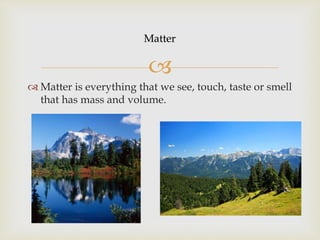
 Matter is everything that we see, touch, taste or smell 
that has mass and volume.
Matter 
 
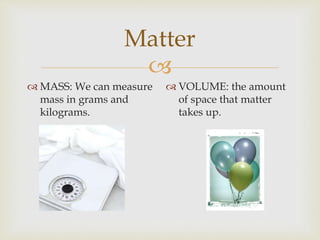
 MASS: We can measure 
mass in grams and 
kilograms. 
 VOLUME: the amount 
of space that matter 
takes up.
The three states of matter: solid, 
liquid and gass. 
 
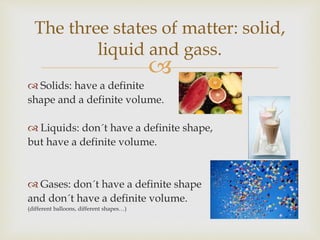
 Solids: have a definite 
shape and a definite volume. 
 Liquids: don´t have a definite shape, 
but have a definite volume. 
 Gases: don´t have a definite shape 
and don´t have a definite volume. 
(different balloons, different shapes…)
Matter 
 
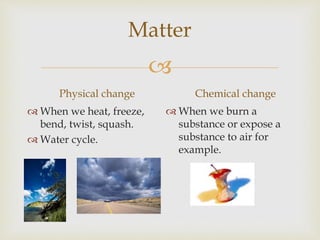
Physical change 
 When we heat, freeze, 
bend, twist, squash. 
 Water cycle. 
Chemical change 
 When we burn a 
substance or expose a 
substance to air for 
example.
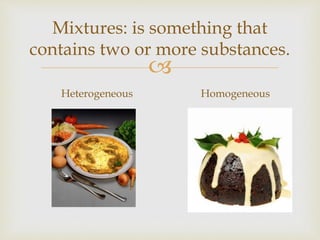
Mixtures: is something that 
contains two or more substances. 
 
Heterogeneous Homogeneous
Properties of materials. 
 
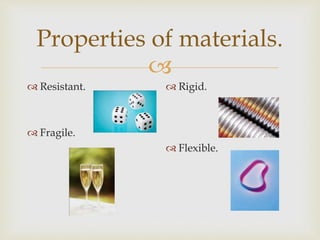
 Resistant. 
 Fragile. 
 Rigid. 
 Flexible.
Properties of materials. 
 
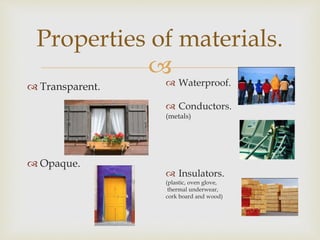
 Transparent. 
 Opaque. 
 Waterproof. 
 Conductors. 
(metals) 
 Insulators. 
(plastic, oven glove, 
thermal underwear, 
cork board and wood)
Natural and manufactured 
materials 
 
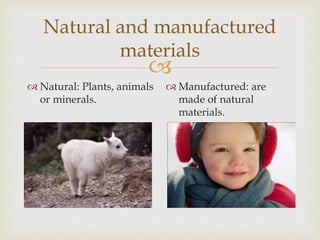
 Natural: Plants, animals 
or minerals. 
 Manufactured: are 
made of natural 
materials.
 
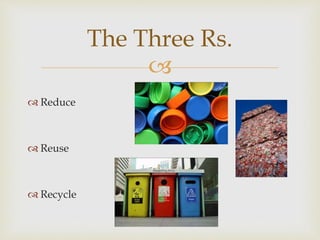
 Reduce 
 Reuse 
 Recycle 
The Three Rs.
THE END

Matter 4º

  • 1.
    In this unitwe are going to learn about matter and the properties of materials.
  • 2.
    Matter  Matter is everything that we see, touch, taste or smell that has mass and volume.
  • 3.
    Matter  MASS: We can measure mass in grams and kilograms.  VOLUME: the amount of space that matter takes up.
  • 4.
    The three statesof matter: solid, liquid and gass.   Solids: have a definite shape and a definite volume.  Liquids: don´t have a definite shape, but have a definite volume.  Gases: don´t have a definite shape and don´t have a definite volume. (different balloons, different shapes…)
  • 5.
    Matter  Physicalchange  When we heat, freeze, bend, twist, squash.  Water cycle. Chemical change  When we burn a substance or expose a substance to air for example.
  • 6.
    Mixtures: is somethingthat contains two or more substances.  Heterogeneous Homogeneous
  • 7.
    Properties of materials.   Resistant.  Fragile.  Rigid.  Flexible.
  • 8.
    Properties of materials.   Transparent.  Opaque.  Waterproof.  Conductors. (metals)  Insulators. (plastic, oven glove, thermal underwear, cork board and wood)
  • 9.
    Natural and manufactured materials   Natural: Plants, animals or minerals.  Manufactured: are made of natural materials.
  • 10.
      Reduce  Reuse  Recycle The Three Rs.
  • 11.