UNIT 9
MATTER AND MATERIALS
INDEX
1. VOCABULARY
2. WHAT IS MATTER?
3. MATTER STATES:
3.1 SOLID
3.2 LIQUID
3.3 GAS
4. MATERIALS
WHAT ARE MATERIALS?
KIND OF MATERIALS
MATERIALS PROPERTIES
5. RECYCLING
1. VOCABULARY
A
Atom
B
Bend
C
Cloth
Concrete
Container
D
Dig
Environment
L
Leather
M
Matter
Molecules
P
Pottery
Preserve
R
Rubber
S
Steel
U
Useless
V
Volume
W
Weakness
2. WHAT IS MATTER?
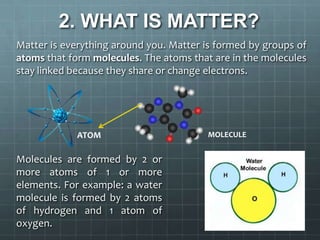
Matter is everything around you. Matter is formed by groups of
atoms that form molecules. The atoms that are in the molecules
stay linked because they share or change electrons.
Molecules are formed by 2 or
more atoms of 1 or more
elements. For example: a water
molecule is formed by 2 atoms
of hydrogen and 1 atom of
oxygen.
ATOM MOLECULE
3. MATTER STATES
3.1 SOLID
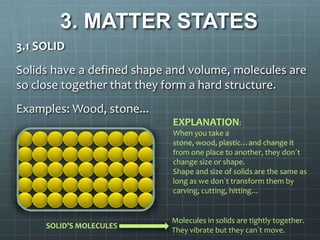
Solids have a defined shape and volume, molecules are
so close together that they form a hard structure.
Examples: Wood, stone...
EXPLANATION:
When you take a
stone, wood, plastic…and change it
from one place to another, they don´t
change size or shape.
Shape and size of solids are the same as
long as we don´t transform them by
carving, cutting, hitting…
SOLID’S MOLECULES
Molecules in solids are tightly together.
They vibrate but they can´t move.
3. MATTER STATES
3.2 LIQUID
Liquids fill up the shape of their containers. Liquids can
flow into any container and change their shape, while
they stay with the same volume.
Examples: Water, oil, milk, juice...
EXPLANATION:
When you pour water into a glass, the
water gets the shape of the glass. If you
change that water into a bowl, it gets
the shape of the bowl.
The amount of water doesn´t
change, only the shape.
LIQUID’S MOLECULES
Molecules in liquids are close together.
They move and slide past each other.
3. MATTER STATES
3.3 GAS
Gases don´t have a defined shape or volume. They take
the shape and the size of their container. Gases are as
big as their containers.
Examples: Hydrogen, oxygen...
EXPLANATION:
Gases are all around us. They move and
grow as long as they have space to do it.
GAS’ MOLECULES
Molecules in gases are separated and free.
They move around and vibrate at high speed.
3. MATTER STATES
MATTER STATE CHANGES
SOLID
GAS
LIQUID
SOLIDIFICATION
MELTING
3. MATTER STATES
http://www.youtube.com/watch?v=HAPc6JH85pM
http://www.youtube.com/watch?v=UnBoQe2rsgo
4. MATERIALS
4.1 WHAT ARE MATERIALS?
Objects are made of matter. Matter that is used to
make objects is called material.
Wood, plastic and glass are materials.
All these things are
made out of wood.
4. MATERIALS
4.2 KIND OF MATERIALS
Materials are classified into two main groups:
- Natural materials: Materials that are found around us.
To take them we have to dig them out the ground, or
take them from living things.
Examples: Wood, metal, stone...
- Artificial materials: Are natural materials transformed
by humans in many different ways.
Examples: Oil can be changed into plastic, glass is
made by heating sand...
4. MATERIALS
4.3 MATTER PROPERTIES
Each material has different properties. These properties tell us
what they are like, and how we can use them:
- Strength: the property of a material to support weight without
breaking. Concrete and steel are strong, so they are used in
construction.
- Flexibility: the property of bending without breaking down.
Leather, paper and cloth are flexible materials.
- Elasticity: the property of recovering the shape after being
deformed. Rubber is elastic, so it is used to do wheels.
- Weakness: the property of being easily broken down. Glass and
pottery are weak materials.
5. RECYCLING
Materials are used to do different kind of things.
Sometimes when things are useless we throw them
away, but it would be better to use them for something
different.
Recycle: process that changes something so it can be used
again.
Reuse: using something again without changing it.
Reduce: using less things as possible.
5. RECYCLING
Recycling is very important to preserve the environment.
Plastic and metallic materials are very contaminant because
nature takes a long time to degrade them. To recycle all
these materials there are different containers for each kind
of waste:
- Green for glass.
- Blue for paper.
- Black/grey for organic wastes.
- Yellow for plastics and cans.
GLASS
ORGANIC
WASTES
PLASTIC
AND
CANS
PAPER

MATTER AND MATERIALS

  • 1.
  • 2.
    INDEX 1. VOCABULARY 2. WHATIS MATTER? 3. MATTER STATES: 3.1 SOLID 3.2 LIQUID 3.3 GAS 4. MATERIALS WHAT ARE MATERIALS? KIND OF MATERIALS MATERIALS PROPERTIES 5. RECYCLING
  • 3.
  • 4.
    2. WHAT ISMATTER? Matter is everything around you. Matter is formed by groups of atoms that form molecules. The atoms that are in the molecules stay linked because they share or change electrons. Molecules are formed by 2 or more atoms of 1 or more elements. For example: a water molecule is formed by 2 atoms of hydrogen and 1 atom of oxygen. ATOM MOLECULE
  • 5.
    3. MATTER STATES 3.1SOLID Solids have a defined shape and volume, molecules are so close together that they form a hard structure. Examples: Wood, stone... EXPLANATION: When you take a stone, wood, plastic…and change it from one place to another, they don´t change size or shape. Shape and size of solids are the same as long as we don´t transform them by carving, cutting, hitting… SOLID’S MOLECULES Molecules in solids are tightly together. They vibrate but they can´t move.
  • 6.
    3. MATTER STATES 3.2LIQUID Liquids fill up the shape of their containers. Liquids can flow into any container and change their shape, while they stay with the same volume. Examples: Water, oil, milk, juice... EXPLANATION: When you pour water into a glass, the water gets the shape of the glass. If you change that water into a bowl, it gets the shape of the bowl. The amount of water doesn´t change, only the shape. LIQUID’S MOLECULES Molecules in liquids are close together. They move and slide past each other.
  • 7.
    3. MATTER STATES 3.3GAS Gases don´t have a defined shape or volume. They take the shape and the size of their container. Gases are as big as their containers. Examples: Hydrogen, oxygen... EXPLANATION: Gases are all around us. They move and grow as long as they have space to do it. GAS’ MOLECULES Molecules in gases are separated and free. They move around and vibrate at high speed.
  • 8.
    3. MATTER STATES MATTERSTATE CHANGES SOLID GAS LIQUID SOLIDIFICATION MELTING
  • 9.
  • 10.
    4. MATERIALS 4.1 WHATARE MATERIALS? Objects are made of matter. Matter that is used to make objects is called material. Wood, plastic and glass are materials. All these things are made out of wood.
  • 11.
    4. MATERIALS 4.2 KINDOF MATERIALS Materials are classified into two main groups: - Natural materials: Materials that are found around us. To take them we have to dig them out the ground, or take them from living things. Examples: Wood, metal, stone... - Artificial materials: Are natural materials transformed by humans in many different ways. Examples: Oil can be changed into plastic, glass is made by heating sand...
  • 12.
    4. MATERIALS 4.3 MATTERPROPERTIES Each material has different properties. These properties tell us what they are like, and how we can use them: - Strength: the property of a material to support weight without breaking. Concrete and steel are strong, so they are used in construction. - Flexibility: the property of bending without breaking down. Leather, paper and cloth are flexible materials. - Elasticity: the property of recovering the shape after being deformed. Rubber is elastic, so it is used to do wheels. - Weakness: the property of being easily broken down. Glass and pottery are weak materials.
  • 13.
    5. RECYCLING Materials areused to do different kind of things. Sometimes when things are useless we throw them away, but it would be better to use them for something different. Recycle: process that changes something so it can be used again. Reuse: using something again without changing it. Reduce: using less things as possible.
  • 14.
    5. RECYCLING Recycling isvery important to preserve the environment. Plastic and metallic materials are very contaminant because nature takes a long time to degrade them. To recycle all these materials there are different containers for each kind of waste: - Green for glass. - Blue for paper. - Black/grey for organic wastes. - Yellow for plastics and cans. GLASS ORGANIC WASTES PLASTIC AND CANS PAPER