PRACTICAL
Name- Saloni Singhal
M.Sc. (Statistics) II-Sem.
Roll No: 2046398
Course- MATH-409 L
Numerical Analysis Lab
Submitted To: Dr. S.C. Pandey
1
OBJECTIVE
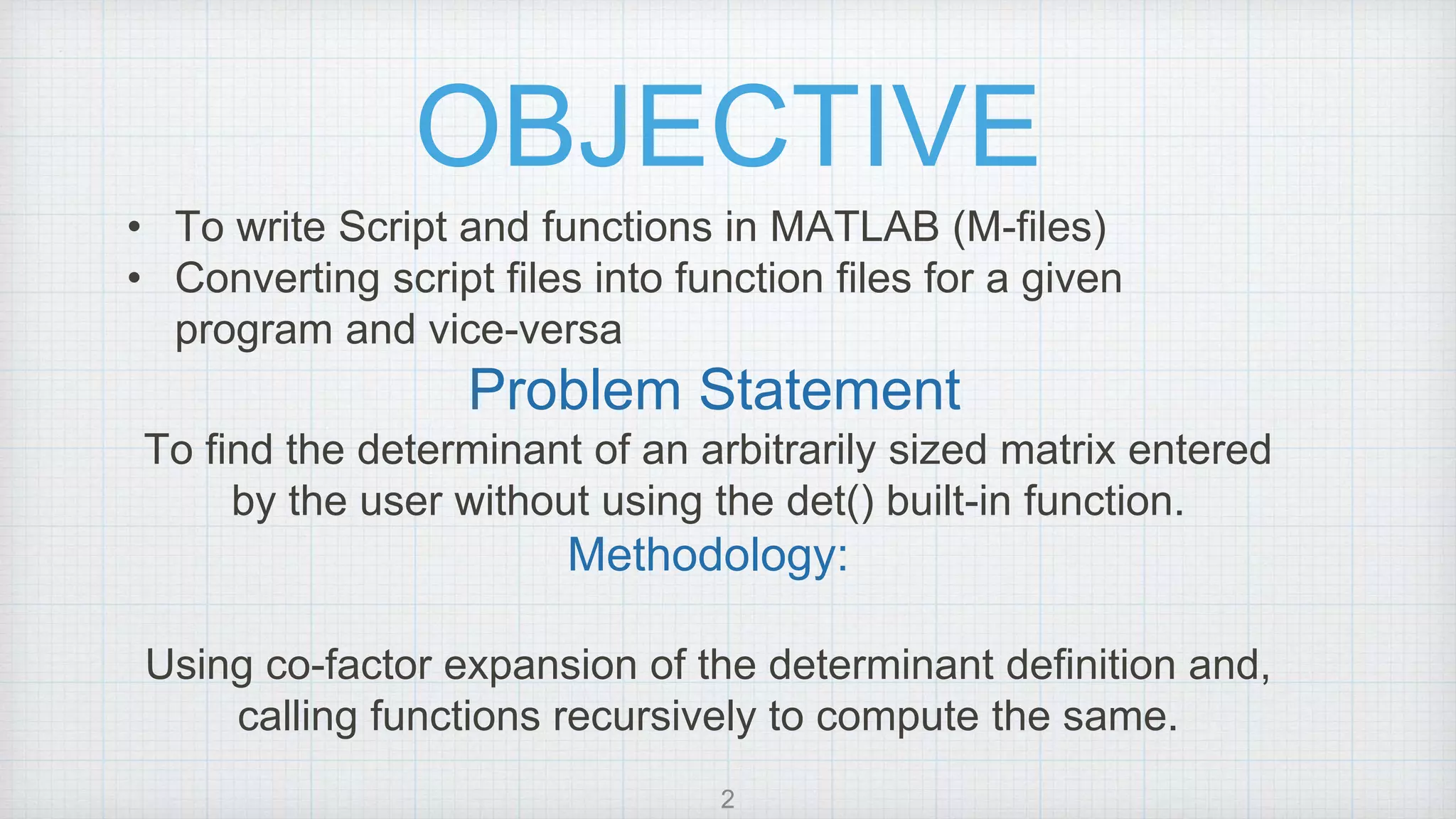
• To write Script and functions in MATLAB (M-files)
• Converting script files into function files for a given
program and vice-versa
Problem Statement
To find the determinant of an arbitrarily sized matrix entered
by the user without using the det() built-in function.
Methodology:
Using co-factor expansion of the determinant definition and,
calling functions recursively to compute the same.
2
Theory
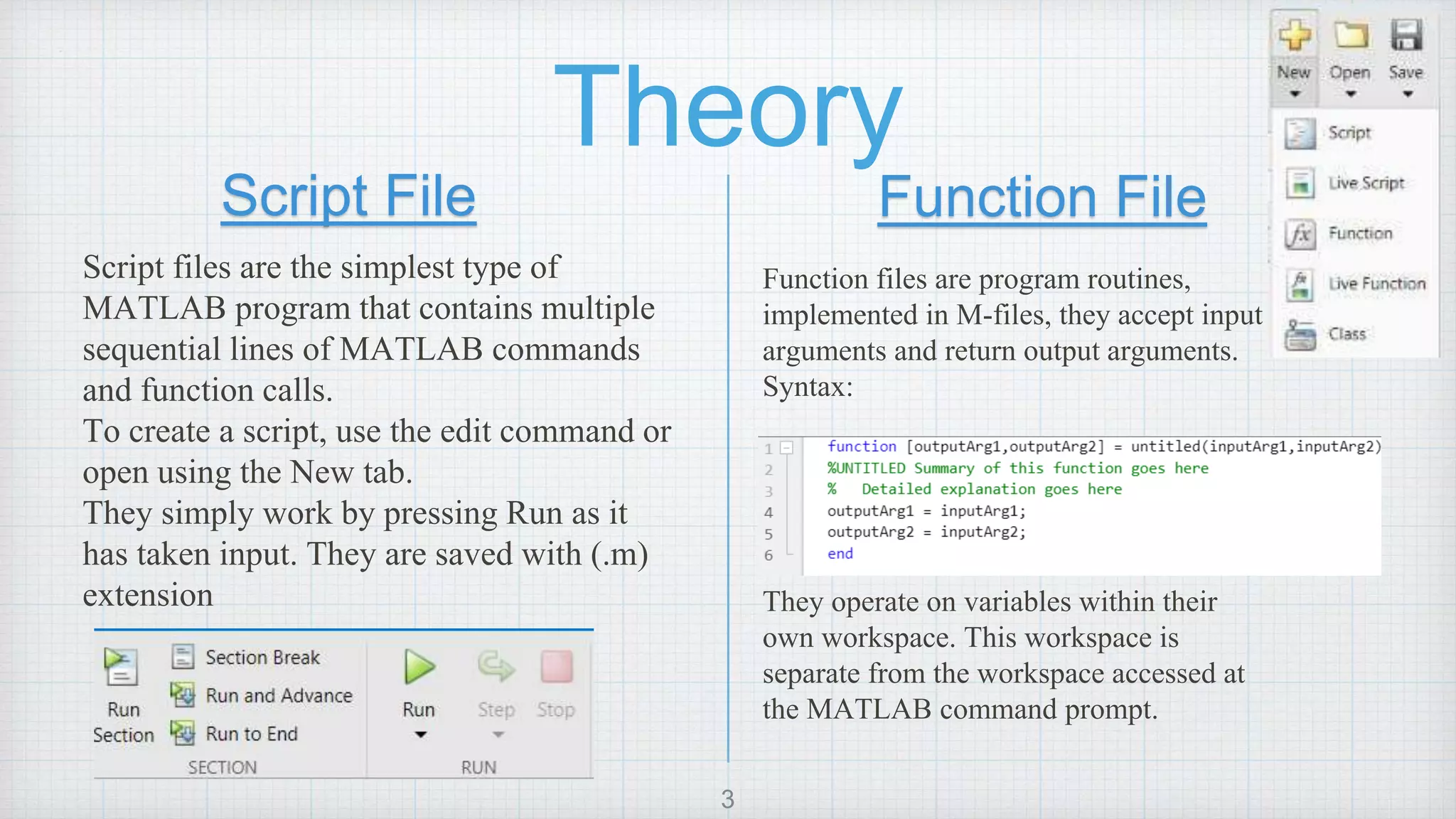
Script files are the simplest type of
MATLAB program that contains multiple
sequential lines of MATLAB commands
and function calls.
To create a script, use the edit command or
open using the New tab.
They simply work by pressing Run as it
has taken input. They are saved with (.m)
extension
Function files are program routines,
implemented in M-files, they accept input
arguments and return output arguments.
Syntax:
They operate on variables within their
own workspace. This workspace is
separate from the workspace accessed at
the MATLAB command prompt.
Script File Function File
3
Determinants
4
• The determinant (in linear algebra) is a value associated with a
square matrix, that is a matrix with as many rows as columns.
• Determinant of a matrix A is given by det(A). determinant is a real
number, it is not a matrix.
• determinant only exists for square matrices
Cofactor expansion: determinant is obtained by
multiplying the entries in any row/column of A
by the corresponding cofactors and adding the
resulting products
det(A) = a1jC1j + a2jC2j + ... + anjCnj
det(A) = ai1Ci1 + ai2Ci2 + ... + ainCin1
To map between two distinct vector
spaces, we define a volume on each
of them. Then the “determinant” of a
linear map between them would be
the (inverse) ratio between the
volume of a parallelepiped in the
domain and the volume of its image.
Any nonzero multiple of a volume
form is again a volume form. So the
ambiguity resulting from these
arbitrary scale factors renders that
“determinant” useless.
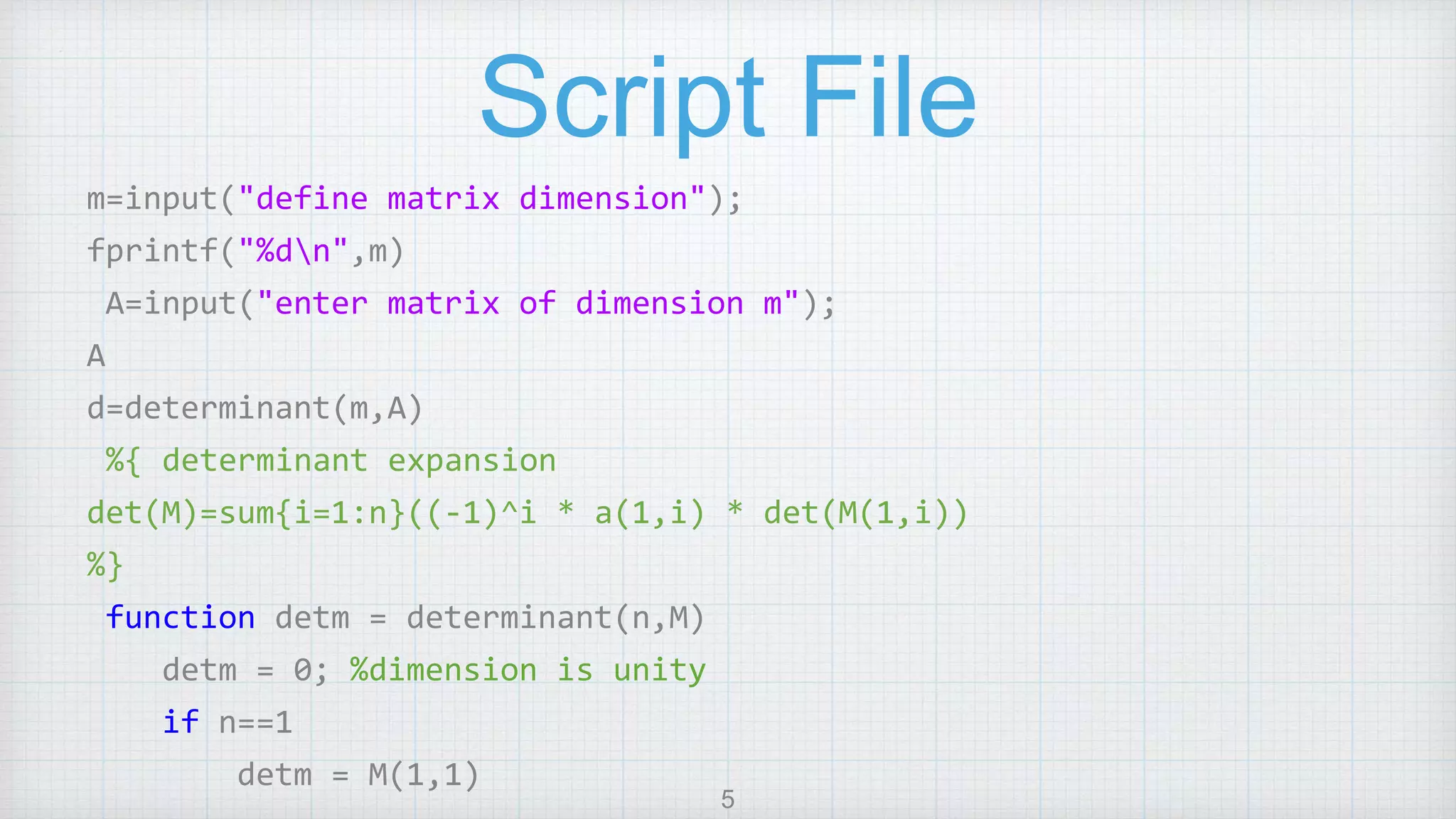
Script File
m=input("define matrix dimension");
fprintf("%dn",m)
A=input("enter matrix of dimension m");
A
d=determinant(m,A)
%{ determinant expansion
det(M)=sum{i=1:n}((-1)^i * a(1,i) * det(M(1,i))
%}
function detm = determinant(n,M)
detm = 0; %dimension is unity
if n==1
detm = M(1,1)
5
Program Contd.
else
for i=1:n
M1 = M
M1(1,:)=[]
M1(:,i)=[]
detm = detm + ((-1)^i)*M(1,i)*determinant(n-1,M1)
end
end
end
Outputs
Verification
6
Function File
function detm = detfunc(n,M)
detm = 0;
if n==1
detm = M(1,1);
else
for i=1:n
M1 = M;
M1(1,:)=[];
M1(:,i)=[];
detm = detm + ((-1)^i)*M(1,i)*detfunc(n-1,M1);
end
end
end 7
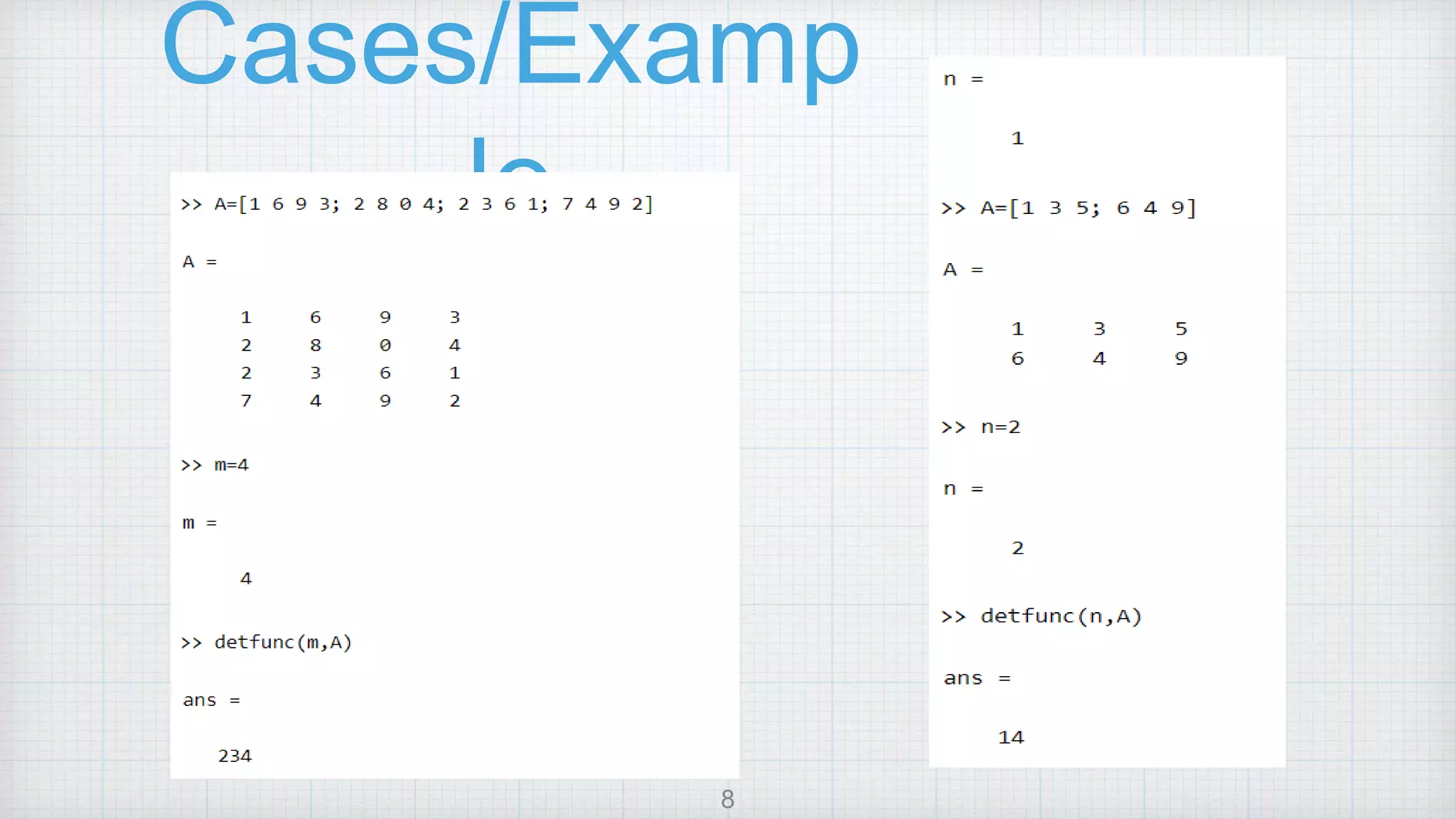
Cases/Examp
le
8
Time Complexity
9
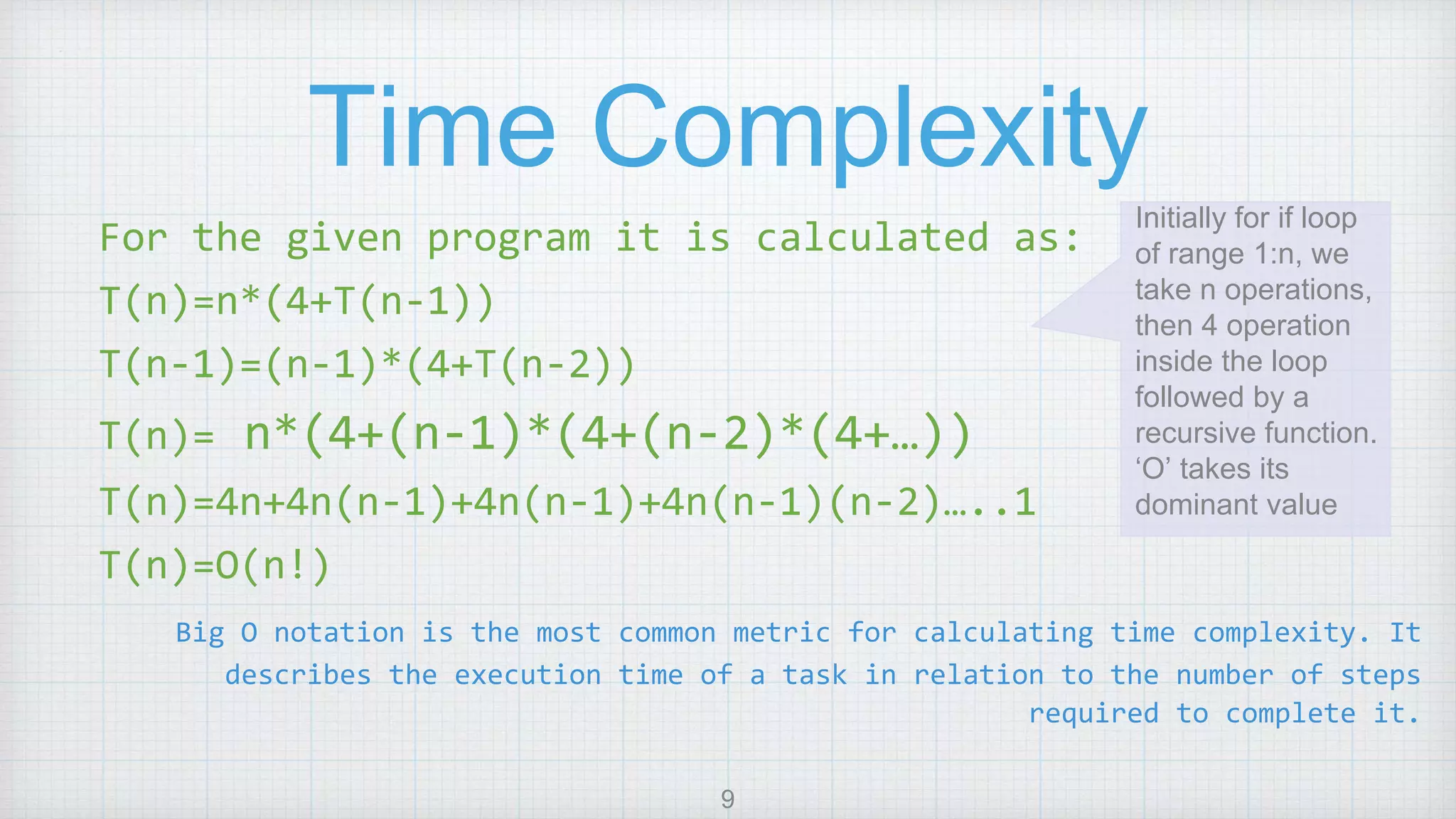
For the given program it is calculated as:
T(n)=n*(4+T(n-1))
T(n-1)=(n-1)*(4+T(n-2))
T(n)= n*(4+(n-1)*(4+(n-2)*(4+…))
T(n)=4n+4n(n-1)+4n(n-1)+4n(n-1)(n-2)…..1
T(n)=O(n!)
Big O notation is the most common metric for calculating time complexity. It
describes the execution time of a task in relation to the number of steps
required to complete it.
Initially for if loop
of range 1:n, we
take n operations,
then 4 operation
inside the loop
followed by a
recursive function.
‘O’ takes its
dominant value
Caveats
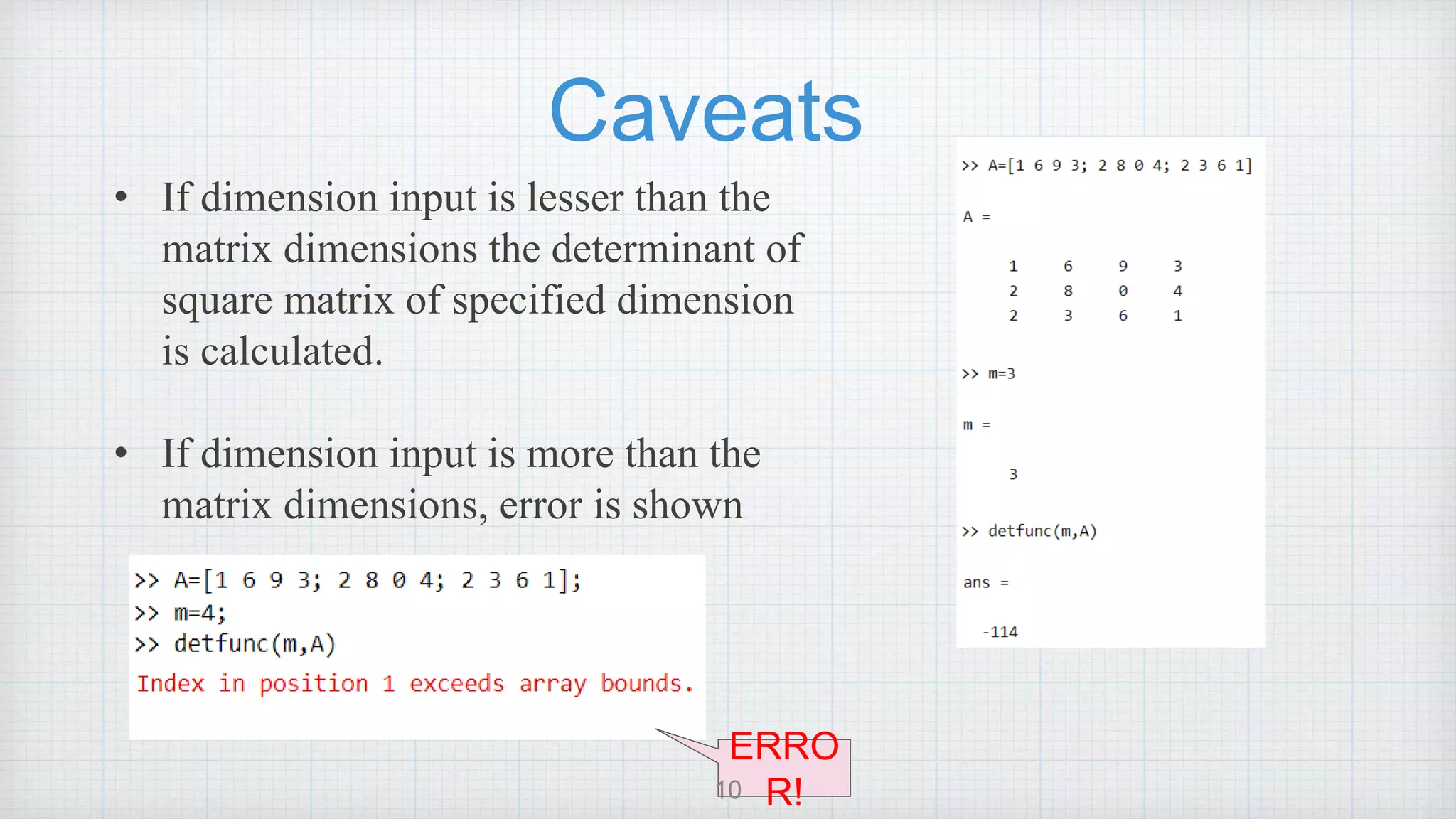
• If dimension input is lesser than the
matrix dimensions the determinant of
square matrix of specified dimension
is calculated.
• If dimension input is more than the
matrix dimensions, error is shown
ERRO
R!
10
Conclusion
• MATLAB allows writing two kinds of program files. We can use the
MATLAB editor or any other text editor to create m-files.
• Function can be used within same script (locally)
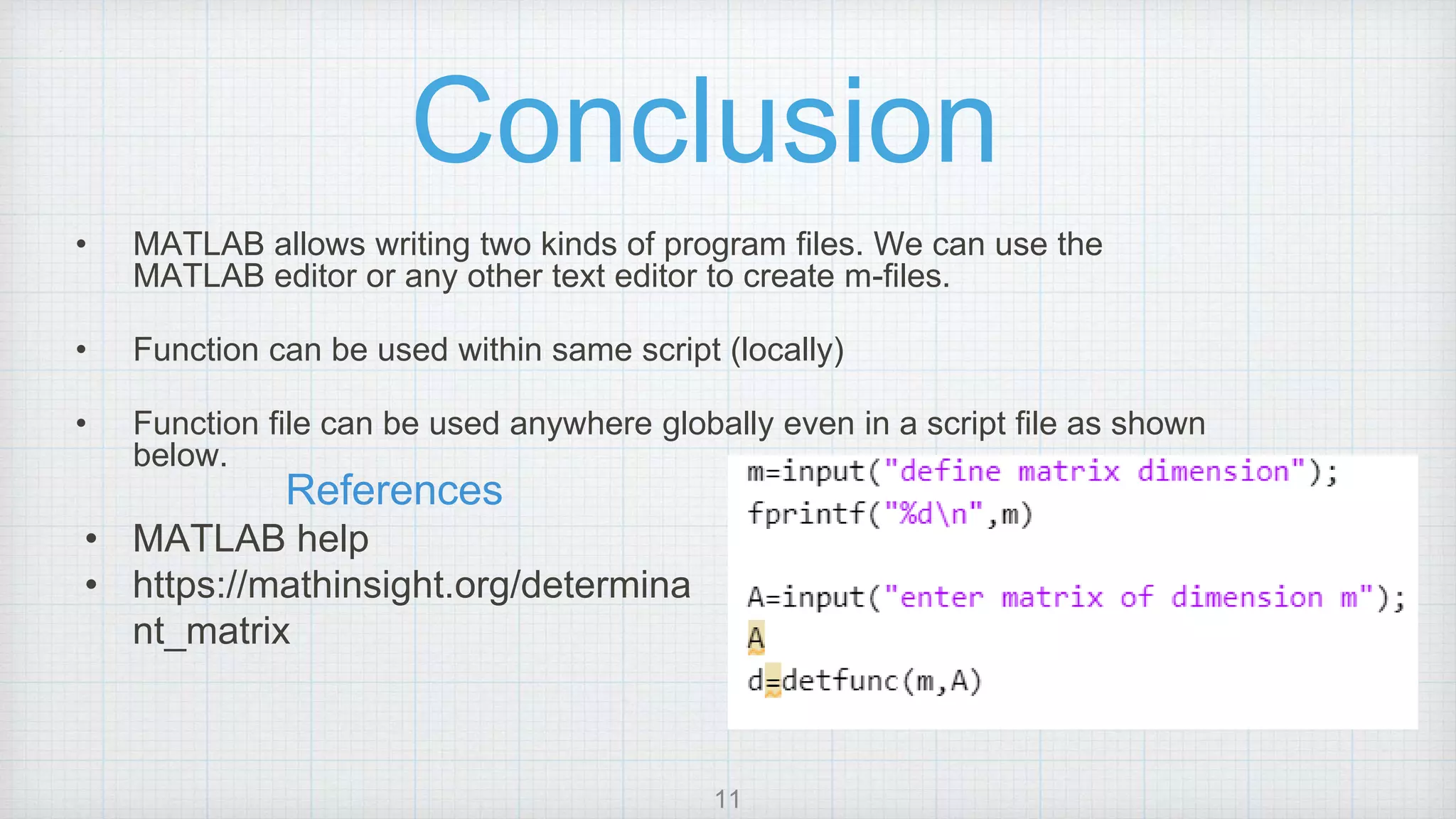
• Function file can be used anywhere globally even in a script file as shown
below.
11
References
• MATLAB help
• https://mathinsight.org/determina
nt_matrix

Matlab Files

  • 1.
    PRACTICAL Name- Saloni Singhal M.Sc.(Statistics) II-Sem. Roll No: 2046398 Course- MATH-409 L Numerical Analysis Lab Submitted To: Dr. S.C. Pandey 1
  • 2.
    OBJECTIVE • To writeScript and functions in MATLAB (M-files) • Converting script files into function files for a given program and vice-versa Problem Statement To find the determinant of an arbitrarily sized matrix entered by the user without using the det() built-in function. Methodology: Using co-factor expansion of the determinant definition and, calling functions recursively to compute the same. 2
  • 3.
    Theory Script files arethe simplest type of MATLAB program that contains multiple sequential lines of MATLAB commands and function calls. To create a script, use the edit command or open using the New tab. They simply work by pressing Run as it has taken input. They are saved with (.m) extension Function files are program routines, implemented in M-files, they accept input arguments and return output arguments. Syntax: They operate on variables within their own workspace. This workspace is separate from the workspace accessed at the MATLAB command prompt. Script File Function File 3
  • 4.
    Determinants 4 • The determinant(in linear algebra) is a value associated with a square matrix, that is a matrix with as many rows as columns. • Determinant of a matrix A is given by det(A). determinant is a real number, it is not a matrix. • determinant only exists for square matrices Cofactor expansion: determinant is obtained by multiplying the entries in any row/column of A by the corresponding cofactors and adding the resulting products det(A) = a1jC1j + a2jC2j + ... + anjCnj det(A) = ai1Ci1 + ai2Ci2 + ... + ainCin1 To map between two distinct vector spaces, we define a volume on each of them. Then the “determinant” of a linear map between them would be the (inverse) ratio between the volume of a parallelepiped in the domain and the volume of its image. Any nonzero multiple of a volume form is again a volume form. So the ambiguity resulting from these arbitrary scale factors renders that “determinant” useless.
  • 5.
    Script File m=input("define matrixdimension"); fprintf("%dn",m) A=input("enter matrix of dimension m"); A d=determinant(m,A) %{ determinant expansion det(M)=sum{i=1:n}((-1)^i * a(1,i) * det(M(1,i)) %} function detm = determinant(n,M) detm = 0; %dimension is unity if n==1 detm = M(1,1) 5
  • 6.
    Program Contd. else for i=1:n M1= M M1(1,:)=[] M1(:,i)=[] detm = detm + ((-1)^i)*M(1,i)*determinant(n-1,M1) end end end Outputs Verification 6
  • 7.
    Function File function detm= detfunc(n,M) detm = 0; if n==1 detm = M(1,1); else for i=1:n M1 = M; M1(1,:)=[]; M1(:,i)=[]; detm = detm + ((-1)^i)*M(1,i)*detfunc(n-1,M1); end end end 7
  • 8.
  • 9.
    Time Complexity 9 For thegiven program it is calculated as: T(n)=n*(4+T(n-1)) T(n-1)=(n-1)*(4+T(n-2)) T(n)= n*(4+(n-1)*(4+(n-2)*(4+…)) T(n)=4n+4n(n-1)+4n(n-1)+4n(n-1)(n-2)…..1 T(n)=O(n!) Big O notation is the most common metric for calculating time complexity. It describes the execution time of a task in relation to the number of steps required to complete it. Initially for if loop of range 1:n, we take n operations, then 4 operation inside the loop followed by a recursive function. ‘O’ takes its dominant value
  • 10.
    Caveats • If dimensioninput is lesser than the matrix dimensions the determinant of square matrix of specified dimension is calculated. • If dimension input is more than the matrix dimensions, error is shown ERRO R! 10
  • 11.
    Conclusion • MATLAB allowswriting two kinds of program files. We can use the MATLAB editor or any other text editor to create m-files. • Function can be used within same script (locally) • Function file can be used anywhere globally even in a script file as shown below. 11 References • MATLAB help • https://mathinsight.org/determina nt_matrix