ENZO EXPOSYTO
MATHS
SYMBOLS
2 - OPERATIONS

Enzo Exposyto 1
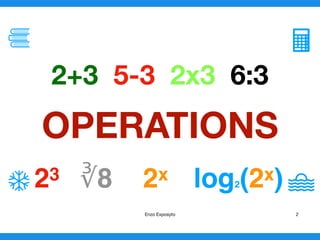
2+3 5-3 2x3 6:3
OPERATIONS
23 ∛8 2x log2(2x)

Enzo Exposyto 2


Enzo Exposyto 3
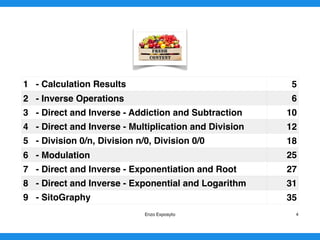
1 - Calculation Results 5
2 - Inverse Operations 6
3 - Direct and Inverse - Addiction and Subtraction 10
4 - Direct and Inverse - Multiplication and Division 12
5 - Division 0/n, Division n/0, Division 0/0 18
6 - Modulo (mod) 25
7 - Direct and Inverse - Exponentiation and Root 27
8 - Direct and Inverse - Exponential and Logarithm 31
9 - SitoGraphy 35
Enzo Exposyto 4
Enzo Exposyto 5
INVERSE
OPERATIONS


Enzo Exposyto 6
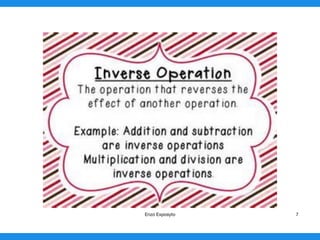
Enzo Exposyto 7
EXPONENTIATION
and
ROOT
ARE
INVERSE
OPERATIONS
Enzo Exposyto 8
EXPONENTIAL
and
LOGARITHM
ARE
INVERSE
OPERATIONS

Enzo Exposyto 9
DIRECT
and
INVERSE
CALCULATIONS
Addition
and
Subtraction

Enzo Exposyto 10
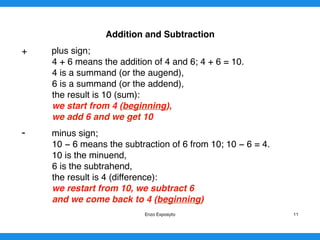
Addition and Subtraction
+ plus sign;
4 + 6 means the addition of 4 and 6; 4 + 6 = 10.
4 is a summand (or the augend),
6 is a summand (or the addend),
the result is 10 (sum):
we start from 4 (beginning),
we add 6 and we get 10
- minus sign;
10 − 6 means the subtraction of 6 from 10; 10 − 6 = 4.
10 is the minuend,
6 is the subtrahend,
the result is 4 (difference):
we restart from 10, we subtract 6
and we come back to 4 (beginning)

Enzo Exposyto 11
DIRECT
and
INVERSE
CALCULATIONS
Multiplication
and
Division

Enzo Exposyto 12
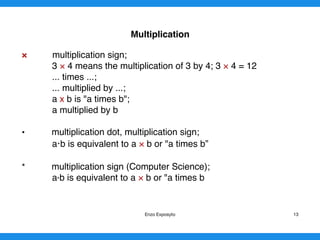
Multiplication
× multiplication sign;
3 × 4 means the multiplication of 3 by 4; 3 × 4 = 12
... times ...;
... multiplied by ...;
a x b is "a times b";
a multiplied by b
• multiplication dot, multiplication sign;
a b is equivalent to a × b or "a times b”
* multiplication sign (Computer Science);
a*b is equivalent to a × b or "a times b
Enzo Exposyto 13
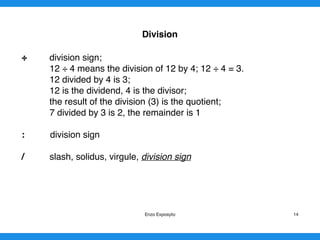
Division
÷ division sign;
12 ÷ 4 means the division of 12 by 4; 12 ÷ 4 = 3.
12 divided by 4 is 3;
12 is the dividend, 4 is the divisor;
the result of the division (3) is the quotient;
7 divided by 3 is 2, the remainder is 1
: division sign
/ slash, solidus, virgule, division sign

Enzo Exposyto 14
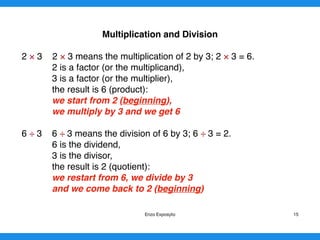
Multiplication and Division
2 × 3 2 × 3 means the multiplication of 2 by 3; 2 × 3 = 6.
2 is a factor (or the multiplicand),
3 is a factor (or the multiplier),
the result is 6 (product):
we start from 2 (beginning),
we multiply by 3 and we get 6
6 ÷ 3 6 ÷ 3 means the division of 6 by 3; 6 ÷ 3 = 2.
6 is the dividend,
3 is the divisor,
the result is 2 (quotient):
we restart from 6, we divide by 3
and we come back to 2 (beginning)
Enzo Exposyto 15
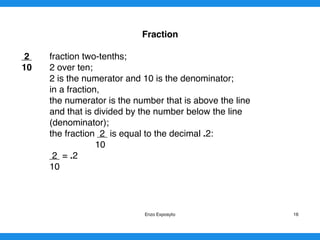
Fraction
2 fraction two-tenths;
10 2 over ten;
2 is the numerator and 10 is the denominator;
in a fraction,
the numerator is the number that is above the line
and that is divided by the number below the line
(denominator);
the fraction 2 is equal to the decimal .2:
10
2 = .2
10

Enzo Exposyto 16
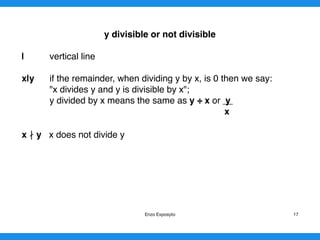
y divisible or not divisible
| vertical line
x|y if the remainder, when dividing y by x, is 0 then we say:
"x divides y and y is divisible by x";
y divided by x means the same as y ÷ x or y
x
x ∤ y x does not divide y
Enzo Exposyto 17
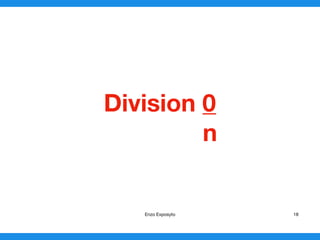
Division 0
n
Enzo Exposyto 18
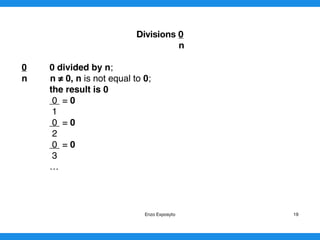
Divisions 0
n
0 0 divided by n;
n n ≠ 0, n is not equal to 0;
the result is 0
0 = 0
1
0 = 0
2
0 = 0
3
…

Enzo Exposyto 19
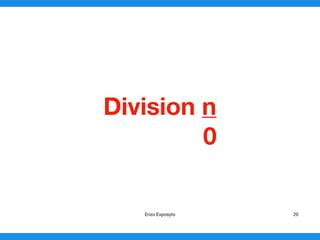
Division n
0
Enzo Exposyto 20
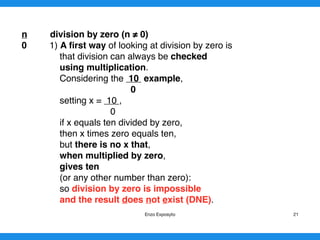
n division by zero (n ≠ 0)
0 1) A first way of looking at division by zero is
that division can always be checked
using multiplication.
Considering the 10 example,
0
setting x = 10 ,
0
if x equals ten divided by zero,
then x times zero equals ten,
but there is no x that,
when multiplied by zero,
gives ten
(or any other number than zero):
so division by zero is impossible
and the result does not exist (DNE).
Enzo Exposyto 21
n division by zero (n ≠ 0)
0 2) Another way of looking at division by zero:
considering again 10
0
(for example, 10 cookies over 0),
it is obvious that there is
no way to evenly distribute 10 cookies to nobody;
so 10,
0
at least in elementary Arithmetic,
is said to be
either meaningless
or impossible.
Enzo Exposyto 22
Division 0
0
Enzo Exposyto 23
Divisions 0
0
0 If, instead of x = 10,
0 0
we have x = 0,
0
then every x satisfies the question
"what number x, multiplied by zero, gives zero?"
Since any number multiplied by zero is zero,
the expression 0 has no defined value
0
and is called an indeterminate form.
Enzo Exposyto 24
Modulo
(mod)

Enzo Exposyto 25
Modulo (mod)
mod modulo;
7 divided by 3 is 2, the remainder is 1

and we write:

7 mod 3 = 1

7 is the dividend,

3 is the divisor,

1 is the remainder

dividend mod divisor = remainder

Enzo Exposyto 26
DIRECT
and
INVERSE
CALCULATIONS
Exponentiation
and
Root

Enzo Exposyto 27
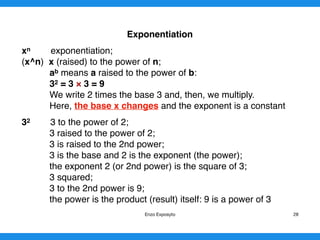
Exponentiation
xn exponentiation;
(x^n) x (raised) to the power of n;
ab means a raised to the power of b:
32 = 3 × 3 = 9
We write 2 times the base 3 and, then, we multiply.
Here, the base x changes and the exponent is a constant
32 3 to the power of 2;
3 raised to the power of 2;
3 is raised to the 2nd power;
3 is the base and 2 is the exponent (the power);
the exponent 2 (or 2nd power) is the square of 3;
3 squared;
3 to the 2nd power is 9;
the power is the product (result) itself: 9 is a power of 3

Enzo Exposyto 28
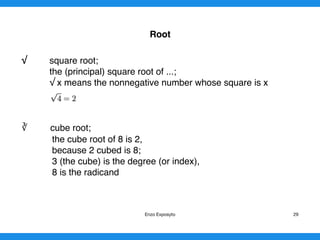
Root
√ square root;
the (principal) square root of ...;
√ x means the nonnegative number whose square is x
∛ cube root;
the cube root of 8 is 2,
because 2 cubed is 8;
3 (the cube) is the degree (or index),
8 is the radicand

Enzo Exposyto 29
Exponentiation and Root
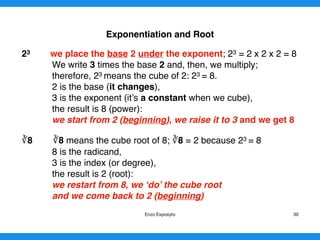
23 we place the base 2 under the exponent; 23 = 2 x 2 x 2 = 8
We write 3 times the base 2 and, then, we multiply;
therefore, 23 means the cube of 2: 23 = 8.
2 is the base (it changes),
3 is the exponent (it’s a constant when we cube),
the result is 8 (power):
we start from 2 (beginning), we raise it to 3 and we get 8
∛8 ∛8 means the cube root of 8; ∛8 = 2 because 23 = 8
8 is the radicand,
3 is the index (or degree),
the result is 2 (root):
we restart from 8, we ‘do’ the cube root
and we come back to 2 (beginning)
Enzo Exposyto 30
DIRECT
and
INVERSE
CALCULATIONS
Exponential
and
Logarithm (log)

Enzo Exposyto 31
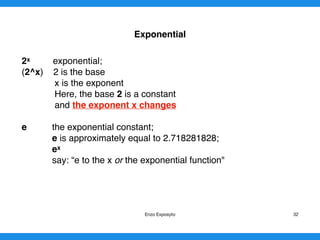
Exponential
2x exponential;
(2^x) 2 is the base
x is the exponent
Here, the base 2 is a constant
and the exponent x changes
e the exponential constant;
e is approximately equal to 2.718281828;
ex
say: “e to the x or the exponential function"

Enzo Exposyto 32
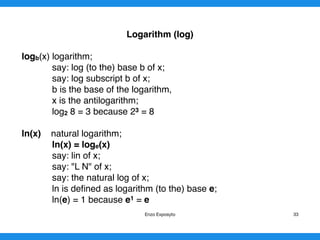
Logarithm (log)
logb(x) logarithm;
say: log (to the) base b of x;
say: log subscript b of x;
b is the base of the logarithm,
x is the antilogarithm;
log2 8 = 3 because 23 = 8
ln(x) natural logarithm;
ln(x) = loge(x)
say: lin of x;
say: "L N" of x;
say: the natural log of x;
ln is defined as logarithm (to the) base e;
ln(e) = 1 because e1 = e

Enzo Exposyto 33
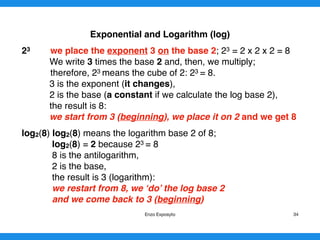
Exponential and Logarithm (log)
23 we place the exponent 3 on the base 2; 23 = 2 x 2 x 2 = 8
We write 3 times the base 2 and, then, we multiply;
therefore, 23 means the cube of 2: 23 = 8.
3 is the exponent (it changes),
2 is the base (a constant if we calculate the log base 2),
the result is 8:
we start from 3 (beginning), we place it on 2 and we get 8
log2(8) log2(8) means the logarithm base 2 of 8;
log2(8) = 2 because 23 = 8
8 is the antilogarithm,
2 is the base,
the result is 3 (logarithm):
we restart from 8, we ‘do’ the log base 2
and we come back to 3 (beginning)
Enzo Exposyto 34
SitoGraphy

Enzo Exposyto 35
http://en.m.wikipedia.org/wiki/Subtraction
http://www.gh-mathspeak.com/examples/grammar-rules/?rule=scripts
http://www.rapidtables.com/math/number/exponent.htm
http://www.rapidtables.com/math/symbols/Algebra_Symbols.htm
Enzo Exposyto 36

MATHS SYMBOLS - INVERSE OPERATIONS

  • 1.
    ENZO EXPOSYTO MATHS SYMBOLS 2 -OPERATIONS
 Enzo Exposyto 1
  • 2.
    2+3 5-3 2x36:3 OPERATIONS 23 ∛8 2x log2(2x)
 Enzo Exposyto 2
  • 3.
  • 4.
    1 - CalculationResults 5 2 - Inverse Operations 6 3 - Direct and Inverse - Addiction and Subtraction 10 4 - Direct and Inverse - Multiplication and Division 12 5 - Division 0/n, Division n/0, Division 0/0 18 6 - Modulo (mod) 25 7 - Direct and Inverse - Exponentiation and Root 27 8 - Direct and Inverse - Exponential and Logarithm 31 9 - SitoGraphy 35 Enzo Exposyto 4
  • 5.
  • 6.
  • 7.
  • 8.
  • 9.
  • 10.
  • 11.
    Addition and Subtraction +plus sign; 4 + 6 means the addition of 4 and 6; 4 + 6 = 10. 4 is a summand (or the augend), 6 is a summand (or the addend), the result is 10 (sum): we start from 4 (beginning), we add 6 and we get 10 - minus sign; 10 − 6 means the subtraction of 6 from 10; 10 − 6 = 4. 10 is the minuend, 6 is the subtrahend, the result is 4 (difference): we restart from 10, we subtract 6 and we come back to 4 (beginning)
 Enzo Exposyto 11
  • 12.
  • 13.
    Multiplication × multiplication sign; 3× 4 means the multiplication of 3 by 4; 3 × 4 = 12 ... times ...; ... multiplied by ...; a x b is "a times b"; a multiplied by b • multiplication dot, multiplication sign; a b is equivalent to a × b or "a times b” * multiplication sign (Computer Science); a*b is equivalent to a × b or "a times b Enzo Exposyto 13
  • 14.
    Division ÷ division sign; 12÷ 4 means the division of 12 by 4; 12 ÷ 4 = 3. 12 divided by 4 is 3; 12 is the dividend, 4 is the divisor; the result of the division (3) is the quotient; 7 divided by 3 is 2, the remainder is 1 : division sign / slash, solidus, virgule, division sign
 Enzo Exposyto 14
  • 15.
    Multiplication and Division 2× 3 2 × 3 means the multiplication of 2 by 3; 2 × 3 = 6. 2 is a factor (or the multiplicand), 3 is a factor (or the multiplier), the result is 6 (product): we start from 2 (beginning), we multiply by 3 and we get 6 6 ÷ 3 6 ÷ 3 means the division of 6 by 3; 6 ÷ 3 = 2. 6 is the dividend, 3 is the divisor, the result is 2 (quotient): we restart from 6, we divide by 3 and we come back to 2 (beginning) Enzo Exposyto 15
  • 16.
    Fraction 2 fraction two-tenths; 102 over ten; 2 is the numerator and 10 is the denominator; in a fraction, the numerator is the number that is above the line and that is divided by the number below the line (denominator); the fraction 2 is equal to the decimal .2: 10 2 = .2 10
 Enzo Exposyto 16
  • 17.
    y divisible ornot divisible | vertical line x|y if the remainder, when dividing y by x, is 0 then we say: "x divides y and y is divisible by x"; y divided by x means the same as y ÷ x or y x x ∤ y x does not divide y Enzo Exposyto 17
  • 18.
  • 19.
    Divisions 0 n 0 0divided by n; n n ≠ 0, n is not equal to 0; the result is 0 0 = 0 1 0 = 0 2 0 = 0 3 …
 Enzo Exposyto 19
  • 20.
  • 21.
    n division byzero (n ≠ 0) 0 1) A first way of looking at division by zero is that division can always be checked using multiplication. Considering the 10 example, 0 setting x = 10 , 0 if x equals ten divided by zero, then x times zero equals ten, but there is no x that, when multiplied by zero, gives ten (or any other number than zero): so division by zero is impossible and the result does not exist (DNE). Enzo Exposyto 21
  • 22.
    n division byzero (n ≠ 0) 0 2) Another way of looking at division by zero: considering again 10 0 (for example, 10 cookies over 0), it is obvious that there is no way to evenly distribute 10 cookies to nobody; so 10, 0 at least in elementary Arithmetic, is said to be either meaningless or impossible. Enzo Exposyto 22
  • 23.
  • 24.
    Divisions 0 0 0 If,instead of x = 10, 0 0 we have x = 0, 0 then every x satisfies the question "what number x, multiplied by zero, gives zero?" Since any number multiplied by zero is zero, the expression 0 has no defined value 0 and is called an indeterminate form. Enzo Exposyto 24
  • 25.
  • 26.
    Modulo (mod) mod modulo; 7divided by 3 is 2, the remainder is 1 and we write: 7 mod 3 = 1 7 is the dividend, 3 is the divisor, 1 is the remainder dividend mod divisor = remainder Enzo Exposyto 26
  • 27.
  • 28.
    Exponentiation xn exponentiation; (x^n) x(raised) to the power of n; ab means a raised to the power of b: 32 = 3 × 3 = 9 We write 2 times the base 3 and, then, we multiply. Here, the base x changes and the exponent is a constant 32 3 to the power of 2; 3 raised to the power of 2; 3 is raised to the 2nd power; 3 is the base and 2 is the exponent (the power); the exponent 2 (or 2nd power) is the square of 3; 3 squared; 3 to the 2nd power is 9; the power is the product (result) itself: 9 is a power of 3
 Enzo Exposyto 28
  • 29.
    Root √ square root; the(principal) square root of ...; √ x means the nonnegative number whose square is x ∛ cube root; the cube root of 8 is 2, because 2 cubed is 8; 3 (the cube) is the degree (or index), 8 is the radicand
 Enzo Exposyto 29
  • 30.
    Exponentiation and Root 23we place the base 2 under the exponent; 23 = 2 x 2 x 2 = 8 We write 3 times the base 2 and, then, we multiply; therefore, 23 means the cube of 2: 23 = 8. 2 is the base (it changes), 3 is the exponent (it’s a constant when we cube), the result is 8 (power): we start from 2 (beginning), we raise it to 3 and we get 8 ∛8 ∛8 means the cube root of 8; ∛8 = 2 because 23 = 8 8 is the radicand, 3 is the index (or degree), the result is 2 (root): we restart from 8, we ‘do’ the cube root and we come back to 2 (beginning) Enzo Exposyto 30
  • 31.
  • 32.
    Exponential 2x exponential; (2^x) 2is the base x is the exponent Here, the base 2 is a constant and the exponent x changes e the exponential constant; e is approximately equal to 2.718281828; ex say: “e to the x or the exponential function"
 Enzo Exposyto 32
  • 33.
    Logarithm (log) logb(x) logarithm; say:log (to the) base b of x; say: log subscript b of x; b is the base of the logarithm, x is the antilogarithm; log2 8 = 3 because 23 = 8 ln(x) natural logarithm; ln(x) = loge(x) say: lin of x; say: "L N" of x; say: the natural log of x; ln is defined as logarithm (to the) base e; ln(e) = 1 because e1 = e
 Enzo Exposyto 33
  • 34.
    Exponential and Logarithm(log) 23 we place the exponent 3 on the base 2; 23 = 2 x 2 x 2 = 8 We write 3 times the base 2 and, then, we multiply; therefore, 23 means the cube of 2: 23 = 8. 3 is the exponent (it changes), 2 is the base (a constant if we calculate the log base 2), the result is 8: we start from 3 (beginning), we place it on 2 and we get 8 log2(8) log2(8) means the logarithm base 2 of 8; log2(8) = 2 because 23 = 8 8 is the antilogarithm, 2 is the base, the result is 3 (logarithm): we restart from 8, we ‘do’ the log base 2 and we come back to 3 (beginning) Enzo Exposyto 34
  • 35.
  • 36.