Q.U.A.D.R.I.L.A.T.E.R.A.L
T R A P E Z I U M
CHARACTERISTICS
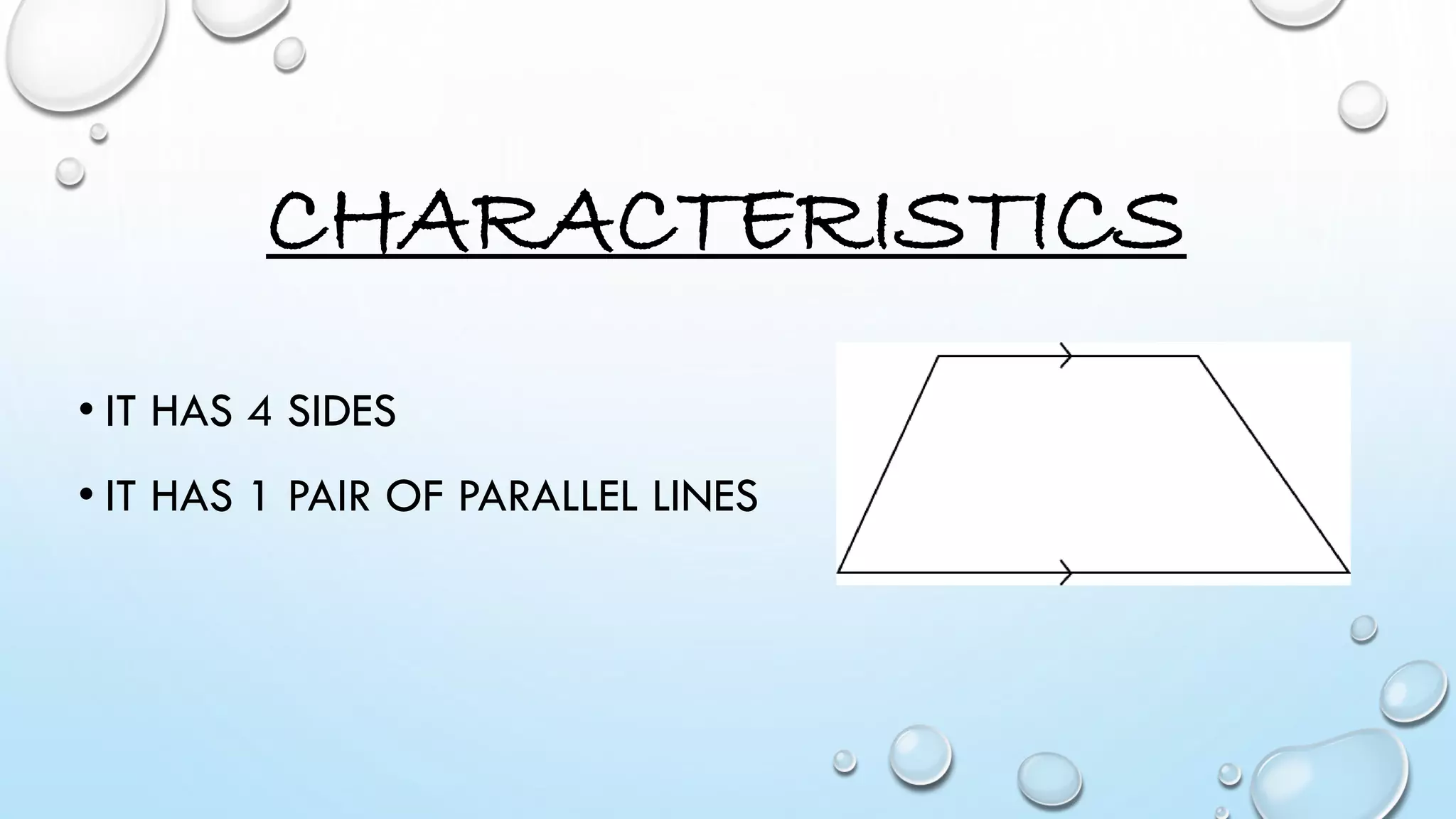
• IT HAS 4 SIDES
• IT HAS 1 PAIR OF PARALLEL LINES
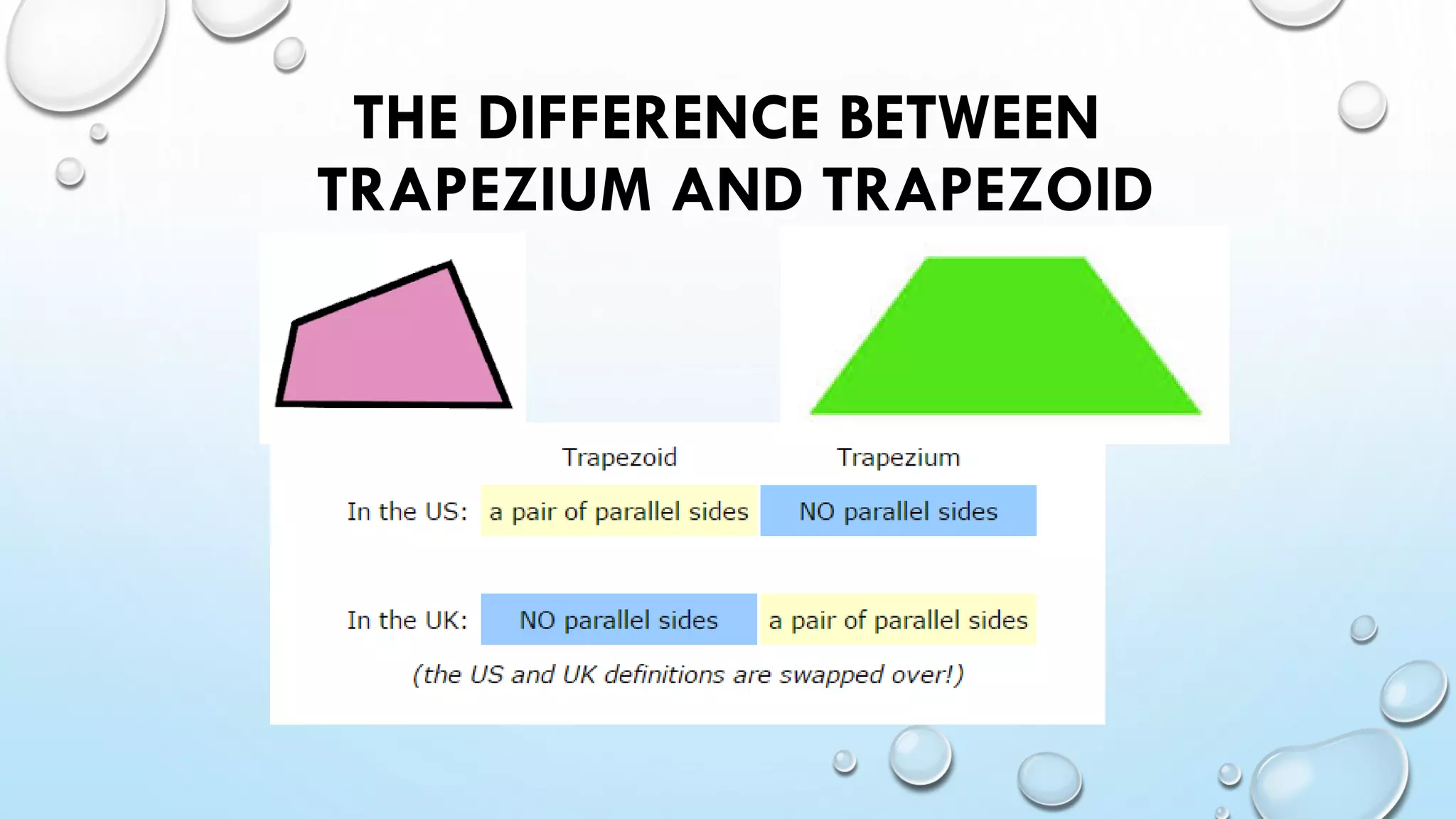
THE DIFFERENCE BETWEEN
TRAPEZIUM AND TRAPEZOID
THE PERIMETER OF A TRAPEZIUM
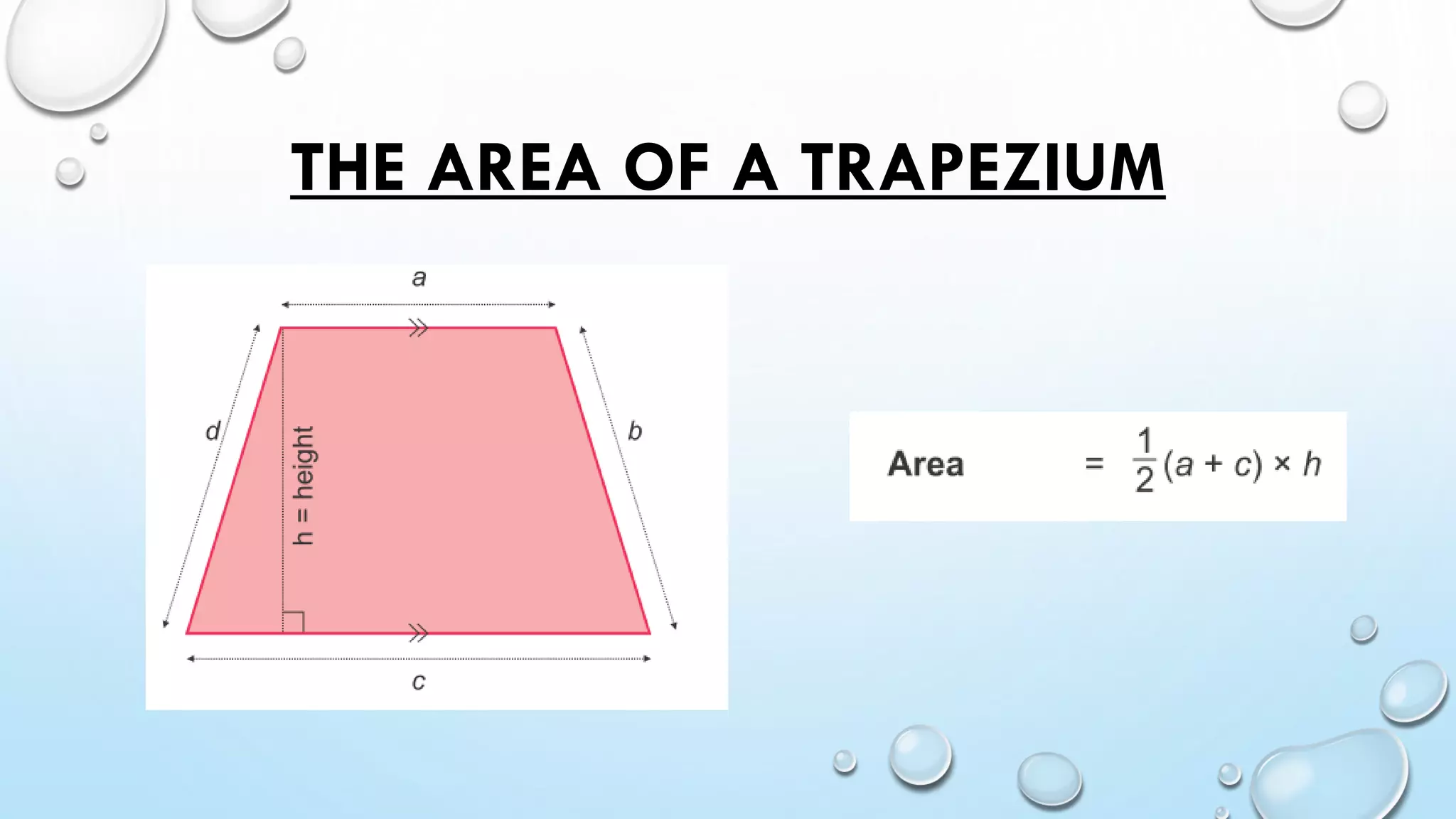
THE AREA OF A TRAPEZIUM
S Q U A R E
CHARACTERISTICS
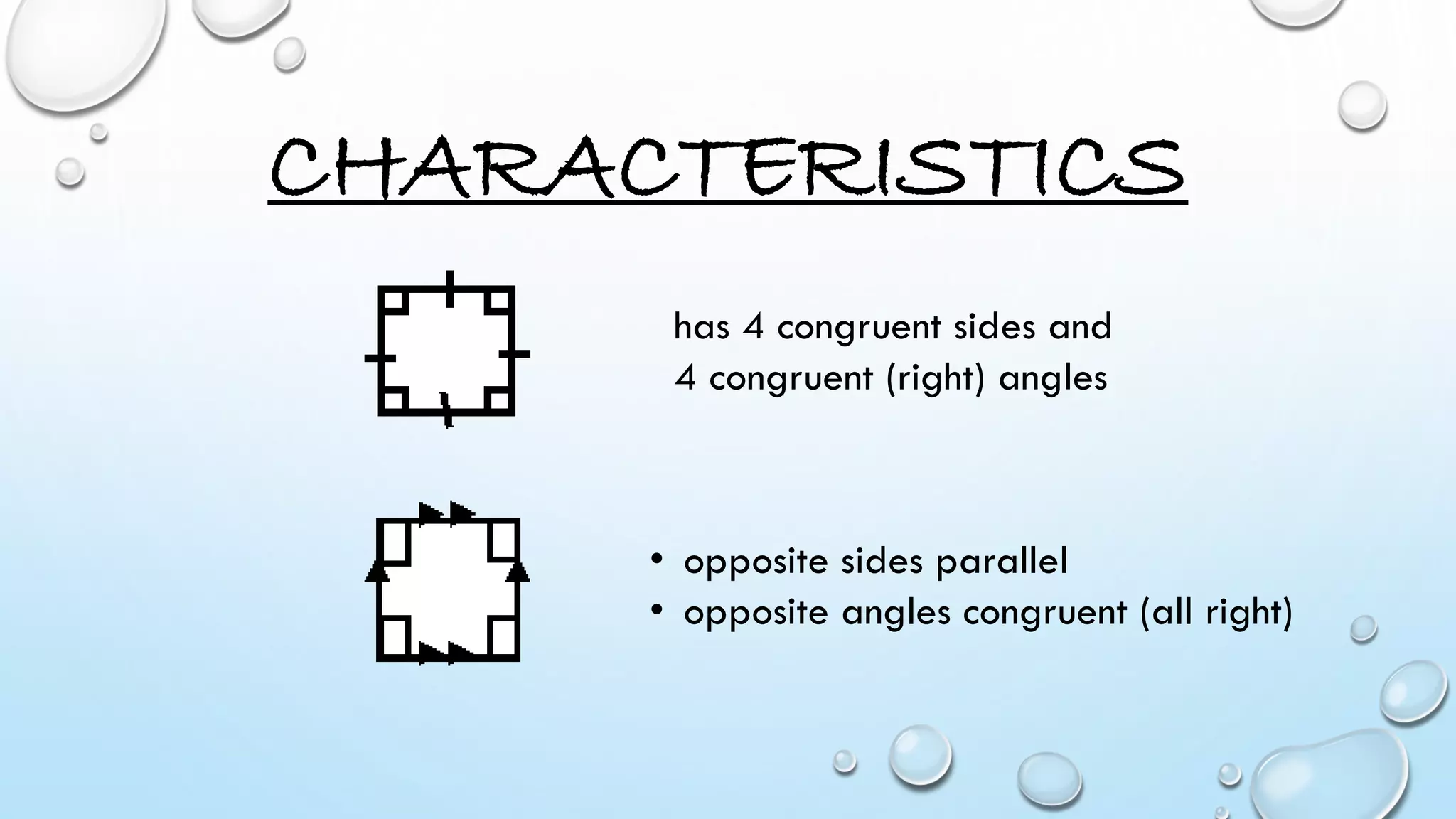
has 4 congruent sides and
4 congruent (right) angles
• opposite sides parallel
• opposite angles congruent (all right)
diagonals are congruent
AC=BD
diagonals bisect each other
• diagonals bisect opposite
angles
• all bisected angles equal 45º
• diagonals are perpendicular
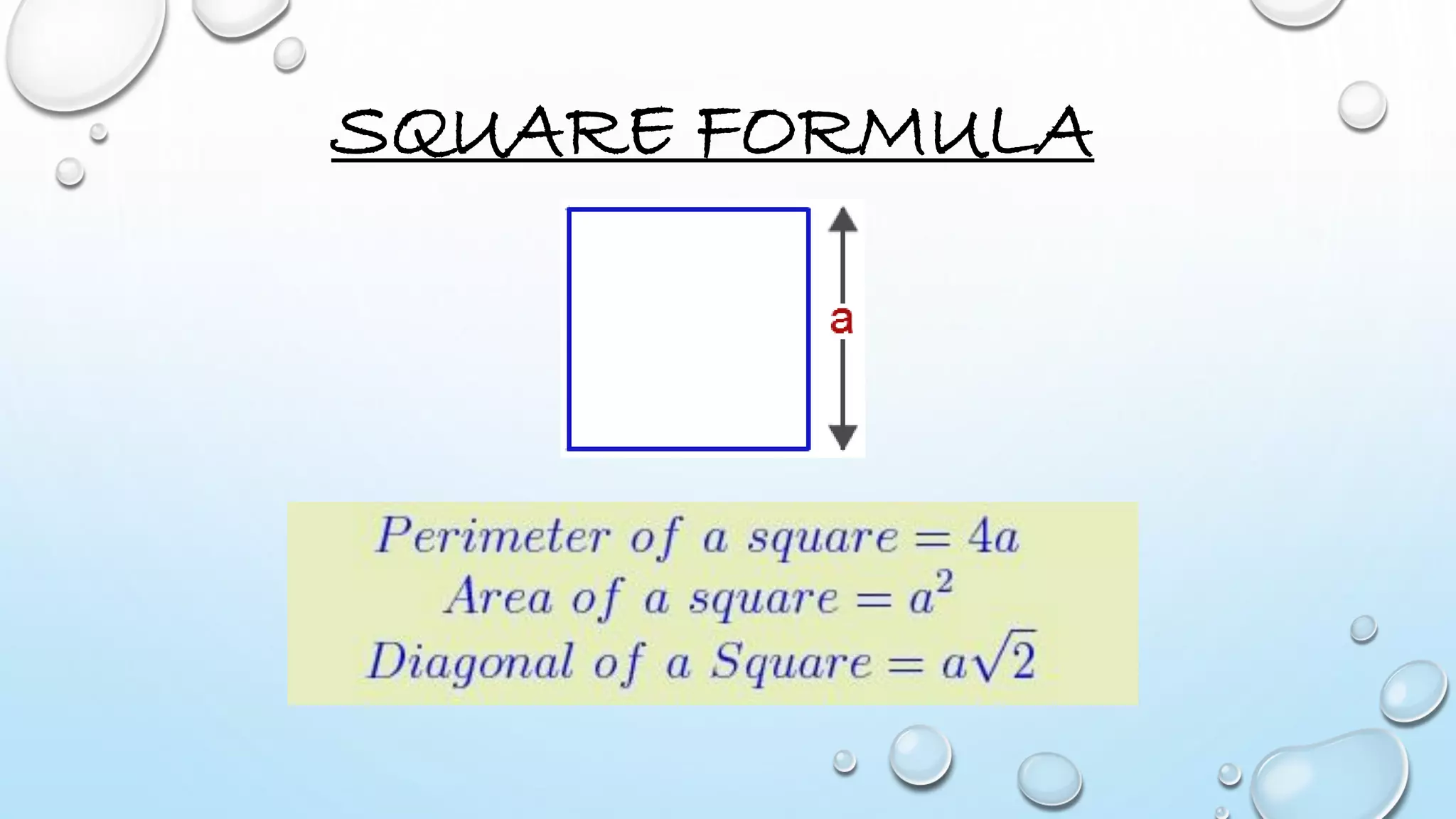
SQUARE FORMULA
AREA OF SQUARE FORMULA
R H O M B U S
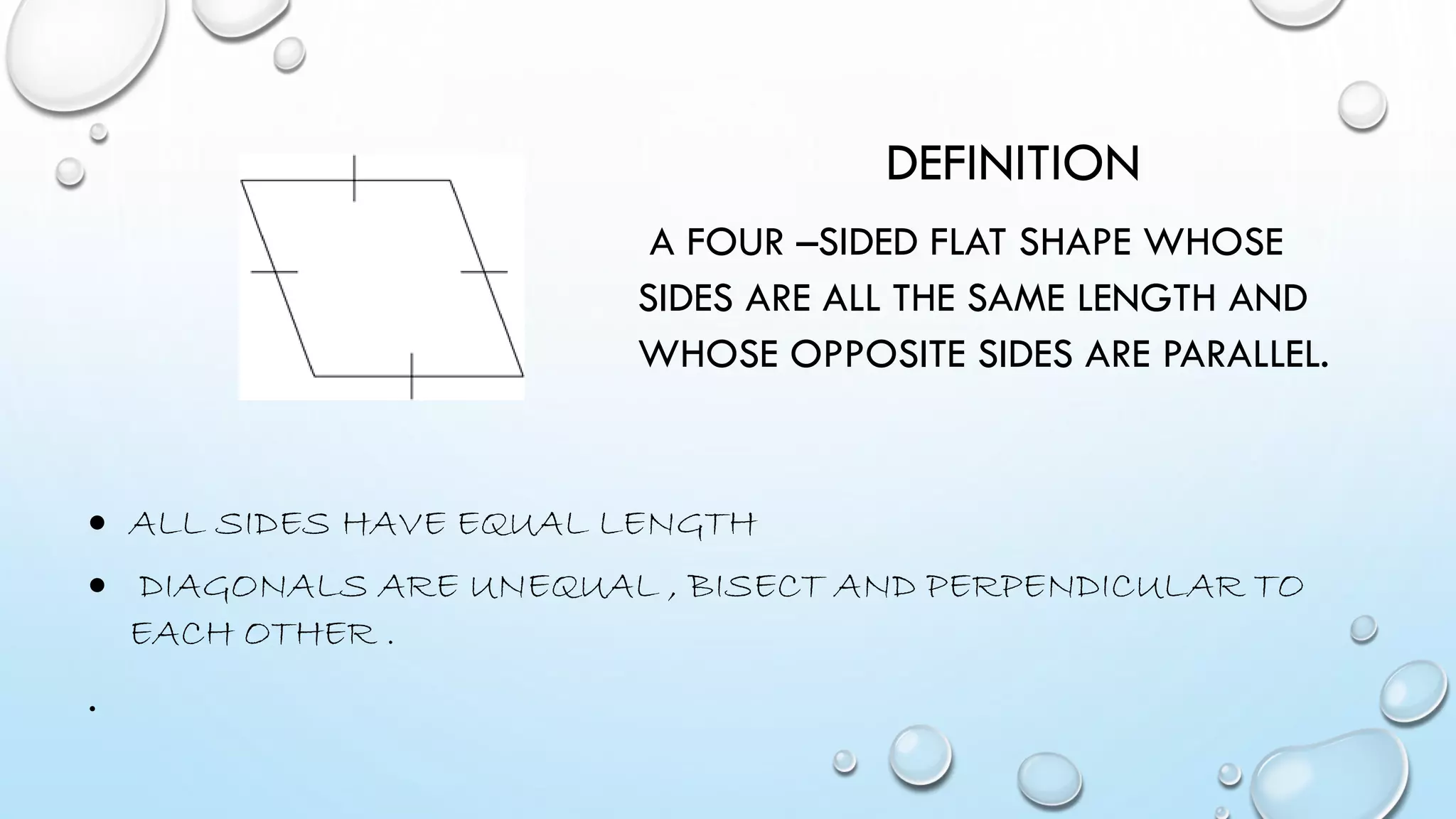
DEFINITION
A FOUR –SIDED FLAT SHAPE WHOSE
SIDES ARE ALL THE SAME LENGTH AND
WHOSE OPPOSITE SIDES ARE PARALLEL.
 ALL SIDES HAVE EQUAL LENGTH
 DIAGONALS ARE UNEQUAL , BISECT AND PERPENDICULAR TO
EACH OTHER .
.
Area
• Altitude x Base ( the ‘base times height’
method)
• s2 sin A ( the trigonometry method )
• (½) ( d1 x d2 ) / (½) ( p x q ) ( the
diagonals method )
PERIMETER
4S (S+S+S+S)
BASE TIMES HEIGHT METHOD
A=bh
where ,
b is the base length
h is the height
A= 5cm x 4cm
= 20cm2
TRIGONOMETRY METHOD
A= a² sin A
where
a is the length of a
A is the interior angle
 Rhombus is formed by two equal triangles
Example :
1. The side of a rhombus is 140m and two
opposite angles are 60 degree each. Find the
area.
A = 140² sin 60
= 19600m² x 0.866
= 16973.60m²
THE DIAGONALS METHOD
A= (1/2) x (d1 x d2)
Where
d1 is the length of diagonal
d2 is the length of another diagonal
Example :
1. The diagonals of a rhombus are 40m and
20m. Find its area .
A = (1/2) (d1 x d2)
= (1/2) (40m x 20m)
= 400m²
R E C T A N G L E
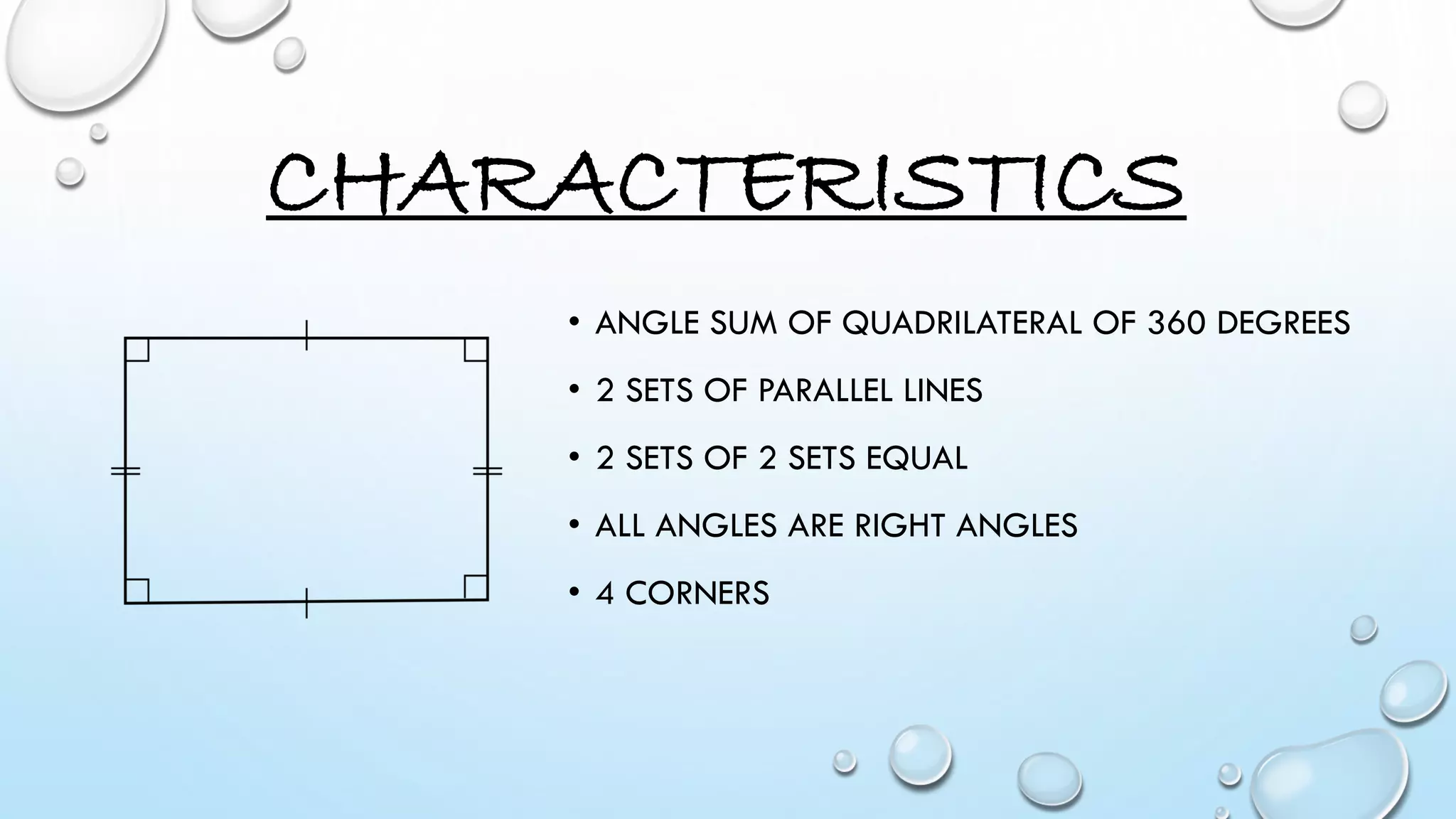
CHARACTERISTICS
• ANGLE SUM OF QUADRILATERAL OF 360 DEGREES
• 2 SETS OF PARALLEL LINES
• 2 SETS OF 2 SETS EQUAL
• ALL ANGLES ARE RIGHT ANGLES
• 4 CORNERS
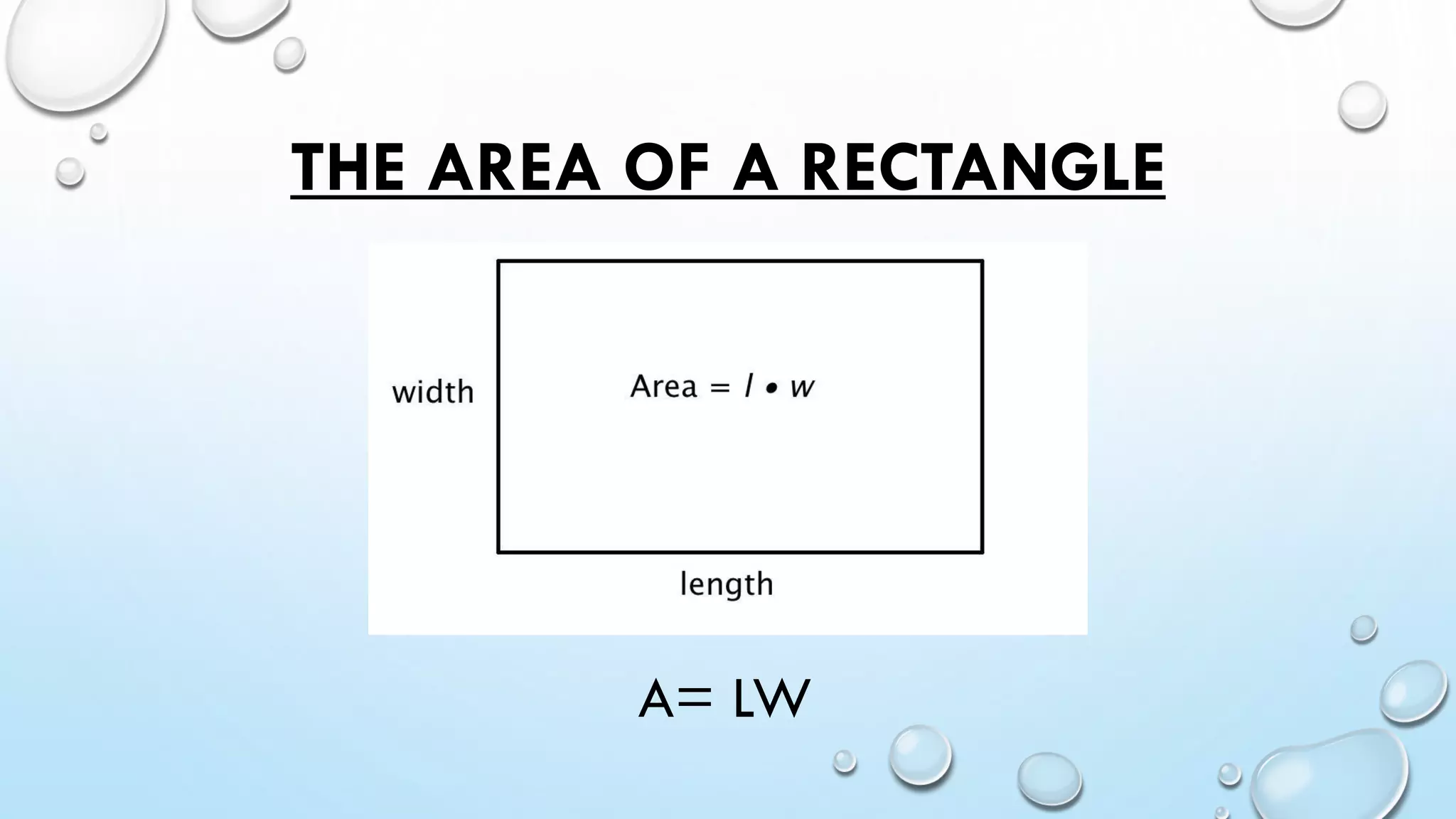
A= LW
THE AREA OF A RECTANGLE
P = 2L+2W
= 2(L+W)
THE PERIMETER OF A RECTANGLE
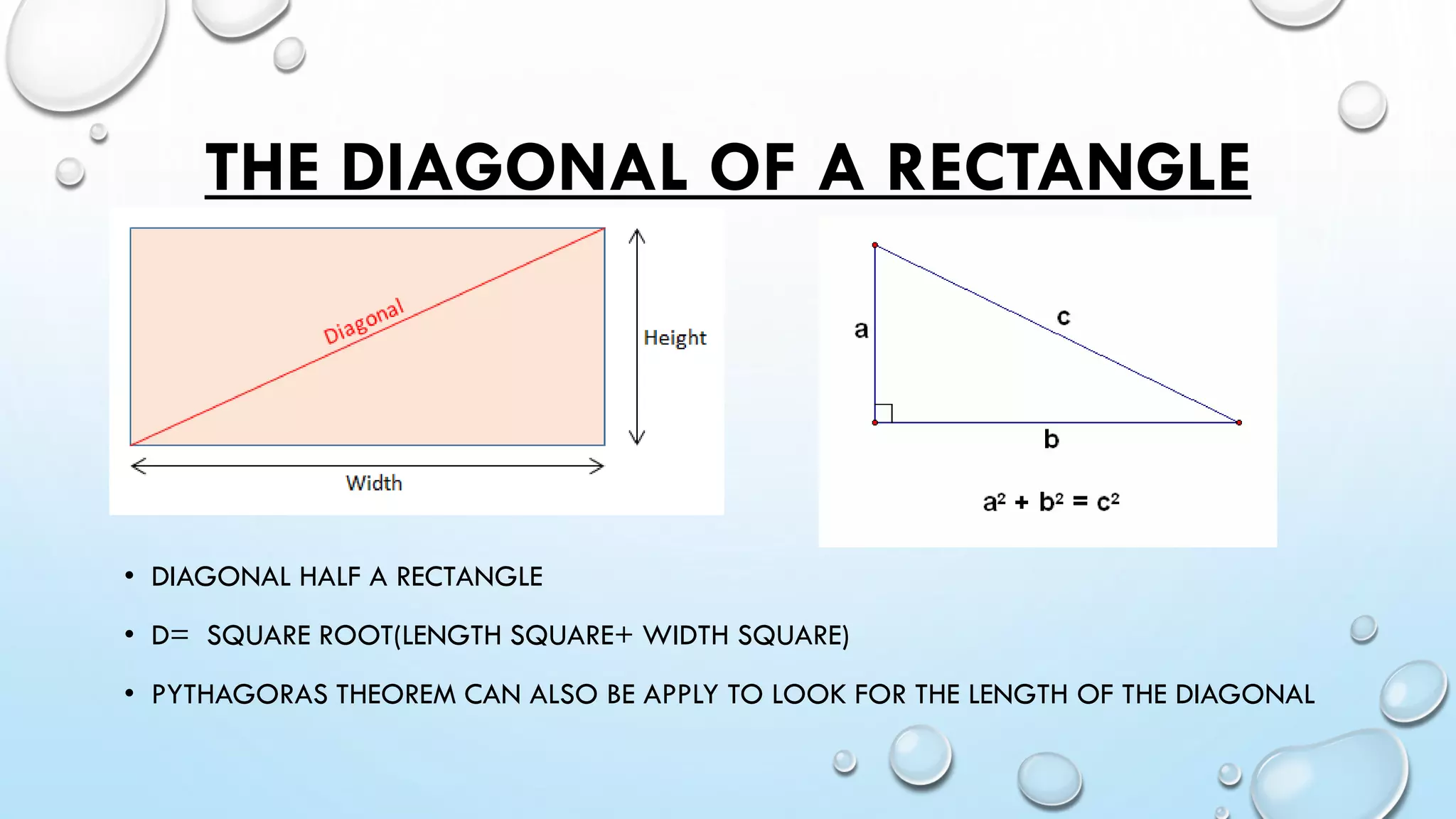
• DIAGONAL HALF A RECTANGLE
• D= SQUARE ROOT(LENGTH SQUARE+ WIDTH SQUARE)
• PYTHAGORAS THEOREM CAN ALSO BE APPLY TO LOOK FOR THE LENGTH OF THE DIAGONAL
THE DIAGONAL OF A RECTANGLE
is
EVERYWHERE !
C Y C L I C
Q U A D R I L A T E R A L
DEFINITION
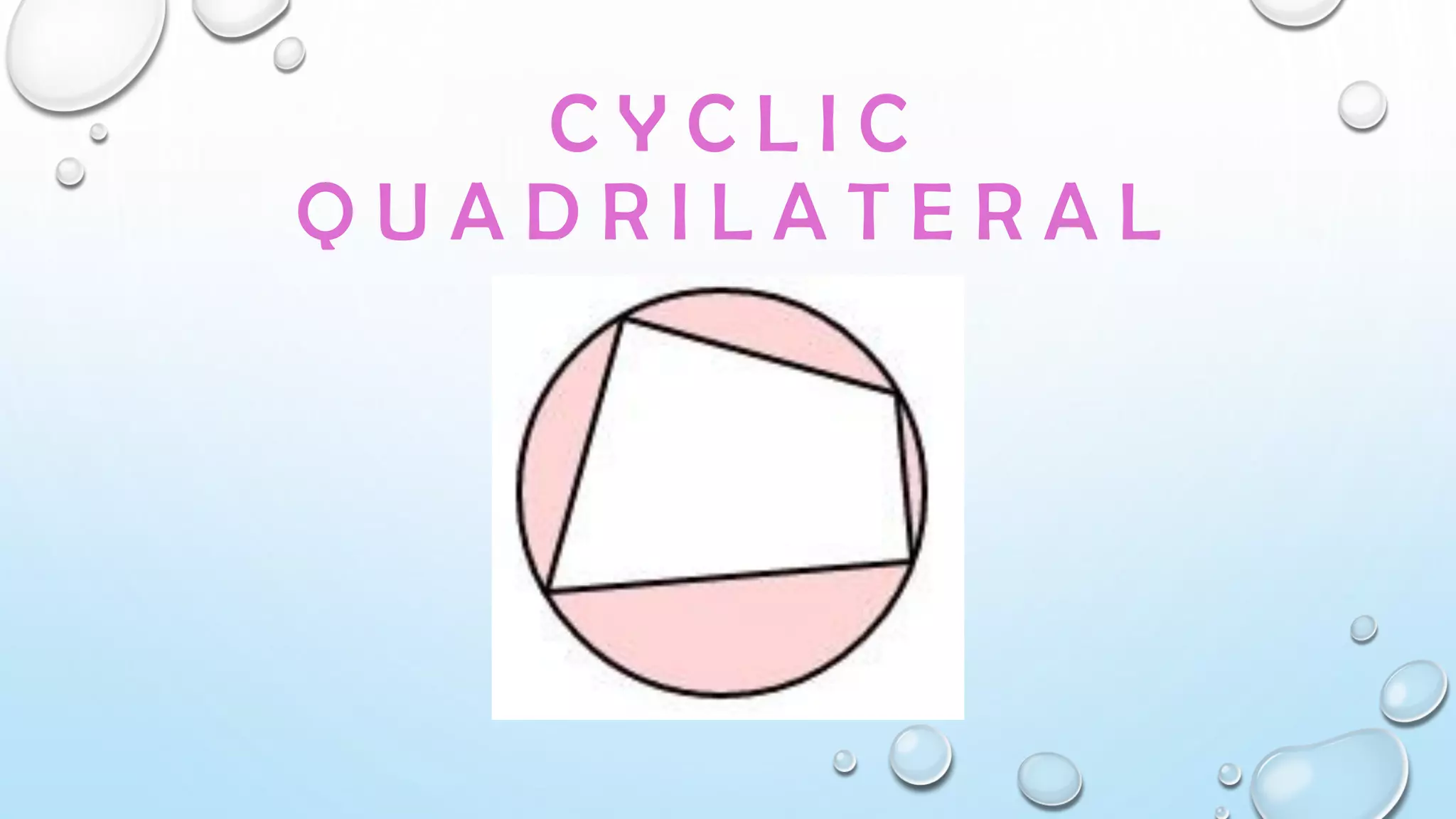
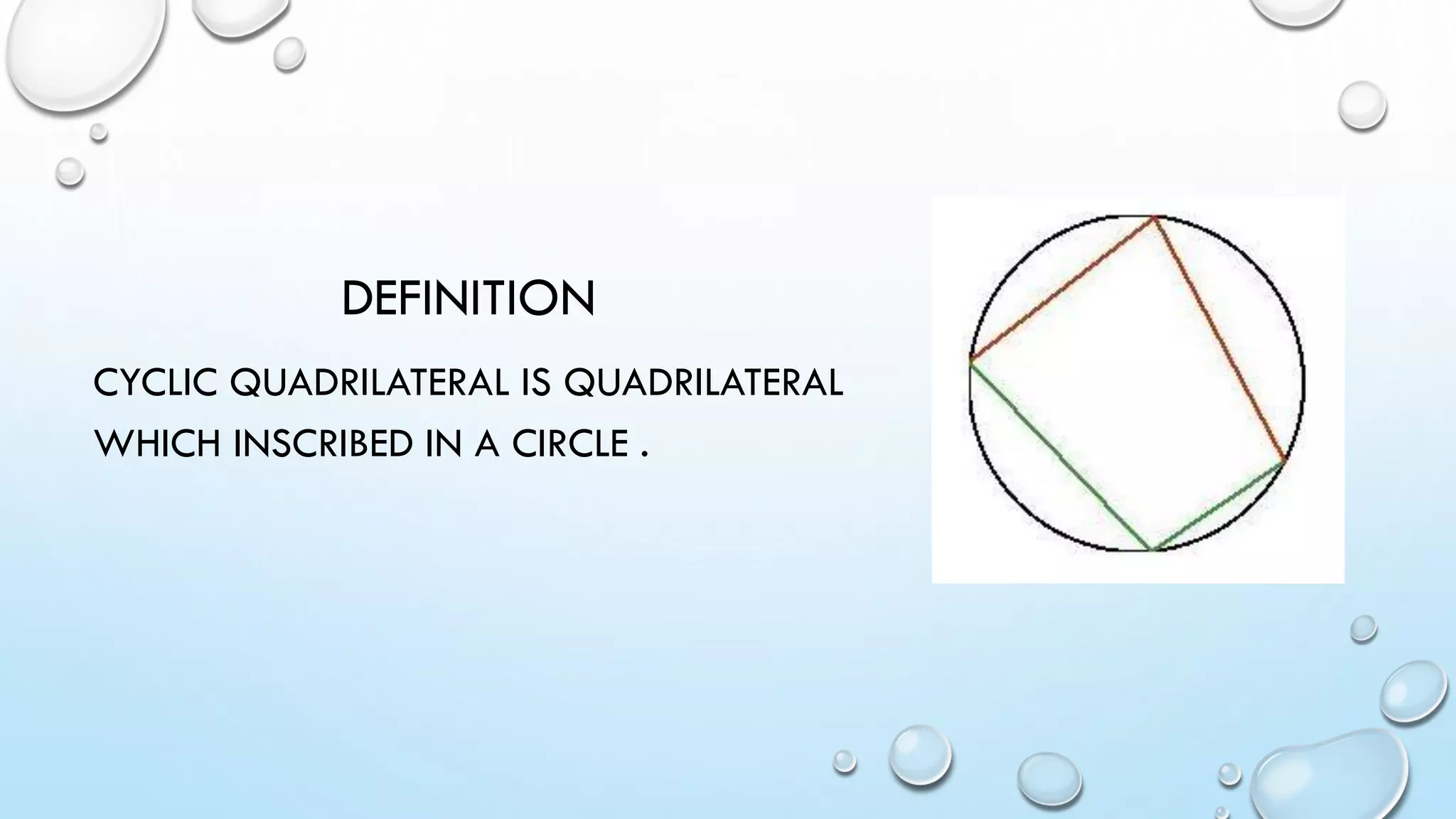
CYCLIC QUADRILATERAL IS QUADRILATERAL
WHICH INSCRIBED IN A CIRCLE .
PROPERTIES
Since
∠ABC+∠ADC=180°,
so ∠ABC= ∠ADE
PROPERTIES
AREA OF CYCLIC QUADRILATERAL
where s is the semi-perimeter of quadrilateral
The Brahmagupta’s Formula :
I R R E G U L A R
Q U A D R I L A T E R A L
• IRREGULAR QUADRILATERAL DOES
NOT HAVE ANY SPECIAL PROPERTIES
• IRREGULAR QUADRILATERAL IS ONE
WHERE THE SIDES ARE UNEQUAL OR
THE ANGLES ARE UNEQUAL OR
BOTH
CHARACTERISTICS
P A R A L L E L O G R A M
A QUADRILATERAL WITH
OPPOSITE SIDES PARALLEL
(AND THEREFORE OPPOSITE
ANGLES EQUAL)
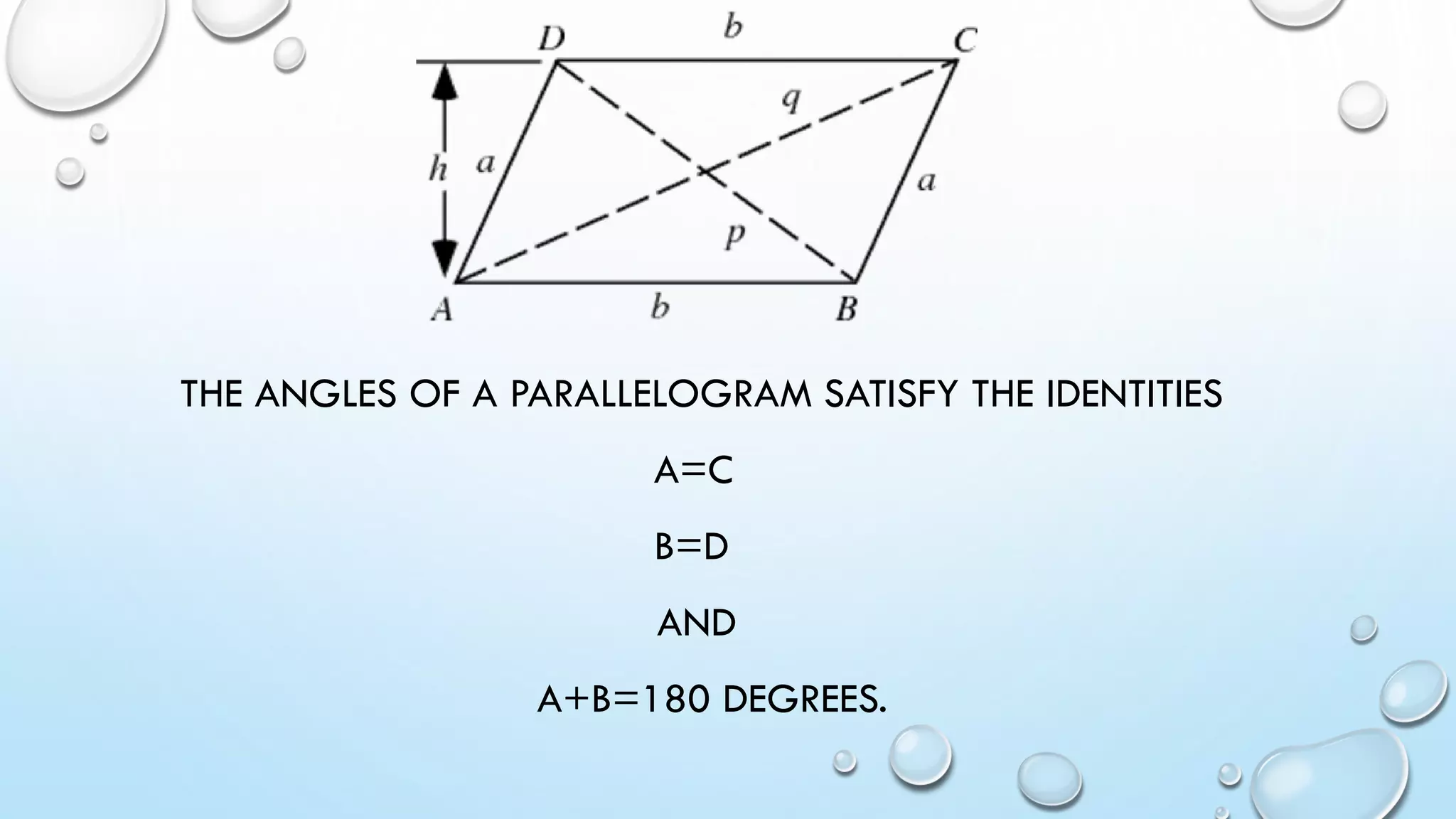
• OPPOSITE SIDES ARE CONGRUENT (AB = DC).
• OPPOSITE ANGELS ARE CONGRUENT (B = D).
• CONSECUTIVE ANGLES ARE SUPPLEMENTARY (A +B = 180°).
• IF ONE ANGLE IS RIGHT, THEN ALL ANGLES ARE RIGHT.
• THE DIAGONALS OF A PARALLELOGRAM BISECT EACH OTHER.
• EACH DIAGONAL OF A PARALLELOGRAM SEPARATES IT INTO TWO CONGRUENT
TRIANGLES. (ABC AND ACD)
THE ANGLES OF A PARALLELOGRAM SATISFY THE IDENTITIES
A=C
B=D
AND
A+B=180 DEGREES.
A PARALLELOGRAM OF BASE, B AND HEIGHT H HAS AREA
AREA= BXH
THE AREA OF A PARALLELOGRAM
K I T E
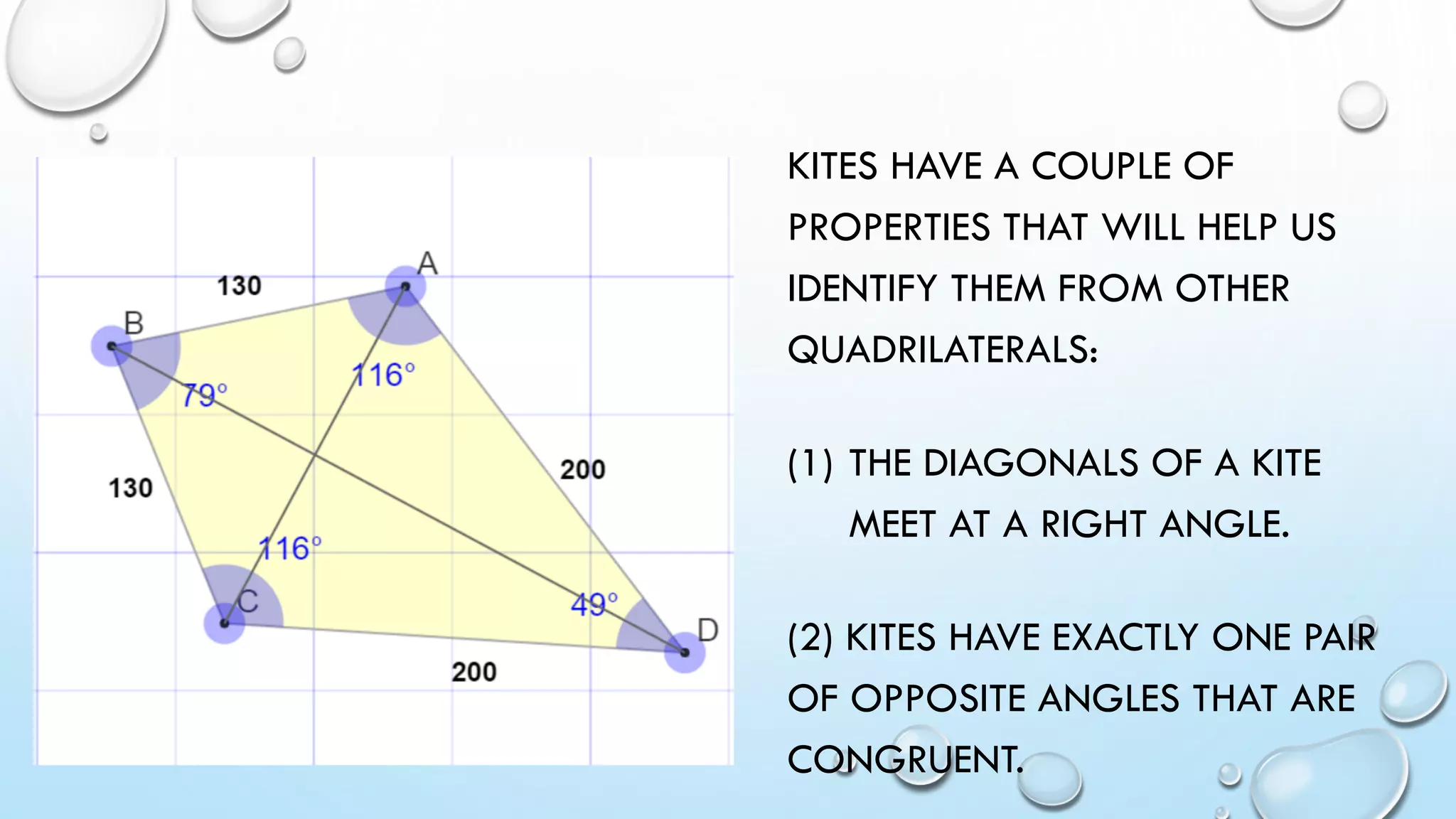
• IT LOOKS LIKE A KITE. IT HAS TWO PAIRS
OF SIDES.
• EACH PAIR IS MADE UP OF ADJACENT
SIDES (THE SIDES THEY MEET) THAT ARE
ALSO EQUAL IN LENGTH.
• THE ANGLES ARE EQUAL WHERE THE
PAIRS MEET.
• DIAGONALS (DASHED LINES) MEET AT A
RIGHT ANGLE, AND ONE OF THE
DIAGONAL BISECTS (CUTS EQUALLY IN
HALF) THE OTHER.​
KITES HAVE A COUPLE OF
PROPERTIES THAT WILL HELP US
IDENTIFY THEM FROM OTHER
QUADRILATERALS:
(1) THE DIAGONALS OF A KITE
MEET AT A RIGHT ANGLE.
(2) KITES HAVE EXACTLY ONE PAIR
OF OPPOSITE ANGLES THAT ARE
CONGRUENT.
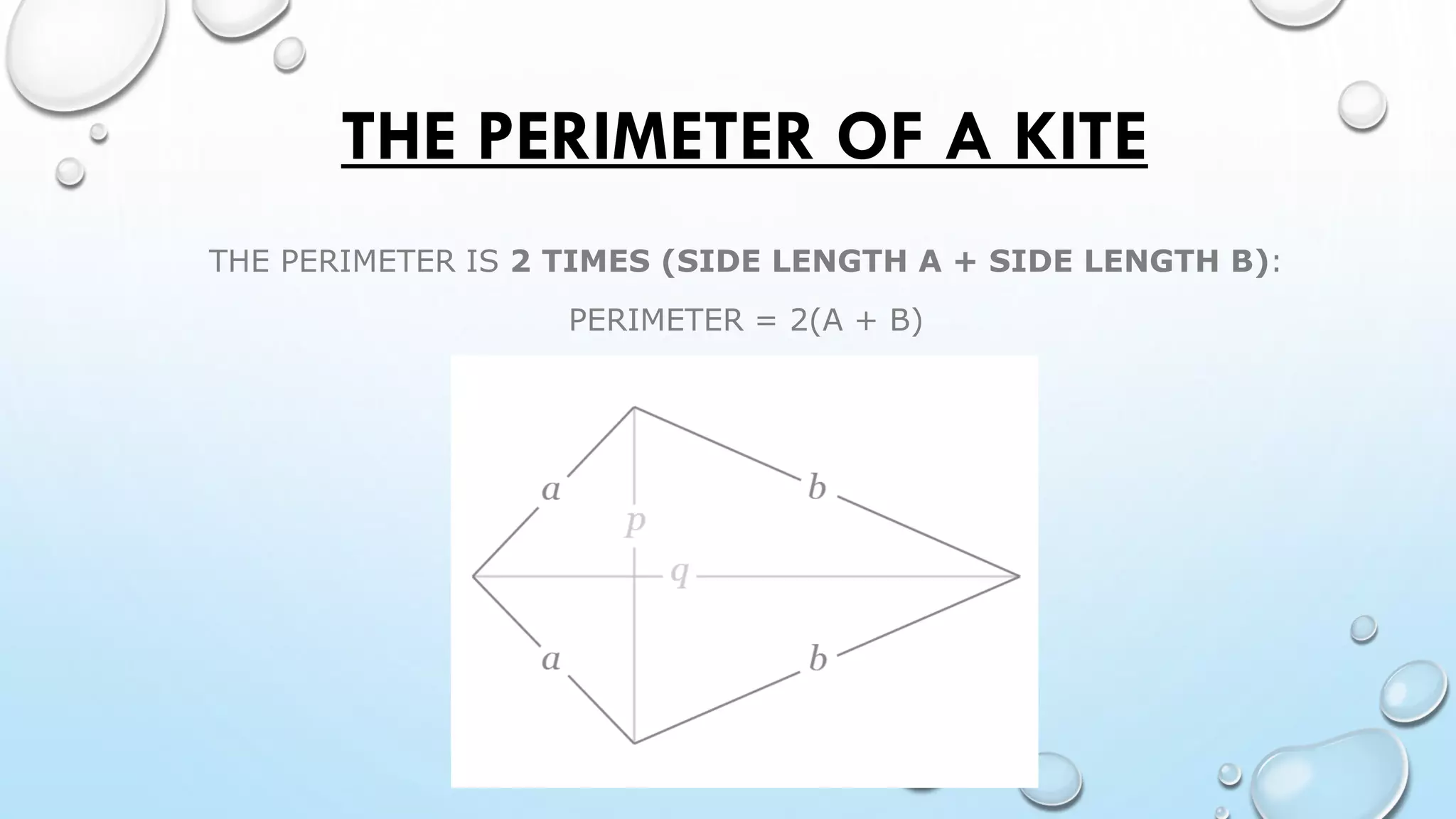
THE PERIMETER IS 2 TIMES (SIDE LENGTH A + SIDE LENGTH B):
PERIMETER = 2(A + B)
THE PERIMETER OF A KITE
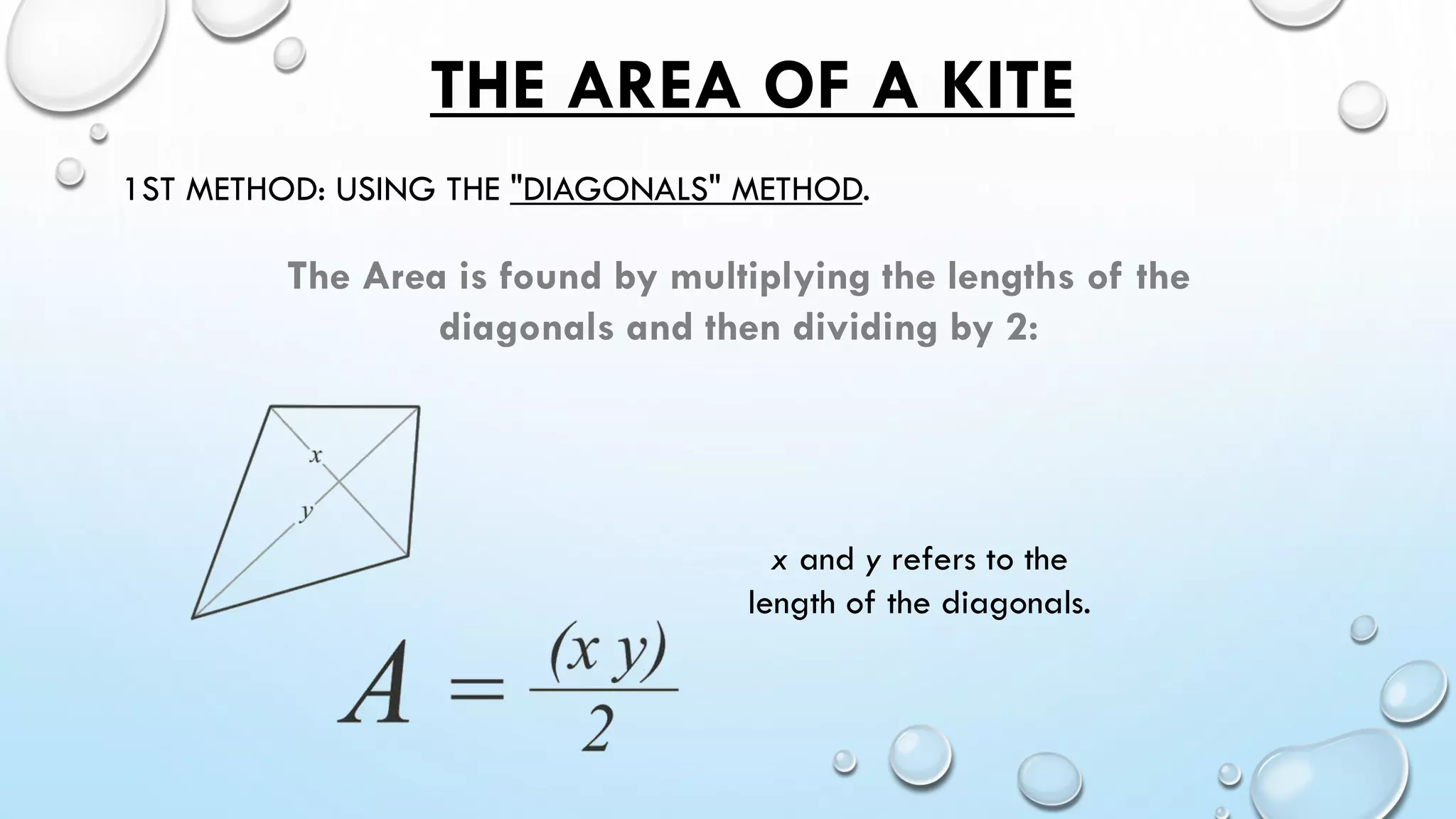
THE AREA OF A KITE
1ST METHOD: USING THE "DIAGONALS" METHOD.
The Area is found by multiplying the lengths of the
diagonals and then dividing by 2:
x and y refers to the
length of the diagonals.
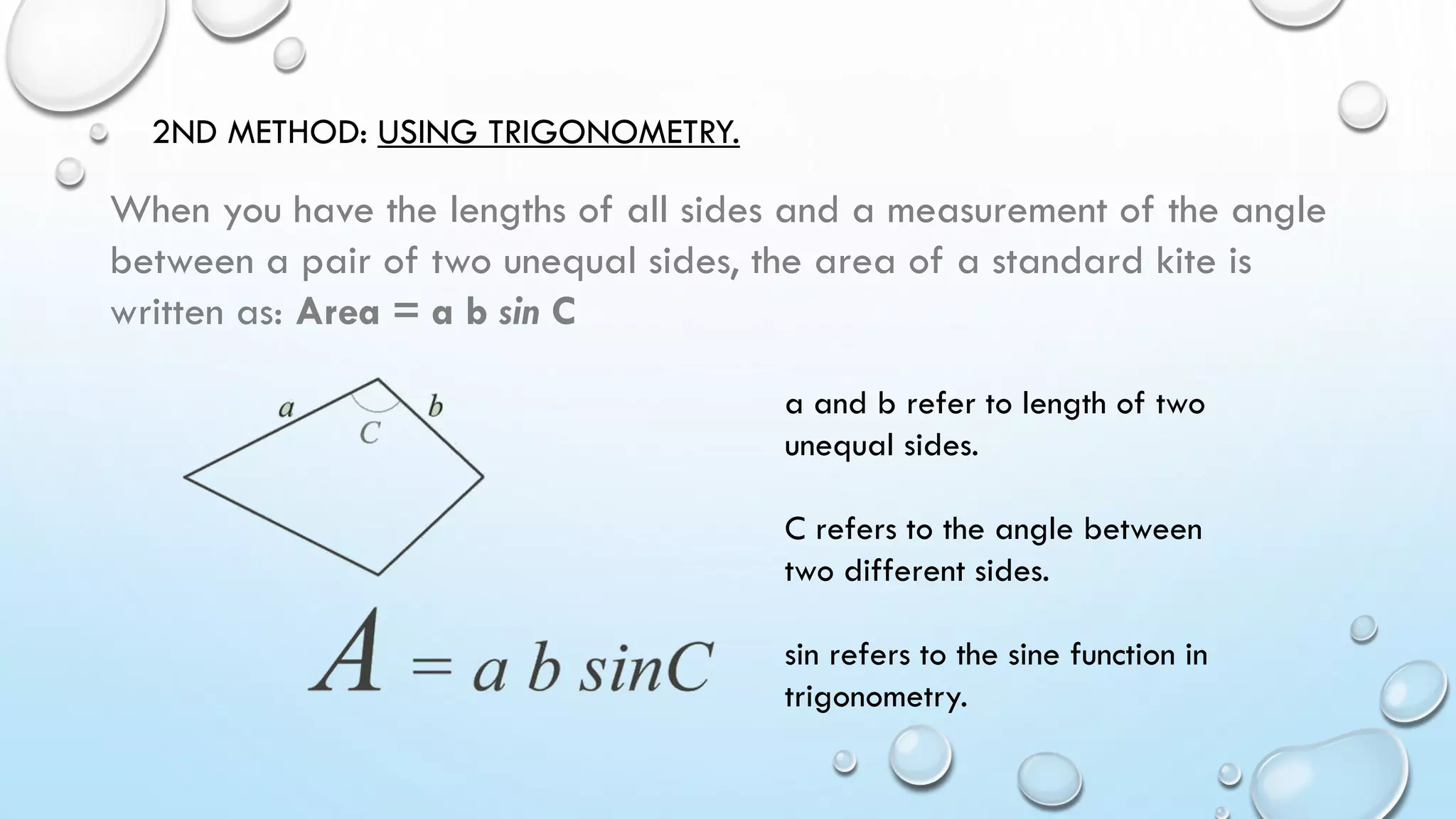
2ND METHOD: USING TRIGONOMETRY.
When you have the lengths of all sides and a measurement of the angle
between a pair of two unequal sides, the area of a standard kite is
written as: Area = a b sin C
a and b refer to length of two
unequal sides.
C refers to the angle between
two different sides.
sin refers to the sine function in
trigonometry.
FOR A KITE THAT IS NOT A SQUARE OR A RHOMBUS,
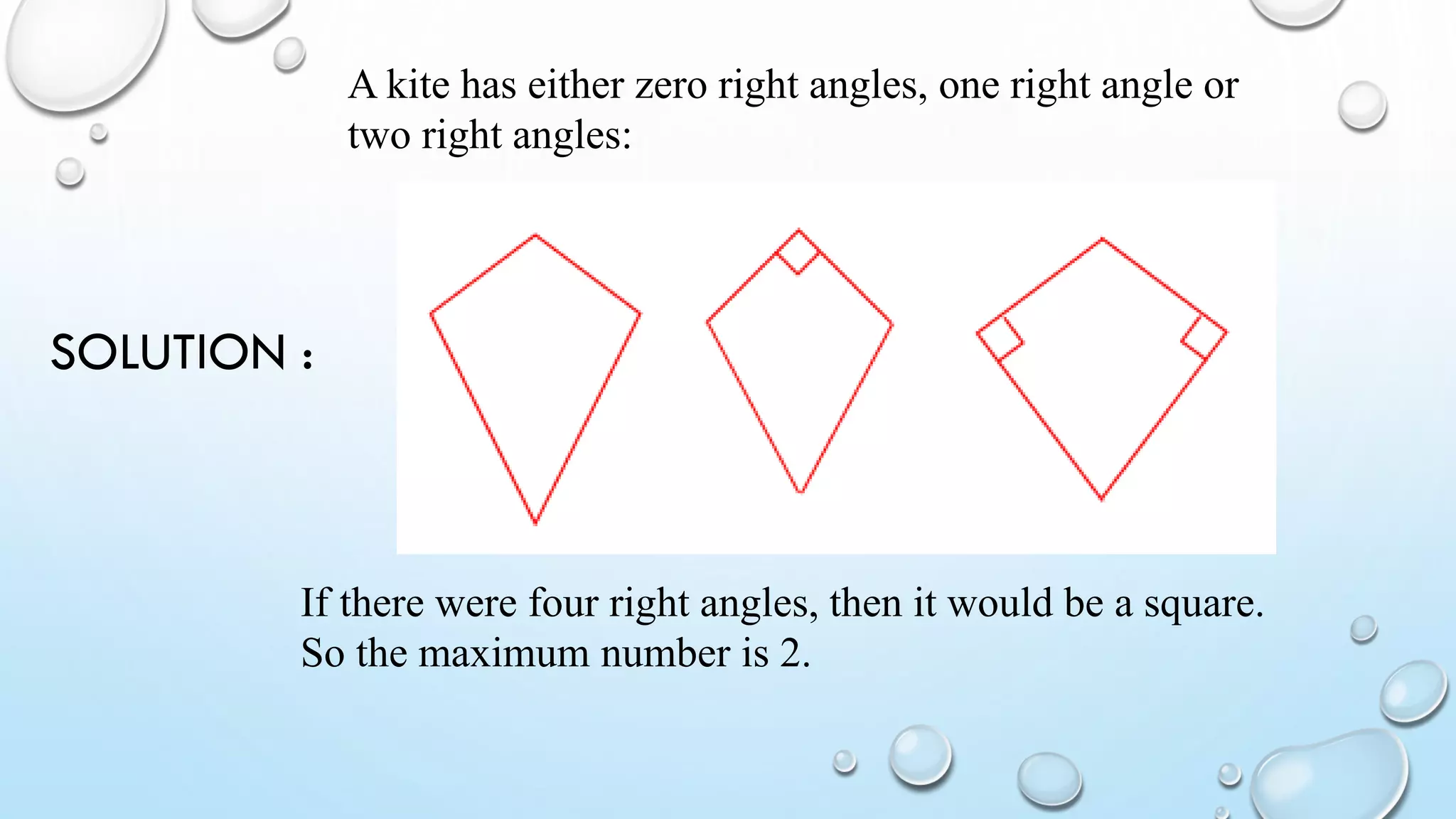
WHAT IS THE MAXIMUM NUMBER OF RIGHT ANGLES IT
COULD HAVE?
QUESTION :
A. 1
B. 2
C. 4
SOLUTION :
A kite has either zero right angles, one right angle or
two right angles:
If there were four right angles, then it would be a square.
So the maximum number is 2.
QUESTION :
Given that h=8 , determine
the perimeter and the area of
the trapezium.
QUESTION :
Given area of the square is
324.
Find the perimeter and the
diagonal length of the
square.
QUESTION :
Find the area of the rhombus
having each side equal to 17 cm
and one of its diagonals equal to
16 cm.
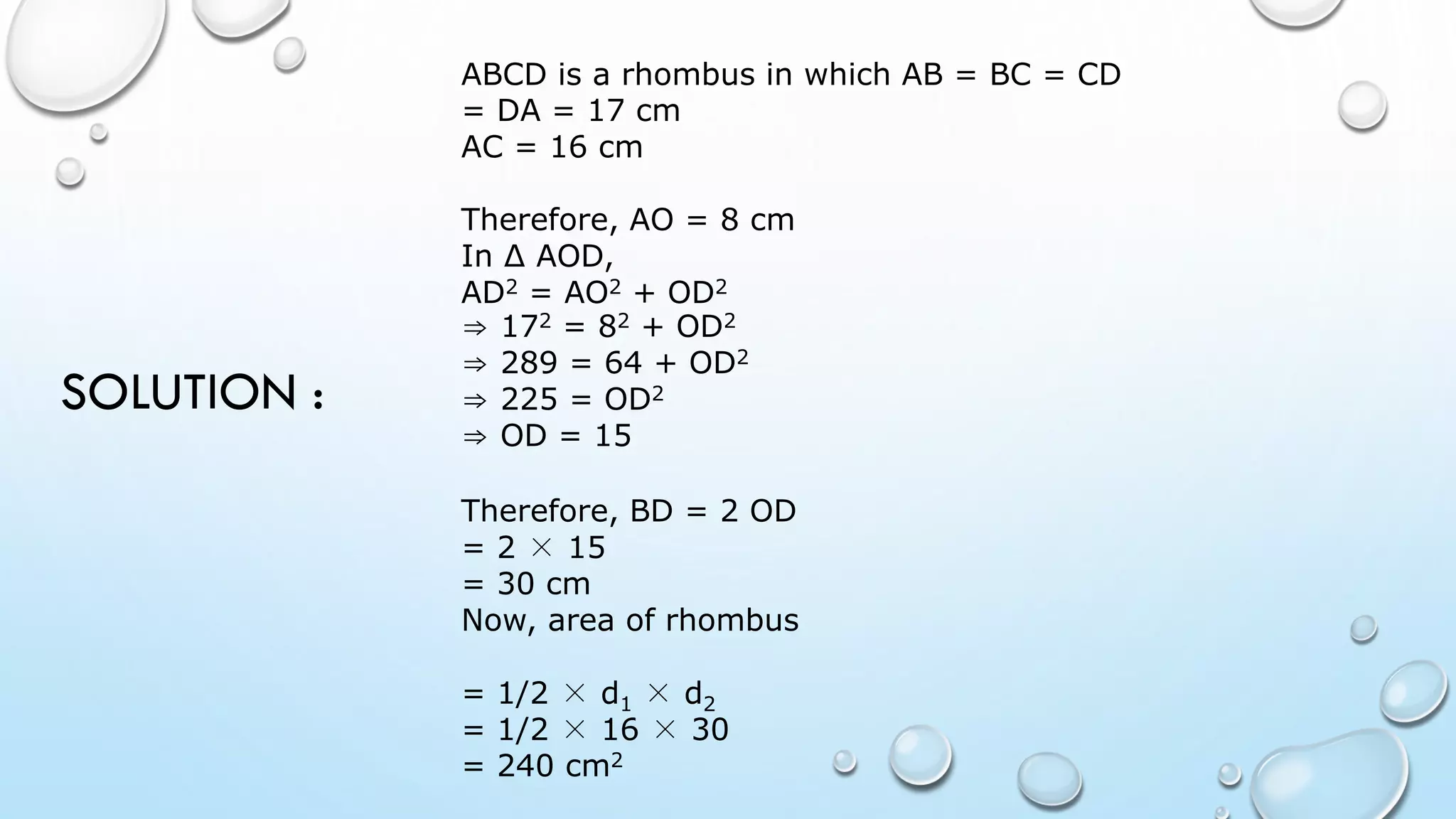
ABCD is a rhombus in which AB = BC = CD
= DA = 17 cm
AC = 16 cm
Therefore, AO = 8 cm
In ∆ AOD,
AD2 = AO2 + OD2
⇒ 172 = 82 + OD2
⇒ 289 = 64 + OD2
⇒ 225 = OD2
⇒ OD = 15
Therefore, BD = 2 OD
= 2 × 15
= 30 cm
Now, area of rhombus
= 1/2 × d1 × d2
= 1/2 × 16 × 30
= 240 cm2
SOLUTION :
QUESTION
THE DIAGONAL D OF A RECTANGLE HAS A
LENGTH OF 100 FEET AND ITS LENGTH Y IS
TWICE ITS WIDTH X (SEE FIGURE BELOW).
FIND ITS AREA.
EXAMPLE :
Find the area of a cyclic quadrilateral whose sides
are 36m , 77m , 75m , 40m.
Solution : Given a=36m, b=77m , c=75m , d=40m
s = (36+77+75+40)/2
= ( 228)/2
=114m
Using Brahmagupta’s Formula :
Area of cyclic quadrilateral =
√(s−a)(s−b)(s−c)(s−d)
A= √(114-36)(114−77)(114−75)(114-40)
= √ (78)(37)(39)(74)
= √ 8328996
= 2886 m2
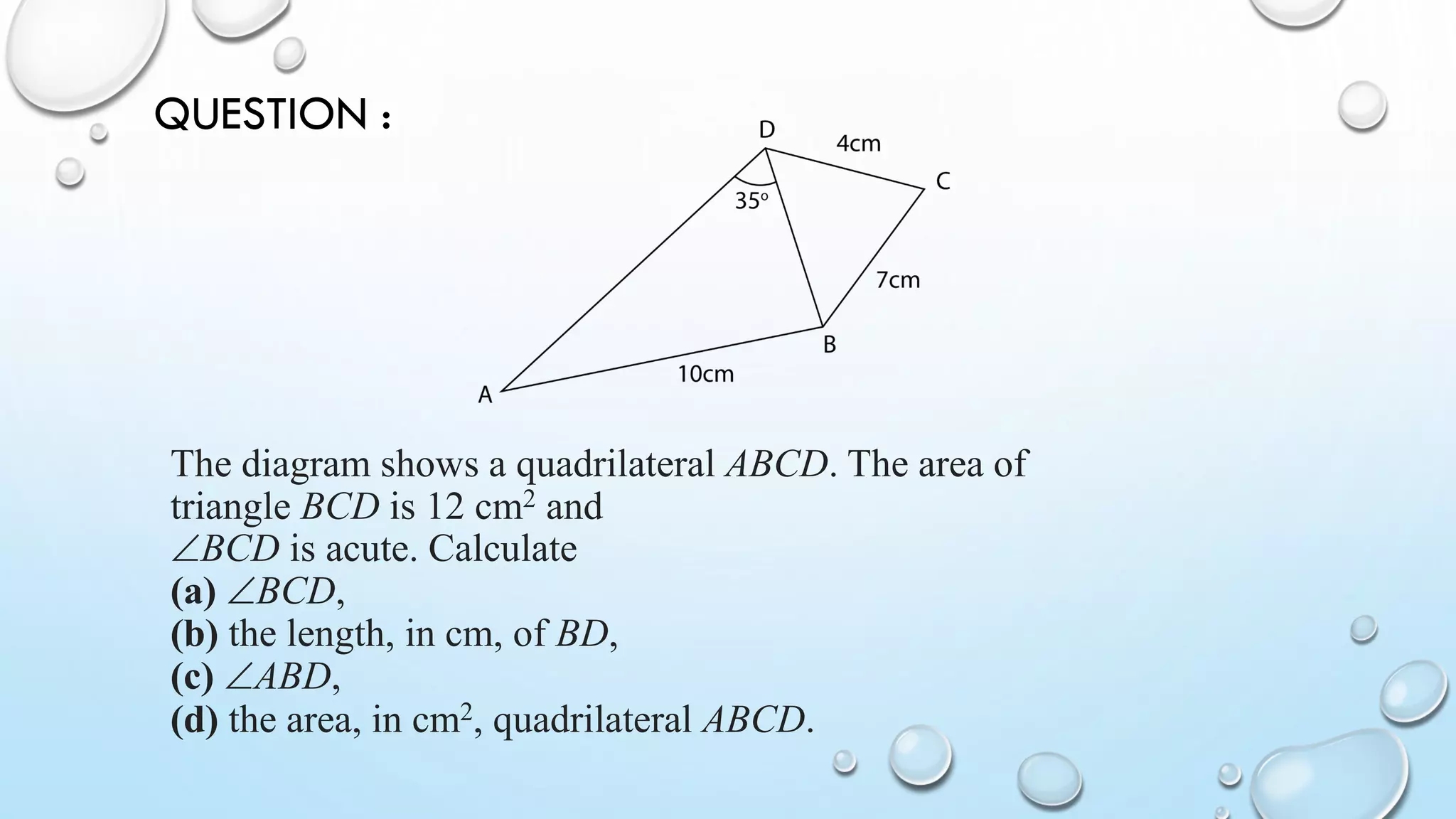
The diagram shows a quadrilateral ABCD. The area of
triangle BCD is 12 cm2 and
BCD is acute. Calculate
(a) BCD,
(b) the length, in cm, of BD,
(c) ABD,
(d) the area, in cm2, quadrilateral ABCD.
QUESTION :
SOLUTION :
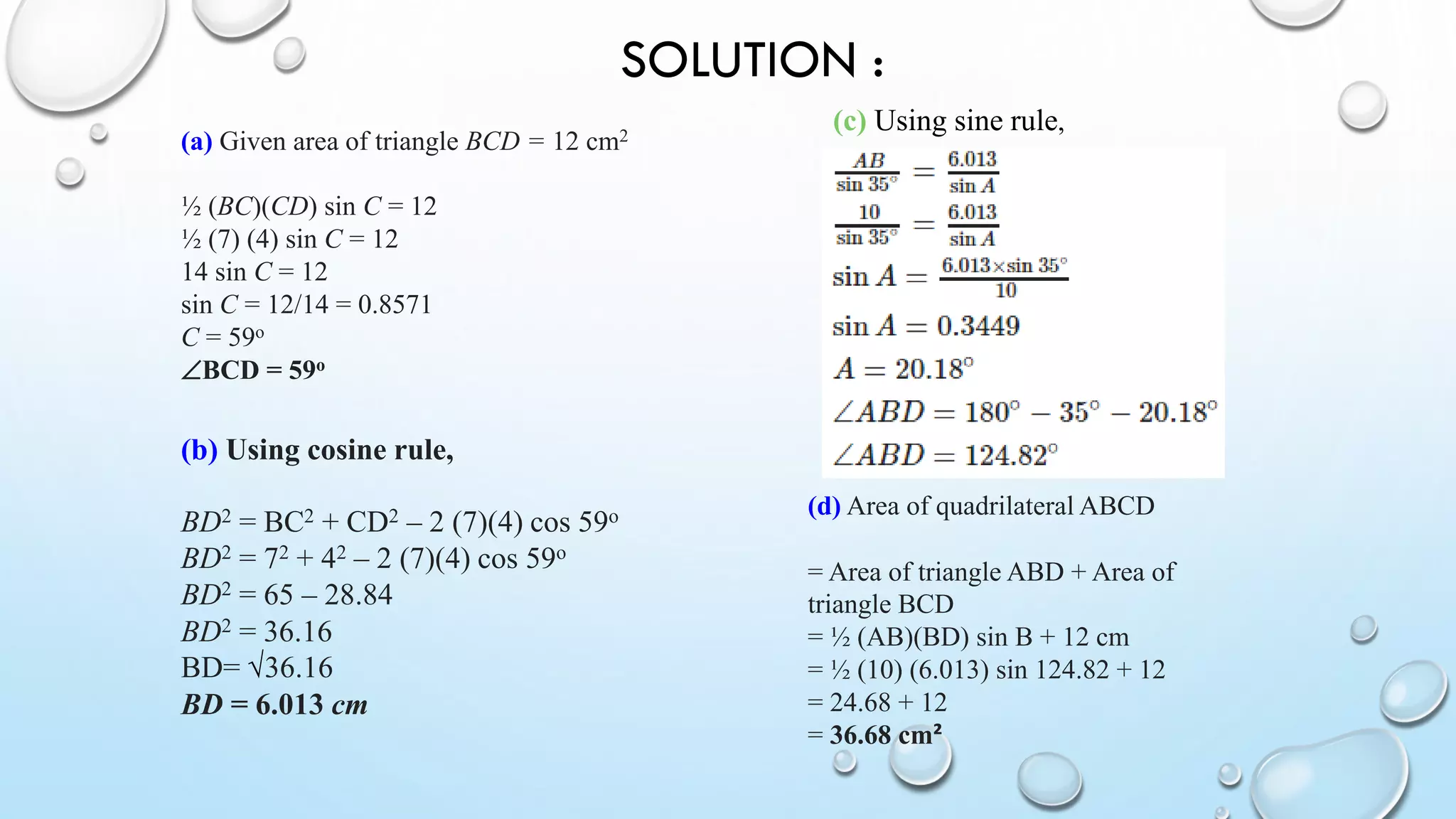
(b) Using cosine rule,
BD2 = BC2 + CD2 – 2 (7)(4) cos 59o
BD2 = 72 + 42 – 2 (7)(4) cos 59o
BD2 = 65 – 28.84
BD2 = 36.16
BD= √36.16
BD = 6.013 cm
(c) Using sine rule,
(d) Area of quadrilateral ABCD
= Area of triangle ABD + Area of
triangle BCD
= ½ (AB)(BD) sin B + 12 cm
= ½ (10) (6.013) sin 124.82 + 12
= 24.68 + 12
= 36.68 cm²
(a) Given area of triangle BCD = 12 cm2
½ (BC)(CD) sin C = 12
½ (7) (4) sin C = 12
14 sin C = 12
sin C = 12/14 = 0.8571
C = 59o
BCD = 59o
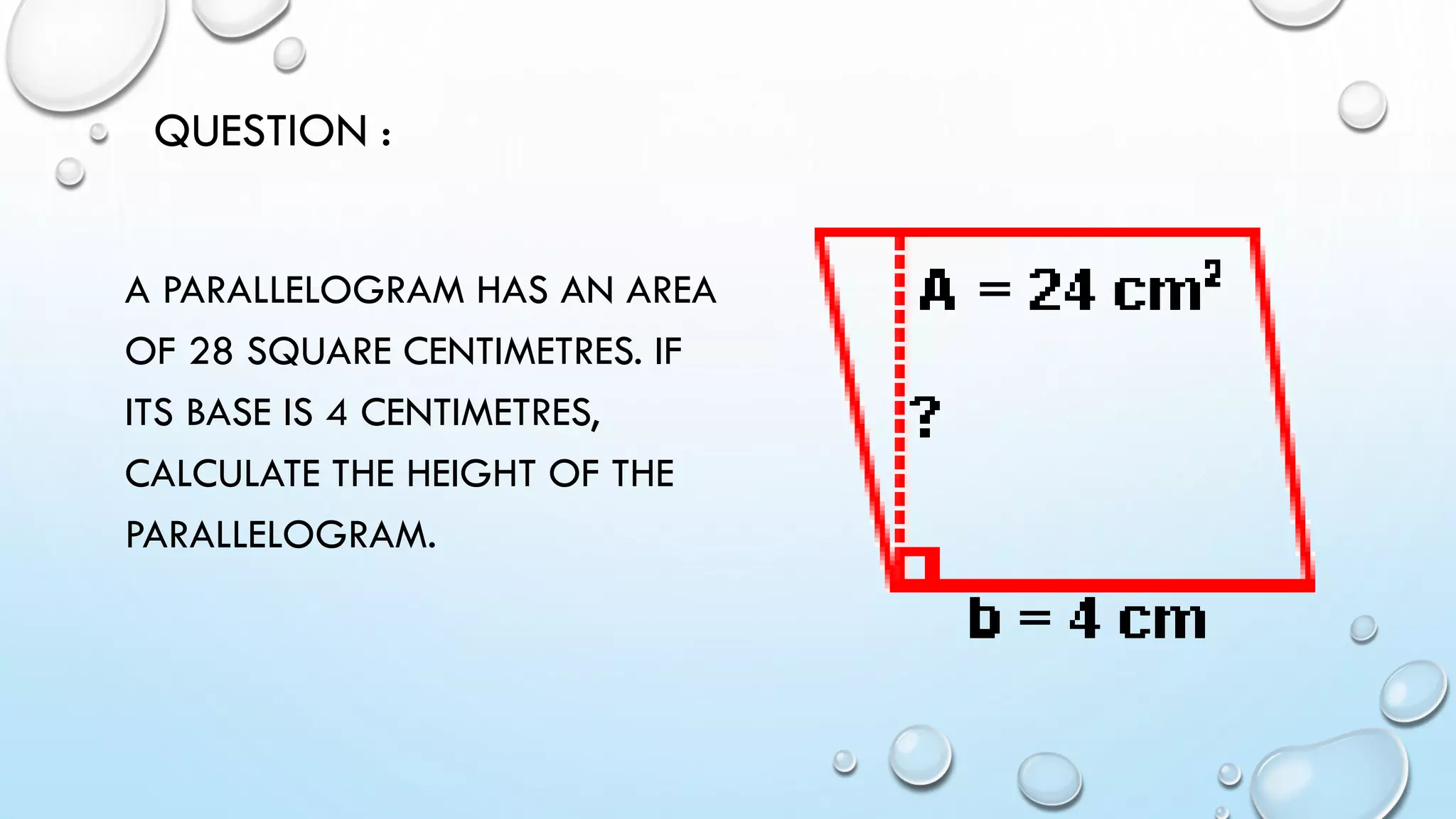
A PARALLELOGRAM HAS AN AREA
OF 28 SQUARE CENTIMETRES. IF
ITS BASE IS 4 CENTIMETRES,
CALCULATE THE HEIGHT OF THE
PARALLELOGRAM.
QUESTION :

Mathpre 160125161014

  • 1.
  • 4.
    T R AP E Z I U M
  • 5.
    CHARACTERISTICS • IT HAS4 SIDES • IT HAS 1 PAIR OF PARALLEL LINES
  • 6.
  • 7.
    THE PERIMETER OFA TRAPEZIUM
  • 8.
    THE AREA OFA TRAPEZIUM
  • 9.
    S Q UA R E
  • 10.
    CHARACTERISTICS has 4 congruentsides and 4 congruent (right) angles • opposite sides parallel • opposite angles congruent (all right)
  • 11.
    diagonals are congruent AC=BD diagonalsbisect each other • diagonals bisect opposite angles • all bisected angles equal 45º • diagonals are perpendicular
  • 12.
  • 13.
  • 14.
    R H OM B U S
  • 15.
    DEFINITION A FOUR –SIDEDFLAT SHAPE WHOSE SIDES ARE ALL THE SAME LENGTH AND WHOSE OPPOSITE SIDES ARE PARALLEL.  ALL SIDES HAVE EQUAL LENGTH  DIAGONALS ARE UNEQUAL , BISECT AND PERPENDICULAR TO EACH OTHER . .
  • 16.
    Area • Altitude xBase ( the ‘base times height’ method) • s2 sin A ( the trigonometry method ) • (½) ( d1 x d2 ) / (½) ( p x q ) ( the diagonals method ) PERIMETER 4S (S+S+S+S)
  • 17.
    BASE TIMES HEIGHTMETHOD A=bh where , b is the base length h is the height A= 5cm x 4cm = 20cm2
  • 18.
    TRIGONOMETRY METHOD A= a²sin A where a is the length of a A is the interior angle  Rhombus is formed by two equal triangles Example : 1. The side of a rhombus is 140m and two opposite angles are 60 degree each. Find the area. A = 140² sin 60 = 19600m² x 0.866 = 16973.60m²
  • 19.
    THE DIAGONALS METHOD A=(1/2) x (d1 x d2) Where d1 is the length of diagonal d2 is the length of another diagonal Example : 1. The diagonals of a rhombus are 40m and 20m. Find its area . A = (1/2) (d1 x d2) = (1/2) (40m x 20m) = 400m²
  • 20.
    R E CT A N G L E
  • 21.
    CHARACTERISTICS • ANGLE SUMOF QUADRILATERAL OF 360 DEGREES • 2 SETS OF PARALLEL LINES • 2 SETS OF 2 SETS EQUAL • ALL ANGLES ARE RIGHT ANGLES • 4 CORNERS
  • 22.
    A= LW THE AREAOF A RECTANGLE
  • 23.
    P = 2L+2W =2(L+W) THE PERIMETER OF A RECTANGLE
  • 24.
    • DIAGONAL HALFA RECTANGLE • D= SQUARE ROOT(LENGTH SQUARE+ WIDTH SQUARE) • PYTHAGORAS THEOREM CAN ALSO BE APPLY TO LOOK FOR THE LENGTH OF THE DIAGONAL THE DIAGONAL OF A RECTANGLE
  • 25.
  • 26.
    C Y CL I C Q U A D R I L A T E R A L
  • 27.
    DEFINITION CYCLIC QUADRILATERAL ISQUADRILATERAL WHICH INSCRIBED IN A CIRCLE .
  • 28.
  • 29.
  • 30.
    AREA OF CYCLICQUADRILATERAL where s is the semi-perimeter of quadrilateral The Brahmagupta’s Formula :
  • 31.
    I R RE G U L A R Q U A D R I L A T E R A L
  • 32.
    • IRREGULAR QUADRILATERALDOES NOT HAVE ANY SPECIAL PROPERTIES • IRREGULAR QUADRILATERAL IS ONE WHERE THE SIDES ARE UNEQUAL OR THE ANGLES ARE UNEQUAL OR BOTH CHARACTERISTICS
  • 33.
    P A RA L L E L O G R A M
  • 34.
    A QUADRILATERAL WITH OPPOSITESIDES PARALLEL (AND THEREFORE OPPOSITE ANGLES EQUAL)
  • 35.
    • OPPOSITE SIDESARE CONGRUENT (AB = DC). • OPPOSITE ANGELS ARE CONGRUENT (B = D). • CONSECUTIVE ANGLES ARE SUPPLEMENTARY (A +B = 180°). • IF ONE ANGLE IS RIGHT, THEN ALL ANGLES ARE RIGHT. • THE DIAGONALS OF A PARALLELOGRAM BISECT EACH OTHER. • EACH DIAGONAL OF A PARALLELOGRAM SEPARATES IT INTO TWO CONGRUENT TRIANGLES. (ABC AND ACD)
  • 36.
    THE ANGLES OFA PARALLELOGRAM SATISFY THE IDENTITIES A=C B=D AND A+B=180 DEGREES.
  • 37.
    A PARALLELOGRAM OFBASE, B AND HEIGHT H HAS AREA AREA= BXH THE AREA OF A PARALLELOGRAM
  • 38.
  • 39.
    • IT LOOKSLIKE A KITE. IT HAS TWO PAIRS OF SIDES. • EACH PAIR IS MADE UP OF ADJACENT SIDES (THE SIDES THEY MEET) THAT ARE ALSO EQUAL IN LENGTH. • THE ANGLES ARE EQUAL WHERE THE PAIRS MEET. • DIAGONALS (DASHED LINES) MEET AT A RIGHT ANGLE, AND ONE OF THE DIAGONAL BISECTS (CUTS EQUALLY IN HALF) THE OTHER.​
  • 40.
    KITES HAVE ACOUPLE OF PROPERTIES THAT WILL HELP US IDENTIFY THEM FROM OTHER QUADRILATERALS: (1) THE DIAGONALS OF A KITE MEET AT A RIGHT ANGLE. (2) KITES HAVE EXACTLY ONE PAIR OF OPPOSITE ANGLES THAT ARE CONGRUENT.
  • 41.
    THE PERIMETER IS2 TIMES (SIDE LENGTH A + SIDE LENGTH B): PERIMETER = 2(A + B) THE PERIMETER OF A KITE
  • 42.
    THE AREA OFA KITE 1ST METHOD: USING THE "DIAGONALS" METHOD. The Area is found by multiplying the lengths of the diagonals and then dividing by 2: x and y refers to the length of the diagonals.
  • 43.
    2ND METHOD: USINGTRIGONOMETRY. When you have the lengths of all sides and a measurement of the angle between a pair of two unequal sides, the area of a standard kite is written as: Area = a b sin C a and b refer to length of two unequal sides. C refers to the angle between two different sides. sin refers to the sine function in trigonometry.
  • 44.
    FOR A KITETHAT IS NOT A SQUARE OR A RHOMBUS, WHAT IS THE MAXIMUM NUMBER OF RIGHT ANGLES IT COULD HAVE? QUESTION : A. 1 B. 2 C. 4
  • 45.
    SOLUTION : A kitehas either zero right angles, one right angle or two right angles: If there were four right angles, then it would be a square. So the maximum number is 2.
  • 46.
    QUESTION : Given thath=8 , determine the perimeter and the area of the trapezium.
  • 47.
    QUESTION : Given areaof the square is 324. Find the perimeter and the diagonal length of the square.
  • 48.
    QUESTION : Find thearea of the rhombus having each side equal to 17 cm and one of its diagonals equal to 16 cm.
  • 49.
    ABCD is arhombus in which AB = BC = CD = DA = 17 cm AC = 16 cm Therefore, AO = 8 cm In ∆ AOD, AD2 = AO2 + OD2 ⇒ 172 = 82 + OD2 ⇒ 289 = 64 + OD2 ⇒ 225 = OD2 ⇒ OD = 15 Therefore, BD = 2 OD = 2 × 15 = 30 cm Now, area of rhombus = 1/2 × d1 × d2 = 1/2 × 16 × 30 = 240 cm2 SOLUTION :
  • 50.
    QUESTION THE DIAGONAL DOF A RECTANGLE HAS A LENGTH OF 100 FEET AND ITS LENGTH Y IS TWICE ITS WIDTH X (SEE FIGURE BELOW). FIND ITS AREA.
  • 51.
    EXAMPLE : Find thearea of a cyclic quadrilateral whose sides are 36m , 77m , 75m , 40m. Solution : Given a=36m, b=77m , c=75m , d=40m s = (36+77+75+40)/2 = ( 228)/2 =114m Using Brahmagupta’s Formula : Area of cyclic quadrilateral = √(s−a)(s−b)(s−c)(s−d) A= √(114-36)(114−77)(114−75)(114-40) = √ (78)(37)(39)(74) = √ 8328996 = 2886 m2
  • 52.
    The diagram showsa quadrilateral ABCD. The area of triangle BCD is 12 cm2 and BCD is acute. Calculate (a) BCD, (b) the length, in cm, of BD, (c) ABD, (d) the area, in cm2, quadrilateral ABCD. QUESTION :
  • 53.
    SOLUTION : (b) Usingcosine rule, BD2 = BC2 + CD2 – 2 (7)(4) cos 59o BD2 = 72 + 42 – 2 (7)(4) cos 59o BD2 = 65 – 28.84 BD2 = 36.16 BD= √36.16 BD = 6.013 cm (c) Using sine rule, (d) Area of quadrilateral ABCD = Area of triangle ABD + Area of triangle BCD = ½ (AB)(BD) sin B + 12 cm = ½ (10) (6.013) sin 124.82 + 12 = 24.68 + 12 = 36.68 cm² (a) Given area of triangle BCD = 12 cm2 ½ (BC)(CD) sin C = 12 ½ (7) (4) sin C = 12 14 sin C = 12 sin C = 12/14 = 0.8571 C = 59o BCD = 59o
  • 54.
    A PARALLELOGRAM HASAN AREA OF 28 SQUARE CENTIMETRES. IF ITS BASE IS 4 CENTIMETRES, CALCULATE THE HEIGHT OF THE PARALLELOGRAM. QUESTION :