Effective Public
Communication Presentation
Presented by
Christina Chua Yi Mei
0323859
COM 30103
Thursday 8-10am
BROOKLYN BOTANICAL GARDEN
Introduction
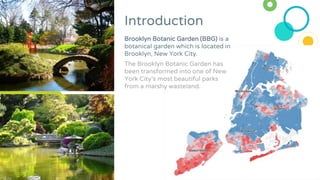
Brooklyn Botanic Garden (BBG) is a
botanical garden which is located in
Brooklyn, New York City.
The Brooklyn Botanic Garden has
been transformed into one of New
York City’s most beautiful parks
from a marshy wasteland.
Historical Background
◎Founded in 1910
◎Located in Brooklyn,
New York
◎52-acre
◎ Founded first by Dr.
Charles Stuart Gager
Harold Caparn
• Appointed as the
landscape architect in
1912
• Caparn saw the garden as an artistic and educational
facility.
• Borrowing a page from nature, he let the Brooklyn
Botanic Garden organically grow over the course of
decades
• Adding sections as he could and refurbishing others
when needed
• Until it included over 13 separate gardens, buildings and
museums when he left it in 1945.
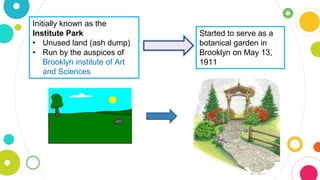
Initially known as the
Institute Park
• Unused land (ash dump)
• Run by the auspices of
Brooklyn institute of Art
and Sciences
Started to serve as a
botanical garden in
Brooklyn on May 13,
1911
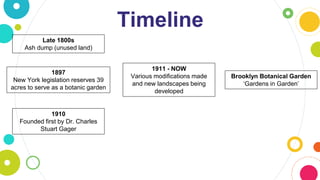
Timeline
Late 1800s
Ash dump (unused land)
1897
New York legislation reserves 39
acres to serve as a botanic garden
1910
Founded first by Dr. Charles
Stuart Gager
1911 - NOW
Various modifications made
and new landscapes being
developed
Brooklyn Botanical Garden
‘Gardens in Garden’
Structure and layout
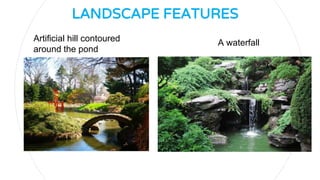
LANDSCAPE FEATURES
Artificial hill contoured
around the pond
A waterfall
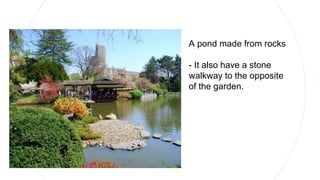
A pond made from rocks
- It also have a stone
walkway to the opposite
of the garden.
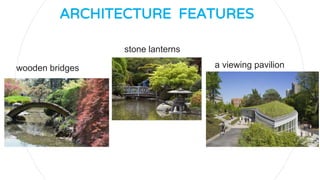
ARCHITECTURE FEATURES
wooden bridges
stone lanterns
a viewing pavilion
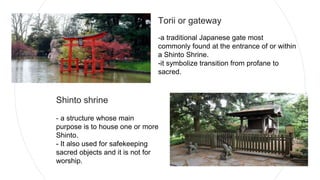
Torii or gateway
-a traditional Japanese gate most
commonly found at the entrance of or within
a Shinto Shrine.
-it symbolize transition from profane to
sacred.
Shinto shrine
- a structure whose main
purpose is to house one or more
Shinto.
- It also used for safekeeping
sacred objects and it is not for
worship.
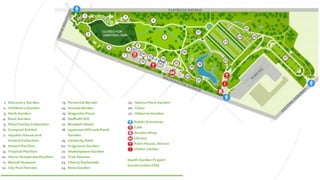
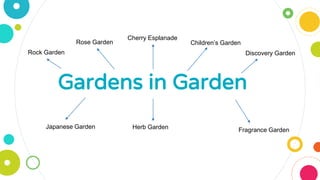
Gardens in Garden
Cherry Esplanade
Children’s Garden
Discovery Garden
Fragrance GardenHerb GardenJapanese Garden
Rock Garden
Rose Garden
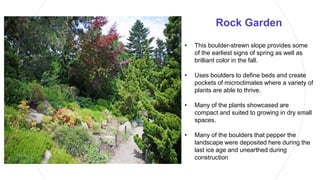
Rock Garden
• This boulder-strewn slope provides some
of the earliest signs of spring as well as
brilliant color in the fall.
• Uses boulders to define beds and create
pockets of microclimates where a variety of
plants are able to thrive.
• Many of the plants showcased are
compact and suited to growing in dry small
spaces.
• Many of the boulders that pepper the
landscape were deposited here during the
last ice age and unearthed during
construction
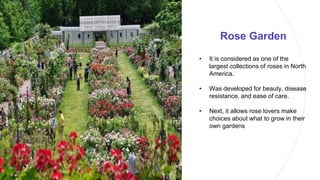
Rose Garden
• It is considered as one of the
largest collections of roses in North
America.
• Was developed for beauty, disease
resistance, and ease of care.
• Next, it allows rose lovers make
choices about what to grow in their
own gardens
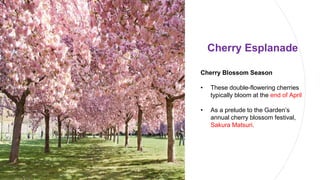
Cherry Esplanade
Cherry Blossom Season
• These double-flowering cherries
typically bloom at the end of April
• As a prelude to the Garden’s
annual cherry blossom festival,
Sakura Matsuri.
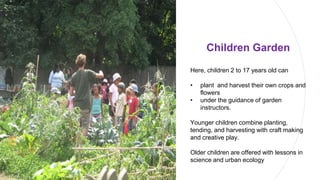
Children Garden
Here, children 2 to 17 years old can
• plant and harvest their own crops and
flowers
• under the guidance of garden
instructors.
Younger children combine planting,
tending, and harvesting with craft making
and creative play.
Older children are offered with lessons in
science and urban ecology
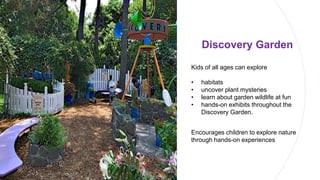
Discovery Garden
Kids of all ages can explore
• habitats
• uncover plant mysteries
• learn about garden wildlife at fun
• hands-on exhibits throughout the
Discovery Garden.
Encourages children to explore nature
through hands-on experiences
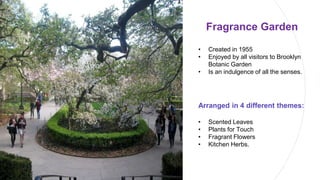
Fragrance Garden
• Created in 1955
• Enjoyed by all visitors to Brooklyn
Botanic Garden
• Is an indulgence of all the senses.
Arranged in 4 different themes:
• Scented Leaves
• Plants for Touch
• Fragrant Flowers
• Kitchen Herbs.
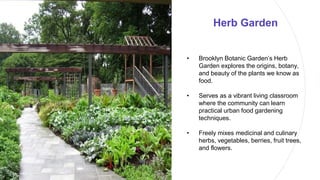
Herb Garden
• Brooklyn Botanic Garden’s Herb
Garden explores the origins, botany,
and beauty of the plants we know as
food.
• Serves as a vibrant living classroom
where the community can learn
practical urban food gardening
techniques.
• Freely mixes medicinal and culinary
herbs, vegetables, berries, fruit trees,
and flowers.
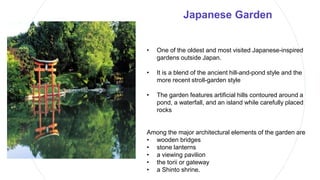
Japanese Garden
• One of the oldest and most visited Japanese-inspired
gardens outside Japan.
• It is a blend of the ancient hill-and-pond style and the
more recent stroll-garden style
• The garden features artificial hills contoured around a
pond, a waterfall, and an island while carefully placed
rocks
Among the major architectural elements of the garden are
• wooden bridges
• stone lanterns
• a viewing pavilion
• the torii or gateway
• a Shinto shrine.
Activities
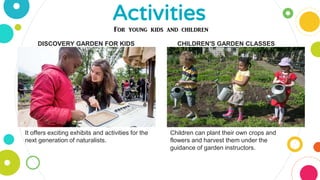
DISCOVERY GARDEN FOR KIDS CHILDREN'S GARDEN CLASSES
Children can plant their own crops and
flowers and harvest them under the
guidance of garden instructors.
It offers exciting exhibits and activities for the
next generation of naturalists.
For young kids and children
TEEN APPRENTICESHIPS
The Garden Apprentice Program (GAP) is a
way for teens to learn about urban
agriculture and the environment!
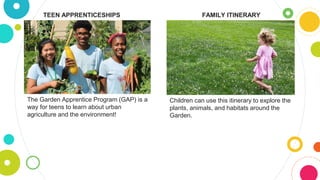
FAMILY ITINERARY
Children can use this itinerary to explore the
plants, animals, and habitats around the
Garden.
For Adults
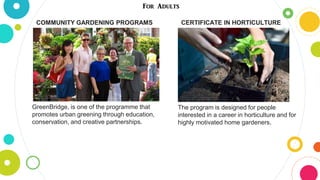
COMMUNITY GARDENING PROGRAMS
GreenBridge, is one of the programme that
promotes urban greening through education,
conservation, and creative partnerships.
CERTIFICATE IN HORTICULTURE
The program is designed for people
interested in a career in horticulture and for
highly motivated home gardeners.
SELF-GUIDED SCHOOLS &
CAMP GROUP VISITS
Teacher and Schools
URBAN ADVANTAGE PROGRAM
Encourages rich learning experiences.
Others Activities
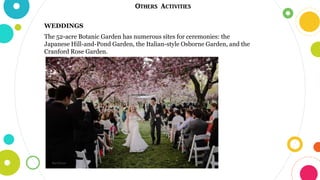
WEDDINGS
The 52-acre Botanic Garden has numerous sites for ceremonies: the
Japanese Hill-and-Pond Garden, the Italian-style Osborne Garden, and the
Cranford Rose Garden.
Building Features
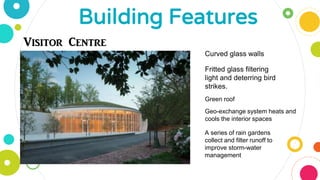
Visitor Centre
Curved glass walls
Fritted glass filtering
light and deterring bird
strikes.
Green roof
Geo-exchange system heats and
cools the interior spaces
A series of rain gardens
collect and filter runoff to
improve storm-water
management
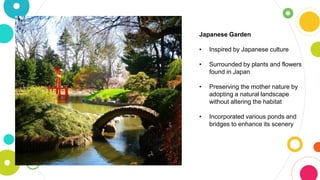
Japanese Garden
• Inspired by Japanese culture
• Surrounded by plants and flowers
found in Japan
• Preserving the mother nature by
adopting a natural landscape
without altering the habitat
• Incorporated various ponds and
bridges to enhance its scenery
Material Used
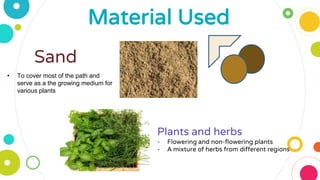
Sand
Plants and herbs
- Flowering and non-flowering plants
- A mixture of herbs from different regions
• To cover most of the path and
serve as a the growing medium for
various plants
Glasses
Concrete and cement
• To modernize the structures and
buildings
• Serves as the building blocks and material
for most of the structures and buildings
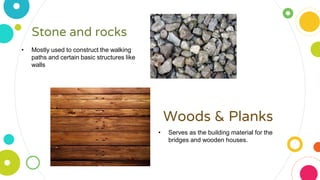
Stone and rocks
Woods & Planks
• Mostly used to construct the walking
paths and certain basic structures like
walls
• Serves as the building material for the
bridges and wooden houses.
Conclusion
• A botanical garden located in Brooklyn, New York
• Initially, was an unused land
• Known as the Gardens in Garden due to various types of
different garden being developed within it
• A natural source of tourist attraction
• Suitable for all walks of life, regardless of age, sex and
races due to various itinerary and programs installed for its
visitors
REFERENCES
http://www.nycgovparks.org/parks/brooklyn-botanic-garden/history
http://www.bbg.org/collections/gardens/rock_garden
THANK YOU

Epc final

  • 1.
    Effective Public Communication Presentation Presentedby Christina Chua Yi Mei 0323859 COM 30103 Thursday 8-10am BROOKLYN BOTANICAL GARDEN
  • 2.
    Introduction Brooklyn Botanic Garden(BBG) is a botanical garden which is located in Brooklyn, New York City. The Brooklyn Botanic Garden has been transformed into one of New York City’s most beautiful parks from a marshy wasteland.
  • 3.
    Historical Background ◎Founded in1910 ◎Located in Brooklyn, New York ◎52-acre ◎ Founded first by Dr. Charles Stuart Gager
  • 4.
    Harold Caparn • Appointedas the landscape architect in 1912 • Caparn saw the garden as an artistic and educational facility. • Borrowing a page from nature, he let the Brooklyn Botanic Garden organically grow over the course of decades • Adding sections as he could and refurbishing others when needed • Until it included over 13 separate gardens, buildings and museums when he left it in 1945.
  • 5.
    Initially known asthe Institute Park • Unused land (ash dump) • Run by the auspices of Brooklyn institute of Art and Sciences Started to serve as a botanical garden in Brooklyn on May 13, 1911
  • 6.
    Timeline Late 1800s Ash dump(unused land) 1897 New York legislation reserves 39 acres to serve as a botanic garden 1910 Founded first by Dr. Charles Stuart Gager 1911 - NOW Various modifications made and new landscapes being developed Brooklyn Botanical Garden ‘Gardens in Garden’
  • 7.
  • 9.
    LANDSCAPE FEATURES Artificial hillcontoured around the pond A waterfall
  • 10.
    A pond madefrom rocks - It also have a stone walkway to the opposite of the garden.
  • 11.
    ARCHITECTURE FEATURES wooden bridges stonelanterns a viewing pavilion
  • 12.
    Torii or gateway -atraditional Japanese gate most commonly found at the entrance of or within a Shinto Shrine. -it symbolize transition from profane to sacred. Shinto shrine - a structure whose main purpose is to house one or more Shinto. - It also used for safekeeping sacred objects and it is not for worship.
  • 13.
    Gardens in Garden CherryEsplanade Children’s Garden Discovery Garden Fragrance GardenHerb GardenJapanese Garden Rock Garden Rose Garden
  • 14.
    Rock Garden • Thisboulder-strewn slope provides some of the earliest signs of spring as well as brilliant color in the fall. • Uses boulders to define beds and create pockets of microclimates where a variety of plants are able to thrive. • Many of the plants showcased are compact and suited to growing in dry small spaces. • Many of the boulders that pepper the landscape were deposited here during the last ice age and unearthed during construction
  • 15.
    Rose Garden • Itis considered as one of the largest collections of roses in North America. • Was developed for beauty, disease resistance, and ease of care. • Next, it allows rose lovers make choices about what to grow in their own gardens
  • 16.
    Cherry Esplanade Cherry BlossomSeason • These double-flowering cherries typically bloom at the end of April • As a prelude to the Garden’s annual cherry blossom festival, Sakura Matsuri.
  • 17.
    Children Garden Here, children2 to 17 years old can • plant and harvest their own crops and flowers • under the guidance of garden instructors. Younger children combine planting, tending, and harvesting with craft making and creative play. Older children are offered with lessons in science and urban ecology
  • 18.
    Discovery Garden Kids ofall ages can explore • habitats • uncover plant mysteries • learn about garden wildlife at fun • hands-on exhibits throughout the Discovery Garden. Encourages children to explore nature through hands-on experiences
  • 19.
    Fragrance Garden • Createdin 1955 • Enjoyed by all visitors to Brooklyn Botanic Garden • Is an indulgence of all the senses. Arranged in 4 different themes: • Scented Leaves • Plants for Touch • Fragrant Flowers • Kitchen Herbs.
  • 20.
    Herb Garden • BrooklynBotanic Garden’s Herb Garden explores the origins, botany, and beauty of the plants we know as food. • Serves as a vibrant living classroom where the community can learn practical urban food gardening techniques. • Freely mixes medicinal and culinary herbs, vegetables, berries, fruit trees, and flowers.
  • 21.
    Japanese Garden • Oneof the oldest and most visited Japanese-inspired gardens outside Japan. • It is a blend of the ancient hill-and-pond style and the more recent stroll-garden style • The garden features artificial hills contoured around a pond, a waterfall, and an island while carefully placed rocks Among the major architectural elements of the garden are • wooden bridges • stone lanterns • a viewing pavilion • the torii or gateway • a Shinto shrine.
  • 22.
    Activities DISCOVERY GARDEN FORKIDS CHILDREN'S GARDEN CLASSES Children can plant their own crops and flowers and harvest them under the guidance of garden instructors. It offers exciting exhibits and activities for the next generation of naturalists. For young kids and children
  • 23.
    TEEN APPRENTICESHIPS The GardenApprentice Program (GAP) is a way for teens to learn about urban agriculture and the environment! FAMILY ITINERARY Children can use this itinerary to explore the plants, animals, and habitats around the Garden.
  • 24.
    For Adults COMMUNITY GARDENINGPROGRAMS GreenBridge, is one of the programme that promotes urban greening through education, conservation, and creative partnerships. CERTIFICATE IN HORTICULTURE The program is designed for people interested in a career in horticulture and for highly motivated home gardeners.
  • 25.
    SELF-GUIDED SCHOOLS & CAMPGROUP VISITS Teacher and Schools URBAN ADVANTAGE PROGRAM Encourages rich learning experiences.
  • 26.
    Others Activities WEDDINGS The 52-acreBotanic Garden has numerous sites for ceremonies: the Japanese Hill-and-Pond Garden, the Italian-style Osborne Garden, and the Cranford Rose Garden.
  • 27.
    Building Features Visitor Centre Curvedglass walls Fritted glass filtering light and deterring bird strikes. Green roof Geo-exchange system heats and cools the interior spaces A series of rain gardens collect and filter runoff to improve storm-water management
  • 28.
    Japanese Garden • Inspiredby Japanese culture • Surrounded by plants and flowers found in Japan • Preserving the mother nature by adopting a natural landscape without altering the habitat • Incorporated various ponds and bridges to enhance its scenery
  • 29.
    Material Used Sand Plants andherbs - Flowering and non-flowering plants - A mixture of herbs from different regions • To cover most of the path and serve as a the growing medium for various plants
  • 30.
    Glasses Concrete and cement •To modernize the structures and buildings • Serves as the building blocks and material for most of the structures and buildings
  • 31.
    Stone and rocks Woods& Planks • Mostly used to construct the walking paths and certain basic structures like walls • Serves as the building material for the bridges and wooden houses.
  • 32.
    Conclusion • A botanicalgarden located in Brooklyn, New York • Initially, was an unused land • Known as the Gardens in Garden due to various types of different garden being developed within it • A natural source of tourist attraction • Suitable for all walks of life, regardless of age, sex and races due to various itinerary and programs installed for its visitors
  • 33.
  • 34.