AREAS
TRIANGLES
• ∠A + ∠B + ∠C = 180o
• Perimeter = a + b + c = 2s
• Area = ½ (b)x (h); where b = side b which is the base
to the altitude h
Based on Heron’s Formula
• Area = 2s = √[s(s-a)(s-b)(s-c)]; where s = ½ (a+b+c)
a, b and c are three sides
of the triangle. ‘h’ is the
altitude. ∠A, ∠B and ∠C
are three angles of the
triangle
EQUILATERAL TRIANGLES
• All three sides have equal length
• ∠A = ∠B = ∠C = 60o
• Area = √ [¾ (a2)], where a is the length of the sides
• Altitude, h = √ [3/2 (a)]
Length of all the sides = ‘a’
A C
B
ac
b
h
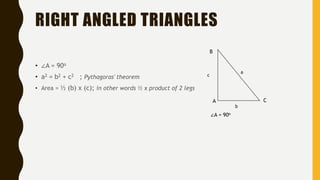
RIGHT ANGLED TRIANGLES
• ∠A = 90o
• a2 = b2 + c2 ; Pythagoras' theorem
• Area = ½ (b) x (c); in other words ½ x product of 2 legs
∠A = 90o
A C
B
a
c
b
ISOSCELES TRIANGLES
• Any 2 sides of the triangle are equal
• AD = b/2 and DC = b/2, BD is perpendicular dropped
on to the base b. It divides the side AC equally.
• Since AB = BC, corresponding angles ∠A = ∠C
• Area = b/4 [√
‘a’ is the length of 2 equal sides
A
C
B
aa
b
D
(4a2 - b2) ]
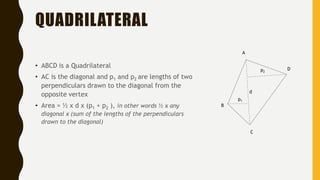
QUADRILATERAL
• ABCD is a Quadrilateral
• AC is the diagonal and p1 and p2 are lengths of two
perpendiculars drawn to the diagonal from the
opposite vertex
• Area = ½ x d x (p1 + p2 ), in other words ½ x any
diagonal x (sum of the lengths of the perpendiculars
drawn to the diagonal)
A
B
C
D
d
p1
p2
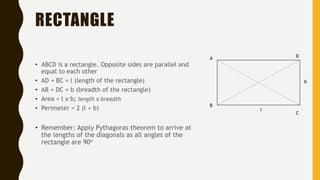
RECTANGLE
• ABCD is a rectangle. Opposite sides are parallel and
equal to each other
• AD = BC = l (length of the rectangle)
• AB = DC = b (breadth of the rectangle)
• Area = l x b; length x breadth
• Perimeter = 2 (l + b)
• Remember: Apply Pythagoras theorem to arrive at
the lengths of the diagonals as all angles of the
rectangle are 90o
A
B
C
D
l
b
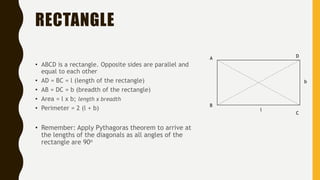
RECTANGLE
• ABCD is a rectangle. Opposite sides are parallel and
equal to each other
• AD = BC = l (length of the rectangle)
• AB = DC = b (breadth of the rectangle)
• Area = l x b; length x breadth
• Perimeter = 2 (l + b)
• Remember: Apply Pythagoras theorem to arrive at
the lengths of the diagonals as all angles of the
rectangle are 90o
A
B
C
D
l
b
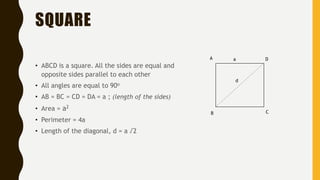
SQUARE
• ABCD is a square. All the sides are equal and
opposite sides parallel to each other
• All angles are equal to 90o
• AB = BC = CD = DA = a ; (length of the sides)
• Area = a2
• Perimeter = 4a
• Length of the diagonal, d = a √2
A
B C
Da
d
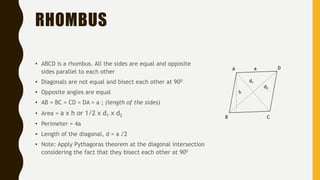
RHOMBUS
• ABCD is a rhombus. All the sides are equal and opposite
sides parallel to each other
• Diagonals are not equal and bisect each other at 900
• Opposite angles are equal
• AB = BC = CD = DA = a ; (length of the sides)
• Area = a x h or 1/2 x d1 x d2
• Perimeter = 4a
• Length of the diagonal, d = a √2
• Note: Apply Pythagoras theorem at the diagonal intersection
considering the fact that they bisect each other at 900
A
B C
D
d1
d2
h
a
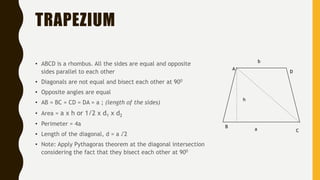
TRAPEZIUM
• ABCD is a rhombus. All the sides are equal and opposite
sides parallel to each other
• Diagonals are not equal and bisect each other at 900
• Opposite angles are equal
• AB = BC = CD = DA = a ; (length of the sides)
• Area = a x h or 1/2 x d1 x d2
• Perimeter = 4a
• Length of the diagonal, d = a √2
• Note: Apply Pythagoras theorem at the diagonal intersection
considering the fact that they bisect each other at 900
h
A
B
C
D
a
b

Areas (planes) - Formulas and Short-cuts

  • 1.
  • 2.
    TRIANGLES • ∠A +∠B + ∠C = 180o • Perimeter = a + b + c = 2s • Area = ½ (b)x (h); where b = side b which is the base to the altitude h Based on Heron’s Formula • Area = 2s = √[s(s-a)(s-b)(s-c)]; where s = ½ (a+b+c) a, b and c are three sides of the triangle. ‘h’ is the altitude. ∠A, ∠B and ∠C are three angles of the triangle
  • 3.
    EQUILATERAL TRIANGLES • Allthree sides have equal length • ∠A = ∠B = ∠C = 60o • Area = √ [¾ (a2)], where a is the length of the sides • Altitude, h = √ [3/2 (a)] Length of all the sides = ‘a’ A C B ac b h
  • 4.
    RIGHT ANGLED TRIANGLES •∠A = 90o • a2 = b2 + c2 ; Pythagoras' theorem • Area = ½ (b) x (c); in other words ½ x product of 2 legs ∠A = 90o A C B a c b
  • 5.
    ISOSCELES TRIANGLES • Any2 sides of the triangle are equal • AD = b/2 and DC = b/2, BD is perpendicular dropped on to the base b. It divides the side AC equally. • Since AB = BC, corresponding angles ∠A = ∠C • Area = b/4 [√ ‘a’ is the length of 2 equal sides A C B aa b D (4a2 - b2) ]
  • 6.
    QUADRILATERAL • ABCD isa Quadrilateral • AC is the diagonal and p1 and p2 are lengths of two perpendiculars drawn to the diagonal from the opposite vertex • Area = ½ x d x (p1 + p2 ), in other words ½ x any diagonal x (sum of the lengths of the perpendiculars drawn to the diagonal) A B C D d p1 p2
  • 7.
    RECTANGLE • ABCD isa rectangle. Opposite sides are parallel and equal to each other • AD = BC = l (length of the rectangle) • AB = DC = b (breadth of the rectangle) • Area = l x b; length x breadth • Perimeter = 2 (l + b) • Remember: Apply Pythagoras theorem to arrive at the lengths of the diagonals as all angles of the rectangle are 90o A B C D l b
  • 8.
    RECTANGLE • ABCD isa rectangle. Opposite sides are parallel and equal to each other • AD = BC = l (length of the rectangle) • AB = DC = b (breadth of the rectangle) • Area = l x b; length x breadth • Perimeter = 2 (l + b) • Remember: Apply Pythagoras theorem to arrive at the lengths of the diagonals as all angles of the rectangle are 90o A B C D l b
  • 9.
    SQUARE • ABCD isa square. All the sides are equal and opposite sides parallel to each other • All angles are equal to 90o • AB = BC = CD = DA = a ; (length of the sides) • Area = a2 • Perimeter = 4a • Length of the diagonal, d = a √2 A B C Da d
  • 10.
    RHOMBUS • ABCD isa rhombus. All the sides are equal and opposite sides parallel to each other • Diagonals are not equal and bisect each other at 900 • Opposite angles are equal • AB = BC = CD = DA = a ; (length of the sides) • Area = a x h or 1/2 x d1 x d2 • Perimeter = 4a • Length of the diagonal, d = a √2 • Note: Apply Pythagoras theorem at the diagonal intersection considering the fact that they bisect each other at 900 A B C D d1 d2 h a
  • 11.
    TRAPEZIUM • ABCD isa rhombus. All the sides are equal and opposite sides parallel to each other • Diagonals are not equal and bisect each other at 900 • Opposite angles are equal • AB = BC = CD = DA = a ; (length of the sides) • Area = a x h or 1/2 x d1 x d2 • Perimeter = 4a • Length of the diagonal, d = a √2 • Note: Apply Pythagoras theorem at the diagonal intersection considering the fact that they bisect each other at 900 h A B C D a b