MATHEMATICS 
LABORATORY 
Mathematics Laboratory is a place where students can learn and 
explore mathematical concepts and verify mathematical facts 
and theorems through a variety of activities using different 
materials.These activities may be carried out by the teacher or 
the student to explore, to learn, to stimulate interest and develop 
favourable attitude towards mathematics. 
Laboratory in Mathematics is the brain child of Mr.Sreedhara 
Chandra Sekhara Sastry, a creative mathematician. The Maths 
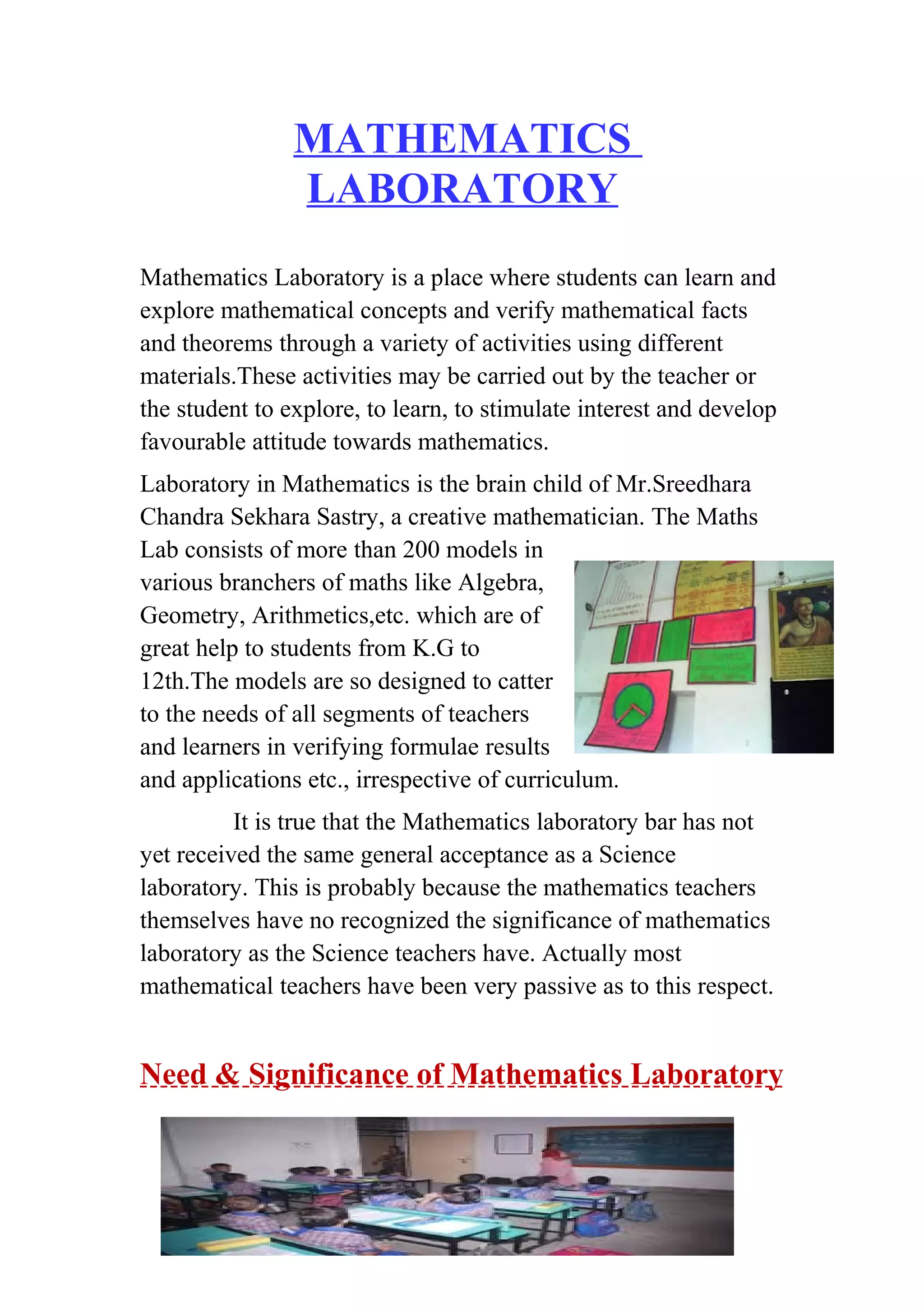
Lab consists of more than 200 models in 
various branchers of maths like Algebra, 
Geometry, Arithmetics,etc. which are of 
great help to students from K.G to 
12th.The models are so designed to catter 
to the needs of all segments of teachers 
and learners in verifying formulae results 
and applications etc., irrespective of curriculum. 
It is true that the Mathematics laboratory bar has not 
yet received the same general acceptance as a Science 
laboratory. This is probably because the mathematics teachers 
themselves have no recognized the significance of mathematics 
laboratory as the Science teachers have. Actually most 
mathematical teachers have been very passive as to this respect. 
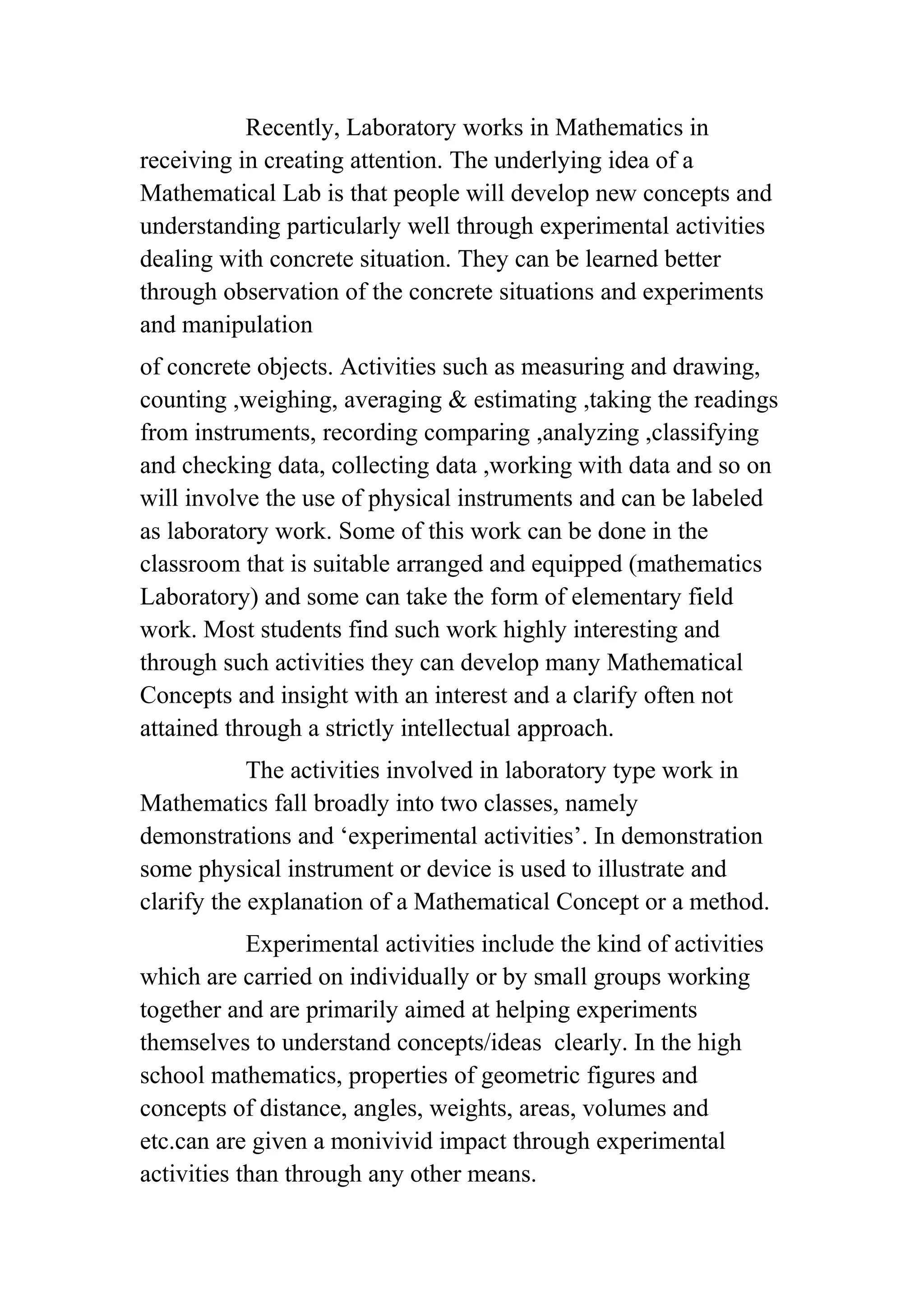
Need & Significance of Mathematics Laboratory
Recently, Laboratory works in Mathematics in 
receiving in creating attention. The underlying idea of a 
Mathematical Lab is that people will develop new concepts and 
understanding particularly well through experimental activities 
dealing with concrete situation. They can be learned better 
through observation of the concrete situations and experiments 
and manipulation 
of concrete objects. Activities such as measuring and drawing, 
counting ,weighing, averaging & estimating ,taking the readings 
from instruments, recording comparing ,analyzing ,classifying 
and checking data, collecting data ,working with data and so on 
will involve the use of physical instruments and can be labeled 
as laboratory work. Some of this work can be done in the 
classroom that is suitable arranged and equipped (mathematics 
Laboratory) and some can take the form of elementary field 
work. Most students find such work highly interesting and 
through such activities they can develop many Mathematical 
Concepts and insight with an interest and a clarify often not 
attained through a strictly intellectual approach. 
The activities involved in laboratory type work in 
Mathematics fall broadly into two classes, namely 
demonstrations and ‘experimental activities’. In demonstration 
some physical instrument or device is used to illustrate and 
clarify the explanation of a Mathematical Concept or a method. 
Experimental activities include the kind of activities 
which are carried on individually or by small groups working 
together and are primarily aimed at helping experiments 
themselves to understand concepts/ideas clearly. In the high 
school mathematics, properties of geometric figures and 
concepts of distance, angles, weights, areas, volumes and 
etc.can are given a monivivid impact through experimental 
activities than through any other means.
Materials & Equipments for a Mathematics 
Laboratory 
For the effective functioning of a Mathematics 
Laboratory, it should be well occupied. A mathematics Lab may 
contain the following type of materials & equipments. 
Materials 
* Concrete Materials
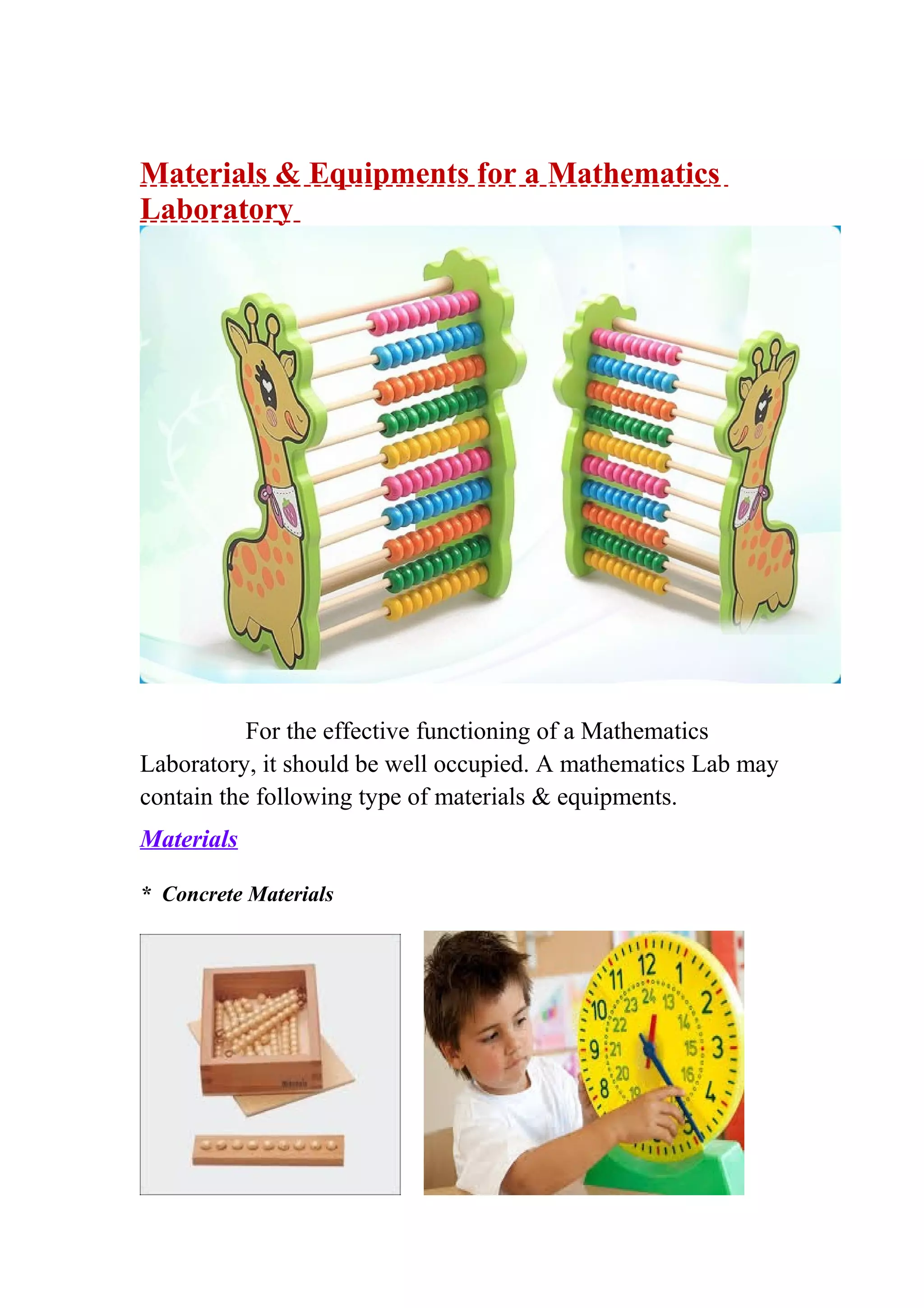
The Mathematics Lab should contain materials such as 
beads, pebbles, sticks ball frames, seeds, balances, weight 
measuring tapes,scisssors,pins,abacus, carboard,boardpins, chart 
paper, graph paper,etc. which are very helpful for demonstrating 
elementary mathematical concepts. 
* Pictures & Charts 
Pictures & Charts depicting different mathematical 
concepts should find a place in a Mathematics Laboratory, 
Pictures of Mathematicians; charts showing the contributions o 
mathematician, History of Mathematics, biographers of 
mathematicians are also very helpful for demonstrating students 
and can be placed in the Mathematical Lab. 
* Models 
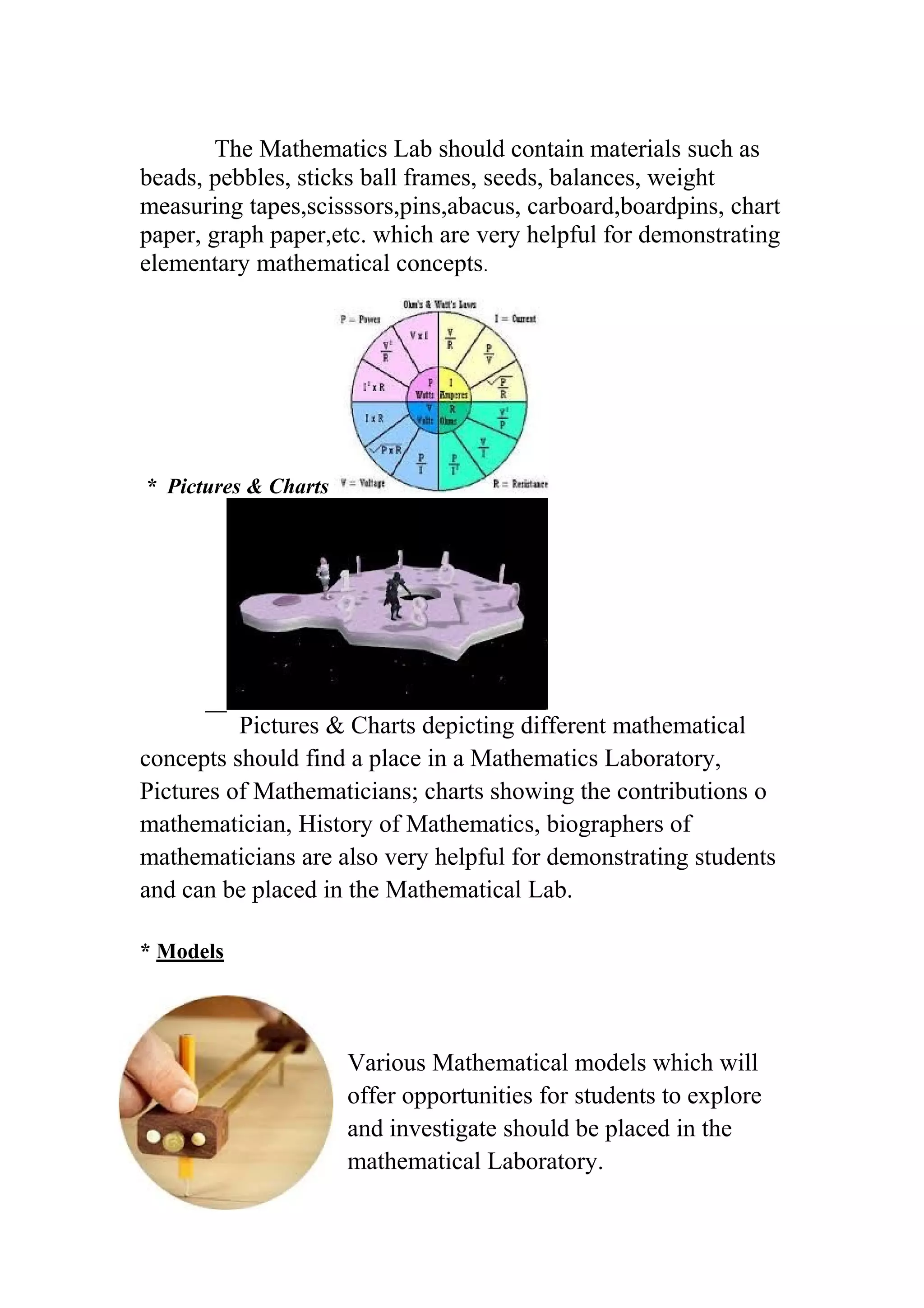
Various Mathematical models which will 
offer opportunities for students to explore 
and investigate should be placed in the 
mathematical Laboratory.
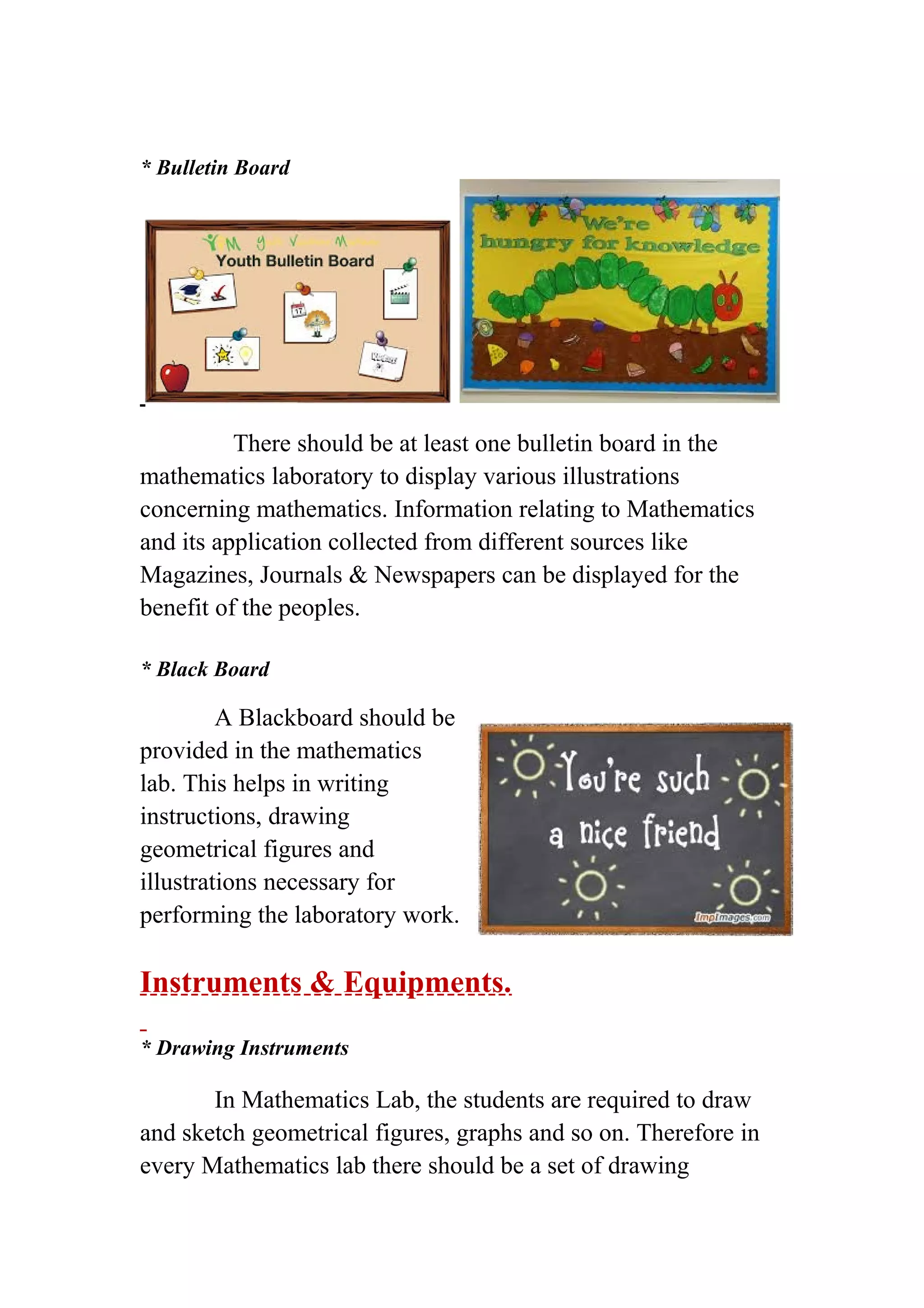
* Bulletin Board 
There should be at least one bulletin board in the 
mathematics laboratory to display various illustrations 
concerning mathematics. Information relating to Mathematics 
and its application collected from different sources like 
Magazines, Journals & Newspapers can be displayed for the 
benefit of the peoples. 
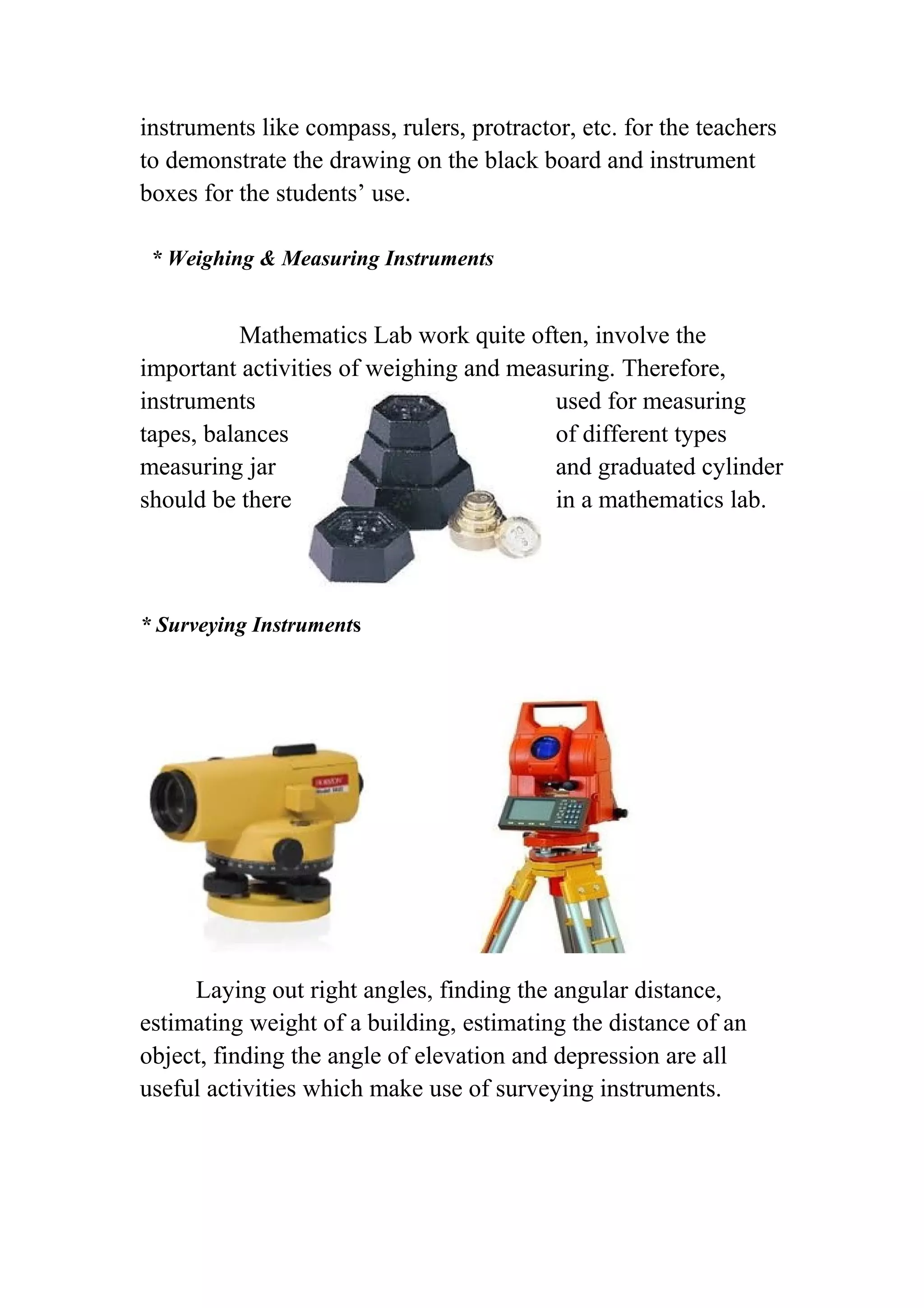
* Black Board 
A Blackboard should be 
provided in the mathematics 
lab. This helps in writing 
instructions, drawing 
geometrical figures and 
illustrations necessary for 
performing the laboratory work. 
Instruments & Equipments. 
* Drawing Instruments 
In Mathematics Lab, the students are required to draw 
and sketch geometrical figures, graphs and so on. Therefore in 
every Mathematics lab there should be a set of drawing
instruments like compass, rulers, protractor, etc. for the teachers 
to demonstrate the drawing on the black board and instrument 
boxes for the students’ use. 
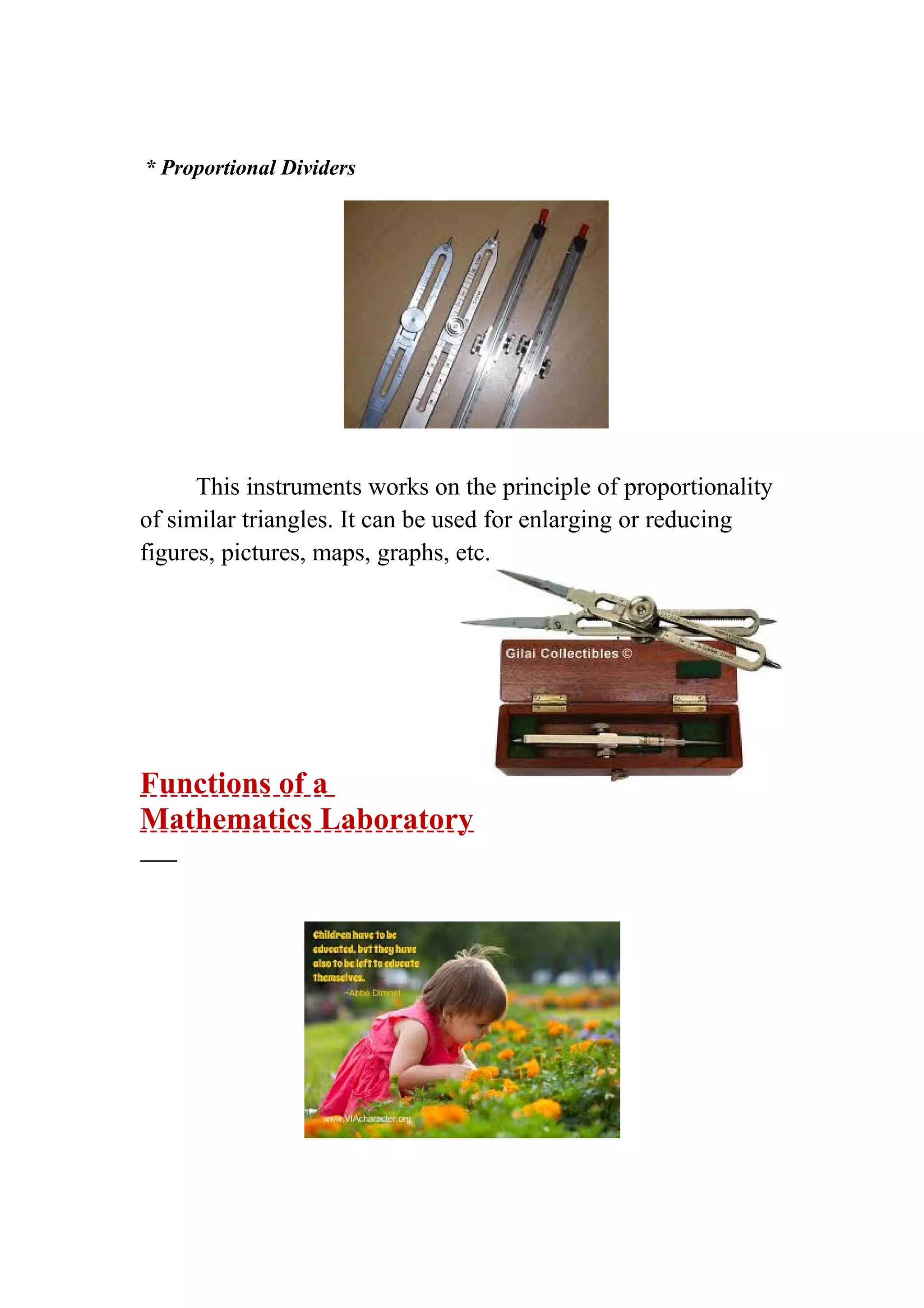
* Weighing & Measuring Instruments 
Mathematics Lab work quite often, involve the 
important activities of weighing and measuring. Therefore, 
instruments used for measuring 
tapes, balances of different types 
measuring jar and graduated cylinder 
should be there in a mathematics lab. 
* Surveying Instruments 
Laying out right angles, finding the angular distance, 
estimating weight of a building, estimating the distance of an 
object, finding the angle of elevation and depression are all 
useful activities which make use of surveying instruments.
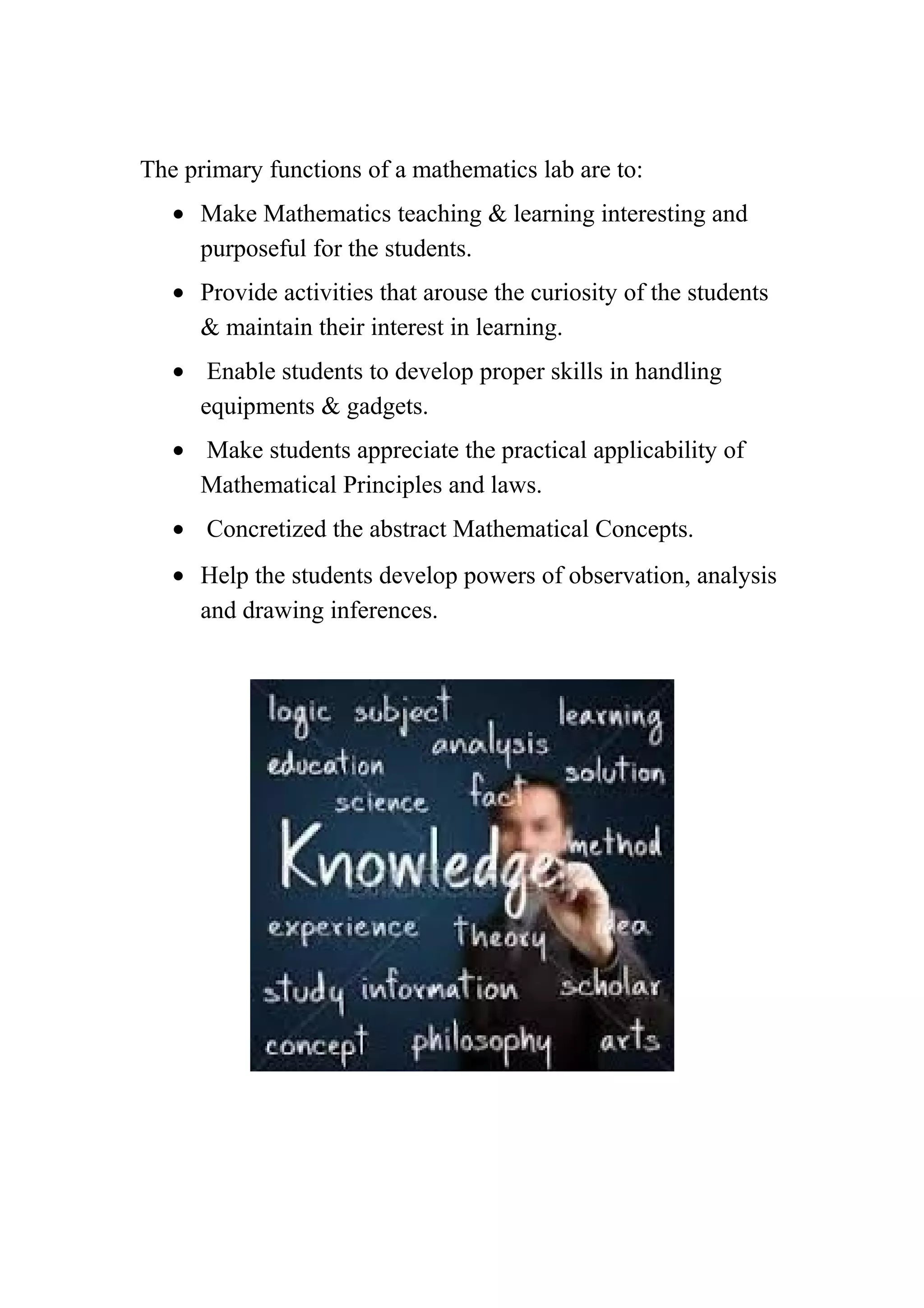
* Proportional Dividers 
This instruments works on the principle of proportionality 
of similar triangles. It can be used for enlarging or reducing 
figures, pictures, maps, graphs, etc. 
Functions of a 
Mathematics Laboratory
The primary functions of a mathematics lab are to: 
· Make Mathematics teaching & learning interesting and 
purposeful for the students. 
· Provide activities that arouse the curiosity of the students 
& maintain their interest in learning. 
· Enable students to develop proper skills in handling 
equipments & gadgets. 
· Make students appreciate the practical applicability of 
Mathematical Principles and laws. 
· Concretized the abstract Mathematical Concepts. 
· Help the students develop powers of observation, analysis 
and drawing inferences.
Do your students rejoice mathematics or are phobic to it? 
"The essence of mathematics is not to make simple things complicated but to make 
complicated things simple." 
THE END
Do your students rejoice mathematics or are phobic to it? 
"The essence of mathematics is not to make simple things complicated but to make 
complicated things simple." 
THE END

Mathematics laboratory saju kumari

  • 1.
    MATHEMATICS LABORATORY MathematicsLaboratory is a place where students can learn and explore mathematical concepts and verify mathematical facts and theorems through a variety of activities using different materials.These activities may be carried out by the teacher or the student to explore, to learn, to stimulate interest and develop favourable attitude towards mathematics. Laboratory in Mathematics is the brain child of Mr.Sreedhara Chandra Sekhara Sastry, a creative mathematician. The Maths Lab consists of more than 200 models in various branchers of maths like Algebra, Geometry, Arithmetics,etc. which are of great help to students from K.G to 12th.The models are so designed to catter to the needs of all segments of teachers and learners in verifying formulae results and applications etc., irrespective of curriculum. It is true that the Mathematics laboratory bar has not yet received the same general acceptance as a Science laboratory. This is probably because the mathematics teachers themselves have no recognized the significance of mathematics laboratory as the Science teachers have. Actually most mathematical teachers have been very passive as to this respect. Need & Significance of Mathematics Laboratory
  • 2.
    Recently, Laboratory worksin Mathematics in receiving in creating attention. The underlying idea of a Mathematical Lab is that people will develop new concepts and understanding particularly well through experimental activities dealing with concrete situation. They can be learned better through observation of the concrete situations and experiments and manipulation of concrete objects. Activities such as measuring and drawing, counting ,weighing, averaging & estimating ,taking the readings from instruments, recording comparing ,analyzing ,classifying and checking data, collecting data ,working with data and so on will involve the use of physical instruments and can be labeled as laboratory work. Some of this work can be done in the classroom that is suitable arranged and equipped (mathematics Laboratory) and some can take the form of elementary field work. Most students find such work highly interesting and through such activities they can develop many Mathematical Concepts and insight with an interest and a clarify often not attained through a strictly intellectual approach. The activities involved in laboratory type work in Mathematics fall broadly into two classes, namely demonstrations and ‘experimental activities’. In demonstration some physical instrument or device is used to illustrate and clarify the explanation of a Mathematical Concept or a method. Experimental activities include the kind of activities which are carried on individually or by small groups working together and are primarily aimed at helping experiments themselves to understand concepts/ideas clearly. In the high school mathematics, properties of geometric figures and concepts of distance, angles, weights, areas, volumes and etc.can are given a monivivid impact through experimental activities than through any other means.
  • 3.
    Materials & Equipmentsfor a Mathematics Laboratory For the effective functioning of a Mathematics Laboratory, it should be well occupied. A mathematics Lab may contain the following type of materials & equipments. Materials * Concrete Materials
  • 4.
    The Mathematics Labshould contain materials such as beads, pebbles, sticks ball frames, seeds, balances, weight measuring tapes,scisssors,pins,abacus, carboard,boardpins, chart paper, graph paper,etc. which are very helpful for demonstrating elementary mathematical concepts. * Pictures & Charts Pictures & Charts depicting different mathematical concepts should find a place in a Mathematics Laboratory, Pictures of Mathematicians; charts showing the contributions o mathematician, History of Mathematics, biographers of mathematicians are also very helpful for demonstrating students and can be placed in the Mathematical Lab. * Models Various Mathematical models which will offer opportunities for students to explore and investigate should be placed in the mathematical Laboratory.
  • 5.
    * Bulletin Board There should be at least one bulletin board in the mathematics laboratory to display various illustrations concerning mathematics. Information relating to Mathematics and its application collected from different sources like Magazines, Journals & Newspapers can be displayed for the benefit of the peoples. * Black Board A Blackboard should be provided in the mathematics lab. This helps in writing instructions, drawing geometrical figures and illustrations necessary for performing the laboratory work. Instruments & Equipments. * Drawing Instruments In Mathematics Lab, the students are required to draw and sketch geometrical figures, graphs and so on. Therefore in every Mathematics lab there should be a set of drawing
  • 6.
    instruments like compass,rulers, protractor, etc. for the teachers to demonstrate the drawing on the black board and instrument boxes for the students’ use. * Weighing & Measuring Instruments Mathematics Lab work quite often, involve the important activities of weighing and measuring. Therefore, instruments used for measuring tapes, balances of different types measuring jar and graduated cylinder should be there in a mathematics lab. * Surveying Instruments Laying out right angles, finding the angular distance, estimating weight of a building, estimating the distance of an object, finding the angle of elevation and depression are all useful activities which make use of surveying instruments.
  • 7.
    * Proportional Dividers This instruments works on the principle of proportionality of similar triangles. It can be used for enlarging or reducing figures, pictures, maps, graphs, etc. Functions of a Mathematics Laboratory
  • 8.
    The primary functionsof a mathematics lab are to: · Make Mathematics teaching & learning interesting and purposeful for the students. · Provide activities that arouse the curiosity of the students & maintain their interest in learning. · Enable students to develop proper skills in handling equipments & gadgets. · Make students appreciate the practical applicability of Mathematical Principles and laws. · Concretized the abstract Mathematical Concepts. · Help the students develop powers of observation, analysis and drawing inferences.
  • 9.
    Do your studentsrejoice mathematics or are phobic to it? "The essence of mathematics is not to make simple things complicated but to make complicated things simple." THE END
  • 10.
    Do your studentsrejoice mathematics or are phobic to it? "The essence of mathematics is not to make simple things complicated but to make complicated things simple." THE END