Mathematics Including Technology on the MTSS Continuum:  Solutions for Practice
Agenda for Today Consider MTSS - Overview Connection to Resources Connection to Elementary/Middle/High - What we Know Tiers and Technology Structuring technology considerations Technology-based solutions
Who am I? Associate Professor Father of Four Who are you?
MTSS Primer MTSS stands for? There are _____ tiers? Three critical features of MTSS include: ___ ___ ___
Three Models (Uses) of MTSS Prediction & Prevention prediction of at-risk students and preventing students from falling behind Remediation intervention for students with academic or behavioral difficulties Disability Assessment an intensive intervention test that is one component in the SLD determination process
Critical Elements of MTSS Implementation of a differentiated curriculum with different instructional methods  Two or more tiers of increasingly intense, scientific, research-based interventions
Critical Elements of MTSS Individual problem-solving model or standardized intervention protocol for intervention tiers (possibly in combination) Progress monitoring to assess entire class progress and individual student progress Explicit decision rules for assessing learners’ progress (e.g., level and/or rate)
What Does MTSS Implementation Look Like? Students receive high-quality, research-based instruction by qualified staff in their general education setting (primary intervention) General education instructors and staff assume an active role in students’ assessment in that curriculum School staff conduct universal screening  of (a) academics and (b) behavior (> 1/yr) School staff implement specific, research-based interventions to address the students’ difficulties
Core of MTSS Please list  three  research-based practices that you use across the course of a week? Describe it? How do you know it is evidence-based?
Do we Teach to Learning Styles? What Type of Learner Are You? I like to: Hear it… See it… Touch it… Read it… Experience it… What is your Learning Style?
Learning Styles - Research-based? Structure experiences based on the type of learner we believe our students to be… Offer more visual experiences because we have a class of visual learners… Hands-on experiences for those tactile learners… Auditory experiences for those that learn best through listening…   Examples?
MTSS @ the Middle/High School
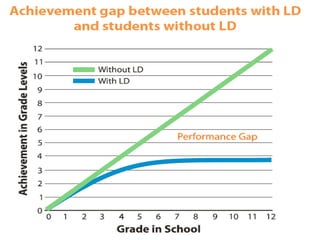
Why the Need for MTSS? School Implications for Mathematics
Implications - Needs Literacy Mathematics Behavior
Identify Challenges and Solutions A Synopsis of a Synthesis of Empirical Research on Teaching Mathematics to Low-Achieving Students   Mathematics Instruction for Students with Learning Disabilities or Difficultly Learning Mathematics Response to Intervention: The Future for Secondary Schools Part I & II IES Practice Guide for Assisting Students Struggling with Mathematics: Response to Intervention (RtI) for Elementary and Middle Schools Meeting the Needs of Significantly Struggling Learners in HS: A Look at Approaches to Tiered Intervention
Seven Effective Instructional Practices The Final Report of the National Mathematics Advisory Panel (National Mathematics Advisory Panel, 2008)
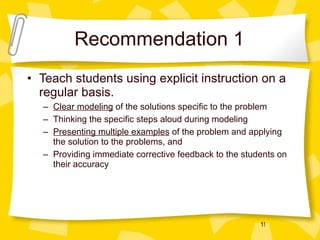
Recommendation 1 Teach students using explicit instruction on a regular basis. Clear modeling  of the solutions specific to the problem Thinking the specific steps aloud during modeling Presenting multiple examples  of the problem and applying the solution to the problems, and Providing immediate corrective feedback to the students on their accuracy
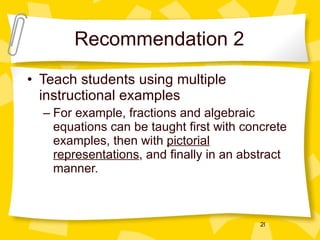
Recommendation 2 Teach students using multiple instructional examples For example, fractions and algebraic equations can be taught first with concrete examples, then with  pictorial representations , and finally in an abstract manner.
Recommendation 3 Have students verbalize decisions and solutions to a math problem Verbalize specific steps Think outloud
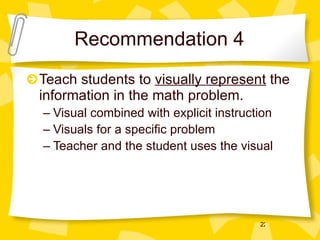
Recommendation 4 Teach students to  visually represent  the information in the math problem. Visual combined with explicit instruction Visuals for a specific problem Teacher and the student uses the visual
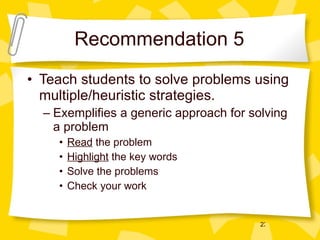
Recommendation 5 Teach students to solve problems using multiple/heuristic strategies. Exemplifies a generic approach for solving a problem Read  the problem Highlight  the key words Solve the problems Check your work
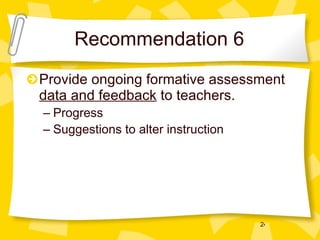
Recommendation 6 Provide ongoing formative assessment  data and feedback  to teachers. Progress Suggestions to alter instruction
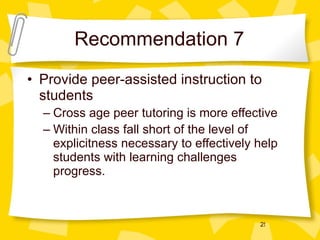
Recommendation 7 Provide peer-assisted instruction to students Cross age peer tutoring is more effective  Within class fall short of the level of explicitness necessary to effectively help students with learning challenges progress.
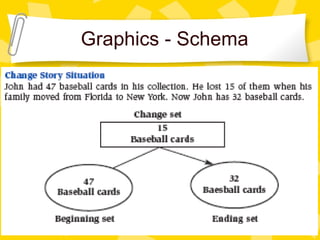
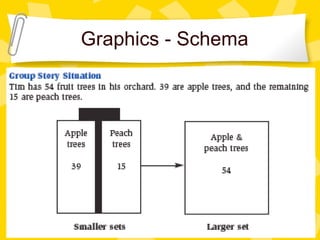
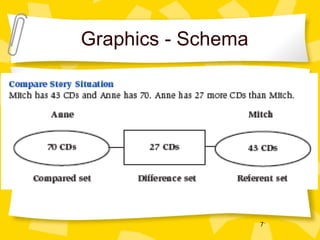
Recommendation - MTSS Interventions should include instruction on solving word problems that is based on common underlying structures. Explicit Systematic Connections between known, familiar word problems and unfamiliar, new problems.
Recommendation - MTSS Teach students about the structure of various problem types, how to  categorize problems  based on structure, and how to determine appropriate solutions for each problem type.
Recommendations - MTSS Intervention materials should include opportunities for students to work with visual representations of mathematical ideas and interventionists should be proficient in the use of  visual representation  of mathematical ideas.
Recommendation Monitor progress of students receiving supplemental instruction and other students who are at risk. Include motivational strategies in tier 2 and 3 interventions
Brief Look - Textbooks/Reading History Mathematics Science
Math - Text - Expectations Understand and apply word problems Understand and apply graphic illustrations Ability to understand how book is structured and thus to use To use the text to become independent learners in respect to mathematics Comprehend and apply data
Math - Text - Expectations Need to offer information within real world context Need explicit and repeated instruction on specific language and form of mathematics
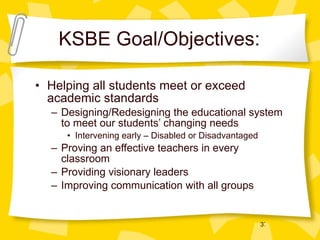
KSBE Goal/Objectives: Helping all students meet or exceed academic standards Designing/Redesigning the educational system to meet our students’ changing needs Intervening early – Disabled or Disadvantaged Proving an effective teachers in every classroom Providing visionary leaders Improving communication with all groups
What is MTSS? Response to Intervention  Early Intervening School Improvement System Design/Redesign All Students Achieve
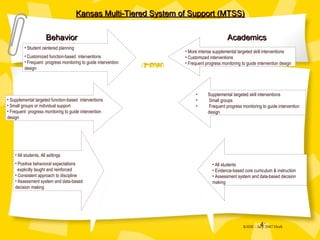
Kansas Multi-Tiered System of Support (MTSS) Academics Behavior KSDE - July 2007 Draft More intense supplemental targeted skill interventions Customized interventions Frequent progress monitoring to guide intervention design Student centered planning Customized function-based  interventions Frequent  progress monitoring to guide intervention design  All students Evidence-based core curriculum & instruction Assessment system and data-based decision making All students, All settings Positive behavioral expectations explicitly taught and reinforced Consistent approach to discipline Assessment system and data-based  decision making Supplemental targeted function-based  interventions Small groups or individual support Frequent  progress monitoring to guide intervention design Supplemental targeted skill interventions  Small groups Frequent progress monitoring to guide intervention design
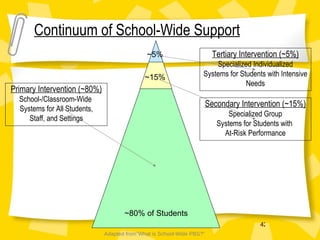
Primary Intervention (~80%) School-/Classroom-Wide  Systems for All Students, Staff, and Settings Secondary Intervention (~15%) Specialized Group Systems for Students with  At-Risk Performance Tertiary Intervention (~5%) Specialized Individualized Systems for Students with Intensive Needs ~80% of Students ~15%  ~5%  Continuum of School-Wide Support Adapted from”What is School-Wide PBS?”
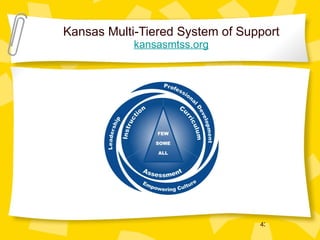
Kansas Multi-Tiered System of Support kansasmtss.org
Part of the Solution - MTSS Planning teams Scheduling intervention Scheduling interaction Need for collaboration skills Capacity building Collaboration Considering data and the continued use of data driven decisions
Activity Time
MTSS Interventions Let’s take a few minutes and consider the interventions we are currently using or considering: Tier One Tier Two Tier Three What are some? What is the Research behind these interventions?
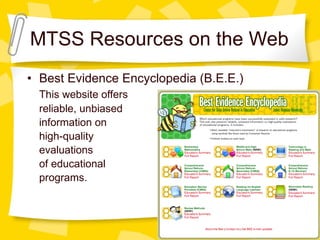
MTSS Resources on the Web Best Evidence Encyclopedia (B.E.E.) This website offers reliable, unbiased  information on high-quality evaluations of educational programs.
What We Know What Works Clearinghouse ies.ed.gov/ncee/wwc Institute of Education Science’s Database sharing what we know about related research specific to standards and the research arm of NCLB.
RtI Action Network A program of the National Center for Learning Disabilities  Offers a guide educators and families in the large-scale implementation of RTI Access research reports How to tips Temperature of what is happening in the field
National Center on RtI Technical assistance to states and districts and building the capacity of states to assist districts in implementing proven models for RTI. Reports Products for consideration Evidence-based practices for High School Considerations for implementation
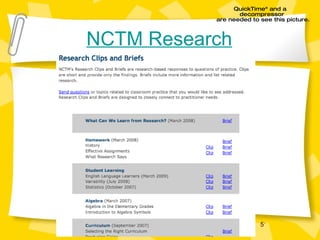
NCTM Research
What We Know Resources - Application Tomorrow Math and Reading Help http://math-and-reading-help-for-kids.org LD Online http://www.ldonline.org/indepth/math Intervention Central http://www.interventioncentral.org/
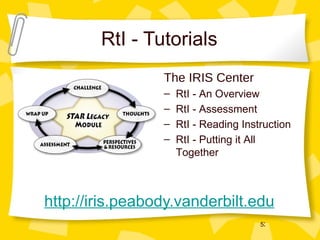
RtI - Tutorials http://iris.peabody.vanderbilt.edu The IRIS Center RtI - An Overview RtI - Assessment RtI - Reading Instruction RtI - Putting it All Together
Progress Monitoring  National Center on Progress Monitoring Tools for comparison Tools for understanding ways to complete Resources for application Teacher Family Administrator
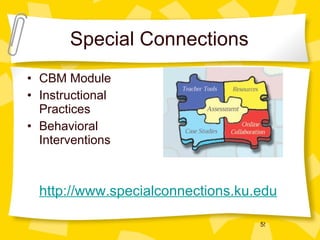
Special Connections CBM Module Instructional Practices Behavioral Interventions http://www.specialconnections.ku.edu
How do we Structure our Interventions? Framework for Consideration
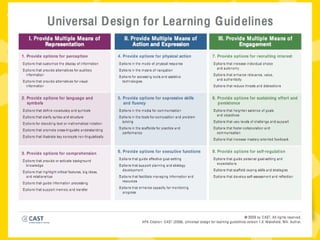
Principle One Supporting Recognition Learning Provide multiple examples Highlight critical features Provide multiple media formats Support background contexts
Some Examples Reading Readplease.com Texthelp.com Setting an Anchor http://streaming.discoveryeducation.com/ Representing Material http://nlvm.usu.edu/en/NAV/vlibrary.html
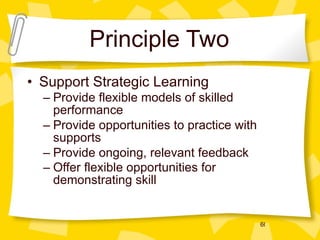
Principle Two Support Strategic Learning Provide flexible models of skilled performance  Provide opportunities to practice with supports  Provide ongoing, relevant feedback  Offer flexible opportunities for demonstrating skill
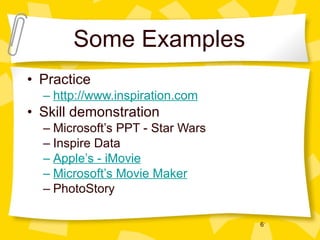
Some Examples Practice http://www.inspiration.com Skill demonstration Microsoft’s PPT - Star Wars Inspire Data Apple’s - iMovie Microsoft’s Movie Maker PhotoStory
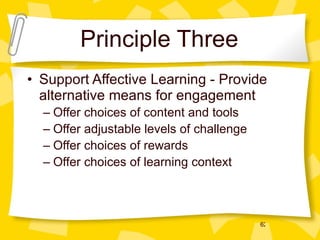
Principle Three Support Affective Learning - Provide alternative means for engagement Offer choices of content and tools  Offer adjustable levels of challenge  Offer choices of rewards  Offer choices of learning context
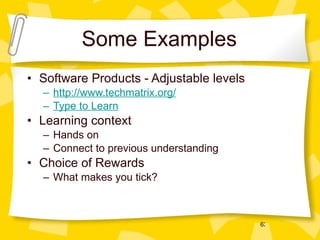
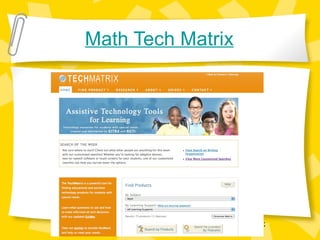
Some Examples Software Products - Adjustable levels http://www.techmatrix.org/ Type to Learn Learning context Hands on Connect to previous understanding Choice of Rewards What makes you tick?
UDL Toolkit http://udltechtoolkit.wikispaces.com http://readilyaccessibletools.wikispaces.com/ Learn more about UDL UDL-based solutions tied to reading, organization, writing, etc. Wikis are free to all of us Disseminate information Demonstrate knowledge Communicate with parents/students/general community
Technology-based Solutions Bringing UDL to Life
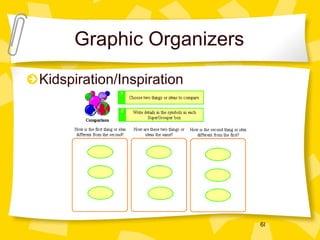
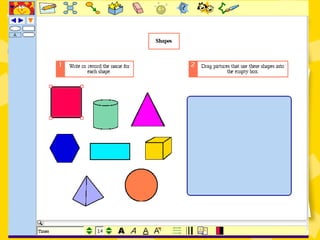
Graphic Organizers Teaching Students Math Problem-solving Through Graphic Representations
Graphic Organizers Kidspiration/Inspiration
Graphics - Schema
Graphics - Schema
Graphics - Schema
Visual Representation A Few Examples
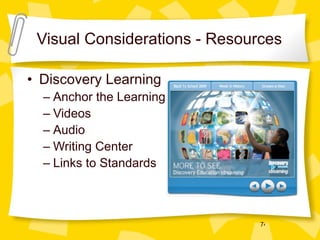
Visual Considerations - Resources Discovery Learning Anchor the Learning Videos Audio Writing Center Links to Standards
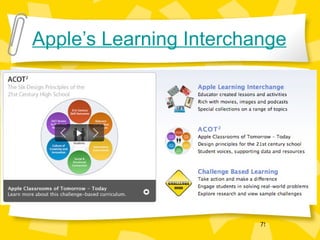
Apple’s Learning Interchange
Photo Story Show - n - Tell Share Your Stories Create Stories Runs free on Windows http://www.microsoft.com/windowsxp/using/digitalphotography/photostory/photostory3_share.mspx
Developing Visual Connections Apple Learning Interchange http://edcommunity.apple.com/ali/ ABCs All Quiet on the Western Front Apple’s iMovie -  apple.com Microsoft’s MovieMaker -  microsoft.com
Some Examples Let’s check out the Handout Learn Alberta  -  learnalberta.ca  - parts free & offers across the grade and content level illustrations. Brain Pop  -  brainpop.com  - for pay but visually displays (offers text as well) information - context for the user.
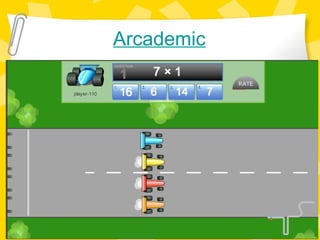
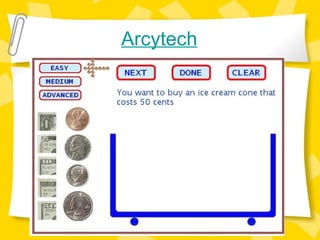
Math Games A few Considerations
Arcademic
Arcytech
Math Tech Matrix
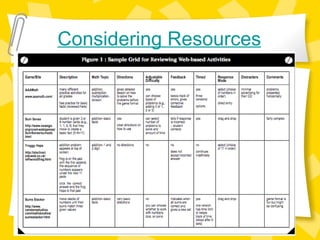
Considering Resources
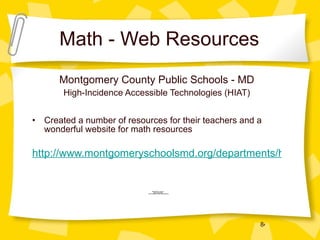
Math - Web Resources Montgomery County Public Schools - MD High-Incidence Accessible Technologies (HIAT) Created a number of resources for their teachers and a wonderful website for math resources http://www.montgomeryschoolsmd.org/departments/hiat/resources/digital_text.shtm
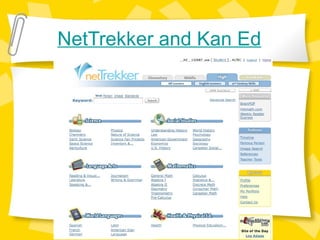
NetTrekker and Kan Ed
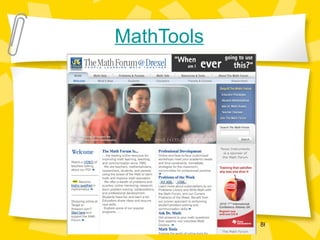
MathTools
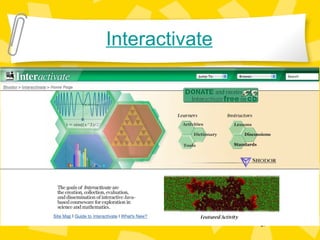
Interactivate
Mathematics Considerations - Resources Illuminations http://illuminations.nctm.org/ Lessons Student Interactive Resources Web Resources for Mathematics Thinkfinity http://www.thinkfinity.org/ Manages the Literacy Network Manages Marco Polo
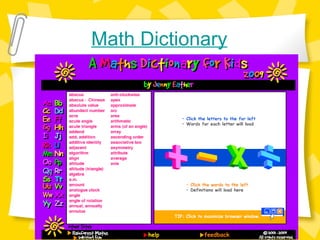
Math Dictionary
Web 2.0 Considerations Additional Resources to Consider
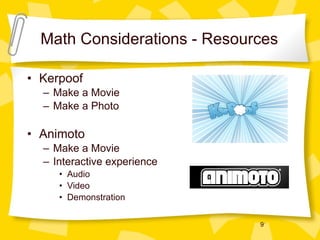
Math Considerations - Resources Kerpoof Make a Movie Make a Photo Animoto Make a Movie Interactive experience Audio Video Demonstration
Text-to-Speech Do we Really Need to Read It?
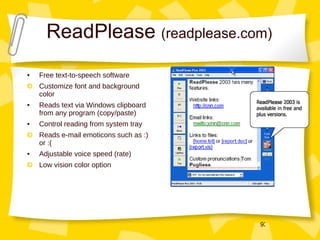
ReadPlease  (readplease.com) Free text-to-speech software Customize font and background color Reads text via Windows clipboard from any program (copy/paste) Control reading from system tray Reads e-mail emoticons such as :) or :( Adjustable voice speed (rate) Low vision color option
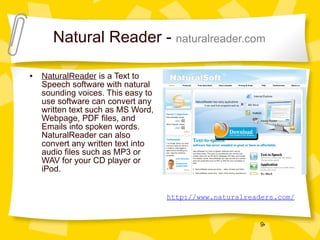
Natural Reader -  naturalreader.com NaturalReader  is a Text to Speech software with natural sounding voices. This easy to use software can convert any written text such as MS Word, Webpage, PDF files, and Emails into spoken words. NaturalReader can also convert any written text into audio files such as MP3 or WAV for your CD player or iPod. http://www.naturalreaders.com/
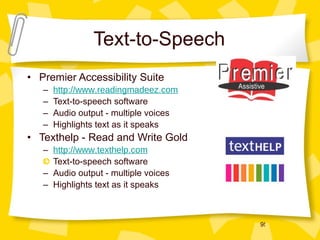
Premier Accessibility Suite http://www.readingmadeez.com Text-to-speech software Audio output - multiple voices Highlights text as it speaks Texthelp - Read and Write Gold http://www.texthelp.com Text-to-speech software Audio output - multiple voices Highlights text as it speaks Text-to-Speech
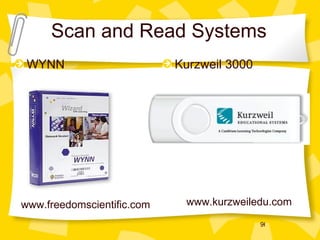
Scan and Read Systems WYNN  Kurzweil 3000 www.freedomscientific.com www.kurzweiledu.com
Text-to-Speech - Becoming Universal Firefox’s Text-to Speech Click Speak Bundle Does the Trick Acrobat Reader - Free Version
Podcasting, Audio Books, & More - Oh My! http://movies.atomiclearning.com/k12/podcasting Student demonstrate knowledge Information on the go Multiple means for representation Narrated   Book series
Thank You Questions Contact Information - seanj@ku.edu

Final Math

  • 1.
    Mathematics Including Technologyon the MTSS Continuum: Solutions for Practice
  • 2.
    Agenda for TodayConsider MTSS - Overview Connection to Resources Connection to Elementary/Middle/High - What we Know Tiers and Technology Structuring technology considerations Technology-based solutions
  • 3.
    Who am I?Associate Professor Father of Four Who are you?
  • 5.
    MTSS Primer MTSSstands for? There are _____ tiers? Three critical features of MTSS include: ___ ___ ___
  • 6.
    Three Models (Uses)of MTSS Prediction & Prevention prediction of at-risk students and preventing students from falling behind Remediation intervention for students with academic or behavioral difficulties Disability Assessment an intensive intervention test that is one component in the SLD determination process
  • 7.
    Critical Elements ofMTSS Implementation of a differentiated curriculum with different instructional methods Two or more tiers of increasingly intense, scientific, research-based interventions
  • 8.
    Critical Elements ofMTSS Individual problem-solving model or standardized intervention protocol for intervention tiers (possibly in combination) Progress monitoring to assess entire class progress and individual student progress Explicit decision rules for assessing learners’ progress (e.g., level and/or rate)
  • 9.
    What Does MTSSImplementation Look Like? Students receive high-quality, research-based instruction by qualified staff in their general education setting (primary intervention) General education instructors and staff assume an active role in students’ assessment in that curriculum School staff conduct universal screening of (a) academics and (b) behavior (> 1/yr) School staff implement specific, research-based interventions to address the students’ difficulties
  • 10.
    Core of MTSSPlease list three research-based practices that you use across the course of a week? Describe it? How do you know it is evidence-based?
  • 11.
    Do we Teachto Learning Styles? What Type of Learner Are You? I like to: Hear it… See it… Touch it… Read it… Experience it… What is your Learning Style?
  • 12.
    Learning Styles -Research-based? Structure experiences based on the type of learner we believe our students to be… Offer more visual experiences because we have a class of visual learners… Hands-on experiences for those tactile learners… Auditory experiences for those that learn best through listening… Examples?
  • 13.
    MTSS @ theMiddle/High School
  • 14.
    Why the Needfor MTSS? School Implications for Mathematics
  • 16.
    Implications - NeedsLiteracy Mathematics Behavior
  • 17.
    Identify Challenges andSolutions A Synopsis of a Synthesis of Empirical Research on Teaching Mathematics to Low-Achieving Students Mathematics Instruction for Students with Learning Disabilities or Difficultly Learning Mathematics Response to Intervention: The Future for Secondary Schools Part I & II IES Practice Guide for Assisting Students Struggling with Mathematics: Response to Intervention (RtI) for Elementary and Middle Schools Meeting the Needs of Significantly Struggling Learners in HS: A Look at Approaches to Tiered Intervention
  • 18.
    Seven Effective InstructionalPractices The Final Report of the National Mathematics Advisory Panel (National Mathematics Advisory Panel, 2008)
  • 19.
    Recommendation 1 Teachstudents using explicit instruction on a regular basis. Clear modeling of the solutions specific to the problem Thinking the specific steps aloud during modeling Presenting multiple examples of the problem and applying the solution to the problems, and Providing immediate corrective feedback to the students on their accuracy
  • 20.
    Recommendation 2 Teachstudents using multiple instructional examples For example, fractions and algebraic equations can be taught first with concrete examples, then with pictorial representations , and finally in an abstract manner.
  • 21.
    Recommendation 3 Havestudents verbalize decisions and solutions to a math problem Verbalize specific steps Think outloud
  • 22.
    Recommendation 4 Teachstudents to visually represent the information in the math problem. Visual combined with explicit instruction Visuals for a specific problem Teacher and the student uses the visual
  • 23.
    Recommendation 5 Teachstudents to solve problems using multiple/heuristic strategies. Exemplifies a generic approach for solving a problem Read the problem Highlight the key words Solve the problems Check your work
  • 24.
    Recommendation 6 Provideongoing formative assessment data and feedback to teachers. Progress Suggestions to alter instruction
  • 25.
    Recommendation 7 Providepeer-assisted instruction to students Cross age peer tutoring is more effective Within class fall short of the level of explicitness necessary to effectively help students with learning challenges progress.
  • 26.
    Recommendation - MTSSInterventions should include instruction on solving word problems that is based on common underlying structures. Explicit Systematic Connections between known, familiar word problems and unfamiliar, new problems.
  • 27.
    Recommendation - MTSSTeach students about the structure of various problem types, how to categorize problems based on structure, and how to determine appropriate solutions for each problem type.
  • 28.
    Recommendations - MTSSIntervention materials should include opportunities for students to work with visual representations of mathematical ideas and interventionists should be proficient in the use of visual representation of mathematical ideas.
  • 33.
    Recommendation Monitor progressof students receiving supplemental instruction and other students who are at risk. Include motivational strategies in tier 2 and 3 interventions
  • 34.
    Brief Look -Textbooks/Reading History Mathematics Science
  • 35.
    Math - Text- Expectations Understand and apply word problems Understand and apply graphic illustrations Ability to understand how book is structured and thus to use To use the text to become independent learners in respect to mathematics Comprehend and apply data
  • 36.
    Math - Text- Expectations Need to offer information within real world context Need explicit and repeated instruction on specific language and form of mathematics
  • 37.
    KSBE Goal/Objectives: Helpingall students meet or exceed academic standards Designing/Redesigning the educational system to meet our students’ changing needs Intervening early – Disabled or Disadvantaged Proving an effective teachers in every classroom Providing visionary leaders Improving communication with all groups
  • 38.
    What is MTSS?Response to Intervention Early Intervening School Improvement System Design/Redesign All Students Achieve
  • 41.
    Kansas Multi-Tiered Systemof Support (MTSS) Academics Behavior KSDE - July 2007 Draft More intense supplemental targeted skill interventions Customized interventions Frequent progress monitoring to guide intervention design Student centered planning Customized function-based interventions Frequent progress monitoring to guide intervention design All students Evidence-based core curriculum & instruction Assessment system and data-based decision making All students, All settings Positive behavioral expectations explicitly taught and reinforced Consistent approach to discipline Assessment system and data-based decision making Supplemental targeted function-based interventions Small groups or individual support Frequent progress monitoring to guide intervention design Supplemental targeted skill interventions Small groups Frequent progress monitoring to guide intervention design
  • 42.
    Primary Intervention (~80%)School-/Classroom-Wide Systems for All Students, Staff, and Settings Secondary Intervention (~15%) Specialized Group Systems for Students with At-Risk Performance Tertiary Intervention (~5%) Specialized Individualized Systems for Students with Intensive Needs ~80% of Students ~15% ~5% Continuum of School-Wide Support Adapted from”What is School-Wide PBS?”
  • 43.
    Kansas Multi-Tiered Systemof Support kansasmtss.org
  • 44.
    Part of theSolution - MTSS Planning teams Scheduling intervention Scheduling interaction Need for collaboration skills Capacity building Collaboration Considering data and the continued use of data driven decisions
  • 45.
  • 46.
    MTSS Interventions Let’stake a few minutes and consider the interventions we are currently using or considering: Tier One Tier Two Tier Three What are some? What is the Research behind these interventions?
  • 47.
    MTSS Resources onthe Web Best Evidence Encyclopedia (B.E.E.) This website offers reliable, unbiased information on high-quality evaluations of educational programs.
  • 48.
    What We KnowWhat Works Clearinghouse ies.ed.gov/ncee/wwc Institute of Education Science’s Database sharing what we know about related research specific to standards and the research arm of NCLB.
  • 49.
    RtI Action NetworkA program of the National Center for Learning Disabilities Offers a guide educators and families in the large-scale implementation of RTI Access research reports How to tips Temperature of what is happening in the field
  • 50.
    National Center onRtI Technical assistance to states and districts and building the capacity of states to assist districts in implementing proven models for RTI. Reports Products for consideration Evidence-based practices for High School Considerations for implementation
  • 51.
  • 52.
    What We KnowResources - Application Tomorrow Math and Reading Help http://math-and-reading-help-for-kids.org LD Online http://www.ldonline.org/indepth/math Intervention Central http://www.interventioncentral.org/
  • 53.
    RtI - Tutorialshttp://iris.peabody.vanderbilt.edu The IRIS Center RtI - An Overview RtI - Assessment RtI - Reading Instruction RtI - Putting it All Together
  • 54.
    Progress Monitoring National Center on Progress Monitoring Tools for comparison Tools for understanding ways to complete Resources for application Teacher Family Administrator
  • 55.
    Special Connections CBMModule Instructional Practices Behavioral Interventions http://www.specialconnections.ku.edu
  • 56.
    How do weStructure our Interventions? Framework for Consideration
  • 58.
    Principle One SupportingRecognition Learning Provide multiple examples Highlight critical features Provide multiple media formats Support background contexts
  • 59.
    Some Examples ReadingReadplease.com Texthelp.com Setting an Anchor http://streaming.discoveryeducation.com/ Representing Material http://nlvm.usu.edu/en/NAV/vlibrary.html
  • 60.
    Principle Two SupportStrategic Learning Provide flexible models of skilled performance Provide opportunities to practice with supports Provide ongoing, relevant feedback Offer flexible opportunities for demonstrating skill
  • 61.
    Some Examples Practicehttp://www.inspiration.com Skill demonstration Microsoft’s PPT - Star Wars Inspire Data Apple’s - iMovie Microsoft’s Movie Maker PhotoStory
  • 62.
    Principle Three SupportAffective Learning - Provide alternative means for engagement Offer choices of content and tools Offer adjustable levels of challenge Offer choices of rewards Offer choices of learning context
  • 63.
    Some Examples SoftwareProducts - Adjustable levels http://www.techmatrix.org/ Type to Learn Learning context Hands on Connect to previous understanding Choice of Rewards What makes you tick?
  • 64.
    UDL Toolkit http://udltechtoolkit.wikispaces.comhttp://readilyaccessibletools.wikispaces.com/ Learn more about UDL UDL-based solutions tied to reading, organization, writing, etc. Wikis are free to all of us Disseminate information Demonstrate knowledge Communicate with parents/students/general community
  • 66.
  • 67.
    Graphic Organizers TeachingStudents Math Problem-solving Through Graphic Representations
  • 68.
  • 69.
  • 70.
  • 71.
  • 73.
  • 74.
    Visual Considerations -Resources Discovery Learning Anchor the Learning Videos Audio Writing Center Links to Standards
  • 75.
  • 76.
    Photo Story Show- n - Tell Share Your Stories Create Stories Runs free on Windows http://www.microsoft.com/windowsxp/using/digitalphotography/photostory/photostory3_share.mspx
  • 77.
    Developing Visual ConnectionsApple Learning Interchange http://edcommunity.apple.com/ali/ ABCs All Quiet on the Western Front Apple’s iMovie - apple.com Microsoft’s MovieMaker - microsoft.com
  • 78.
    Some Examples Let’scheck out the Handout Learn Alberta - learnalberta.ca - parts free & offers across the grade and content level illustrations. Brain Pop - brainpop.com - for pay but visually displays (offers text as well) information - context for the user.
  • 79.
    Math Games Afew Considerations
  • 80.
  • 81.
  • 82.
  • 83.
  • 84.
    Math - WebResources Montgomery County Public Schools - MD High-Incidence Accessible Technologies (HIAT) Created a number of resources for their teachers and a wonderful website for math resources http://www.montgomeryschoolsmd.org/departments/hiat/resources/digital_text.shtm
  • 85.
  • 86.
  • 87.
  • 88.
    Mathematics Considerations -Resources Illuminations http://illuminations.nctm.org/ Lessons Student Interactive Resources Web Resources for Mathematics Thinkfinity http://www.thinkfinity.org/ Manages the Literacy Network Manages Marco Polo
  • 89.
  • 90.
    Web 2.0 ConsiderationsAdditional Resources to Consider
  • 91.
    Math Considerations -Resources Kerpoof Make a Movie Make a Photo Animoto Make a Movie Interactive experience Audio Video Demonstration
  • 92.
    Text-to-Speech Do weReally Need to Read It?
  • 93.
    ReadPlease (readplease.com)Free text-to-speech software Customize font and background color Reads text via Windows clipboard from any program (copy/paste) Control reading from system tray Reads e-mail emoticons such as :) or :( Adjustable voice speed (rate) Low vision color option
  • 94.
    Natural Reader - naturalreader.com NaturalReader is a Text to Speech software with natural sounding voices. This easy to use software can convert any written text such as MS Word, Webpage, PDF files, and Emails into spoken words. NaturalReader can also convert any written text into audio files such as MP3 or WAV for your CD player or iPod. http://www.naturalreaders.com/
  • 95.
    Premier Accessibility Suitehttp://www.readingmadeez.com Text-to-speech software Audio output - multiple voices Highlights text as it speaks Texthelp - Read and Write Gold http://www.texthelp.com Text-to-speech software Audio output - multiple voices Highlights text as it speaks Text-to-Speech
  • 96.
    Scan and ReadSystems WYNN Kurzweil 3000 www.freedomscientific.com www.kurzweiledu.com
  • 97.
    Text-to-Speech - BecomingUniversal Firefox’s Text-to Speech Click Speak Bundle Does the Trick Acrobat Reader - Free Version
  • 98.
    Podcasting, Audio Books,& More - Oh My! http://movies.atomiclearning.com/k12/podcasting Student demonstrate knowledge Information on the go Multiple means for representation Narrated Book series
  • 99.
    Thank You QuestionsContact Information - seanj@ku.edu

Editor's Notes

  • #8 Review what I believe we know…
  • #11 They can use the term scientifcally based as well to clarify what they know and the like…
  • #12 Learning styles is something we all appear to know about, parents connect with learning styles, and the like…so how do you fall and do we teach to a student’s learning style? Talk about the fact that others will state they work…effective…appear in the literature…Dunn and Dunn out of NY…make a point that these are used…my entire Masters program was centered around this aspect…
  • #15 Set the stage that we have RtI and there is a federal push Folks see this as an Elelmentary Push states are strating to focus beyond prek-6
  • #16 Part of the National Center on LD why is this occuring what does this mean ask them when what we generlaly due when do we stop these efforts?
  • #17 Make the point that RtI covers a great deal of information but specific to Literacy we are learning a bunch
  • #29 Number lines Arrays Strip diagram
  • #65 Wiki Use Collaborative Projects using wikis where students combine knowledge Project based learning - cross curricular projects at middle school level thematic units Student demonstrate knowledge Online resource for the class Wikis as a classroom webpage (calendar, to do, notes, tips to students) Wiki filing cabinets for teachers
  • #66 Make the point KS Nutcracker Could have described it could have offered a text description Pictures Had us act it out as a group Would have lost the music - context that this is part of the Nutcracker’s music score Would have lost the cuteness Seeing Nolan meaningfully included in the show The whole cuteness factor Transition here to how I see framing this to enhance our instruction and how we look at curriculum and make curriculum decisions based on the needs of ALL learners
  • #78 Connection here is to get ideas on how to use the application for instructional purposes.
  • #98 If I haven’t already done this go to the Newspaper and show the Print Function and then have it read to the user. Also need to mention Balabolka - http://www.cross-plus-a.com/balabolka.htm
  • #99 Look to download in YouTube http://www.youtube.com/watch?v=mHGo-64dXJc&feature=player_embedded