Dear Colleagues,
Welcome to the Teacher Professional Development session. We will involves
ourselves in the discussion and conceptualizing with various evidence on Types
and Purpose of Assessment in Mathematics. I hope we together will enjoy this
session .
Thank you
Niroj Dahal
Community Facilitator of Mathematics
Aksharaa School
Sunday, 10 March 2019
Outlook of Session
(8:00am-11:30am)
• Wel-come (8: 00 am-8:01 am)
• Notice regarding racecourses necessary for
academic year 2019 (8: 02am-8:05 am)
• Warm-up activity (08:05am - 08:20am)• Warm-up activity (08:05am - 08:20am)
• Sharing of the expectation of the session
facilitator (08: 20am-08:23 am)
• Professional development session (08:25 am-11:30
am)
Types and Purpose ofTypes and Purpose of
Assessment in MathematicsAssessment in Mathematics
Types and Purpose ofTypes and Purpose of
Assessment in MathematicsAssessment in Mathematics
Niroj DahalNiroj DahalNiroj DahalNiroj Dahal
Mathematics DepartmentMathematics Department
AksharaaAksharaa SchoolSchool
Teacher Professional DevelopmentTeacher Professional Development
March 10, 2019March 10, 2019
Resources Necessary for
Academic Year-2076
Dear Colleagues,
Please complete the excel sheet form
for the necessary resources you may need for
academic year 2076 that will send to your email asacademic year 2076 that will send to your email as
soon as possible, please provide your email address
by today.
Niroj Dahal
Community Facilitator of Mathematics
What is a “Student
Learning Outcome?
• Student learning outcomes are properly
defined in terms of the knowledge, skills,
and abilities that a student has attained at
the end (or as a result) of his or herthe end (or as a result) of his or her
engagement in a particular set of education
experiences.
Task 1
• Write your best definition of assessment.
• What is the role of assessment in the
classroom?classroom?
• How does assessment impact instruction?
• What is your assessment practice(s)?
Use Search Engine
• Read and rewrite your understanding
In your small group, discuss and
present how your assigned practice
relates to mathematics assessmentrelates to mathematics assessment
Write your definition of assessment.
Task 2
• Write short note on
– Types of Assessment in Mathematics
– Purpose of Assessment in Mathematics
The Purpose of an Assessment
Is:
• to provide information about skills in a content
area
• to guide instruction for the individual and for
groups
• to provide feedback or information
• to plan further instruction
• to improve instructional practices
• to focus on what the student can do
• to guide decisions about instruction (Formative)
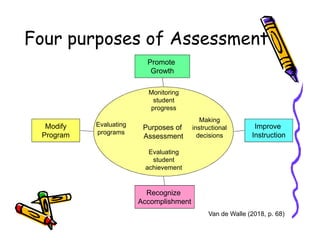
Four purposes of Assessment
Purposes of
Making
Monitoring
student
progress
Evaluating
Promote
Growth
ImproveModify Purposes of
Assessment
Making
instructional
decisions
Evaluating
programs
Evaluating
student
achievement
Improve
Instruction
Recognize
Accomplishment
Modify
Program
Van de Walle (2018, p. 68)
The Purpose of a Test/Exam
Is:
• to provide feedback about skills learned or
obtained via instruction
• to determine the areas in which an
individual needs re-teachingindividual needs re-teaching
• to provide grades
• to focus on what the student cannot do
• to indicate attainment of skills
(Summative)
Characteristics of
Educational Measures
• Educational measures are
– Indirect
– Incomplete
– Relative– Relative
– Used as classification
• Educational measures have errors
Capacity to assess
• Ability
• Achievement
• Personality• Personality
• Skill
• Opinion
• Attitude
Assessment
What can it do?
• Provide
– to students a chance to reflect on what
they have learned and need to learn
– to teachers a chance to reflect on what– to teachers a chance to reflect on what
they have taught well and what needs
further attention
Assessment
What can it do?
• Provide feedback
– to the teacher on the clarity of given
assessments
– to teachers about the progress of– to teachers about the progress of
learning
Assessment
What can it do?
• Providing
– clarity to students on the type of
mathematics knowledge valued
– clarity to students on the type of– clarity to students on the type of
mathematics proficiency valued
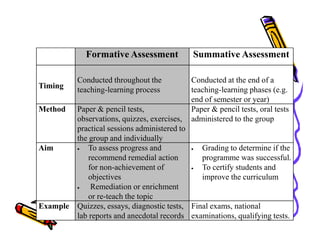
Formative Assessment Summative Assessment
Timing
Conducted throughout the
teaching-learning process
Conducted at the end of a
teaching-learning phases (e.g.
end of semester or year)
Method Paper & pencil tests,
observations, quizzes, exercises,
Paper & pencil tests, oral tests
administered to the group
practical sessions administered to
the group and individually
Aim • To assess progress and
recommend remedial action
for non-achievement of
objectives
• Remediation or enrichment
or re-teach the topic
• Grading to determine if the
programme was successful.
• To certify students and
improve the curriculum
Example Quizzes, essays, diagnostic tests,
lab reports and anecdotal records
Final exams, national
examinations, qualifying tests.
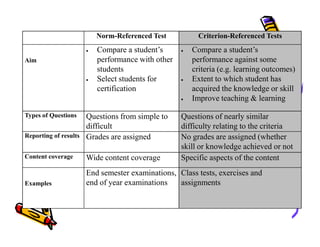
Norm-Referenced Test Criterion-Referenced Tests
Aim
• Compare a student’s
performance with other
students
• Select students for
certification
• Compare a student’s
performance against some
criteria (e.g. learning outcomes)
• Extent to which student has
acquired the knowledge or skill
• Improve teaching & learning
Types of Questions Questions from simple to
difficult
Questions of nearly similar
difficulty relating to the criteriadifficult difficulty relating to the criteria
Reporting of results Grades are assigned No grades are assigned (whether
skill or knowledge achieved or not
Content coverage Wide content coverage Specific aspects of the content
Examples
End semester examinations,
end of year examinations
Class tests, exercises and
assignments
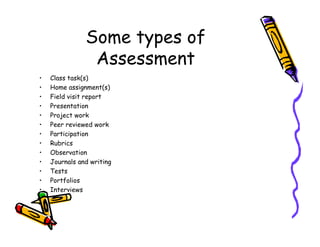
Some types of
Assessment
• Class task(s)
• Home assignment(s)
• Field visit report
• Presentation
• Project work
• Peer reviewed work• Peer reviewed work
• Participation
• Rubrics
• Observation
• Journals and writing
• Tests
• Portfolios
• Interviews
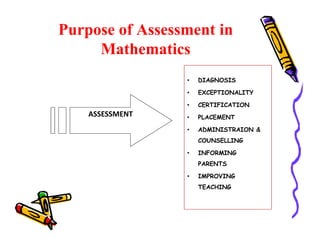
Purpose of Assessment in
Mathematics
• DIAGNOSIS
• EXCEPTIONALITY
• CERTIFICATION
• PLACEMENTASSESSMENT
• ADMINISTRAION &
COUNSELLING
• INFORMING
PARENTS
• IMPROVING
TEACHING
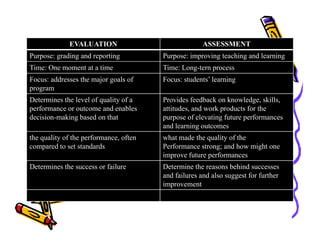
EVALUATION ASSESSMENT
Purpose: grading and reporting Purpose: improving teaching and learning
Time: One moment at a time Time: Long-tern process
Focus: addresses the major goals of
program
Focus: students’ learning
Determines the level of quality of a
performance or outcome and enables
decision-making based on that
Provides feedback on knowledge, skills,
attitudes, and work products for the
purpose of elevating future performances
and learning outcomesand learning outcomes
the quality of the performance, often
compared to set standards
what made the quality of the
Performance strong; and how might one
improve future performances
Determines the success or failure Determine the reasons behind successes
and failures and also suggest for further
improvement
Q/A….?
~5 Minute
Game Over!

Assessment in Mathematics

  • 1.
    Dear Colleagues, Welcome tothe Teacher Professional Development session. We will involves ourselves in the discussion and conceptualizing with various evidence on Types and Purpose of Assessment in Mathematics. I hope we together will enjoy this session . Thank you Niroj Dahal Community Facilitator of Mathematics Aksharaa School Sunday, 10 March 2019
  • 2.
    Outlook of Session (8:00am-11:30am) •Wel-come (8: 00 am-8:01 am) • Notice regarding racecourses necessary for academic year 2019 (8: 02am-8:05 am) • Warm-up activity (08:05am - 08:20am)• Warm-up activity (08:05am - 08:20am) • Sharing of the expectation of the session facilitator (08: 20am-08:23 am) • Professional development session (08:25 am-11:30 am)
  • 3.
    Types and PurposeofTypes and Purpose of Assessment in MathematicsAssessment in Mathematics Types and Purpose ofTypes and Purpose of Assessment in MathematicsAssessment in Mathematics Niroj DahalNiroj DahalNiroj DahalNiroj Dahal Mathematics DepartmentMathematics Department AksharaaAksharaa SchoolSchool Teacher Professional DevelopmentTeacher Professional Development March 10, 2019March 10, 2019
  • 4.
    Resources Necessary for AcademicYear-2076 Dear Colleagues, Please complete the excel sheet form for the necessary resources you may need for academic year 2076 that will send to your email asacademic year 2076 that will send to your email as soon as possible, please provide your email address by today. Niroj Dahal Community Facilitator of Mathematics
  • 5.
    What is a“Student Learning Outcome? • Student learning outcomes are properly defined in terms of the knowledge, skills, and abilities that a student has attained at the end (or as a result) of his or herthe end (or as a result) of his or her engagement in a particular set of education experiences.
  • 6.
    Task 1 • Writeyour best definition of assessment. • What is the role of assessment in the classroom?classroom? • How does assessment impact instruction? • What is your assessment practice(s)?
  • 7.
    Use Search Engine •Read and rewrite your understanding
  • 8.
    In your smallgroup, discuss and present how your assigned practice relates to mathematics assessmentrelates to mathematics assessment
  • 9.
    Write your definitionof assessment.
  • 10.
    Task 2 • Writeshort note on – Types of Assessment in Mathematics – Purpose of Assessment in Mathematics
  • 11.
    The Purpose ofan Assessment Is: • to provide information about skills in a content area • to guide instruction for the individual and for groups • to provide feedback or information • to plan further instruction • to improve instructional practices • to focus on what the student can do • to guide decisions about instruction (Formative)
  • 12.
    Four purposes ofAssessment Purposes of Making Monitoring student progress Evaluating Promote Growth ImproveModify Purposes of Assessment Making instructional decisions Evaluating programs Evaluating student achievement Improve Instruction Recognize Accomplishment Modify Program Van de Walle (2018, p. 68)
  • 13.
    The Purpose ofa Test/Exam Is: • to provide feedback about skills learned or obtained via instruction • to determine the areas in which an individual needs re-teachingindividual needs re-teaching • to provide grades • to focus on what the student cannot do • to indicate attainment of skills (Summative)
  • 14.
    Characteristics of Educational Measures •Educational measures are – Indirect – Incomplete – Relative– Relative – Used as classification • Educational measures have errors
  • 15.
    Capacity to assess •Ability • Achievement • Personality• Personality • Skill • Opinion • Attitude
  • 16.
    Assessment What can itdo? • Provide – to students a chance to reflect on what they have learned and need to learn – to teachers a chance to reflect on what– to teachers a chance to reflect on what they have taught well and what needs further attention
  • 17.
    Assessment What can itdo? • Provide feedback – to the teacher on the clarity of given assessments – to teachers about the progress of– to teachers about the progress of learning
  • 18.
    Assessment What can itdo? • Providing – clarity to students on the type of mathematics knowledge valued – clarity to students on the type of– clarity to students on the type of mathematics proficiency valued
  • 19.
    Formative Assessment SummativeAssessment Timing Conducted throughout the teaching-learning process Conducted at the end of a teaching-learning phases (e.g. end of semester or year) Method Paper & pencil tests, observations, quizzes, exercises, Paper & pencil tests, oral tests administered to the group practical sessions administered to the group and individually Aim • To assess progress and recommend remedial action for non-achievement of objectives • Remediation or enrichment or re-teach the topic • Grading to determine if the programme was successful. • To certify students and improve the curriculum Example Quizzes, essays, diagnostic tests, lab reports and anecdotal records Final exams, national examinations, qualifying tests.
  • 20.
    Norm-Referenced Test Criterion-ReferencedTests Aim • Compare a student’s performance with other students • Select students for certification • Compare a student’s performance against some criteria (e.g. learning outcomes) • Extent to which student has acquired the knowledge or skill • Improve teaching & learning Types of Questions Questions from simple to difficult Questions of nearly similar difficulty relating to the criteriadifficult difficulty relating to the criteria Reporting of results Grades are assigned No grades are assigned (whether skill or knowledge achieved or not Content coverage Wide content coverage Specific aspects of the content Examples End semester examinations, end of year examinations Class tests, exercises and assignments
  • 21.
    Some types of Assessment •Class task(s) • Home assignment(s) • Field visit report • Presentation • Project work • Peer reviewed work• Peer reviewed work • Participation • Rubrics • Observation • Journals and writing • Tests • Portfolios • Interviews
  • 22.
    Purpose of Assessmentin Mathematics • DIAGNOSIS • EXCEPTIONALITY • CERTIFICATION • PLACEMENTASSESSMENT • ADMINISTRAION & COUNSELLING • INFORMING PARENTS • IMPROVING TEACHING
  • 23.
    EVALUATION ASSESSMENT Purpose: gradingand reporting Purpose: improving teaching and learning Time: One moment at a time Time: Long-tern process Focus: addresses the major goals of program Focus: students’ learning Determines the level of quality of a performance or outcome and enables decision-making based on that Provides feedback on knowledge, skills, attitudes, and work products for the purpose of elevating future performances and learning outcomesand learning outcomes the quality of the performance, often compared to set standards what made the quality of the Performance strong; and how might one improve future performances Determines the success or failure Determine the reasons behind successes and failures and also suggest for further improvement
  • 24.
  • 25.