7.4 Integration of
 Rational Functions
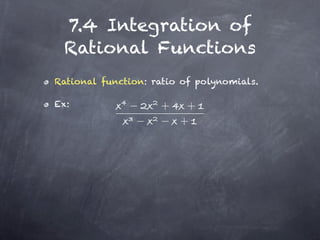
Rational function: ratio of polynomials.

Ex:                 +    +
                        +
7.4 Integration of
  Rational Functions
Rational function: ratio of polynomials.

Ex:                 +    +
                        +
Fact: A rational function can always be
decomposed to summation of terms like
                               +
polynomials or ( + ) or ( + + ) where
A, B, etc. are constants.

Ex:   −  + +
                = + +          +           −
       − − +               −       ( − )       +

                           Partial Fractions
First step: if the rational function is
improper (the degree of numerator is more
than or equal to the degree of dominator),
use long division to decompose it to a
polynomial plus a proper rational function.

       +
Ex:        =    + +     +
First step: if the rational function is
improper (the degree of numerator is more
than or equal to the degree of dominator),
use long division to decompose it to a
polynomial plus a proper rational function.

        +
Ex:            =       + +   +

As a result:

        +
                   =    +    +   +   |   |+
Second step: factor the dominator of the
proper rational function to be a product of
linear factors and/or irreducible quadratic
factors.


      +   +   is irreducible if             <   .


Ex:       +   = (    + )
          +          = (           )( + )
              +            +      =(   ) (      + )
Third step: decompose the proper rational
function to be a sum of partial fractions by
method of undetermined coefficients.

         +
Ex:
         +
Third step: decompose the proper rational
function to be a sum of partial fractions by
method of undetermined coefficients.

            +
Ex:
            +

We factor       +         = (       )( + )
Third step: decompose the proper rational
function to be a sum of partial fractions by
method of undetermined coefficients.

            +
Ex:
            +

We factor       +         = (       )( + )
                +
so assume                 =     +        +
                +                              +
Third step: decompose the proper rational
function to be a sum of partial fractions by
method of undetermined coefficients.

            +
Ex:
            +

We factor       +           = (           )( + )
                +
so assume                   =     +          +
                +                                  +
            (   +   +   )   +(        +       )
       =
                            +
Third step: decompose the proper rational
function to be a sum of partial fractions by
method of undetermined coefficients.

            +
Ex:
            +

We factor           +           = (           )( + )
                    +
so assume                       =     +          +
                    +                                  +
            (       +   +   )   +(        +       )
       =
                                +
thus   =        ,   =   ,   =
CASE I: the dominator is a product of
distinct linear factors.


CASE II: the dominator is a product of
linear factors, some of which are repeated.


CASE III: the dominator contains distinct
irreducible quadratic factors.


Case IV: the dominator contains repeated
irreducible quadratic factors.
+
Ex: find
           +
+
Ex: find
              +

We already knew that

    +
              =        +
    +                      (   )   ( + )
                                     C AS E I
+
Ex: find
                  +

We already knew that

     +
                  =    +
     +                     (       )    ( + )
           +                              C AS E I
so
           +

     =     | |+       |        |       | + |+
Ex: find
           +
Ex: find
                 +

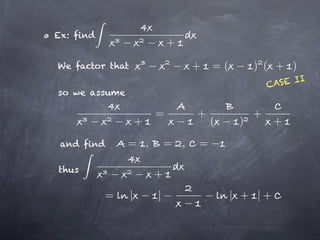
We factor that       +   =(   ) ( + )
                                CAS E II
Ex: find
                         +

We factor that               +   =(       ) ( + )
                                              CAS E II
so we assume

                     =       +            +
                 +               (    )        +
Ex: find
                         +

We factor that               +   =(       ) ( + )
                                              CAS E II
so we assume

                     =       +            +
                 +               (    )        +
 and find      = ,   = ,     =
Ex: find
                             +

We factor that                     +   =(        ) ( + )
                                                     CAS E II
so we assume

                         =         +             +
                     +                 (     )        +
 and find      = ,           = ,   =

thus
                         +
           =     |       |                  | + |+

Calculus II - 4

  • 1.
    7.4 Integration of Rational Functions Rational function: ratio of polynomials. Ex: + + +
  • 2.
    7.4 Integration of Rational Functions Rational function: ratio of polynomials. Ex: + + + Fact: A rational function can always be decomposed to summation of terms like + polynomials or ( + ) or ( + + ) where A, B, etc. are constants. Ex: − + + = + + + − − − + − ( − ) + Partial Fractions
  • 3.
    First step: ifthe rational function is improper (the degree of numerator is more than or equal to the degree of dominator), use long division to decompose it to a polynomial plus a proper rational function. + Ex: = + + +
  • 4.
    First step: ifthe rational function is improper (the degree of numerator is more than or equal to the degree of dominator), use long division to decompose it to a polynomial plus a proper rational function. + Ex: = + + + As a result: + = + + + | |+
  • 5.
    Second step: factorthe dominator of the proper rational function to be a product of linear factors and/or irreducible quadratic factors. + + is irreducible if < . Ex: + = ( + ) + = ( )( + ) + + =( ) ( + )
  • 6.
    Third step: decomposethe proper rational function to be a sum of partial fractions by method of undetermined coefficients. + Ex: +
  • 7.
    Third step: decomposethe proper rational function to be a sum of partial fractions by method of undetermined coefficients. + Ex: + We factor + = ( )( + )
  • 8.
    Third step: decomposethe proper rational function to be a sum of partial fractions by method of undetermined coefficients. + Ex: + We factor + = ( )( + ) + so assume = + + + +
  • 9.
    Third step: decomposethe proper rational function to be a sum of partial fractions by method of undetermined coefficients. + Ex: + We factor + = ( )( + ) + so assume = + + + + ( + + ) +( + ) = +
  • 10.
    Third step: decomposethe proper rational function to be a sum of partial fractions by method of undetermined coefficients. + Ex: + We factor + = ( )( + ) + so assume = + + + + ( + + ) +( + ) = + thus = , = , =
  • 11.
    CASE I: thedominator is a product of distinct linear factors. CASE II: the dominator is a product of linear factors, some of which are repeated. CASE III: the dominator contains distinct irreducible quadratic factors. Case IV: the dominator contains repeated irreducible quadratic factors.
  • 12.
  • 13.
    + Ex: find + We already knew that + = + + ( ) ( + ) C AS E I
  • 14.
    + Ex: find + We already knew that + = + + ( ) ( + ) + C AS E I so + = | |+ | | | + |+
  • 15.
  • 16.
    Ex: find + We factor that + =( ) ( + ) CAS E II
  • 17.
    Ex: find + We factor that + =( ) ( + ) CAS E II so we assume = + + + ( ) +
  • 18.
    Ex: find + We factor that + =( ) ( + ) CAS E II so we assume = + + + ( ) + and find = , = , =
  • 19.
    Ex: find + We factor that + =( ) ( + ) CAS E II so we assume = + + + ( ) + and find = , = , = thus + = | | | + |+