Mathematics
Trigonometric ratios and Identities
Session 1
Topics
Transformation of Angles
Compound Angles
Definition and Domain and Range
of Trigonometric Function
Measurement of Angles
O A
B
OA InitialRay−
uuur
OB Ter minal Ray−
uuur
Angle is considered as the figure obtained by
rotating initial ray about its end point.
J001
Measure and Sign of an Angle
Measure of an Angle :-
Amount of rotation from initial side
to terminal side.
Sign of an Angle :-
O A
B
θ
Rotation anticlockwise –
Angle positive
B’
− θ
Rotation clockwise –
Angle negative
J001
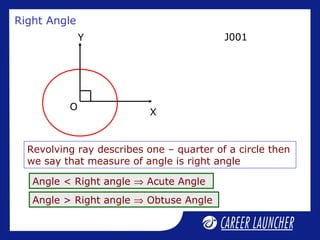
Right Angle
O
Y
X
Revolving ray describes one – quarter of a circle then
we say that measure of angle is right angle
J001
Angle < Right angle ⇒ Acute Angle
Angle > Right angle ⇒ Obtuse Angle
Quadrants
O
Y
Y’
X’ X
II Quadrant
( , )− +
I Quadrant
( , )+ +
IV Quadrant
( , )+ −
III Quadrant
( , )− −
X’OX – x - axis
Y’OY – y - axis
J001
System of Measurement of Angle
Measurement of Angle
Sexagesimal System
or
British System
Centesimal System
or
French System
Circular System
or
Radian Measure
J001
System of Measurement of Angles
Sexagesimal System (British System)
1 right angle = 90 degrees (=90o
)
1 degree = 60 minutes (=60’)
1 minute = 60 seconds (=60”)
Centesimal System (French System)
1 right angle = 100 grades (=100g
)
1 grade = 100 minutes (=100’)
1 minute = 100 Seconds (=100”)
J001
Is 1 minute of
sexagesimal
1 minute of
centesimal ?
=
NO
System of Measurement of Angle
Circular System
J001
O
r
r
r
A
B
1c
If OA = OB = arc AB
c
Then AOB 1radian( 1 )∠ = =
System of Measurement of Angle
Circular System
O A
C
B
1c
AOC arc AC
AOB arc ACB
∠
=
∠
Q
1radian r
2right angles r
⇒ =
π
2right angles radian⇒ = π
J001
180 radian⇒ = πo
Relation Between Degree Grade
And Radian Measure of An Angle
0 g
D G 2C
90 100
= =
π
OR
0 g
D G C
180 200
= =
π
J002
Illustrative Problem
Find the grade and radian measures
of the angle 5o
37’30”
Solution
o' o
30 30 1
30"
60 60 60 120
    
= = = ÷  ÷ ÷×    
o
37
and37'
60
 
=  ÷
 
o o
o 37 1 45
5 37'30" 5
60 120 8
   
∴ = + + = ÷  ÷
   
J002
We know that
D G 2C
90 100
= =
π
Illustrative Problem
Find the grade and radian measures of the
angle 5o
37’30”
g
10
G D
9
 
⇒ = × ÷
 
( )
g g
g10 45 225
12.5 Ans
9 8 18
   
= × = = ÷  ÷
   
c
and R D
180
π 
= × ÷
 
c
45
radian Ans
180 8 32
π π 
= × = ÷
 
Solution
J002
Relation Between Angle Subtended
by an Arc At The Center of Circle
O A
C
1c
θ
B
Arc AC = r and Arc ACB = 
AOC arc AC
AOB arc ACB
∠
=
∠
Q
J002
1radian r
⇒ =
θ l
r
⇒ θ =
l
Illustrative Problem
A horse is tied to a post by a rope. If
the horse moves along a circular path
always keeping the rope tight and
describes 88 meters when it has traced
out 72o
at the center. Find the length of
rope. [ Take π = 22/7 approx.].
Solution
P A
B
72o
Arc AB = 88 m and AP = ?
c
o 2
72 72 rad
180 5
π π 
θ = = × = ÷
 
J002
arc AB
r AP
θ = =
l
Q
2 88 22
AP 70m [ approx.]
5 AP 7
π
= ⇒ = π =
Definition of Trigonometric Ratios
J003
2 2
r x y= +
xO
Y
X
P (x,y)
M
θ
y
r
y
sin
r
x
cos
r
y
tan
x
θ =
θ =
θ =
x
cot
y
r
sec
x
r
cosec
y
θ =
θ =
θ =
Some Basic Identities
sin cosec 1 ; n ,n I• θ × θ = θ ≠ π ∈
2 2
sin cos 1• θ + θ =
2 2
sec tan 1• θ − θ =
2 2
cosec cot 1• θ − θ =
( )
sin
tan ; 2n 1 ,n I
cos 2
θ π
• θ = θ ≠ + ∈
θ
( )tan cot 1 ; 2n 1 ; n ,n I
2
π
• θ × θ = θ ≠ + θ ≠ π ∈
cos
cot ; n ,n I
sin
θ
• θ = θ ≠ π ∈
θ
( )cos sec 1 ; 2n 1 ,n I
2
π
• θ × θ = θ ≠ + ∈
Illustrative Problem
Solution
3
sec tan .cosec= θ + θ θ
3 cosec
sec 1 tan
sec
θ 
= θ + θ ÷θ 
( )3
sec 1 tan cot= θ + θ θ ( )2
sec 1 tan= θ + θ
( )2 2
1 tan 1 tan= + θ + θ ( )
3
2 21 tan= + θ
( )
3
2 22 e Proved= −
J0032 2
If tan 1 e ,prove thatθ = −
( )
3
3 2 2sec tan .cosec 2 eθ + θ θ = −
0
2
π 
< θ < ÷
 
Signs of Trigonometric Function In
All Quadrants
In First Quadrant
xO
Y
X
P (x,y)
M
θ
y
r
Here x >0, y>0, 2 2
r x y= + >0
y
sin 0
r
θ = >
x
cos 0
r
θ = >
y
tan 0
x
θ = >
x
cot 0
y
θ = >
r
sec 0
x
θ = >
r
cosec 0
y
θ = >
J004
Signs of Trigonometric Function In
All Quadrants
In Second Quadrant
Here x <0, y>0, 2 2
r x y= + >0
y
sin 0
r
θ = >
r
cosec 0
y
θ = >
θ
XX’
Y
Y’
P (x,y)
x
y
r
x
cos 0
r
θ = <
y
tan 0
x
θ = <
x
cot 0
y
θ = <
r
sec 0
x
θ = <
J004
Signs of Trigonometric Function In
All Quadrants
In Third Quadrant
Here x <0, y<0, 2 2
r x y= + >0
r
cosec 0
y
θ = >
r
sec 0
x
θ = <
θ
X’ X
P (x,y)
O
Y’
Y
M
y
sin 0
r
θ = <
x
cos 0
r
θ = <
y
tan 0
x
θ = >
x
cot 0
y
θ = >
J004
Signs of Trigonometric Function In
All Quadrants
In Fourth Quadrant
Here x >0, y<0, 2 2
r x y= + >0
y
sin 0
r
θ = <
θ
XO
P (x,y)
Y’
M
x
cos 0
r
θ = >
y
tan 0
x
θ = <
x
cot 0
y
θ = <
r
sec 0
x
θ = >
r
cosec 0
y
θ = <
J004
Signs of Trigonometric Function In
All Quadrants
I Quadrant
All Positive
II Quadrant
sin & cosec
are Positive
III Quadrant
tan & cot are
Positive
IV Quadrant
cos & sec are
Positive
X
Y’
X’
Y
O
J004
ASTC :- All Sin Tan Cos
Illustrative Problem
θ lies in secondIf cot θ =
12
,
5
−
quadrant, find the values of
other five trigonometric function
Solution
12 5
cot tan
5 12
θ = − ⇒ θ = −Q
2 2 2 169
sec 1 tan sec
144
θ = + θ ⇒ θ =Q
( )
13 13
sec sec liesinsec ondquadrant
12 12
⇒ θ = ± ⇒ θ = − θ
12
Whichgivescos
13
θ = −
13
cosec
5
∴ θ =
J004
Method : 1
5 12 5
Thensin tan cos
12 13 13
θ = θ × θ = − × − =
Illustrative Problem
θ lies in secondIf cot θ =
12
,
5
−
quadrant, find the values of other five
trigonometric function
Solution
J004
Method : 2
Y
θ
XX’
Y’
P (-12,5)
-12
5
r
Here x = -12, y = 5 and r = 13
y 5
sin
r 13
θ = =
x 12
cos
r 13
−
θ = =
y 5
tan
x 12
θ = =
−
r 13
sec
x 12
θ = =
−
r 13
cosec
y 5
θ = =
Functions Domain Range
sinθ R [-1,1]
cosθ R [-1,1]
secθ R : (2n 1)
2
π 
− θ θ = + 
 
R-(-1,1)
cosecθ { }R : n− θ θ = π R-(-1,1)
tanθ R : (2n 1)
2
π 
− θ θ = + 
 
R
cotθ
{ }R : n− θ θ = π R
Domain and Range of Trigonometric
Function
J005
Illustrative problem
Prove that
2
2 (x y)
sin
4xy
+
θ =
is possible for real values of x and
y only when x=y
Solution
( )
2
2(x y)
1 x y 4xy
4xy
+
⇒ ≤ ⇒ + ≤
2
sin 1θ ≤Q
( ) ( )2 2
x y 4xy 0 x y 0⇒ + − ≤ ⇒ − ≤
But for real values of x and y
( )2
x y− is not less than zero
( )2
x y 0 x y Pr oved∴ − = ⇒ =
J005
Trigonometric Function For Allied
Angles
Trig. ratio -θ 90o
-θ 90o
+θ 180o
-θ 180o
+θ 360o
-θ 360o
+θ
cosθ cosθ sinθ - sinθ - cosθ - cosθ cosθ cosθ
tanθ - tanθ cotθ - cotθ -tanθ tanθ - tanθ tanθ
sinθ - sinθ cosθ cosθ sinθ - sinθ - sinθ sinθ
If angle is multiple of 900
then
sin ⇔ cos;tan ⇔ cot; sec ⇔ cosec
If angle is multiple of 1800
then
sin ⇔ sin;cos ⇔ cos; tan ⇔ tan etc.
Trigonometric Function For Allied
Angles
Trig. ratio -θ 90o
-θ 90o
+θ 180o
-θ 180o
+θ 360o
-θ 360o
+θ
secθ secθ cosecθ - cosecθ - secθ - secθ secθ secθ
cosecθ - cosecθ secθ secθ cosecθ -cosecθ - cosecθ cosecθ
cotθ - cotθ tanθ -tanθ -cotθ cotθ - cotθ cotθ
Periodicity of Trigonometric
Function
Periodicity : After certain value of
x the functional values repeats
itself
Period of basic trigonometric functions
sin (360o
+θ) = sinθ ⇒ period of sinθ is 360o
or 2π
cos (360o
+θ) = cosθ ⇒ period of cosθ is 360o
or 2π
tan (180o
+θ) = tanθ ⇒ period of tanθ is 180o
or π
J005
If f(x+T) = f(x) ∀ x,then T is called
period of f(x) if T is the smallest
possible positive number
Trigonometric Ratio of Compound
Angle
Angles of the form of A+B, A-B,
A+B+C, A-B+C etc. are called
compound angles
(I) The Addition Formula
• sin (A+B) = sinAcosB + cosAsinB
• cos (A+B) = cosAcosB - sinAsinB
( )
tanA tanB
tan A B
1 tanA tanB
+
• + =
−
J006
( )
sin(A B)
Pr oof: tan A B
cos(A B)
+
− + =
+
Q
sinA cosB cos A sinB
cos A cosB sinA sinB
+
=
−
Trigonometric Ratio of Compound
Angle
J006
sinA cosB cos A sinB
cos A cosB sinA sinB
+
=
−
r r
Dividing N and D by cos A cosB
We get
tanA tanB
1 tanA tanB
+
=
−
Proved
( )
cotBcot A 1
cot A B
cotB cot A
−
• + =
+
Illustrative problem
Find the value of
(i) sin 75o
(ii) tan 105o
Solution
(i) Sin 75o
= sin (45o
+ 30o
)
= sin 45o
cos 30o
+ cos 45o
sin 30o
1 3 1 1 3 1
2 22 2 2 2
+
= × + × =
( )(ii) Ans: 2 3− +
Trigonometric Ratio of
Compound Angle
(I) The Difference Formula
• sin (A - B) = sinAcosB - cosAsinB
• cos (A - B) = cosAcosB + sinAsinB
( )
tanA tanB
tan A B
1 tanA tanB
−
• − =
+
Note :- by replacing B to -B in addition
formula we get difference formula
( )
cotB cot A 1
cot A B
cot A cotB
+
• − = −
−
Illustrative problem
If tan (θ+α) = a and tan (θ - α) = b
Prove that
a b
tan2
1 ab
−
α =
−
Solution
( ) ( ){ }tan2 tanα = θ + α − θ − α
( ) ( )
( ) ( )
tan tan
1 tan tan
θ + α − θ − α
=
+ θ + α θ − α
a b
1 ab
−
=
+
Some Important Deductions
• sin (A+B) sin (A-B) = sin2
A - sin2
B = cos2
B - cos2
A
• cos (A+B) cos (A-B) = cos2
A - sin2
B = cos2
B - sin2
A
( )
tanA tanB tanC tanA tanB tanC
tan A B C
1 tanA tanB tanB tanC tanC tanA
+ + −
• + + =
− − −
To Express acosθ + bsinθ in the
form kcosφ or λsinψ
acosθ +bsinθ
2 2
2 2 2 2
a b
a b cos sin
a b a b
 
= + θ + θ ÷
+ + 
2 2 2 2
a b
Let cos ,thensin
a b a b
α = α =
+ +
( )2 2
acos b sin a b cos cos sin sin∴ θ + θ = + θ α + θ α
( )2 2
a b cos= + θ − α
Similarly we get acosθ + bsinθ = λsinψ
2 2
k cos ,where k a b ,= φ = + φ = θ − α
Illustrative problem
7cosθ +24sinθ
Find the maximum and minimum
values of 7cosθ + 24sinθ
Solution
2 2
2 2 2 2
7 24
7 24 cos sin
7 24 7 24
 
= + θ + θ ÷
+ + 
7 24
25 cos sin
25 25
 
= θ + θ ÷
 
7 24
Let cos sin
25 25
α = ⇒ α =
( )7cos 24sin 25 cos cos sin sin∴ θ + θ = θ α + θ α
Illustrative problem
Find the maximum and minimum value of
7cosθ + 24sinθ
Solution
( )25cos 25cos where= θ − α = φ φ = θ − α
1 cos 1− ≤ φ ≤Q
25 25cos 25⇒ − ≤ φ ≤
∴ Max. value =25, Min. value = -25 Ans.
Transformation Formulae
• Transformation of product into sum
and difference
• 2 sinAcosB = sin(A+B) + sin(A - B)
• 2 cosAsinB = sin(A+B) - sin(A - B)
• 2 cosAcosB = cos(A+B) + cos(A - B)
Proof :- R.H.S = cos(A+B) + cos(A - B)
= cosAcosB - sinAsinB+cosAcosB+sinAsinB
= 2cosAcosB =L.H.S
• 2 sinAsinB = cos(A - B) - cos(A+B) [Note]
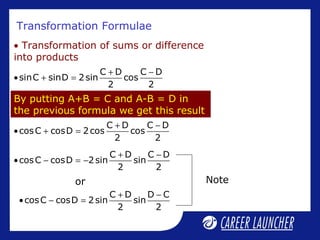
Transformation Formulae
• Transformation of sums or difference
into products
C D C D
sinC sinD 2sin cos
2 2
+ −
• + =
C D C D
sinC sinD 2cos sin
2 2
+ −
• − =
C D C D
cosC cosD 2cos cos
2 2
+ −
• + =
C D C D
cosC cosD 2sin sin
2 2
+ −
• − = −
C D D C
cosC cosD 2sin sin
2 2
+ −
• − =
or Note
By putting A+B = C and A-B = D in
the previous formula we get this result
Illustrative problem
Prove that
cos8x cos6x cos 4x
cot 6x
sin8x sin6x sin4x
+ +
=
+ +
Solution
(cos8x cos 4x) cos6x
L.H.S
(sin8x sin4x) sin6x
+ +
=
+ +
8x 4x 8x 4x
2cos cos cos6x
2 2
8x 4x 8x 4x
2sin cos sin6x
2 2
+ −
+
=
+ −
+
2cos6x cos2x cos6x
2sin6x sin2x sin6x
+
=
+
2cos6x(cos2x 1)
2sin6x(cos2x 1)
+
=
+
cot 6x= Proved
Class Exercise - 1
If the angular diameter of the moon
be 30´, how far from the eye can a
coin of diameter 2.2 cm be kept to
hide the moon? (Take p =
approximately)
22
7
A
B
E ( E y e )
r
M o o n
Class Exercise - 1
If the angular diameter of the moon be 30´,
how far from the eye can a coin of diameter
2.2 cm be kept to hide the moon? (Take p =
approximately)
22
7
A
B
E ( E y e )
r
M o o n
Solution :-
Let the coin is kept at a distance r
from the eye to hide the moon
completely. Let AB = Diameter of
the coin. Then arc AB = Diameter
AB = 2.2 cm
c c
30 1
30´
60 2 180 360
π π     
θ = = = × =     
     
o
arc 2.2
radius 360 r
π
∴ θ = ⇒ =
360 2.2 360 2.2 7
r 252 cm
22
× × ×
= = =
π
Class Exercise - 2
Solution :-
Prove that tan3A tan2A tanA =
tan3A – tan2A – tanA.
We have 3A = 2A + A
⇒ tan3A = tan(2A + A)
⇒ tan3A = tan2A tanA
1– tan2A tanA
+
⇒ tan3A – tan3A tan2A tanA = tan2A + tanA
⇒ tan3A – tan2A – tanA = tan3A tan2A tanA (Proved)
Class Exercise - 3
If sinα = sinβ and cosα = cosβ, then
–
sin 0
2
α β
=(c)
–
cos 0
2
α β
=(d)
sin 0
2
α + β
=(a) cos 0
2
α + β
=(b)
Solution :-
α = βQsin sin α = βcos cosand
⇒ α β = α β =sin – sin 0 and cos – cos 0
– –
2sin cos 0 and – 2sin sin 0
2 2 2 2
α β α + β α β α + β
⇒ = =
–
sin 0
2
α β
⇒ =
Class Exercise - 4
Prove that
° ° ° ° =
3
sin20 sin40 sin60 sin80
16
LHS = sin20° sin40° sin60° sin80°
Solution:-
1
sin60 [2sin20 sin40 ] sin80
2
= ° × ° ° × °
3 1
[cos(40 – 20 ) – cos(40 20 )] sin80
2 2
= × ° ° ° + ° × °
3
[cos20 – cos60 ]sin80
4
= ° ° °
3 1
sin80 cos20 – sin80
4 2
 
= ° ° × ° 
 
[ ]
3
2sin80 cos20 – sin80
8
= ° ° °
Class Exercise - 4
Prove that
° ° ° ° =
3
sin20 sin40 sin60 sin80
16
Solution:-
[ ]3
sin(80 20 ) sin(80 – 20 )– sin80
8
= ° + ° + ° ° °
[ ]
3
sin100 sin60 – sin80
8
= ° + ° °
[ ]
3
sin(180 – 80 ) sin60 – sin80
8
= ° ° + ° °
3 3
sin80 – sin80
8 2
 
= ° + ° 
  
3
16
=
Proved.
Class Exercise - 5
Prove that
n n
n
cos A cosB sin A sinB
sin A – sinB cos A – cosB
A B
2 cot , if n is even
2
0, if n is odd
+ +   
+   
   
 + 
  =   


Solution :-
n n
cos A cosB sinA sinB
LHS
sinA – sinB cos A – cosB
+ +   
= +   
   
n n
A B A – B A B A – B
2cos cos 2sin cos
2 2 2 2
A B A – B A B A – B
2cos sin –2sin sin
2 2 2 2
+ +   
   
= +   
+ +      
   
n n
A– B A – B
cot –cot
2 2
      
= +      
      
Class Exercise - 5
Solution :-
n n nA – B A – B
cot (–1) cot
2 2
   
= +   
   
n
n n
A – B
2cot , if n is evenA – B
cot 1 (–1) 2
2
0, if n is odd

   = + =      
Prove that
n n
n
cos A cosB sin A sinB
sin A – sinB cos A – cosB
A B
2 cot , if n is even
2
0, if n is odd
+ +   
+   
   
 + 
  =   


Class Exercise - 6
The maximum value of 3 cosx + 4
sinx + 5 is
(d) None of these
(a) 5 (b) 9
(c) 7
2 23cos x 4sinx 3 4+ = +Q
Solution :-
2 2 2 2
3 4
cos x sinx
3 4 3 4
 
+  
+ + 
3 4
5 cos x sinx
5 5
 
= + 
 
[ ]5 cosx cos sinx sin= α + α
3 4
Let cos sin
5 5
 
α = ⇒ α = 
 
Class Exercise - 6
The maximum value of 3 cosx + 4 sinx + 5
is
Solution :-
3 4
Let cos sin
5 5
 
α = ⇒ α = 
 
5cos(x – )= α
–1 cos(x – ) 1≤ α ≤Q
–5 5cos(x – ) 5⇒ ≤ α ≤
–5 5 5cos(x – ) 5 10⇒ + ≤ α + ≤
0 3cosx 4sinx 5 10⇒ ≤ + + ≤
∴ Maximum value of the given expression = 10.
Class Exercise - 7
If a and b are the solutions of a
cosθ + b sinθ = c, then show that
2 2
2 2
a – b
cos( )
a b
α+β =
+
Solution :-
We have … (i)acos bsin cθ + θ =
acos c – bsin⇒ θ = θ
2 2 2
a cos (c – bsin )⇒ θ = θ
( )2 2 2 2 2
a 1– sin c –2bcsin b sin⇒ θ = θ + θ
( )2 2 2 2 2a b sin – 2bcsin (c – a ) 0⇒ + θ θ + =
∴αβare roots of equatoin (i),
Class Exercise - 7
If a and b are the solutions of acosθ + bsinθ
= c, then show that α + β =
+
2 2
2 2
a – b
cos( )
a b
Solution :-
2 2
2 2
c – a
sin sin
a b
α β =
+
Hence
Again from (i),bsin c – acosθ = θ
2 2 2b sin (c – acos )⇒ θ = θ
2 2 2 2 2b (1– cos ) c a cos –2cacos⇒ θ = + θ θ
2 2 2 2 2(a b )cos – 2ac cos c – b 0⇒ + θ θ + =
∴sinα and sinβ are roots of equ. (ii).
Class Exercise - 7
If a and b are the solutions of acosθ + bsinθ
= c, then show that α + β =
+
2 2
2 2
a – b
cos( )
a b
Solution :- (iv)
∴α and β be the roots of equation (i),
∴cosα and cosβ are the roots of equation (iv).
2 2
2 2
c – b
cos cos
a b
α β =
+
2 2 2 2 2 2
2 2 2 2 2 2
c – b c – a a – b
–
a b a b a b
= =
+ + +
cos( ) cos cos – sin sinα + β = α β α βNow
Class Exercise - 8
If a seca – c tana = d and b seca
+ d tana = c, then
(a) a2
+ b2
= c2
+ d2
+ cd
(c) a2
+ b2
= c2
+ d2
(d) ab = cd
+ = +2 2
2 2
1 1
a b
c d
(b)
Class Exercise - 8
If a seca – c tana = d and b seca
+ d tana = c, then
asec – c tan dα α =Q
a c sin
– d
cos cos
α
⇒ =
α α
Solution :-
b sec dtan cα + α =QAgain
b dsin
c
cos cos
α
⇒ + =
α α
⇒ = α αb ccos – dsin ….. ii
a csin dcos⇒ = α + α ….. (I)
Squaring and adding
(i) and (ii), we get
2 2 2 2 2 2 2 2a b c (sin cos ) d (cos sin )+ = α + α + α + α
2cd sin cos 2cd sin cos+ α α − α α 2 2c d= +
Class Exercise -9
2 2A A
sin – sin –
8 2 8 2
π π   
+   
   
The value of
(a) 2 sinA
(c) 2 cosA
1
sinA
2
(b)
1
cosA
2
(d)
Class Exercise -9
2 2A A
sin – sin –
8 2 8 2
π π   
+   
   
Q
Solution :-
A A A A
sin – sin – –
8 2 8 2 8 2 8 2
   π π π π       
= + + +          
          
1
sin sin A sin A
4 2
π
= ⋅ =
2 2
sin A – sin B sin(A B)sin(A – B) = +  
Q
2 2A A
sin – sin –
8 2 8 2
π π   
+   
   
The value of
Class Exercise -10
If , ,
α and β lie between0 and , then value
α of tan2α is
4
cos( )
5
α + β =
5
sin( – )
13
α β =
4
π
(a) 1
(c) 0
(b)
56
33
(d)
33
56
Solution :- ∴α and βbetween 0 and ,
π
4
– – and 0
4 4 2
π π π
∴ < α β < < α + β <
Consequently, cos(α − β) and sin(α + β) are positive.
2
sin( ) 1– cos ( )α + β = α + β
Class Exercise -10
Solution :-
16 3
1 –
25 5
= =
2 25 12
cos( – ) 1– sin ( – ) 1–
169 13
α β = α β = =
3 5
tan( ) , tan( – )
4 12
∴ α + β = α β =
tan2 tan[( ) ( – )]α = α + β + α β
3 5
tan( ) tan( – ) 564 12
3 51– tan( )tan( – ) 33
1–
4 12
+
α + β + α β
= = =
α + β α β
×
If , ,
α and β lie between0 and , then value
α of tan2α is
4
cos( )
5
α + β =
5
sin( – )
13
α β =
4
π

Trigonometric ratios and identities 1

  • 1.
  • 2.
    Trigonometric ratios andIdentities Session 1
  • 3.
    Topics Transformation of Angles CompoundAngles Definition and Domain and Range of Trigonometric Function Measurement of Angles
  • 4.
    Measurement of Angles OA B OA InitialRay− uuur OB Ter minal Ray− uuur Angle is considered as the figure obtained by rotating initial ray about its end point. J001
  • 5.
    Measure and Signof an Angle Measure of an Angle :- Amount of rotation from initial side to terminal side. Sign of an Angle :- O A B θ Rotation anticlockwise – Angle positive B’ − θ Rotation clockwise – Angle negative J001
  • 6.
    Right Angle O Y X Revolving raydescribes one – quarter of a circle then we say that measure of angle is right angle J001 Angle < Right angle ⇒ Acute Angle Angle > Right angle ⇒ Obtuse Angle
  • 7.
    Quadrants O Y Y’ X’ X II Quadrant (, )− + I Quadrant ( , )+ + IV Quadrant ( , )+ − III Quadrant ( , )− − X’OX – x - axis Y’OY – y - axis J001
  • 8.
    System of Measurementof Angle Measurement of Angle Sexagesimal System or British System Centesimal System or French System Circular System or Radian Measure J001
  • 9.
    System of Measurementof Angles Sexagesimal System (British System) 1 right angle = 90 degrees (=90o ) 1 degree = 60 minutes (=60’) 1 minute = 60 seconds (=60”) Centesimal System (French System) 1 right angle = 100 grades (=100g ) 1 grade = 100 minutes (=100’) 1 minute = 100 Seconds (=100”) J001 Is 1 minute of sexagesimal 1 minute of centesimal ? = NO
  • 10.
    System of Measurementof Angle Circular System J001 O r r r A B 1c If OA = OB = arc AB c Then AOB 1radian( 1 )∠ = =
  • 11.
    System of Measurementof Angle Circular System O A C B 1c AOC arc AC AOB arc ACB ∠ = ∠ Q 1radian r 2right angles r ⇒ = π 2right angles radian⇒ = π J001 180 radian⇒ = πo
  • 12.
    Relation Between DegreeGrade And Radian Measure of An Angle 0 g D G 2C 90 100 = = π OR 0 g D G C 180 200 = = π J002
  • 13.
    Illustrative Problem Find thegrade and radian measures of the angle 5o 37’30” Solution o' o 30 30 1 30" 60 60 60 120      = = = ÷  ÷ ÷×     o 37 and37' 60   =  ÷   o o o 37 1 45 5 37'30" 5 60 120 8     ∴ = + + = ÷  ÷     J002 We know that D G 2C 90 100 = = π
  • 14.
    Illustrative Problem Find thegrade and radian measures of the angle 5o 37’30” g 10 G D 9   ⇒ = × ÷   ( ) g g g10 45 225 12.5 Ans 9 8 18     = × = = ÷  ÷     c and R D 180 π  = × ÷   c 45 radian Ans 180 8 32 π π  = × = ÷   Solution J002
  • 15.
    Relation Between AngleSubtended by an Arc At The Center of Circle O A C 1c θ B Arc AC = r and Arc ACB =  AOC arc AC AOB arc ACB ∠ = ∠ Q J002 1radian r ⇒ = θ l r ⇒ θ = l
  • 16.
    Illustrative Problem A horseis tied to a post by a rope. If the horse moves along a circular path always keeping the rope tight and describes 88 meters when it has traced out 72o at the center. Find the length of rope. [ Take π = 22/7 approx.]. Solution P A B 72o Arc AB = 88 m and AP = ? c o 2 72 72 rad 180 5 π π  θ = = × = ÷   J002 arc AB r AP θ = = l Q 2 88 22 AP 70m [ approx.] 5 AP 7 π = ⇒ = π =
  • 17.
    Definition of TrigonometricRatios J003 2 2 r x y= + xO Y X P (x,y) M θ y r y sin r x cos r y tan x θ = θ = θ = x cot y r sec x r cosec y θ = θ = θ =
  • 18.
    Some Basic Identities sincosec 1 ; n ,n I• θ × θ = θ ≠ π ∈ 2 2 sin cos 1• θ + θ = 2 2 sec tan 1• θ − θ = 2 2 cosec cot 1• θ − θ = ( ) sin tan ; 2n 1 ,n I cos 2 θ π • θ = θ ≠ + ∈ θ ( )tan cot 1 ; 2n 1 ; n ,n I 2 π • θ × θ = θ ≠ + θ ≠ π ∈ cos cot ; n ,n I sin θ • θ = θ ≠ π ∈ θ ( )cos sec 1 ; 2n 1 ,n I 2 π • θ × θ = θ ≠ + ∈
  • 19.
    Illustrative Problem Solution 3 sec tan.cosec= θ + θ θ 3 cosec sec 1 tan sec θ  = θ + θ ÷θ  ( )3 sec 1 tan cot= θ + θ θ ( )2 sec 1 tan= θ + θ ( )2 2 1 tan 1 tan= + θ + θ ( ) 3 2 21 tan= + θ ( ) 3 2 22 e Proved= − J0032 2 If tan 1 e ,prove thatθ = − ( ) 3 3 2 2sec tan .cosec 2 eθ + θ θ = − 0 2 π  < θ < ÷  
  • 20.
    Signs of TrigonometricFunction In All Quadrants In First Quadrant xO Y X P (x,y) M θ y r Here x >0, y>0, 2 2 r x y= + >0 y sin 0 r θ = > x cos 0 r θ = > y tan 0 x θ = > x cot 0 y θ = > r sec 0 x θ = > r cosec 0 y θ = > J004
  • 21.
    Signs of TrigonometricFunction In All Quadrants In Second Quadrant Here x <0, y>0, 2 2 r x y= + >0 y sin 0 r θ = > r cosec 0 y θ = > θ XX’ Y Y’ P (x,y) x y r x cos 0 r θ = < y tan 0 x θ = < x cot 0 y θ = < r sec 0 x θ = < J004
  • 22.
    Signs of TrigonometricFunction In All Quadrants In Third Quadrant Here x <0, y<0, 2 2 r x y= + >0 r cosec 0 y θ = > r sec 0 x θ = < θ X’ X P (x,y) O Y’ Y M y sin 0 r θ = < x cos 0 r θ = < y tan 0 x θ = > x cot 0 y θ = > J004
  • 23.
    Signs of TrigonometricFunction In All Quadrants In Fourth Quadrant Here x >0, y<0, 2 2 r x y= + >0 y sin 0 r θ = < θ XO P (x,y) Y’ M x cos 0 r θ = > y tan 0 x θ = < x cot 0 y θ = < r sec 0 x θ = > r cosec 0 y θ = < J004
  • 24.
    Signs of TrigonometricFunction In All Quadrants I Quadrant All Positive II Quadrant sin & cosec are Positive III Quadrant tan & cot are Positive IV Quadrant cos & sec are Positive X Y’ X’ Y O J004 ASTC :- All Sin Tan Cos
  • 25.
    Illustrative Problem θ liesin secondIf cot θ = 12 , 5 − quadrant, find the values of other five trigonometric function Solution 12 5 cot tan 5 12 θ = − ⇒ θ = −Q 2 2 2 169 sec 1 tan sec 144 θ = + θ ⇒ θ =Q ( ) 13 13 sec sec liesinsec ondquadrant 12 12 ⇒ θ = ± ⇒ θ = − θ 12 Whichgivescos 13 θ = − 13 cosec 5 ∴ θ = J004 Method : 1 5 12 5 Thensin tan cos 12 13 13 θ = θ × θ = − × − =
  • 26.
    Illustrative Problem θ liesin secondIf cot θ = 12 , 5 − quadrant, find the values of other five trigonometric function Solution J004 Method : 2 Y θ XX’ Y’ P (-12,5) -12 5 r Here x = -12, y = 5 and r = 13 y 5 sin r 13 θ = = x 12 cos r 13 − θ = = y 5 tan x 12 θ = = − r 13 sec x 12 θ = = − r 13 cosec y 5 θ = =
  • 27.
    Functions Domain Range sinθR [-1,1] cosθ R [-1,1] secθ R : (2n 1) 2 π  − θ θ = +    R-(-1,1) cosecθ { }R : n− θ θ = π R-(-1,1) tanθ R : (2n 1) 2 π  − θ θ = +    R cotθ { }R : n− θ θ = π R Domain and Range of Trigonometric Function J005
  • 28.
    Illustrative problem Prove that 2 2(x y) sin 4xy + θ = is possible for real values of x and y only when x=y Solution ( ) 2 2(x y) 1 x y 4xy 4xy + ⇒ ≤ ⇒ + ≤ 2 sin 1θ ≤Q ( ) ( )2 2 x y 4xy 0 x y 0⇒ + − ≤ ⇒ − ≤ But for real values of x and y ( )2 x y− is not less than zero ( )2 x y 0 x y Pr oved∴ − = ⇒ = J005
  • 29.
    Trigonometric Function ForAllied Angles Trig. ratio -θ 90o -θ 90o +θ 180o -θ 180o +θ 360o -θ 360o +θ cosθ cosθ sinθ - sinθ - cosθ - cosθ cosθ cosθ tanθ - tanθ cotθ - cotθ -tanθ tanθ - tanθ tanθ sinθ - sinθ cosθ cosθ sinθ - sinθ - sinθ sinθ If angle is multiple of 900 then sin ⇔ cos;tan ⇔ cot; sec ⇔ cosec If angle is multiple of 1800 then sin ⇔ sin;cos ⇔ cos; tan ⇔ tan etc.
  • 30.
    Trigonometric Function ForAllied Angles Trig. ratio -θ 90o -θ 90o +θ 180o -θ 180o +θ 360o -θ 360o +θ secθ secθ cosecθ - cosecθ - secθ - secθ secθ secθ cosecθ - cosecθ secθ secθ cosecθ -cosecθ - cosecθ cosecθ cotθ - cotθ tanθ -tanθ -cotθ cotθ - cotθ cotθ
  • 31.
    Periodicity of Trigonometric Function Periodicity: After certain value of x the functional values repeats itself Period of basic trigonometric functions sin (360o +θ) = sinθ ⇒ period of sinθ is 360o or 2π cos (360o +θ) = cosθ ⇒ period of cosθ is 360o or 2π tan (180o +θ) = tanθ ⇒ period of tanθ is 180o or π J005 If f(x+T) = f(x) ∀ x,then T is called period of f(x) if T is the smallest possible positive number
  • 32.
    Trigonometric Ratio ofCompound Angle Angles of the form of A+B, A-B, A+B+C, A-B+C etc. are called compound angles (I) The Addition Formula • sin (A+B) = sinAcosB + cosAsinB • cos (A+B) = cosAcosB - sinAsinB ( ) tanA tanB tan A B 1 tanA tanB + • + = − J006 ( ) sin(A B) Pr oof: tan A B cos(A B) + − + = + Q sinA cosB cos A sinB cos A cosB sinA sinB + = −
  • 33.
    Trigonometric Ratio ofCompound Angle J006 sinA cosB cos A sinB cos A cosB sinA sinB + = − r r Dividing N and D by cos A cosB We get tanA tanB 1 tanA tanB + = − Proved ( ) cotBcot A 1 cot A B cotB cot A − • + = +
  • 34.
    Illustrative problem Find thevalue of (i) sin 75o (ii) tan 105o Solution (i) Sin 75o = sin (45o + 30o ) = sin 45o cos 30o + cos 45o sin 30o 1 3 1 1 3 1 2 22 2 2 2 + = × + × = ( )(ii) Ans: 2 3− +
  • 35.
    Trigonometric Ratio of CompoundAngle (I) The Difference Formula • sin (A - B) = sinAcosB - cosAsinB • cos (A - B) = cosAcosB + sinAsinB ( ) tanA tanB tan A B 1 tanA tanB − • − = + Note :- by replacing B to -B in addition formula we get difference formula ( ) cotB cot A 1 cot A B cot A cotB + • − = − −
  • 36.
    Illustrative problem If tan(θ+α) = a and tan (θ - α) = b Prove that a b tan2 1 ab − α = − Solution ( ) ( ){ }tan2 tanα = θ + α − θ − α ( ) ( ) ( ) ( ) tan tan 1 tan tan θ + α − θ − α = + θ + α θ − α a b 1 ab − = +
  • 37.
    Some Important Deductions •sin (A+B) sin (A-B) = sin2 A - sin2 B = cos2 B - cos2 A • cos (A+B) cos (A-B) = cos2 A - sin2 B = cos2 B - sin2 A ( ) tanA tanB tanC tanA tanB tanC tan A B C 1 tanA tanB tanB tanC tanC tanA + + − • + + = − − −
  • 38.
    To Express acosθ+ bsinθ in the form kcosφ or λsinψ acosθ +bsinθ 2 2 2 2 2 2 a b a b cos sin a b a b   = + θ + θ ÷ + +  2 2 2 2 a b Let cos ,thensin a b a b α = α = + + ( )2 2 acos b sin a b cos cos sin sin∴ θ + θ = + θ α + θ α ( )2 2 a b cos= + θ − α Similarly we get acosθ + bsinθ = λsinψ 2 2 k cos ,where k a b ,= φ = + φ = θ − α
  • 39.
    Illustrative problem 7cosθ +24sinθ Findthe maximum and minimum values of 7cosθ + 24sinθ Solution 2 2 2 2 2 2 7 24 7 24 cos sin 7 24 7 24   = + θ + θ ÷ + +  7 24 25 cos sin 25 25   = θ + θ ÷   7 24 Let cos sin 25 25 α = ⇒ α = ( )7cos 24sin 25 cos cos sin sin∴ θ + θ = θ α + θ α
  • 40.
    Illustrative problem Find themaximum and minimum value of 7cosθ + 24sinθ Solution ( )25cos 25cos where= θ − α = φ φ = θ − α 1 cos 1− ≤ φ ≤Q 25 25cos 25⇒ − ≤ φ ≤ ∴ Max. value =25, Min. value = -25 Ans.
  • 41.
    Transformation Formulae • Transformationof product into sum and difference • 2 sinAcosB = sin(A+B) + sin(A - B) • 2 cosAsinB = sin(A+B) - sin(A - B) • 2 cosAcosB = cos(A+B) + cos(A - B) Proof :- R.H.S = cos(A+B) + cos(A - B) = cosAcosB - sinAsinB+cosAcosB+sinAsinB = 2cosAcosB =L.H.S • 2 sinAsinB = cos(A - B) - cos(A+B) [Note]
  • 42.
    Transformation Formulae • Transformationof sums or difference into products C D C D sinC sinD 2sin cos 2 2 + − • + = C D C D sinC sinD 2cos sin 2 2 + − • − = C D C D cosC cosD 2cos cos 2 2 + − • + = C D C D cosC cosD 2sin sin 2 2 + − • − = − C D D C cosC cosD 2sin sin 2 2 + − • − = or Note By putting A+B = C and A-B = D in the previous formula we get this result
  • 43.
    Illustrative problem Prove that cos8xcos6x cos 4x cot 6x sin8x sin6x sin4x + + = + + Solution (cos8x cos 4x) cos6x L.H.S (sin8x sin4x) sin6x + + = + + 8x 4x 8x 4x 2cos cos cos6x 2 2 8x 4x 8x 4x 2sin cos sin6x 2 2 + − + = + − + 2cos6x cos2x cos6x 2sin6x sin2x sin6x + = + 2cos6x(cos2x 1) 2sin6x(cos2x 1) + = + cot 6x= Proved
  • 44.
    Class Exercise -1 If the angular diameter of the moon be 30´, how far from the eye can a coin of diameter 2.2 cm be kept to hide the moon? (Take p = approximately) 22 7 A B E ( E y e ) r M o o n
  • 45.
    Class Exercise -1 If the angular diameter of the moon be 30´, how far from the eye can a coin of diameter 2.2 cm be kept to hide the moon? (Take p = approximately) 22 7 A B E ( E y e ) r M o o n Solution :- Let the coin is kept at a distance r from the eye to hide the moon completely. Let AB = Diameter of the coin. Then arc AB = Diameter AB = 2.2 cm c c 30 1 30´ 60 2 180 360 π π      θ = = = × =            o arc 2.2 radius 360 r π ∴ θ = ⇒ = 360 2.2 360 2.2 7 r 252 cm 22 × × × = = = π
  • 46.
    Class Exercise -2 Solution :- Prove that tan3A tan2A tanA = tan3A – tan2A – tanA. We have 3A = 2A + A ⇒ tan3A = tan(2A + A) ⇒ tan3A = tan2A tanA 1– tan2A tanA + ⇒ tan3A – tan3A tan2A tanA = tan2A + tanA ⇒ tan3A – tan2A – tanA = tan3A tan2A tanA (Proved)
  • 47.
    Class Exercise -3 If sinα = sinβ and cosα = cosβ, then – sin 0 2 α β =(c) – cos 0 2 α β =(d) sin 0 2 α + β =(a) cos 0 2 α + β =(b) Solution :- α = βQsin sin α = βcos cosand ⇒ α β = α β =sin – sin 0 and cos – cos 0 – – 2sin cos 0 and – 2sin sin 0 2 2 2 2 α β α + β α β α + β ⇒ = = – sin 0 2 α β ⇒ =
  • 48.
    Class Exercise -4 Prove that ° ° ° ° = 3 sin20 sin40 sin60 sin80 16 LHS = sin20° sin40° sin60° sin80° Solution:- 1 sin60 [2sin20 sin40 ] sin80 2 = ° × ° ° × ° 3 1 [cos(40 – 20 ) – cos(40 20 )] sin80 2 2 = × ° ° ° + ° × ° 3 [cos20 – cos60 ]sin80 4 = ° ° ° 3 1 sin80 cos20 – sin80 4 2   = ° ° × °    [ ] 3 2sin80 cos20 – sin80 8 = ° ° °
  • 49.
    Class Exercise -4 Prove that ° ° ° ° = 3 sin20 sin40 sin60 sin80 16 Solution:- [ ]3 sin(80 20 ) sin(80 – 20 )– sin80 8 = ° + ° + ° ° ° [ ] 3 sin100 sin60 – sin80 8 = ° + ° ° [ ] 3 sin(180 – 80 ) sin60 – sin80 8 = ° ° + ° ° 3 3 sin80 – sin80 8 2   = ° + °     3 16 = Proved.
  • 50.
    Class Exercise -5 Prove that n n n cos A cosB sin A sinB sin A – sinB cos A – cosB A B 2 cot , if n is even 2 0, if n is odd + +    +         +    =      Solution :- n n cos A cosB sinA sinB LHS sinA – sinB cos A – cosB + +    = +        n n A B A – B A B A – B 2cos cos 2sin cos 2 2 2 2 A B A – B A B A – B 2cos sin –2sin sin 2 2 2 2 + +        = +    + +           n n A– B A – B cot –cot 2 2        = +             
  • 51.
    Class Exercise -5 Solution :- n n nA – B A – B cot (–1) cot 2 2     = +        n n n A – B 2cot , if n is evenA – B cot 1 (–1) 2 2 0, if n is odd     = + =       Prove that n n n cos A cosB sin A sinB sin A – sinB cos A – cosB A B 2 cot , if n is even 2 0, if n is odd + +    +         +    =     
  • 52.
    Class Exercise -6 The maximum value of 3 cosx + 4 sinx + 5 is (d) None of these (a) 5 (b) 9 (c) 7 2 23cos x 4sinx 3 4+ = +Q Solution :- 2 2 2 2 3 4 cos x sinx 3 4 3 4   +   + +  3 4 5 cos x sinx 5 5   = +    [ ]5 cosx cos sinx sin= α + α 3 4 Let cos sin 5 5   α = ⇒ α =   
  • 53.
    Class Exercise -6 The maximum value of 3 cosx + 4 sinx + 5 is Solution :- 3 4 Let cos sin 5 5   α = ⇒ α =    5cos(x – )= α –1 cos(x – ) 1≤ α ≤Q –5 5cos(x – ) 5⇒ ≤ α ≤ –5 5 5cos(x – ) 5 10⇒ + ≤ α + ≤ 0 3cosx 4sinx 5 10⇒ ≤ + + ≤ ∴ Maximum value of the given expression = 10.
  • 54.
    Class Exercise -7 If a and b are the solutions of a cosθ + b sinθ = c, then show that 2 2 2 2 a – b cos( ) a b α+β = + Solution :- We have … (i)acos bsin cθ + θ = acos c – bsin⇒ θ = θ 2 2 2 a cos (c – bsin )⇒ θ = θ ( )2 2 2 2 2 a 1– sin c –2bcsin b sin⇒ θ = θ + θ ( )2 2 2 2 2a b sin – 2bcsin (c – a ) 0⇒ + θ θ + = ∴αβare roots of equatoin (i),
  • 55.
    Class Exercise -7 If a and b are the solutions of acosθ + bsinθ = c, then show that α + β = + 2 2 2 2 a – b cos( ) a b Solution :- 2 2 2 2 c – a sin sin a b α β = + Hence Again from (i),bsin c – acosθ = θ 2 2 2b sin (c – acos )⇒ θ = θ 2 2 2 2 2b (1– cos ) c a cos –2cacos⇒ θ = + θ θ 2 2 2 2 2(a b )cos – 2ac cos c – b 0⇒ + θ θ + = ∴sinα and sinβ are roots of equ. (ii).
  • 56.
    Class Exercise -7 If a and b are the solutions of acosθ + bsinθ = c, then show that α + β = + 2 2 2 2 a – b cos( ) a b Solution :- (iv) ∴α and β be the roots of equation (i), ∴cosα and cosβ are the roots of equation (iv). 2 2 2 2 c – b cos cos a b α β = + 2 2 2 2 2 2 2 2 2 2 2 2 c – b c – a a – b – a b a b a b = = + + + cos( ) cos cos – sin sinα + β = α β α βNow
  • 57.
    Class Exercise -8 If a seca – c tana = d and b seca + d tana = c, then (a) a2 + b2 = c2 + d2 + cd (c) a2 + b2 = c2 + d2 (d) ab = cd + = +2 2 2 2 1 1 a b c d (b)
  • 58.
    Class Exercise -8 If a seca – c tana = d and b seca + d tana = c, then asec – c tan dα α =Q a c sin – d cos cos α ⇒ = α α Solution :- b sec dtan cα + α =QAgain b dsin c cos cos α ⇒ + = α α ⇒ = α αb ccos – dsin ….. ii a csin dcos⇒ = α + α ….. (I) Squaring and adding (i) and (ii), we get 2 2 2 2 2 2 2 2a b c (sin cos ) d (cos sin )+ = α + α + α + α 2cd sin cos 2cd sin cos+ α α − α α 2 2c d= +
  • 59.
    Class Exercise -9 22A A sin – sin – 8 2 8 2 π π    +        The value of (a) 2 sinA (c) 2 cosA 1 sinA 2 (b) 1 cosA 2 (d)
  • 60.
    Class Exercise -9 22A A sin – sin – 8 2 8 2 π π    +        Q Solution :- A A A A sin – sin – – 8 2 8 2 8 2 8 2    π π π π        = + + +                      1 sin sin A sin A 4 2 π = ⋅ = 2 2 sin A – sin B sin(A B)sin(A – B) = +   Q 2 2A A sin – sin – 8 2 8 2 π π    +        The value of
  • 61.
    Class Exercise -10 If, , α and β lie between0 and , then value α of tan2α is 4 cos( ) 5 α + β = 5 sin( – ) 13 α β = 4 π (a) 1 (c) 0 (b) 56 33 (d) 33 56 Solution :- ∴α and βbetween 0 and , π 4 – – and 0 4 4 2 π π π ∴ < α β < < α + β < Consequently, cos(α − β) and sin(α + β) are positive. 2 sin( ) 1– cos ( )α + β = α + β
  • 62.
    Class Exercise -10 Solution:- 16 3 1 – 25 5 = = 2 25 12 cos( – ) 1– sin ( – ) 1– 169 13 α β = α β = = 3 5 tan( ) , tan( – ) 4 12 ∴ α + β = α β = tan2 tan[( ) ( – )]α = α + β + α β 3 5 tan( ) tan( – ) 564 12 3 51– tan( )tan( – ) 33 1– 4 12 + α + β + α β = = = α + β α β × If , , α and β lie between0 and , then value α of tan2α is 4 cos( ) 5 α + β = 5 sin( – ) 13 α β = 4 π

Editor's Notes

  • #28 Faculty should explain domain of any one of trigonometric function in the class with the help off funda book.
  • #34 Ask the students to attempt cot(A+B) themselves
  • #38 Ask the students to find the expressions for Sin ( A+B+C) and Cos ( A+B+C)
  • #41 Ask them to try using the Sin (A+B ) form
  • #42 Ask student to do 2 sinAsinB = cos(A - B) - cos(A+B)