Classical Mechanics Homework 2
                        Due October 12, 2012

1. (Taylor, Problem 2-11) Consider an object that is thrown vertically up
   with initial speed v0 in a linear medium.
  StatementThis is another problem in which we consider the effects of air
  resistance on motion under gravity. In this case we need to find the height
  as a function of time going up, starting with some initial velocity.
  AssumptionsWe assume linear drag plus gravity, and linear motion. The
  object is a point particle.
  Physical representationThe forces we need are gravity pointing down,
  hence negative, and drag pointing down, also negative. We consider mo-
  tion going up only, and do not worry what happens after we reach the top
  of the orbit.
  Mathematical representation and solutionMathematical representa-
  tion and solution, see parts below.

   (a) Measuring y upward from the point of release, write expressions for
       the object’s velocity vy (t) and position y(t).
        This follows exactly what we did in class. Starting with an expression
       for Newton’s 2nd Law (coordinate system positive upward):

                                       mv
                                        ˙     =   −mg − bv
                     ∫   v                            ∫   t
                               m
                                       dv ′   =   −           dt′
                      v0     mg + bv ′                0
                             (           )
                    m    mg + bv
                −     ln                      =   t
                    b    mg + bv0
                                                  ( mg      )         mg
                                         v    =         + v0 e−bt/m −
                                                      b                b
       Now, separate again to find position as a function of time:
                ∫ y          ∫ t [(        )
                      ′             mg            ′     mg ] ′
                    dy =               + v0 e−bt /m −        dt
                 y0           0      b                   b

                                     m ( mg     )(         ) mg
                  y − y0         =          + v0 1 − e−bt/m −   t
                                     b    b                   b


   (b) Find the time for the object to reach its highest point and its position
       ymax at that point.
The highest point occurs when the velocity goes to zero:
                                       (           )
                                  m       mg + bv
                         t = − ln
                                   b     mg + bv0
                                       (          )
                                   m       mg
                         tmax   = − ln
                                   b     mg + bv0
                                         (          )
                                     m     mg + bv0
                                =      ln
                                     b       mg
    Finding the height at this time:
                         −b −m
                                   ( mg )
       e−btmax /m = e m b
                                 ln mg+bv
                                          0


                            mg
                     =
                          mg + bv0

                          m ( mg      )(      mg
                                                     )
                                                        m2 g
                                                              (
                                                                mg + bv0
                                                                         )
         ymax − y0   =           + v0    1−            − 2 ln
                          b    b            mg + bv0     b        mg

           mg               bv0
    1−               =
         mg + bv0         mg + bv0
                                                        (          )
                          m ( mg     )     v0      m2 g   mg + bv0
         ymax − y0   =           + v0 ( mg      ) − 2 ln
                          b    b         b + v0
                                                    b       mg

                                     (          )
                          m     m2 g   mg + bv0
         ymax − y0   =      v0 − 2 ln
                          b      b       mg

(c) Show that as the drag coefficient approaches zero, your last answer
                                                      2
    reduces to the well known result ymax = 1/2 v0 /g for an object in
    vacuum. [Hint: If the drag force is very small, the terminal speed is
    very big, so v0 /vterm is very small. Use the Taylor series for the log
    function to approximate ln (1 + δ) by δ − 1 δ 2 .
                                                2
     Now, recognizing that b is small:
                        (          )         (         )
                          mg + bv0                 bv0
                     ln               = ln 1 +
                            mg                     mg

                                           bv0   1 (bv0 )2
                                       ≈       −
                                           mg 2 (mg)2


    So, the maximum height becomes:
                                              (                     )
                                m     m2 g        bv0   1 (bv0 )2
              ymax − y0    ≈      v0 − 2              −
                                b      b          mg 2 (mg)2
2
                                   m      m      1 v0
                              =      v0 −   v0 +
                                   b      b      2 g
                                      2
                                   1 v0
                  ymax − y0   ≈
                                   2 g
        So, the power series approximation of the maximum height in drag
        case reduces to the non-drag case when the drag coefficient is small
        (as it should).
  Evaluation The equation we found for y(t) had the same form as the
  equation we had in class, so that sounds right. There is a term linear
  in time going down, representing the terminal velocity, and an exponen-
  tial approach to this terminal velocity. The formula gives us a maximum
  height, which in the limit of small drag gives the standard result. We could
  also check to see that the maximum height is actually less than the maxi-
  mum height without drag! Finally, for linear motion the equation is valid
  for all directions of the motion, so we can use the same equation for going
  down!
2. (Thorton & Marion, Problem 2-15) A particle of mass m slides down an
   inclined plane under the influence of gravity. If the motion is resisted by
   a force f = kmv 2 , show that the time required to move a distance d after
   starting from rest is:

                                     cosh−1 ekd
                                  t= √
                                       kg sin θ
  where θ is the angle of inclination of the plane.
  StatementThis problem is a variation on the well known inclined plane
  problem. We add friction and are asked to evaluate distance versus time.
  The equations are more complicated then those we had in Ph211.
  AssumptionsWe assume we have a point particle, with gravity, and that
  the friction force is quadratic. We included the mass as a second factor
  in the model for friction, the guess is that this will make the equations
  somewhat more simple.
  Physical representationThis is a problem with motion in one dimen-
  sion, one degree of freedom, so we use a coordinate system that reflects
  this. Taking the x-axis along the plane of the incline seems reasonable.
  We take x positive in the down direction. The set-up of the problem is a
  second law problem, F=ma, which we need to solve.
  Mathematical representation and solutionMathematical representa-
  tion and solution, see parts below.
   I’ll use a coordinate system where the coordinate x is parallel to the in-
  clined plane. The component of the net force parallel to the incline is:
                        ΣFx = mvx = mg sin θ − kmv 2
                         ⃗     ˙
mdv ′
                                                           = dt′
                                       mg sin(θ) − kmv ′ 2
Note that as usual the mass of the object drops out! Gravity and acceler-
ation always contain mass in the same manner.
                                               dv ′
                                                           = dt′
                                         g sin(θ) − kv ′ 2
Integrating:
                           ∫                                     ∫
                                   v
                                             dv ′                        t
                                                        =                    dt′
                               0       g sin θ − kv ′ 2              0


                                            ∫                        ∫
                                        1           v
                                                            dv ′                 t
                                   −                             =                   dt′
                                        k       0       v ′ − c2
                                                           2
                                                                             0
where we have defined
                                       g
                                         sin(θ) c2 =
                                       k
                             ∫ v[                ] ∫ t
                           1      dv ′      dv ′
                        −               − ′       =    dt′
                          2ck 0 v ′ − c v + c       0
              1
                  −
                 [ln(|v − c|) − ln(c) − ln(v + c) + ln(c)] = t
             2ck
We know that we have v < c, we never reach terminal velocity. Therefore
                                                    c−v
                                            ln(         ) = −2ckt
                                                    c+v
Solve for v so that I can find the distance:

                                       (c − v) = (c + v)e−2ckt

                            v(1 + e−2ckt ) = c(1 − e−2ckt )
                                                          1 − e−2ckt
                                             v=c
                                                          1 + e−2ckt
                           √              (√        )
                            g sin θ
                  v    =            tanh t kg sin θ
                               k
        ∫    d           ∫ t √              ( √         )
                                g sin θ
                 dx′   =                tanh t′ kg sin θ dt′
         0                0        k
                           √                           [    ( √          )]
                                   g sin θ    1                                            t
                  d    =                   √         ln cosh t′ kg sin θ
                                      k     kg sin θ                                       0

                           1 [      (√          )]
                  d    =     ln cosh t kg sin θ
                           k
Solving for t:
                                               (√          )
                               ekd       = cosh t kg sin θ

                                               cosh−1 ekd
                                   t =          √
                                                 kg sin θ
This part of the question was not asked, but is a useful example. Using:
                                                                    2
                                     k    =     0.5 N/(m/s)
                                                    π
                                     θ    =           radians
                                                    3


                        0.7

                        0.6

                        0.5

             Time, t [s] 0.4

                        0.3

                        0.2

                        0.1

                          0
                               0              0.5           1.0             1.5   2.0
                                                      Distance , d m
                                         Quadratic Drag           No Drag

For the no drag case:                               √
                                                          2d
                                           t=
                                                        g sin θ
The plot shows that the no drag case reaches a larger distance in the same
amount of time.
Evaluation In order to make sense of the results we do have to look at
the extra parts. With friction we travel a smaller distance than without,
which is expected. Also, in the limit of zero friction we have from
                                                    1 − e−2ckt
                                         v=c
                                                    1 + e−2ckt
that
                                               2ckt
                                         v≈c        = c2 kt
                                               1+1
, or
                                    v = g sin(θ)t
  as expected.

3. (Taylor, Problem 2-55) A charged particle of mass m and positive charge q
   moves in uniform electric and magnetic fields, E pointing in the y-direction
   and B in the z-direction (an arrangement called “crossed E and B fields”).
   Suppose the particle is initially at the origin and is given a kick at time
   t = 0 along the x-axis with vx = vx0 (positive or negative).
  Statement This is an example of a two-dimensional problem, with a ve-
  locity dependent force. Hence the directions of the force are complicated,
  even though the magnitudes are not.
  AssumptionsWe assume a point particle. The total force is a combina-
  tion of the electric and magnetic force.
  Physical representationWe need to write a two dimensional form of
  F=ma. The forces are given by the Lorentz force. The velocities are given
  by vx and vy , the components of the velocity, and these components can
  be negative. It is easiest to work in Carthesian coordinates.
  Mathematical representation and solutionMathematical representa-
  tion and solution, see parts below.

   (a) Write down the equation of motion for the particle and resolve it
       into its three components. Show that the motion remains in the
       plane z = 0
        Starting with Newton’s Second Law:

                              ΣF = mv = q(E + v × B)
                                    ˙

         Looking at each of the fields:

                                    E = E0 ˆ
                                           j
                             v × B = vy B 0 ˆ − vx B 0 ȷ
                                            ı          ˆ

         So, the equations of motion become:
                                         qB0
                               vx
                               ˙     =       vy
                                          m
                                         q
                               vy
                               ˙     =     (E0 − B0 vx )
                                         m


   (b) Prove that there is a unique value of vx0 , called the drift speed ddr ,
       for which the particle moves undeflected through the fields. (This is
the basis of velocity selectors, which select particles traveling at one
    chosen speed from a beam with many different speeds.)
     For there to be no deflection, the force in the y-direction must be
    zero.

                           ΣFy = q(E0 − B0 vx )

                             0 = q(E0 − B0 vx )

                                                 E0
                                          vx =
                                                 B0

                                                 E0
                                         vdr =
                                                 B0


(c) Solve the equations of motion to give the particle’s velocity as a
    function of t, for arbitrary values of vx0 . [Hint: The equations for
    (vx , vy ) should look very much like Equations (2.86) except for an
    offset of vx by a constant. If you make a change of variables of the
    form ux = vx − vdr and uy = vy , the equations for (ux , uy ) will have
    exactly the form (2.68), whose general solution you know.]
     Letting

                                   ux    = vx − vdr

                            uy = vy

    The equations of motion become:
                                          qB0
                              ux
                              ˙     =         uy
                                           m
                                            qB0
                              uy
                              ˙     = −         ux
                                             m

    Taking another time derivative of the x equation yields:
                                        qB0
                              ux =
                              ¨             uy
                                            ˙
                                         m


    Now, substituting the original equation of motion:
                                   qB0
                      ux
                      ¨    = −         ux
                                    m
                      ux   = A sin ω t + B cos ω t
vx     = A sin ω t + B cos ω t + vdr


                qB0
    where ω =    m           This gives
                                   u˙x = Aω cos(ωt) − Bω sin(ωt)
                       qB0
                           uy = Aω cos(ωt) − Bω sin(ωt)
                        m
    Using the initial condition that uy (t = 0) = 0 gives A = 0. Using the
    initial condition that vx (t = 0) = vx0 :
                                  vx0      =       B + vdr

                                   B       =       vx0 − vdr

                                   vx      =       (vx0 − vdr ) cos ω t + vdr


    Now, using this result to find the vy
                                                       qB0
                                   uy
                                   ˙       = −             ux
                                                        m
                                                       qB0
                                   vy
                                   ˙       = −             (vx − vdr )
                                                        m
                                                       qB0
                                   vy
                                   ˙       = −             (vx0 − vdr ) cos ω t
                                                        m
                    ∫        vy                    ∫    t
                                    ′
                                  dvy      =                −ω(vx0 − vdr ) cos ω t′ dt′
                         0                          0

                                   vy      = −(vx0 − vdr ) sin ω t


(d) Integrate the velocity to find the position as a function of t and sketch
    the trajectory for various values of vx0
     The integration is straightforward:
                             vx        = (vx0 − vdr ) cos (ω t) + vdr
                ∫    x                   ∫ t
                         dx′           =     [(vx0 − vdr ) cos (ω t′ ) + vdr ] dt′
                    x0                         0

                                            [                                     ]   t
                                                vx0 − vdr
                x − x0                 =                  sin (ω t′ ) + vdr t′
                                                    ω                                 0

                                            vx0 − vdr
                x − x0                 =              sin (ω t) + vdr t
                                                ω
vy       = −(vx0 − vdr ) sin (ω t)
                      ∫    y                        ∫     t
                                     ′
                                dy       = −                  (vx0 − vdr ) sin (ω t′ ) dt′
                          y0                          0

                                                                               t
                                                   vx0 − vdr
                       y − y0            =                   cos (ω t′ )
                                                       ω                       0

                                    vx0 − vdr
                       y − y0            =    [cos (ω t) − 1]
                                        ω
        Trajectories can be oscillatory or run back.


                                0.0          2.5              5.0      7.5      10.0     12.5
                          0.0


                       −0.5


                       −1.0


                       −1.5


                       −2.0


   Evaluation We found several familiar results. The condition for no de-
   flection was found in Ph213, as was the cyclotron frequency. We can
   also set the electric field equal to zero, which gives vdr = 0 and the orbit
   becomes a circle as expected.
4. (Thorton & Marion, Problem 9-60) A rocket has an initial mass of 7 × 10⁴
   kg and on firing burns its fuel at a rate of 250 kg/s. The exhaust velocity
   is 2500 m/s. If the rocket has a vertical ascent from rest on the earth, how
   long after the rocket engines fire will the rocket lift off? What is wrong
   with the design of this rocket?
   StatementAn application of what we did in class, but now using realistic
   numbers. We are asked about the conditions for lift-off for a rocket, and
   need to check if the thrust is strong enough.
   AssumptionsThe fuel is spent at a constant rate, and we do not take
   into account how the exhaust gas hits the launch pad.
Physical representationWe choose dm negative, which makes sense
from a mathematical perspective. We use the equation of motion for the
center of mass to get a simple formula. Momentum is changing because
gravity is acting.
Mathematical representation and solutionMathematical representa-
tion and solution, see parts below.
 The rocket will lift off when the acceleration is positive. From the equation
for the motion of the center of mass in the book we have

                      dP = mdv + vex dm = −mgdt

and we need a positive value of dv, or

                              |dm|vex > mgdt

or
                           dm
                              |
                              |vex > mg
                           dt
We’re given that m = constant = −250 kg/s, vex = 2500 m/s. This
                 ˙
implies
                       9.8m < (250)(2500)
                            m < 63.8 × 10³ kg
But m0 = 7 × 10⁴ kg. Hence we need to lose 6, 200 kg before we can take
off. At the rate we have here that takes 24.8 seconds!
Evaluation This is a long time to be sitting on the launch pad. Either
the rocket should be made lighter (perhaps by including less fuel, or by
constructing it out of lighter materials) or the thrust should be bigger (by
increasing the relative velocity of the rocket and the exhaust or by increas-
ing the fuel burn rate m.
                        ˙
30


                                                                                  20


                                                                                       t         [s]
                                                                                           liftoff


                                                                                  10


               K                  K                      K          K
                                                                                  0

                  280                 270                 260        250

                                                    dm        kg
                                                    dt         s

5. (Taylor, Problem 10.6) Find the CM of a uniform hemispherical shell of
   inner and outer radii a and b and mass M .
  Statement This problem asks us to evaluate the center of mass.
  AssumptionsWe have a hemispherical shell with constant mass density.
  Physical representationThis problem seems like it works best with spher-
  ical coordinates. We take the x and y axis along the plane of the cut, and
  have the z-axis pointing upwards through the hemisphere. This represen-
  tations makes full use of the symmetry of the problem.
  Mathematical representation and solutionMathematical representa-
  tion and solution, see parts below.
   I’m going to place my origin of coordinates at the center of the sphere.
  Using spherical coordinates:
                 ∫
              1
  ⃗
  RCM =             ρ(⃗′ ) ⃗′ dτ ′
                      r r
             M
                   ∫ ∫ ∫
              1
                                      ρ(⃗′ ) ⃗′ r′ dr′ sinθ dϕ′ dθ′
                                                          2
          =                             r r
              M


      ⃗
      r                                              ˆ
          = r cos ϕ sin θˆ + r sin ϕ sin θˆ + r cos θk
                         ı                ȷ


   ρ(⃗′ ) =
     r        ρ
                   ∫        π/2   ∫   2π    ∫   b   [                                                       ]
              ρ
  ⃗
  RCM     =                                             r′ cos ϕ′ sin θ′ˆ + r′ sin ϕ′ sin θ′ ȷ + r′ cos θ′ k r′ sinθ dr′ dϕ′ dθ′
                                                                        ı                    ˆ             ˆ 2
              M         0         0         a
Considering each component separately:
                    ∫   π/2   ∫       2π   ∫       b
              ρ
                                                       r′ cos ϕ′ sin θ′ˆr′ sinθ dr′ dϕ′ dθ′
                                                                                       2
      Rx =      ˆ
                ı                                                      ı
              M     0             0            a


In performing the ϕ integral, since I’m integrating over a full period, the
integral goes to zero. This is true for Ry too. So:

                                                           Rx = 0

                                                           Ry = 0

                                  ∫       π/2      ∫       2π   ∫       b
                        ρ ˆ
                                                                            r′ cos θ′ r′ sinθ dr′ dϕ′ dθ′
                                                                                           2
         Rz    =          k
                        M             0                0            a

                                  (                b
                                                       )∫
                                                                    π/2
                    ρ                      r4
               = 2π                                                          sin θ′ cos θ′ dθ′
                    M                      4       a            0


let u = sin θ′ so du = cos θ′ dθ′ , then:
                                       (       )∫ 1
                                     ρ b4 − a4
                    Rz = 2π                         u du
                                    M     4      0


                                                                (                  )
                                                       ρ            b4 − a4            1
                                  = 2π
                                                       M               4               2

As expected, RCM lies on the z-axis (expected because of symmetry). Now,
substituting in for the density:
                          M                                M                          3M
                    ρ=      =                                                  =
                          V                 (4/3)π(b3 −a3 )                        2π(b3 − a3 )
                                                  2


                                          ⃗     3 b4 − a4 ˆ
                                          RCM =           k
                                                8 b3 − a3


(a) Comment on the limiting case when a → 0.
    When a → 0:
                              3(b4 − a4 ) ˆ  3 ˆ
                      ⃗
                     RCM =       3 − a3 )
                                          k→ bk
                              8(b            8
     Which is the center of mass for a hemisphere of radius b.
(b) Comment on the limiting case when a → b
     When a → b:
                                 3(b4 − a4 ) ˆ  0
                         ⃗
                        RCM =                k→
                                 8(b3 − a3 )    0
    which is indeterminant. Using L’Hospital’s Rule:
                                    f (a)       f ′ (a)
                                lim       = lim ′
                                a→b g(a)    a→b g (a)


                           ⃗                       3 (b4 − a4 ) ˆ
                       lim RCM           =     lim              k
                       a→b                     a→b 8 (b3 − a3 )


                                                   −12a3 ˆ
                                         =     lim       k
                                               a→b −24a2


                                                b3 ˆ
                                         =          k
                                               2 b2
                                               1 ˆ
                                ⃗
                                RCM      →       bk
                                               2

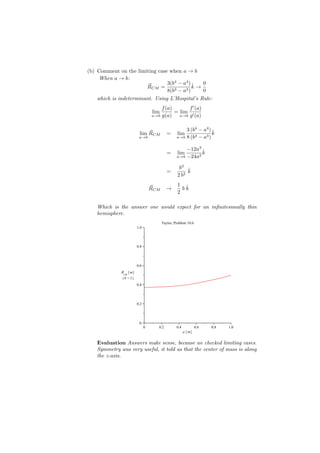
    Which is the answer one would expect for an infinitesimally thin
    hemisphere.
                                      Taylor, Problem 10.6
                      1.0


                      0.8


                      0.6
              Rcm m
               b =1
                      0.4


                      0.2


                       0
                            0      0.2         0.4           0.6   0.8   1.0
                                                     a m

    Evaluation Answers make sense, because we checked limiting cases.
    Symmetry was very useful, it told us that the center of mass is along
    the z-axis.

Solution 3 3

  • 1.
    Classical Mechanics Homework2 Due October 12, 2012 1. (Taylor, Problem 2-11) Consider an object that is thrown vertically up with initial speed v0 in a linear medium. StatementThis is another problem in which we consider the effects of air resistance on motion under gravity. In this case we need to find the height as a function of time going up, starting with some initial velocity. AssumptionsWe assume linear drag plus gravity, and linear motion. The object is a point particle. Physical representationThe forces we need are gravity pointing down, hence negative, and drag pointing down, also negative. We consider mo- tion going up only, and do not worry what happens after we reach the top of the orbit. Mathematical representation and solutionMathematical representa- tion and solution, see parts below. (a) Measuring y upward from the point of release, write expressions for the object’s velocity vy (t) and position y(t). This follows exactly what we did in class. Starting with an expression for Newton’s 2nd Law (coordinate system positive upward): mv ˙ = −mg − bv ∫ v ∫ t m dv ′ = − dt′ v0 mg + bv ′ 0 ( ) m mg + bv − ln = t b mg + bv0 ( mg ) mg v = + v0 e−bt/m − b b Now, separate again to find position as a function of time: ∫ y ∫ t [( ) ′ mg ′ mg ] ′ dy = + v0 e−bt /m − dt y0 0 b b m ( mg )( ) mg y − y0 = + v0 1 − e−bt/m − t b b b (b) Find the time for the object to reach its highest point and its position ymax at that point.
  • 2.
    The highest pointoccurs when the velocity goes to zero: ( ) m mg + bv t = − ln b mg + bv0 ( ) m mg tmax = − ln b mg + bv0 ( ) m mg + bv0 = ln b mg Finding the height at this time: −b −m ( mg ) e−btmax /m = e m b ln mg+bv 0 mg = mg + bv0 m ( mg )( mg ) m2 g ( mg + bv0 ) ymax − y0 = + v0 1− − 2 ln b b mg + bv0 b mg mg bv0 1− = mg + bv0 mg + bv0 ( ) m ( mg ) v0 m2 g mg + bv0 ymax − y0 = + v0 ( mg ) − 2 ln b b b + v0 b mg ( ) m m2 g mg + bv0 ymax − y0 = v0 − 2 ln b b mg (c) Show that as the drag coefficient approaches zero, your last answer 2 reduces to the well known result ymax = 1/2 v0 /g for an object in vacuum. [Hint: If the drag force is very small, the terminal speed is very big, so v0 /vterm is very small. Use the Taylor series for the log function to approximate ln (1 + δ) by δ − 1 δ 2 . 2 Now, recognizing that b is small: ( ) ( ) mg + bv0 bv0 ln = ln 1 + mg mg bv0 1 (bv0 )2 ≈ − mg 2 (mg)2 So, the maximum height becomes: ( ) m m2 g bv0 1 (bv0 )2 ymax − y0 ≈ v0 − 2 − b b mg 2 (mg)2
  • 3.
    2 m m 1 v0 = v0 − v0 + b b 2 g 2 1 v0 ymax − y0 ≈ 2 g So, the power series approximation of the maximum height in drag case reduces to the non-drag case when the drag coefficient is small (as it should). Evaluation The equation we found for y(t) had the same form as the equation we had in class, so that sounds right. There is a term linear in time going down, representing the terminal velocity, and an exponen- tial approach to this terminal velocity. The formula gives us a maximum height, which in the limit of small drag gives the standard result. We could also check to see that the maximum height is actually less than the maxi- mum height without drag! Finally, for linear motion the equation is valid for all directions of the motion, so we can use the same equation for going down! 2. (Thorton & Marion, Problem 2-15) A particle of mass m slides down an inclined plane under the influence of gravity. If the motion is resisted by a force f = kmv 2 , show that the time required to move a distance d after starting from rest is: cosh−1 ekd t= √ kg sin θ where θ is the angle of inclination of the plane. StatementThis problem is a variation on the well known inclined plane problem. We add friction and are asked to evaluate distance versus time. The equations are more complicated then those we had in Ph211. AssumptionsWe assume we have a point particle, with gravity, and that the friction force is quadratic. We included the mass as a second factor in the model for friction, the guess is that this will make the equations somewhat more simple. Physical representationThis is a problem with motion in one dimen- sion, one degree of freedom, so we use a coordinate system that reflects this. Taking the x-axis along the plane of the incline seems reasonable. We take x positive in the down direction. The set-up of the problem is a second law problem, F=ma, which we need to solve. Mathematical representation and solutionMathematical representa- tion and solution, see parts below. I’ll use a coordinate system where the coordinate x is parallel to the in- clined plane. The component of the net force parallel to the incline is: ΣFx = mvx = mg sin θ − kmv 2 ⃗ ˙
  • 4.
    mdv ′ = dt′ mg sin(θ) − kmv ′ 2 Note that as usual the mass of the object drops out! Gravity and acceler- ation always contain mass in the same manner. dv ′ = dt′ g sin(θ) − kv ′ 2 Integrating: ∫ ∫ v dv ′ t = dt′ 0 g sin θ − kv ′ 2 0 ∫ ∫ 1 v dv ′ t − = dt′ k 0 v ′ − c2 2 0 where we have defined g sin(θ) c2 = k ∫ v[ ] ∫ t 1 dv ′ dv ′ − − ′ = dt′ 2ck 0 v ′ − c v + c 0 1 − [ln(|v − c|) − ln(c) − ln(v + c) + ln(c)] = t 2ck We know that we have v < c, we never reach terminal velocity. Therefore c−v ln( ) = −2ckt c+v Solve for v so that I can find the distance: (c − v) = (c + v)e−2ckt v(1 + e−2ckt ) = c(1 − e−2ckt ) 1 − e−2ckt v=c 1 + e−2ckt √ (√ ) g sin θ v = tanh t kg sin θ k ∫ d ∫ t √ ( √ ) g sin θ dx′ = tanh t′ kg sin θ dt′ 0 0 k √ [ ( √ )] g sin θ 1 t d = √ ln cosh t′ kg sin θ k kg sin θ 0 1 [ (√ )] d = ln cosh t kg sin θ k
  • 5.
    Solving for t: (√ ) ekd = cosh t kg sin θ cosh−1 ekd t = √ kg sin θ This part of the question was not asked, but is a useful example. Using: 2 k = 0.5 N/(m/s) π θ = radians 3 0.7 0.6 0.5 Time, t [s] 0.4 0.3 0.2 0.1 0 0 0.5 1.0 1.5 2.0 Distance , d m Quadratic Drag No Drag For the no drag case: √ 2d t= g sin θ The plot shows that the no drag case reaches a larger distance in the same amount of time. Evaluation In order to make sense of the results we do have to look at the extra parts. With friction we travel a smaller distance than without, which is expected. Also, in the limit of zero friction we have from 1 − e−2ckt v=c 1 + e−2ckt that 2ckt v≈c = c2 kt 1+1
  • 6.
    , or v = g sin(θ)t as expected. 3. (Taylor, Problem 2-55) A charged particle of mass m and positive charge q moves in uniform electric and magnetic fields, E pointing in the y-direction and B in the z-direction (an arrangement called “crossed E and B fields”). Suppose the particle is initially at the origin and is given a kick at time t = 0 along the x-axis with vx = vx0 (positive or negative). Statement This is an example of a two-dimensional problem, with a ve- locity dependent force. Hence the directions of the force are complicated, even though the magnitudes are not. AssumptionsWe assume a point particle. The total force is a combina- tion of the electric and magnetic force. Physical representationWe need to write a two dimensional form of F=ma. The forces are given by the Lorentz force. The velocities are given by vx and vy , the components of the velocity, and these components can be negative. It is easiest to work in Carthesian coordinates. Mathematical representation and solutionMathematical representa- tion and solution, see parts below. (a) Write down the equation of motion for the particle and resolve it into its three components. Show that the motion remains in the plane z = 0 Starting with Newton’s Second Law: ΣF = mv = q(E + v × B) ˙ Looking at each of the fields: E = E0 ˆ j v × B = vy B 0 ˆ − vx B 0 ȷ ı ˆ So, the equations of motion become: qB0 vx ˙ = vy m q vy ˙ = (E0 − B0 vx ) m (b) Prove that there is a unique value of vx0 , called the drift speed ddr , for which the particle moves undeflected through the fields. (This is
  • 7.
    the basis ofvelocity selectors, which select particles traveling at one chosen speed from a beam with many different speeds.) For there to be no deflection, the force in the y-direction must be zero. ΣFy = q(E0 − B0 vx ) 0 = q(E0 − B0 vx ) E0 vx = B0 E0 vdr = B0 (c) Solve the equations of motion to give the particle’s velocity as a function of t, for arbitrary values of vx0 . [Hint: The equations for (vx , vy ) should look very much like Equations (2.86) except for an offset of vx by a constant. If you make a change of variables of the form ux = vx − vdr and uy = vy , the equations for (ux , uy ) will have exactly the form (2.68), whose general solution you know.] Letting ux = vx − vdr uy = vy The equations of motion become: qB0 ux ˙ = uy m qB0 uy ˙ = − ux m Taking another time derivative of the x equation yields: qB0 ux = ¨ uy ˙ m Now, substituting the original equation of motion: qB0 ux ¨ = − ux m ux = A sin ω t + B cos ω t
  • 8.
    vx = A sin ω t + B cos ω t + vdr qB0 where ω = m This gives u˙x = Aω cos(ωt) − Bω sin(ωt) qB0 uy = Aω cos(ωt) − Bω sin(ωt) m Using the initial condition that uy (t = 0) = 0 gives A = 0. Using the initial condition that vx (t = 0) = vx0 : vx0 = B + vdr B = vx0 − vdr vx = (vx0 − vdr ) cos ω t + vdr Now, using this result to find the vy qB0 uy ˙ = − ux m qB0 vy ˙ = − (vx − vdr ) m qB0 vy ˙ = − (vx0 − vdr ) cos ω t m ∫ vy ∫ t ′ dvy = −ω(vx0 − vdr ) cos ω t′ dt′ 0 0 vy = −(vx0 − vdr ) sin ω t (d) Integrate the velocity to find the position as a function of t and sketch the trajectory for various values of vx0 The integration is straightforward: vx = (vx0 − vdr ) cos (ω t) + vdr ∫ x ∫ t dx′ = [(vx0 − vdr ) cos (ω t′ ) + vdr ] dt′ x0 0 [ ] t vx0 − vdr x − x0 = sin (ω t′ ) + vdr t′ ω 0 vx0 − vdr x − x0 = sin (ω t) + vdr t ω
  • 9.
    vy = −(vx0 − vdr ) sin (ω t) ∫ y ∫ t ′ dy = − (vx0 − vdr ) sin (ω t′ ) dt′ y0 0 t vx0 − vdr y − y0 = cos (ω t′ ) ω 0 vx0 − vdr y − y0 = [cos (ω t) − 1] ω Trajectories can be oscillatory or run back. 0.0 2.5 5.0 7.5 10.0 12.5 0.0 −0.5 −1.0 −1.5 −2.0 Evaluation We found several familiar results. The condition for no de- flection was found in Ph213, as was the cyclotron frequency. We can also set the electric field equal to zero, which gives vdr = 0 and the orbit becomes a circle as expected. 4. (Thorton & Marion, Problem 9-60) A rocket has an initial mass of 7 × 10⁴ kg and on firing burns its fuel at a rate of 250 kg/s. The exhaust velocity is 2500 m/s. If the rocket has a vertical ascent from rest on the earth, how long after the rocket engines fire will the rocket lift off? What is wrong with the design of this rocket? StatementAn application of what we did in class, but now using realistic numbers. We are asked about the conditions for lift-off for a rocket, and need to check if the thrust is strong enough. AssumptionsThe fuel is spent at a constant rate, and we do not take into account how the exhaust gas hits the launch pad.
  • 10.
    Physical representationWe choosedm negative, which makes sense from a mathematical perspective. We use the equation of motion for the center of mass to get a simple formula. Momentum is changing because gravity is acting. Mathematical representation and solutionMathematical representa- tion and solution, see parts below. The rocket will lift off when the acceleration is positive. From the equation for the motion of the center of mass in the book we have dP = mdv + vex dm = −mgdt and we need a positive value of dv, or |dm|vex > mgdt or dm | |vex > mg dt We’re given that m = constant = −250 kg/s, vex = 2500 m/s. This ˙ implies 9.8m < (250)(2500) m < 63.8 × 10³ kg But m0 = 7 × 10⁴ kg. Hence we need to lose 6, 200 kg before we can take off. At the rate we have here that takes 24.8 seconds! Evaluation This is a long time to be sitting on the launch pad. Either the rocket should be made lighter (perhaps by including less fuel, or by constructing it out of lighter materials) or the thrust should be bigger (by increasing the relative velocity of the rocket and the exhaust or by increas- ing the fuel burn rate m. ˙
  • 11.
    30 20 t [s] liftoff 10 K K K K 0 280 270 260 250 dm kg dt s 5. (Taylor, Problem 10.6) Find the CM of a uniform hemispherical shell of inner and outer radii a and b and mass M . Statement This problem asks us to evaluate the center of mass. AssumptionsWe have a hemispherical shell with constant mass density. Physical representationThis problem seems like it works best with spher- ical coordinates. We take the x and y axis along the plane of the cut, and have the z-axis pointing upwards through the hemisphere. This represen- tations makes full use of the symmetry of the problem. Mathematical representation and solutionMathematical representa- tion and solution, see parts below. I’m going to place my origin of coordinates at the center of the sphere. Using spherical coordinates: ∫ 1 ⃗ RCM = ρ(⃗′ ) ⃗′ dτ ′ r r M ∫ ∫ ∫ 1 ρ(⃗′ ) ⃗′ r′ dr′ sinθ dϕ′ dθ′ 2 = r r M ⃗ r ˆ = r cos ϕ sin θˆ + r sin ϕ sin θˆ + r cos θk ı ȷ ρ(⃗′ ) = r ρ ∫ π/2 ∫ 2π ∫ b [ ] ρ ⃗ RCM = r′ cos ϕ′ sin θ′ˆ + r′ sin ϕ′ sin θ′ ȷ + r′ cos θ′ k r′ sinθ dr′ dϕ′ dθ′ ı ˆ ˆ 2 M 0 0 a
  • 12.
    Considering each componentseparately: ∫ π/2 ∫ 2π ∫ b ρ r′ cos ϕ′ sin θ′ˆr′ sinθ dr′ dϕ′ dθ′ 2 Rx = ˆ ı ı M 0 0 a In performing the ϕ integral, since I’m integrating over a full period, the integral goes to zero. This is true for Ry too. So: Rx = 0 Ry = 0 ∫ π/2 ∫ 2π ∫ b ρ ˆ r′ cos θ′ r′ sinθ dr′ dϕ′ dθ′ 2 Rz = k M 0 0 a ( b )∫ π/2 ρ r4 = 2π sin θ′ cos θ′ dθ′ M 4 a 0 let u = sin θ′ so du = cos θ′ dθ′ , then: ( )∫ 1 ρ b4 − a4 Rz = 2π u du M 4 0 ( ) ρ b4 − a4 1 = 2π M 4 2 As expected, RCM lies on the z-axis (expected because of symmetry). Now, substituting in for the density: M M 3M ρ= = = V (4/3)π(b3 −a3 ) 2π(b3 − a3 ) 2 ⃗ 3 b4 − a4 ˆ RCM = k 8 b3 − a3 (a) Comment on the limiting case when a → 0. When a → 0: 3(b4 − a4 ) ˆ 3 ˆ ⃗ RCM = 3 − a3 ) k→ bk 8(b 8 Which is the center of mass for a hemisphere of radius b.
  • 13.
    (b) Comment onthe limiting case when a → b When a → b: 3(b4 − a4 ) ˆ 0 ⃗ RCM = k→ 8(b3 − a3 ) 0 which is indeterminant. Using L’Hospital’s Rule: f (a) f ′ (a) lim = lim ′ a→b g(a) a→b g (a) ⃗ 3 (b4 − a4 ) ˆ lim RCM = lim k a→b a→b 8 (b3 − a3 ) −12a3 ˆ = lim k a→b −24a2 b3 ˆ = k 2 b2 1 ˆ ⃗ RCM → bk 2 Which is the answer one would expect for an infinitesimally thin hemisphere. Taylor, Problem 10.6 1.0 0.8 0.6 Rcm m b =1 0.4 0.2 0 0 0.2 0.4 0.6 0.8 1.0 a m Evaluation Answers make sense, because we checked limiting cases. Symmetry was very useful, it told us that the center of mass is along the z-axis.