This presentation done by Zaheer Ismail
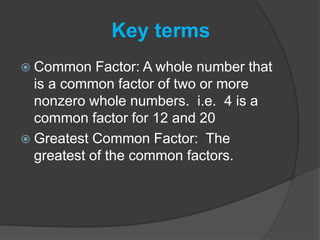
Key terms
 Common

Factor: A whole number that
is a common factor of two or more
nonzero whole numbers. i.e. 4 is a
common factor for 12 and 20
 Greatest Common Factor: The
greatest of the common factors.
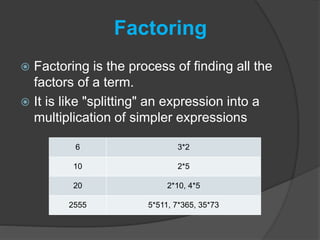
Factoring
Factoring is the process of finding all the
factors of a term.
 It is like "splitting" an expression into a
multiplication of simpler expressions


6

3*2

10

2*5

20

2*10, 4*5

2555

5*511, 7*365, 35*73
How to find the factors
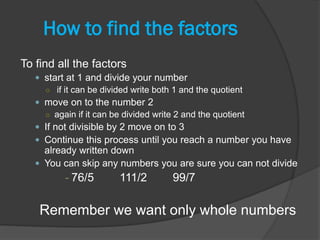
To find all the factors
 start at 1 and divide your number
○ if it can be divided write both 1 and the quotient
 move on to the number 2
○ again if it can be divided write 2 and the quotient
 If not divisible by 2 move on to 3
 Continue this process until you reach a number you have

already written down
 You can skip any numbers you are sure you can not divide

- 76/5

111/2

99/7

Remember we want only whole numbers
What is a factor?


Remember that factors are numbers that
you multiply together to reach a product
Factor x Factor = Product



So, factors are numbers that make up a
larger number when multiplied together.
Determining common
multiples


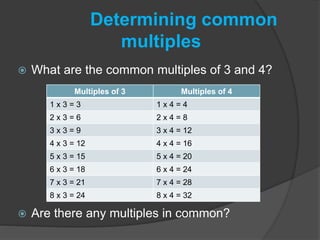
What are the common multiples of 3 and 4?
Multiples of 3

Multiples of 4

1x3=3
2x3=6

2x4=8

3x3=9

3 x 4 = 12

4 x 3 = 12

4 x 4 = 16

5 x 3 = 15

5 x 4 = 20

6 x 3 = 18

6 x 4 = 24

7 x 3 = 21

7 x 4 = 28

8 x 3 = 24



1x4=4

8 x 4 = 32

Are there any multiples in common?
Determining common multiples


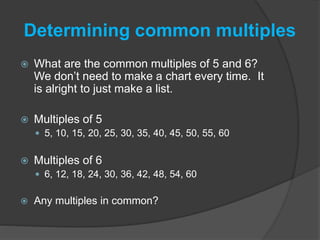
What are the common multiples of 5 and 6?
We don’t need to make a chart every time. It
is alright to just make a list.



Multiples of 5
 5, 10, 15, 20, 25, 30, 35, 40, 45, 50, 55, 60



Multiples of 6
 6, 12, 18, 24, 30, 36, 42, 48, 54, 60



Any multiples in common?
Determining Factors
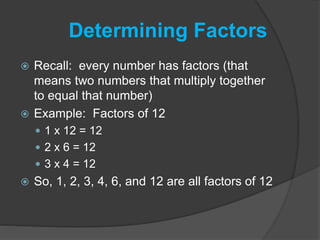
Recall: every number has factors (that
means two numbers that multiply together
to equal that number)
 Example: Factors of 12


 1 x 12 = 12
 2 x 6 = 12
 3 x 4 = 12


So, 1, 2, 3, 4, 6, and 12 are all factors of 12
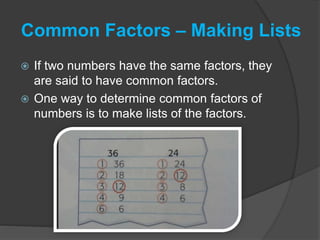
Common Factors – Making Lists
If two numbers have the same factors, they
are said to have common factors.
 One way to determine common factors of
numbers is to make lists of the factors.

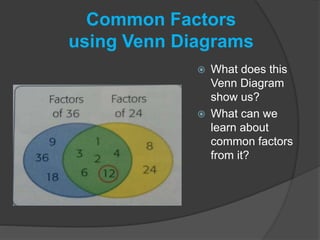
Common Factors
using Venn Diagrams




What does this
Venn Diagram
show us?
What can we
learn about
common factors
from it?
With Variables Involved
 When

you have variables in
your terms you will do the
number things just like we did.
For the variables simply take
the least amount of each one.
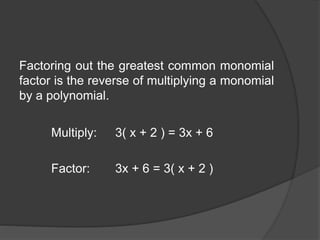
Factoring out the greatest common monomial
factor is the reverse of multiplying a monomial
by a polynomial.
Multiply:

3( x + 2 ) = 3x + 6

Factor:

3x + 6 = 3( x + 2 )
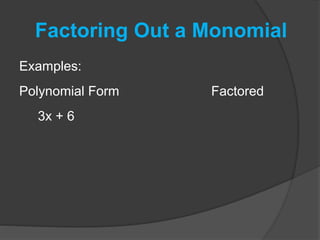
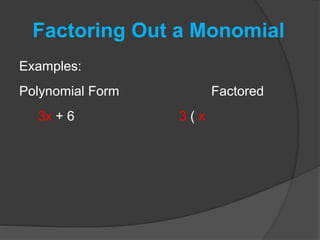
Factoring Out a Monomial
Examples:
Polynomial Form
3x + 6

Factored
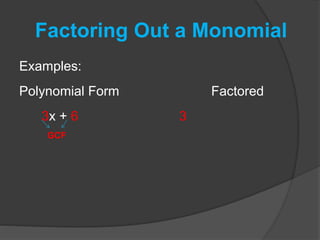
Factoring Out a Monomial
Examples:
Polynomial Form
3x + 6
GCF

Factored
3
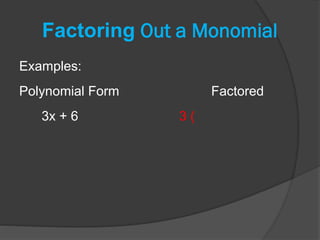
Factoring Out a Monomial
Examples:
Polynomial Form
3x + 6

Factored
3(
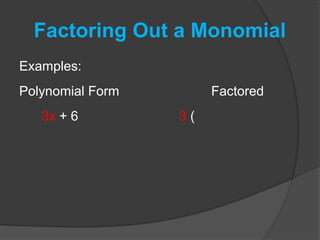
Factoring Out a Monomial
Examples:
Polynomial Form
3x + 6

Factored
3(
Factoring Out a Monomial
Examples:
Polynomial Form
3x + 6

Factored
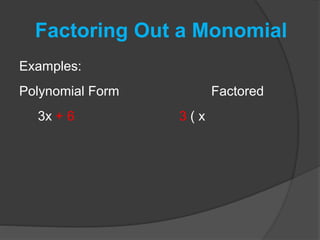
3(x
Factoring Out a Monomial
Examples:
Polynomial Form
3x + 6

Factored
3(x
Factoring Out a Monomial
Examples:
Polynomial Form
3x + 6

Factored
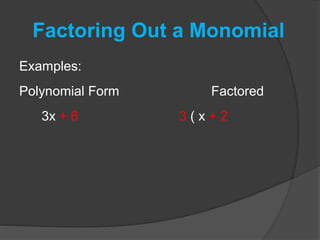
3(x+2
Factoring Out a Monomial
Examples:
Polynomial Form
3x + 6

Factored
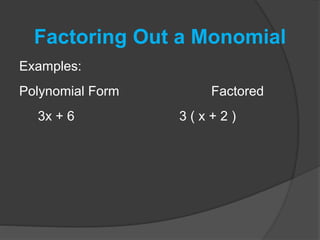
3(x+2)
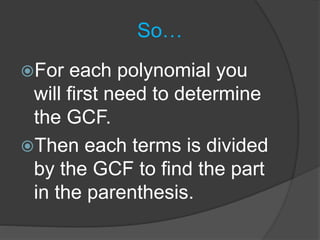
So…
For

each polynomial you
will first need to determine
the GCF.
Then each terms is divided
by the GCF to find the part
in the parenthesis.
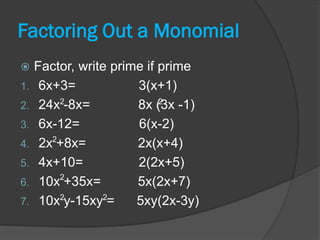
Factoring Out a Monomial
Factor, write prime if prime
1. 6x+3=
3(x+1)
2
2. 24x2-8x=
8x (3x -1)
3. 6x-12=
6(x-2)
2
4. 2x +8x=
2x(x+4)
5. 4x+10=
2(2x+5)
2
6. 10x +35x=
5x(2x+7)
7. 10x2y-15xy2=
5xy(2x-3y)













References

Cocarelli, N., 2012. Slideshare. [Online]
Available at: http://www.slideshare.net/naracocarelli/factoring-the-greatest-commonmonomial-factor?qid=ccb12499-8de0-4d04-8f4e61cef2225ef3&v=qf1&b=&from_search=6
[Accessed 9 March 2014].
J.Bianco, 2014. Slideshare. [Online]
Available at: http://www.slideshare.net/jbianco9910/63-gcf-factoring-day-2
[Accessed 9 March 2014].
Noah, A., 2012. Slideshare. [Online]
Available at: http://www.slideshare.net/AjarnNoah/factorization-12664260
[Accessed 9 March 2014].
T.Bonnar, 2012. Slideshare. [Online]
Available at: http://www.slideshare.net/tbonnar/common-multiples-and-commonfactors?qid=5cec3e53-792f-4f55-838f-b0f0ec18e59e&v=qf1&b=&from_search=3
[Accessed 9 March 2014].
Young, B., 2008. Slideshare. [Online]
Available at: http://www.slideshare.net/bayoung/fractions-least-common-multiplepresentation?qid=5cec3e53-792f-4f55-838fb0f0ec18e59e&v=qf1&b=&from_search=1
[Accessed 9 March 2014].

Common factor factorization

  • 1.
    This presentation doneby Zaheer Ismail
  • 2.
    Key terms  Common Factor:A whole number that is a common factor of two or more nonzero whole numbers. i.e. 4 is a common factor for 12 and 20  Greatest Common Factor: The greatest of the common factors.
  • 3.
    Factoring Factoring is theprocess of finding all the factors of a term.  It is like "splitting" an expression into a multiplication of simpler expressions  6 3*2 10 2*5 20 2*10, 4*5 2555 5*511, 7*365, 35*73
  • 4.
    How to findthe factors To find all the factors  start at 1 and divide your number ○ if it can be divided write both 1 and the quotient  move on to the number 2 ○ again if it can be divided write 2 and the quotient  If not divisible by 2 move on to 3  Continue this process until you reach a number you have already written down  You can skip any numbers you are sure you can not divide - 76/5 111/2 99/7 Remember we want only whole numbers
  • 5.
    What is afactor?  Remember that factors are numbers that you multiply together to reach a product Factor x Factor = Product  So, factors are numbers that make up a larger number when multiplied together.
  • 6.
    Determining common multiples  What arethe common multiples of 3 and 4? Multiples of 3 Multiples of 4 1x3=3 2x3=6 2x4=8 3x3=9 3 x 4 = 12 4 x 3 = 12 4 x 4 = 16 5 x 3 = 15 5 x 4 = 20 6 x 3 = 18 6 x 4 = 24 7 x 3 = 21 7 x 4 = 28 8 x 3 = 24  1x4=4 8 x 4 = 32 Are there any multiples in common?
  • 7.
    Determining common multiples  Whatare the common multiples of 5 and 6? We don’t need to make a chart every time. It is alright to just make a list.  Multiples of 5  5, 10, 15, 20, 25, 30, 35, 40, 45, 50, 55, 60  Multiples of 6  6, 12, 18, 24, 30, 36, 42, 48, 54, 60  Any multiples in common?
  • 8.
    Determining Factors Recall: everynumber has factors (that means two numbers that multiply together to equal that number)  Example: Factors of 12   1 x 12 = 12  2 x 6 = 12  3 x 4 = 12  So, 1, 2, 3, 4, 6, and 12 are all factors of 12
  • 9.
    Common Factors –Making Lists If two numbers have the same factors, they are said to have common factors.  One way to determine common factors of numbers is to make lists of the factors. 
  • 10.
    Common Factors using VennDiagrams   What does this Venn Diagram show us? What can we learn about common factors from it?
  • 11.
    With Variables Involved When you have variables in your terms you will do the number things just like we did. For the variables simply take the least amount of each one.
  • 12.
    Factoring out thegreatest common monomial factor is the reverse of multiplying a monomial by a polynomial. Multiply: 3( x + 2 ) = 3x + 6 Factor: 3x + 6 = 3( x + 2 )
  • 13.
    Factoring Out aMonomial Examples: Polynomial Form 3x + 6 Factored
  • 14.
    Factoring Out aMonomial Examples: Polynomial Form 3x + 6 GCF Factored 3
  • 15.
    Factoring Out aMonomial Examples: Polynomial Form 3x + 6 Factored 3(
  • 16.
    Factoring Out aMonomial Examples: Polynomial Form 3x + 6 Factored 3(
  • 17.
    Factoring Out aMonomial Examples: Polynomial Form 3x + 6 Factored 3(x
  • 18.
    Factoring Out aMonomial Examples: Polynomial Form 3x + 6 Factored 3(x
  • 19.
    Factoring Out aMonomial Examples: Polynomial Form 3x + 6 Factored 3(x+2
  • 20.
    Factoring Out aMonomial Examples: Polynomial Form 3x + 6 Factored 3(x+2)
  • 21.
    So… For each polynomial you willfirst need to determine the GCF. Then each terms is divided by the GCF to find the part in the parenthesis.
  • 22.
    Factoring Out aMonomial Factor, write prime if prime 1. 6x+3= 3(x+1) 2 2. 24x2-8x= 8x (3x -1) 3. 6x-12= 6(x-2) 2 4. 2x +8x= 2x(x+4) 5. 4x+10= 2(2x+5) 2 6. 10x +35x= 5x(2x+7) 7. 10x2y-15xy2= 5xy(2x-3y) 
  • 23.
          References Cocarelli, N., 2012.Slideshare. [Online] Available at: http://www.slideshare.net/naracocarelli/factoring-the-greatest-commonmonomial-factor?qid=ccb12499-8de0-4d04-8f4e61cef2225ef3&v=qf1&b=&from_search=6 [Accessed 9 March 2014]. J.Bianco, 2014. Slideshare. [Online] Available at: http://www.slideshare.net/jbianco9910/63-gcf-factoring-day-2 [Accessed 9 March 2014]. Noah, A., 2012. Slideshare. [Online] Available at: http://www.slideshare.net/AjarnNoah/factorization-12664260 [Accessed 9 March 2014]. T.Bonnar, 2012. Slideshare. [Online] Available at: http://www.slideshare.net/tbonnar/common-multiples-and-commonfactors?qid=5cec3e53-792f-4f55-838f-b0f0ec18e59e&v=qf1&b=&from_search=3 [Accessed 9 March 2014]. Young, B., 2008. Slideshare. [Online] Available at: http://www.slideshare.net/bayoung/fractions-least-common-multiplepresentation?qid=5cec3e53-792f-4f55-838fb0f0ec18e59e&v=qf1&b=&from_search=1 [Accessed 9 March 2014].