WELCOME
HEALTHY CHILDREN NEED HEALTHY MOTHER
MATERNAL
AND CHILD
HEALTH CARE
INTRODUCTION
Maternal and child health (MCH) refer to a
package of comprehensive health care services
which are developed to meet promotive,
preventive, curative, rehabilitative needs of
pregnant women before, during and after
delivery and of infants and pre-school children
from birth to five years.
DEFINITION
Maternal and child health services can be
defined as "promoting, preventing,
therapeutic or rehabilitation facility
or care for the mother and child”.
-WHO
OBJECTIVES OF
MCH CARE
To reduce maternal and
child mortality and
morbidity rate.
To promote a satisfying and
safe sex life.
To promote and protect
health of mothers by early
diagnosis and treatment of
health problems.
To ensure birth of
healthy child.
To regulate fertility
so as to have wanted
and healthy children
when desired.
To prevent and
malnutrition and
communicable
diseases.
To promote and protect
physical growth and
psychosocial development of
children.
To provide health education
and family planning services
GOALS OF MCH CARE
To identify health problems
in mother and children.
To promote the healthy
Growth and Development of
children.
01 03
02
To ensure the birth of
a healthy infant to
every expectant
mother.
GOALS OF MCH CARE
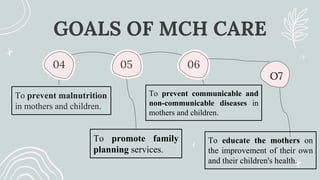
To prevent communicable and
non-communicable diseases in
mothers and children.
To promote family
planning services.
04 06
05
To prevent malnutrition
in mothers and children.
O7
To educate the mothers on
the improvement of their own
and their children's health.
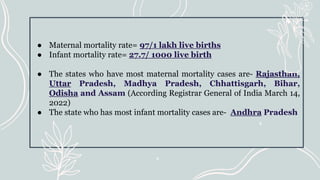
● Maternal mortality rate= 97/1 lakh live births
● Infant mortality rate= 27.7/ 1000 live birth
● The states who have most maternal mortality cases are- Rajasthan,
Uttar Pradesh, Madhya Pradesh, Chhattisgarh, Bihar,
Odisha and Assam (According Registrar General of India March 14,
2022)
● The state who has most infant mortality cases are- Andhra Pradesh
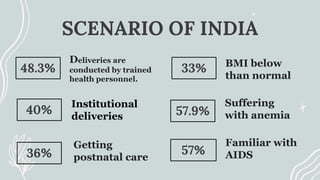
SCENARIO OF INDIA
Deliveries are
conducted by trained
health personnel.
Getting
postnatal care
Institutional
deliveries
BMI below
than normal
Familiar with
AIDS
Suffering
with anemia
48.3%
36%
40%
33%
57%
57.9%
CAUSES OF
MATERNAL
MORTALITY
RATE
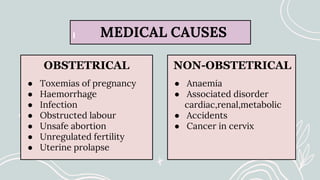
MEDICAL CAUSES
OBSTETRICAL
● Toxemias of pregnancy
● Haemorrhage
● Infection
● Obstructed labour
● Unsafe abortion
● Unregulated fertility
● Uterine prolapse
NON-OBSTETRICAL
● Anaemia
● Associated disorder
cardiac,renal,metabolic
● Accidents
● Cancer in cervix
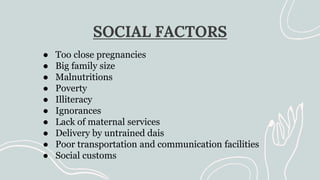
SOCIAL FACTORS
● Too close pregnancies
● Big family size
● Malnutritions
● Poverty
● Illiteracy
● Ignorances
● Lack of maternal services
● Delivery by untrained dais
● Poor transportation and communication facilities
● Social customs
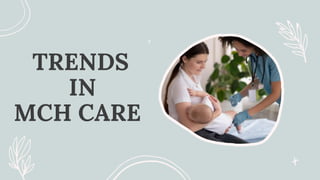
TRENDS
IN
MCH CARE
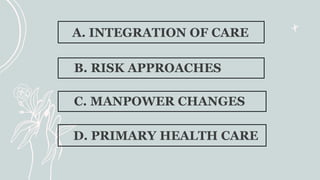
A. INTEGRATION OF CARE
D. PRIMARY HEALTH CARE
C. MANPOWER CHANGES
B. RISK APPROACHES
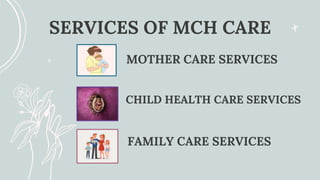
SERVICES OF MCH CARE
FAMILY CARE SERVICES
MOTHER CARE SERVICES
CHILD HEALTH CARE SERVICES
MOTHER
CARE
SERVICES
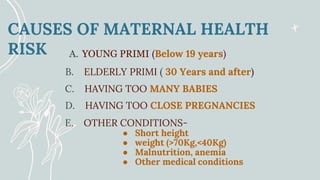
CAUSES OF MATERNAL HEALTH
RISK
B. ELDERLY PRIMI ( 30 Years and after)
A. YOUNG PRIMI (Below 19 years)
E. OTHER CONDITIONS-
● Short height
● weight (>70Kg,<40Kg)
● Malnutrition, anemia
● Other medical conditions
D. HAVING TOO CLOSE PREGNANCIES
C. HAVING TOO MANY BABIES
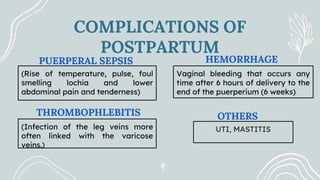
COMPLICATIONS OF
POSTPARTUM
(Rise of temperature, pulse, foul
smelling lochia and lower
abdominal pain and tenderness)
PUERPERAL SEPSIS
(Infection of the leg veins more
often linked with the varicose
veins.)
THROMBOPHLEBITIS
Vaginal bleeding that occurs any
time after 6 hours of delivery to the
end of the puerperium (6 weeks)
HEMORRHAGE
UTI, MASTITIS
OTHERS
ANTENATAL CARE
AIM- To achieve at the end of a
pregnancy a healthy mother and
a healthy baby.
● To promote protect and maintain the health of the
mother during pregnancy
● To detect:" high risk" cases and special attention
● To foresee complications and prevent them
● To reduce maternal and infant mortality and morbidity
● To teach the mother elements of child care, nutrition
personal hygiene and environmental sanitation,family
planning.
OBJECTIVES
SERVICES
The mother must be registered within 12 weeks of pregnancy.
A. REGISTRATION OF PREGNANT MOTHER
Provide one tablet of iron and folic acid twice a day for at least
100 days to prevent anaemia .
C. IRON AND FOLIC ACID
Minimum 4 antenatal care including registration-
12 weeks(1st),14 and 26 weeks(2nd),28 and 34 weeks(3rd),between
36 and term(4th).
B. ANTENATAL VISITS
● Taking health history.
● Physical examination(height,weight)
● General medical examination (anaemia,bleeding)
● Obstetrical examination(FHR,PVE,Fundal grips)
● Laboratory examination(blood,Hb,urine sugar, albumin)
● Identifies high risks.
D. CARE DURING FIRST CONTACT
● 1st dose at 16-20 weeks
● 2nd dose at 20-24 weeks of pregnancy.
E. IMMUNIZATION
● Diet
● Personal hygiene
● Smoking and drinking
● Drugs
● Radiation
● Sexual activites
● Travel
● Identified any abnormalities
● Follow up visits
HEALTH EDUCATION PSYCHOLOGICAL
PREPARATION
The expectant mother,
especially the primary Para
mother has fear and anxiety
about child birth, its
outcome, complications etc.
It is very important to discuss
various aspects of pregnancy
and delivery.
The mother should be
educated and motivated
for small family norm and
spacing of children.
FAMILY
PLANNING
Makes appropriate and timely
referral when higher level
care or opinion needed on
further management.
REFERRAL
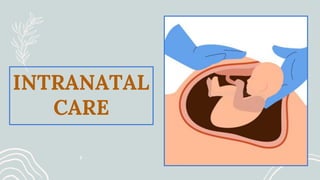
INTRANATAL
CARE
SERVICES
● Preparation of place and surroundings of confinement.
● Preparation of equipment and supplies required during
delivery.
● Physical and psychological preparation of the mother.
● Examination of mother's physical condition, abdominal
palpation, monitoring foetal heart sound, observation of vital
signs, labour pain and uterine extraction etc.
CONT……..
● Conducting delivery, watchful about any problem and
helping mother in taking pains.
● Referral of mother immediately in case of any such
problem.
● Giving immediate care to mother and baby after delivery.
● Giving instruction to the mother and family members.
● Maintaining record and reporting of birth to authority
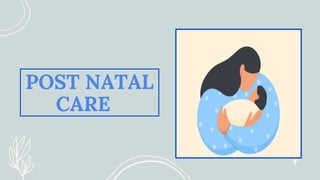
POST NATAL
CARE
OBJECTIVES
➔ To restore, promote and maintain the health of mother and baby.
➔ To promote breastfeeding.
➔ To prevent complications that may occur during the postnatal
period.
➔ To establish good nutrition for the baby.
➔ To prevent infection and identify any health problem/disorder in the
baby.
➔ To support and strengthen the parents confidence and their role
within their family and the cultural environment.
SERVICES
IMMEDIATE CARE
1. After the baby is born and placenta is delivery, it
is very important that mother is made
comfortable and watched for any complication.
2. The fundus is palpated, clots are expressed, and
fundal height is measured.The perineum is
inspected for any laceration or tear, perineal care
is given. Mother is made comfortable by removing
the soiled linen, thorough cleaning and by keeping
her warmth etc.
3.The vital signs are recorded.
POST OP CARE
1. Perform home visit on 3rd day,7th day,42 day
following delivery.
2.General observation of the mother and the
surrounding to assess overall health status of
mother, cleanliness etc.
3.Observation temperature, pulse and
respiration.
4.Examination of breasts for any engorgements
or other problems that interfere with
breastfeeding .
POST-OP CARE
➔ Assess for involutions of uterus, lochia, perineum for any kind of
abnormality,measures fundus.
➔ Observation of any abnormality in the abdomen likes painful and
hard.
➔ Advice on suitable contraceptives measures.
➔ Advises to take an adequate nutritious diet, sufficient rest and sleep.
➔ Keeps herself clean and protects from infections .
CHILD HEALTH
CARE SERVICES
OBJECTIVE
1.To provide adequate care and proper nourishment to
every child.
2.To give immunisation to every child upto 5 year.
3.To monitor growth and development time to time.
4.To identify ailments and treated without delay.
5.To educate the mother and family members to give
proper care to their children.
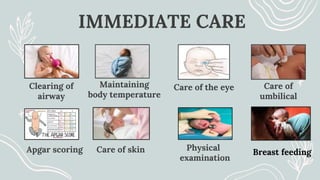
IMMEDIATE CARE
Clearing of
airway
Apgar scoring
Care of the eye
Physical
examination
Maintaining
body temperature
Care of skin
Care of
umbilical
Breast feeding
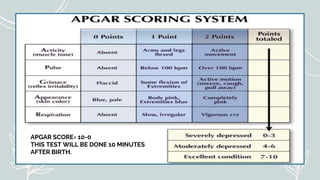
APGAR SCORE= 10-0
THIS TEST WILL BE DONE 10 MINUTES
AFTER BIRTH.
AT VISIT CARE
● General observations of the baby
and how he/she is.
● Observation of temperature, heart
rate and respiration.
● Observation of eyes for any kind of
abnormality such as watering of
eyes or any discharge etc.
● Observation of skin .
● Observation of cord stump.
● The weight is checked and
recorded.
● Observation of any sign of
abnormality of abdomen such as
distension, tenderness etc.
● It should be seen that the baby is.
1.Adequately clothed, kept clean.
2.Breast fed on demand.
3.Allowed to sleep and rest most of
the time and handled only when
necessary.
4.Not given bottle feeds.
● Mother should be enquired about
any problem regarding babies.
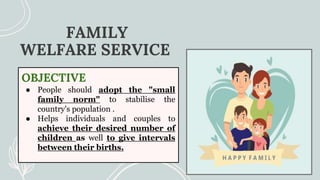
FAMILY
WELFARE SERVICE
OBJECTIVE
● People should adopt the "small
family norm" to stabilise the
country's population .
● Helps individuals and couples to
achieve their desired number of
children as well to give intervals
between their births.
SERVICES
★ Provides advice on sterilisation for married men and women.
★ Assists in spacing and limitation of births.
★ Refers those mothers who need genetic counselling and
premarital consultation and examination.
★ Assesses for any illnesses related to reproductive systems and
refers to the hospital.
★ Provides pre parenthood education.
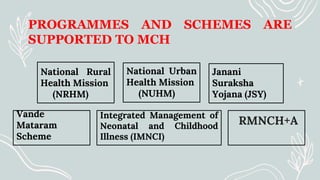
PROGRAMMES AND SCHEMES ARE
SUPPORTED TO MCH
National Rural
Health Mission
(NRHM)
Vande
Mataram
Scheme
Janani
Suraksha
Yojana (JSY)
RMNCH+A
National Urban
Health Mission
(NUHM)
Integrated Management of
Neonatal and Childhood
Illness (IMNCI)
CONCLUSION
The MCH or maternal and child health is not a
new entity to health care professionals.
However, it is definitely a significant area of
importance since this package include two
vulnerable groups the mother and children,
whose health has major contribution in
determining the health status of a country. The
women of reproductive age group (15-44
years) and under five children constitute
major (32.4%) portion of our India's
population. MCH services concentrate on
preventive, curatives and social aspects of
mother and child care.
Credits: This presentation template was created by
Slidesgo, including icons by Flaticon, and
infographics & images by Freepik.
Thanks!

MCH CARE

  • 1.
  • 2.
    HEALTHY CHILDREN NEEDHEALTHY MOTHER
  • 3.
  • 4.
    INTRODUCTION Maternal and childhealth (MCH) refer to a package of comprehensive health care services which are developed to meet promotive, preventive, curative, rehabilitative needs of pregnant women before, during and after delivery and of infants and pre-school children from birth to five years.
  • 5.
    DEFINITION Maternal and childhealth services can be defined as "promoting, preventing, therapeutic or rehabilitation facility or care for the mother and child”. -WHO
  • 6.
  • 7.
    To reduce maternaland child mortality and morbidity rate. To promote a satisfying and safe sex life. To promote and protect health of mothers by early diagnosis and treatment of health problems. To ensure birth of healthy child. To regulate fertility so as to have wanted and healthy children when desired. To prevent and malnutrition and communicable diseases.
  • 8.
    To promote andprotect physical growth and psychosocial development of children. To provide health education and family planning services
  • 9.
    GOALS OF MCHCARE To identify health problems in mother and children. To promote the healthy Growth and Development of children. 01 03 02 To ensure the birth of a healthy infant to every expectant mother.
  • 10.
    GOALS OF MCHCARE To prevent communicable and non-communicable diseases in mothers and children. To promote family planning services. 04 06 05 To prevent malnutrition in mothers and children. O7 To educate the mothers on the improvement of their own and their children's health.
  • 11.
    ● Maternal mortalityrate= 97/1 lakh live births ● Infant mortality rate= 27.7/ 1000 live birth ● The states who have most maternal mortality cases are- Rajasthan, Uttar Pradesh, Madhya Pradesh, Chhattisgarh, Bihar, Odisha and Assam (According Registrar General of India March 14, 2022) ● The state who has most infant mortality cases are- Andhra Pradesh
  • 12.
    SCENARIO OF INDIA Deliveriesare conducted by trained health personnel. Getting postnatal care Institutional deliveries BMI below than normal Familiar with AIDS Suffering with anemia 48.3% 36% 40% 33% 57% 57.9%
  • 13.
  • 14.
    MEDICAL CAUSES OBSTETRICAL ● Toxemiasof pregnancy ● Haemorrhage ● Infection ● Obstructed labour ● Unsafe abortion ● Unregulated fertility ● Uterine prolapse NON-OBSTETRICAL ● Anaemia ● Associated disorder cardiac,renal,metabolic ● Accidents ● Cancer in cervix
  • 15.
    SOCIAL FACTORS ● Tooclose pregnancies ● Big family size ● Malnutritions ● Poverty ● Illiteracy ● Ignorances ● Lack of maternal services ● Delivery by untrained dais ● Poor transportation and communication facilities ● Social customs
  • 16.
  • 17.
    A. INTEGRATION OFCARE D. PRIMARY HEALTH CARE C. MANPOWER CHANGES B. RISK APPROACHES
  • 18.
    SERVICES OF MCHCARE FAMILY CARE SERVICES MOTHER CARE SERVICES CHILD HEALTH CARE SERVICES
  • 19.
  • 20.
    CAUSES OF MATERNALHEALTH RISK B. ELDERLY PRIMI ( 30 Years and after) A. YOUNG PRIMI (Below 19 years) E. OTHER CONDITIONS- ● Short height ● weight (>70Kg,<40Kg) ● Malnutrition, anemia ● Other medical conditions D. HAVING TOO CLOSE PREGNANCIES C. HAVING TOO MANY BABIES
  • 21.
    COMPLICATIONS OF POSTPARTUM (Rise oftemperature, pulse, foul smelling lochia and lower abdominal pain and tenderness) PUERPERAL SEPSIS (Infection of the leg veins more often linked with the varicose veins.) THROMBOPHLEBITIS Vaginal bleeding that occurs any time after 6 hours of delivery to the end of the puerperium (6 weeks) HEMORRHAGE UTI, MASTITIS OTHERS
  • 22.
    ANTENATAL CARE AIM- Toachieve at the end of a pregnancy a healthy mother and a healthy baby.
  • 23.
    ● To promoteprotect and maintain the health of the mother during pregnancy ● To detect:" high risk" cases and special attention ● To foresee complications and prevent them ● To reduce maternal and infant mortality and morbidity ● To teach the mother elements of child care, nutrition personal hygiene and environmental sanitation,family planning. OBJECTIVES
  • 24.
    SERVICES The mother mustbe registered within 12 weeks of pregnancy. A. REGISTRATION OF PREGNANT MOTHER Provide one tablet of iron and folic acid twice a day for at least 100 days to prevent anaemia . C. IRON AND FOLIC ACID Minimum 4 antenatal care including registration- 12 weeks(1st),14 and 26 weeks(2nd),28 and 34 weeks(3rd),between 36 and term(4th). B. ANTENATAL VISITS
  • 25.
    ● Taking healthhistory. ● Physical examination(height,weight) ● General medical examination (anaemia,bleeding) ● Obstetrical examination(FHR,PVE,Fundal grips) ● Laboratory examination(blood,Hb,urine sugar, albumin) ● Identifies high risks. D. CARE DURING FIRST CONTACT ● 1st dose at 16-20 weeks ● 2nd dose at 20-24 weeks of pregnancy. E. IMMUNIZATION
  • 26.
    ● Diet ● Personalhygiene ● Smoking and drinking ● Drugs ● Radiation ● Sexual activites ● Travel ● Identified any abnormalities ● Follow up visits HEALTH EDUCATION PSYCHOLOGICAL PREPARATION The expectant mother, especially the primary Para mother has fear and anxiety about child birth, its outcome, complications etc. It is very important to discuss various aspects of pregnancy and delivery.
  • 27.
    The mother shouldbe educated and motivated for small family norm and spacing of children. FAMILY PLANNING Makes appropriate and timely referral when higher level care or opinion needed on further management. REFERRAL
  • 28.
  • 29.
    SERVICES ● Preparation ofplace and surroundings of confinement. ● Preparation of equipment and supplies required during delivery. ● Physical and psychological preparation of the mother. ● Examination of mother's physical condition, abdominal palpation, monitoring foetal heart sound, observation of vital signs, labour pain and uterine extraction etc.
  • 30.
    CONT…….. ● Conducting delivery,watchful about any problem and helping mother in taking pains. ● Referral of mother immediately in case of any such problem. ● Giving immediate care to mother and baby after delivery. ● Giving instruction to the mother and family members. ● Maintaining record and reporting of birth to authority
  • 31.
  • 32.
    OBJECTIVES ➔ To restore,promote and maintain the health of mother and baby. ➔ To promote breastfeeding. ➔ To prevent complications that may occur during the postnatal period. ➔ To establish good nutrition for the baby. ➔ To prevent infection and identify any health problem/disorder in the baby. ➔ To support and strengthen the parents confidence and their role within their family and the cultural environment.
  • 33.
    SERVICES IMMEDIATE CARE 1. Afterthe baby is born and placenta is delivery, it is very important that mother is made comfortable and watched for any complication. 2. The fundus is palpated, clots are expressed, and fundal height is measured.The perineum is inspected for any laceration or tear, perineal care is given. Mother is made comfortable by removing the soiled linen, thorough cleaning and by keeping her warmth etc. 3.The vital signs are recorded. POST OP CARE 1. Perform home visit on 3rd day,7th day,42 day following delivery. 2.General observation of the mother and the surrounding to assess overall health status of mother, cleanliness etc. 3.Observation temperature, pulse and respiration. 4.Examination of breasts for any engorgements or other problems that interfere with breastfeeding .
  • 34.
    POST-OP CARE ➔ Assessfor involutions of uterus, lochia, perineum for any kind of abnormality,measures fundus. ➔ Observation of any abnormality in the abdomen likes painful and hard. ➔ Advice on suitable contraceptives measures. ➔ Advises to take an adequate nutritious diet, sufficient rest and sleep. ➔ Keeps herself clean and protects from infections .
  • 35.
  • 36.
    OBJECTIVE 1.To provide adequatecare and proper nourishment to every child. 2.To give immunisation to every child upto 5 year. 3.To monitor growth and development time to time. 4.To identify ailments and treated without delay. 5.To educate the mother and family members to give proper care to their children.
  • 37.
    IMMEDIATE CARE Clearing of airway Apgarscoring Care of the eye Physical examination Maintaining body temperature Care of skin Care of umbilical Breast feeding
  • 38.
    APGAR SCORE= 10-0 THISTEST WILL BE DONE 10 MINUTES AFTER BIRTH.
  • 39.
    AT VISIT CARE ●General observations of the baby and how he/she is. ● Observation of temperature, heart rate and respiration. ● Observation of eyes for any kind of abnormality such as watering of eyes or any discharge etc. ● Observation of skin . ● Observation of cord stump. ● The weight is checked and recorded. ● Observation of any sign of abnormality of abdomen such as distension, tenderness etc. ● It should be seen that the baby is. 1.Adequately clothed, kept clean. 2.Breast fed on demand. 3.Allowed to sleep and rest most of the time and handled only when necessary. 4.Not given bottle feeds. ● Mother should be enquired about any problem regarding babies.
  • 40.
    FAMILY WELFARE SERVICE OBJECTIVE ● Peopleshould adopt the "small family norm" to stabilise the country's population . ● Helps individuals and couples to achieve their desired number of children as well to give intervals between their births.
  • 41.
    SERVICES ★ Provides adviceon sterilisation for married men and women. ★ Assists in spacing and limitation of births. ★ Refers those mothers who need genetic counselling and premarital consultation and examination. ★ Assesses for any illnesses related to reproductive systems and refers to the hospital. ★ Provides pre parenthood education.
  • 42.
    PROGRAMMES AND SCHEMESARE SUPPORTED TO MCH National Rural Health Mission (NRHM) Vande Mataram Scheme Janani Suraksha Yojana (JSY) RMNCH+A National Urban Health Mission (NUHM) Integrated Management of Neonatal and Childhood Illness (IMNCI)
  • 43.
    CONCLUSION The MCH ormaternal and child health is not a new entity to health care professionals. However, it is definitely a significant area of importance since this package include two vulnerable groups the mother and children, whose health has major contribution in determining the health status of a country. The women of reproductive age group (15-44 years) and under five children constitute major (32.4%) portion of our India's population. MCH services concentrate on preventive, curatives and social aspects of mother and child care.
  • 44.
    Credits: This presentationtemplate was created by Slidesgo, including icons by Flaticon, and infographics & images by Freepik. Thanks!