Obstetrics is largelya preventive medicine.
Aim: To ensure that throughout pregnancy and puerperium , the
mother will have a good health and that every pregnancy may
culminate in a healthy mother and a healthy baby.
Community Obstetrics : Combination of obstetrical concerns
with concepts of primary health care.
Social Obstetrics: It is defined as the study of the interplay of
social and environmental factors and human reproduction going
back to the preconceptional or even premarital period . The
factors are:
• Age of marriage
• Child bearing
• Child spacing
• Family size fertility patterns
• Level of education
• Economic status
• Customs and beliefs
• Role of women in society
introduction
4.
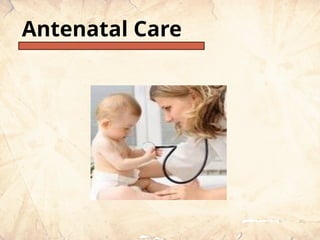
Antenatal Care
Definition :It is the care of women during pregnancy.
Aim : To achieve at the end of pregnancy a healthy mother and a
healthy baby. It should begin soon after conception and
continue throughout pregnancy.
Objectives:
• To promote , protect and maintain the health of the mother
during pregnancy
• To detect “high risk” cases and give them special attention.
•To foresee complications and prevent them.
• To remove anxiety and dread associated with delivery.
• To reduce maternal and infant mortality and morbidity.
• To teach the mother elements of child care , nutrition , personal
hygiene and environmental sanitation.
•To sensitize the mother to the need for family planning ,
including advice to case seeking medical termination of
pregnancy
• To attend the under-fives accompanying the mother
5.
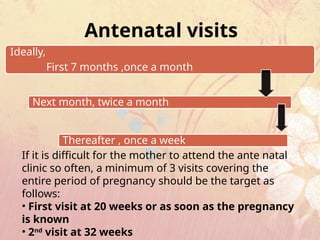
Antenatal visits
Ideally,
First 7months ,once a month
Next month, twice a month
Thereafter , once a week
If it is difficult for the mother to attend the ante natal
clinic so often, a minimum of 3 visits covering the
entire period of pregnancy should be the target as
follows:
• First visit at 20 weeks or as soon as the pregnancy
is known
• 2nd
visit at 32 weeks
6.
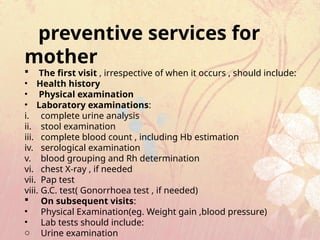
preventive services for
mother
The first visit , irrespective of when it occurs , should include:
• Health history
• Physical examination
• Laboratory examinations:
i. complete urine analysis
ii. stool examination
iii. complete blood count , including Hb estimation
iv. serological examination
v. blood grouping and Rh determination
vi. chest X-ray , if needed
vii. Pap test
viii. G.C. test( Gonorrhoea test , if needed)
On subsequent visits:
• Physical Examination(eg. Weight gain ,blood pressure)
• Lab tests should include:
o Urine examination
7.
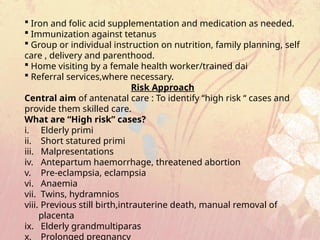
Iron andfolic acid supplementation and medication as needed.
Immunization against tetanus
Group or individual instruction on nutrition, family planning, self
care , delivery and parenthood.
Home visiting by a female health worker/trained dai
Referral services,where necessary.
Risk Approach
Central aim of antenatal care : To identify “high risk “ cases and
provide them skilled care.
What are “High risk” cases?
i. Elderly primi
ii. Short statured primi
iii. Malpresentations
iv. Antepartum haemorrhage, threatened abortion
v. Pre-eclampsia, eclampsia
vi. Anaemia
vii. Twins, hydramnios
viii. Previous still birth,intrauterine death, manual removal of
placenta
ix. Elderly grandmultiparas
x. Prolonged pregnancy
8.
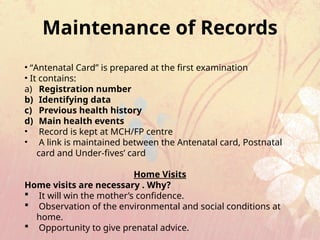
Maintenance of Records
•“Antenatal Card” is prepared at the first examination
• It contains:
a) Registration number
b) Identifying data
c) Previous health history
d) Main health events
• Record is kept at MCH/FP centre
• A link is maintained between the Antenatal card, Postnatal
card and Under-fives’ card
Home Visits
Home visits are necessary . Why?
It will win the mother’s confidence.
Observation of the environmental and social conditions at
home.
Opportunity to give prenatal advice.
9.
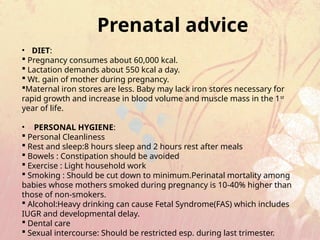
Prenatal advice
• DIET:
Pregnancy consumes about 60,000 kcal.
Lactation demands about 550 kcal a day.
Wt. gain of mother during pregnancy.
Maternal iron stores are less. Baby may lack iron stores necessary for
rapid growth and increase in blood volume and muscle mass in the 1st
year of life.
• PERSONAL HYGIENE:
Personal Cleanliness
Rest and sleep:8 hours sleep and 2 hours rest after meals
Bowels : Constipation should be avoided
Exercise : Light household work
Smoking : Should be cut down to minimum.Perinatal mortality among
babies whose mothers smoked during pregnancy is 10-40% higher than
those of non-smokers.
Alcohol:Heavy drinking can cause Fetal Syndrome(FAS) which includes
IUGR and developmental delay.
Dental care
Sexual intercourse: Should be restricted esp. during last trimester.
10.
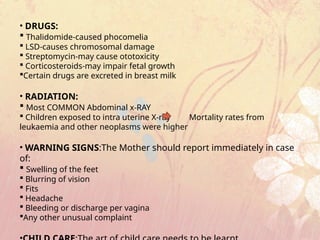
• DRUGS:
Thalidomide-causedphocomelia
LSD-causes chromosomal damage
Streptomycin-may cause ototoxicity
Corticosteroids-may impair fetal growth
Certain drugs are excreted in breast milk
• RADIATION:
Most COMMON Abdominal x-RAY
Children exposed to intra uterine X-ray Mortality rates from
leukaemia and other neoplasms were higher
• WARNING SIGNS:The Mother should report immediately in case
of:
Swelling of the feet
Blurring of vision
Fits
Headache
Bleeding or discharge per vagina
Any other unusual complaint
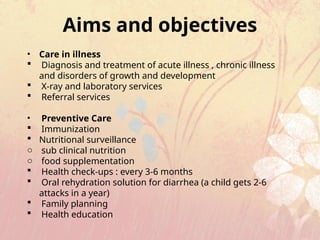
Aims and objectives
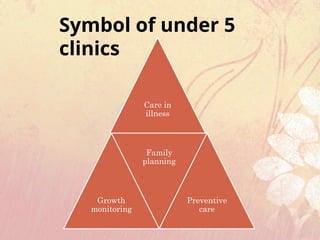
•Care in illness
Diagnosis and treatment of acute illness , chronic illness
and disorders of growth and development
X-ray and laboratory services
Referral services
• Preventive Care
Immunization
Nutritional surveillance
o sub clinical nutrition
o food supplementation
Health check-ups : every 3-6 months
Oral rehydration solution for diarrhea (a child gets 2-6
attacks in a year)
Family planning
Health education
14.
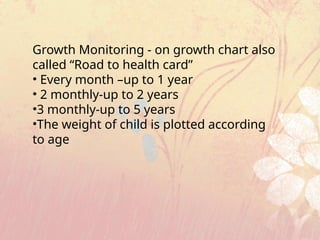
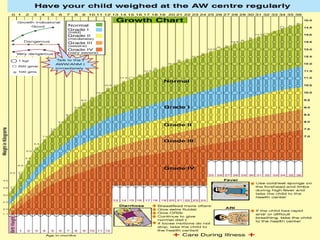
Growth Monitoring -on growth chart also
called “Road to health card”
• Every month –up to 1 year
• 2 monthly-up to 2 years
•3 monthly-up to 5 years
•The weight of child is plotted according
to age




![ONFH[AVN HIP] -TRIPLE REGIME -A NOVAL SURGICAL CONCEPT .pptx](https://cdn.slidesharecdn.com/ss_thumbnails/onfhavnhip2026koaconcalicutdrgokuldevdrmashraf-260210064517-213ec005-thumbnail.jpg?width=640&height=640&fit=bounds)

![CTEV [ clubfoot] DR ARUN LAL ,DR MOHAMED ASHRAF travancore medical college k...](https://cdn.slidesharecdn.com/ss_thumbnails/ctevclubfootdrarunlaldrmohamedashraftravancoremedicalcollegekollamkeralaindia-260208063247-18fc466c-thumbnail.jpg?width=640&height=640&fit=bounds)


![PERI-PROSTHETIC FRACTURE NAIL-PLATE CONSTRUCT [NPC].pptx](https://cdn.slidesharecdn.com/ss_thumbnails/drarunkumardrmohamedashrafperiprostheticfrasturenail-plateconstructnpc-260209164459-7e9d15a1-thumbnail.jpg?width=640&height=640&fit=bounds)
