Ensure quality
Test properties
Prevent failure in use
Make informed choices in using materials
Factor of Safety is the ratio comparing the actual stress on a material and the safe useable stress.
Mechanical tests – the material
may be physically tested to
destruction. Will normally specify a
value for properties such as strength,
hardness, toughness, etc.
• Tensile Test
• Flattening Test
• Flaring Test
• Hardness Test
• Bend Test
• Impact Test
• Creep Test
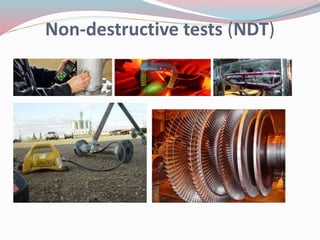
Non-destructive tests (NDT) –
samples or finished articles are
tested before being used.
• Visual Inspection
• Penetrant Testing
• Magnetic Particle Testing
• Ultrasonic Test
• Radiography Test
• Eddy Current Test
• Long Range Ultrasonic Test
• Infrared Thermography
Tensile Testing
Uses an extensometer to apply measured
force to an test specimen. The amount of
extension can be measured and graphed.
Variables such as strain, stress, elasticity,
tensile strength, ductility and shear strength
can be gauged.
Test specimens can be round or flat.
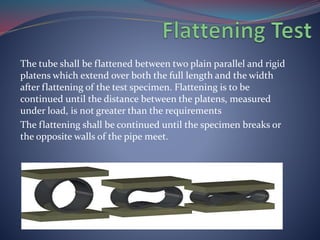
The tube shall be flattened between two plain parallel and rigid
platens which extend over both the full length and the width
after flattening of the test specimen. Flattening is to be
continued until the distance between the platens, measured
under load, is not greater than the requirements
The flattening shall be continued until the specimen breaks or
the opposite walls of the pipe meet.
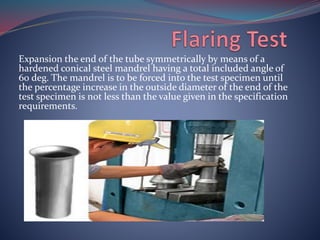
Expansion the end of the tube symmetrically by means of a
hardened conical steel mandrel having a total included angle of
60 deg. The mandrel is to be forced into the test specimen until
the percentage increase in the outside diameter of the end of the
test specimen is not less than the value given in the specification
requirements.
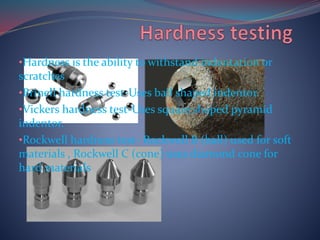
•Hardness is the ability to withstand indentation or
scratches
•Brinell hardness test-Uses ball shaped indentor.
•Vickers hardness test-Uses square shaped pyramid
indentor.
•Rockwell hardness test- Rockwell B (ball) used for soft
materials , Rockwell C (cone) uses diamond cone for
hard materials
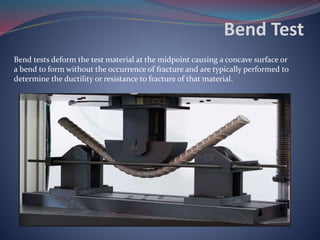
Bend Test
Bend tests deform the test material at the midpoint causing a concave surface or
a bend to form without the occurrence of fracture and are typically performed to
determine the ductility or resistance to fracture of that material.
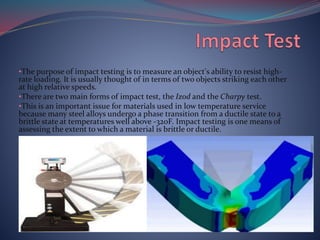
•The purpose of impact testing is to measure an object's ability to resist high-
rate loading. It is usually thought of in terms of two objects striking each other
at high relative speeds.
•There are two main forms of impact test, the Izod and the Charpy test.
•This is an important issue for materials used in low temperature service
because many steel alloys undergo a phase transition from a ductile state to a
brittle state at temperatures well above -320F. Impact testing is one means of
assessing the extent to which a material is brittle or ductile.
Non-destructive tests (NDT)
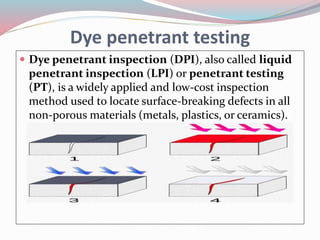
Dye penetrant testing
 Dye penetrant inspection (DPI), also called liquid
penetrant inspection (LPI) or penetrant testing
(PT), is a widely applied and low-cost inspection
method used to locate surface-breaking defects in all
non-porous materials (metals, plastics, or ceramics).
Inspection steps
1. Pre-cleaning
2. Application of Penetrant
3. Excess Penetrant Removal
4. Application of Developer
5. Inspection
6. Post Cleaning
Materials testing
Materials testing
Materials testing
Materials testing
Materials testing

Materials testing

  • 2.
    Ensure quality Test properties Preventfailure in use Make informed choices in using materials Factor of Safety is the ratio comparing the actual stress on a material and the safe useable stress.
  • 3.
    Mechanical tests –the material may be physically tested to destruction. Will normally specify a value for properties such as strength, hardness, toughness, etc. • Tensile Test • Flattening Test • Flaring Test • Hardness Test • Bend Test • Impact Test • Creep Test Non-destructive tests (NDT) – samples or finished articles are tested before being used. • Visual Inspection • Penetrant Testing • Magnetic Particle Testing • Ultrasonic Test • Radiography Test • Eddy Current Test • Long Range Ultrasonic Test • Infrared Thermography
  • 4.
    Tensile Testing Uses anextensometer to apply measured force to an test specimen. The amount of extension can be measured and graphed. Variables such as strain, stress, elasticity, tensile strength, ductility and shear strength can be gauged. Test specimens can be round or flat.
  • 5.
    The tube shallbe flattened between two plain parallel and rigid platens which extend over both the full length and the width after flattening of the test specimen. Flattening is to be continued until the distance between the platens, measured under load, is not greater than the requirements The flattening shall be continued until the specimen breaks or the opposite walls of the pipe meet.
  • 6.
    Expansion the endof the tube symmetrically by means of a hardened conical steel mandrel having a total included angle of 60 deg. The mandrel is to be forced into the test specimen until the percentage increase in the outside diameter of the end of the test specimen is not less than the value given in the specification requirements.
  • 7.
    •Hardness is theability to withstand indentation or scratches •Brinell hardness test-Uses ball shaped indentor. •Vickers hardness test-Uses square shaped pyramid indentor. •Rockwell hardness test- Rockwell B (ball) used for soft materials , Rockwell C (cone) uses diamond cone for hard materials
  • 8.
    Bend Test Bend testsdeform the test material at the midpoint causing a concave surface or a bend to form without the occurrence of fracture and are typically performed to determine the ductility or resistance to fracture of that material.
  • 9.
    •The purpose ofimpact testing is to measure an object's ability to resist high- rate loading. It is usually thought of in terms of two objects striking each other at high relative speeds. •There are two main forms of impact test, the Izod and the Charpy test. •This is an important issue for materials used in low temperature service because many steel alloys undergo a phase transition from a ductile state to a brittle state at temperatures well above -320F. Impact testing is one means of assessing the extent to which a material is brittle or ductile.
  • 10.
  • 11.
    Dye penetrant testing Dye penetrant inspection (DPI), also called liquid penetrant inspection (LPI) or penetrant testing (PT), is a widely applied and low-cost inspection method used to locate surface-breaking defects in all non-porous materials (metals, plastics, or ceramics).
  • 12.
    Inspection steps 1. Pre-cleaning 2.Application of Penetrant 3. Excess Penetrant Removal 4. Application of Developer 5. Inspection 6. Post Cleaning