RECYCLED AGGREGATE
CONCRETE
(RAC)
Mohammad Aquib
Chaitradip Sarkar
Parikshit Chauhan
Naved Khan
Sufiyan Khan
(Diploma in Civil Engineering
M.S.B.T.E., Mumbai)
CONCRETE
• 9000 year old construction material.
• Most used man made material in world.
• India is using more amount of concrete per annum compare
to any other countries in the world.
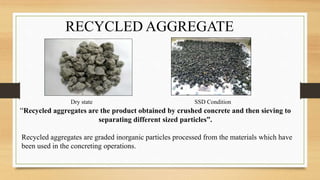
RECYCLED AGGREGATE
Dry state SSD Condition
“Recycled aggregates are the product obtained by crushed concrete and then sieving to
separating different sized particles”.
Recycled aggregates are graded inorganic particles processed from the materials which have
been used in the concreting operations.
HISTORY
 The research on recycled aggregate concrete started from the year 1945 just after
second world war in a fragmented manner.
 In 1977, Nixon prepared a report compiling all the works of recycled aggregate
between 1945 to 1977.
 The studies in the 1980’s were at a time when recycling of concrete aggregates was in
it’s initial stage of development.
 In 2008 a company named Recreate Materials of Denver, Colombia provided 7900
cubic yards of ready mix concrete containing recycled aggregate concrete for use in
foundation successfully.
INTERNATIONAL STATUS
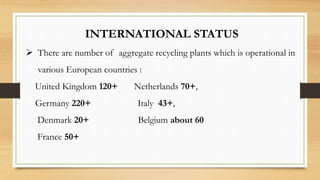
 There are number of aggregate recycling plants which is operational in
various European countries :
United Kingdom 120+ Netherlands 70+,
Germany 220+ Italy 43+,
Denmark 20+ Belgium about 60
France 50+
……INTERNATIONAL STATUS
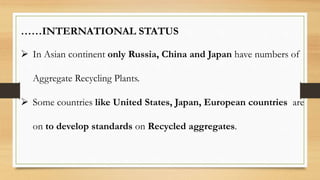
 In Asian continent only Russia, China and Japan have numbers of
Aggregate Recycling Plants.
 Some countries like United States, Japan, European countries are
on to develop standards on Recycled aggregates.
INDIAN STATUS
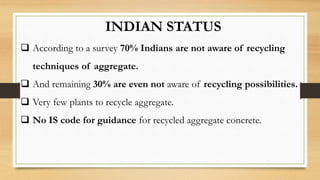
 According to a survey 70% Indians are not aware of recycling
techniques of aggregate.
 And remaining 30% are even not aware of recycling possibilities.
 Very few plants to recycle aggregate.
 No IS code for guidance for recycled aggregate concrete.
NECESSITY IN INDIA (concrete production is maximum in India)
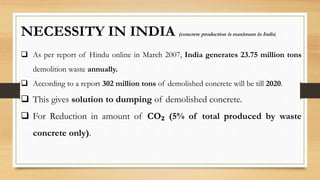
 As per report of Hindu online in March 2007, India generates 23.75 million tons
demolition waste annually.
 According to a report 302 million tons of demolished concrete will be till 2020.
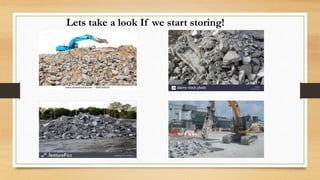
 This gives solution to dumping of demolished concrete.
 For Reduction in amount of CO₂ (5% of total produced by waste
concrete only).
Lets take a look If we start storing!
If not adopted now; then:
 Continuous effect on quality of air.
 Continuous exploitation of natural stone.
 Cost of concrete will increase continuously.
 Old concrete will stored as solid waste in environment.
If we adopt now, then;
(will be beneficial as per economical, environmental prospective)
 Economical concrete production
 The natural stone can be preserved.
 Decrease the amount of concrete waste in the environment .
 Reduction of CO₂.
 Balance the ecological system by reducing the CO₂ i.e.
Greenhouse gas
 Lead the environmental trend in society and in CIVIL
ENGINEERING.
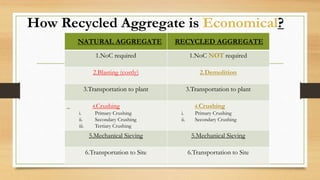
NATURAL AGGREGATE RECYCLED AGGREGATE
1.NoC required 1.NoC NOT required
2.Blasting (costly) 2.Demolition
3.Transportation to plant 3.Transportation to plant
4.Crushing
i. Primary Crushing
ii. Secondary Crushing
iii. Tertiary Crushing
4.Crushing
i. Primary Crushing
ii. Secondary Crushing
5.Mechanical Sieving 5.Mechanical Sieving
6.Transportation to Site 6.Transportation to Site
How Recycled Aggregate is Economical?
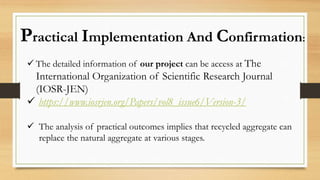
Practical Implementation And Confirmation:
 The detailed information of our project can be access at The
International Organization of Scientific Research Journal
(IOSR-JEN)
 https://www.iosrjen.org/Papers/vol8_issue6/Version-3/
 The analysis of practical outcomes implies that recycled aggregate can
replace the natural aggregate at various stages.
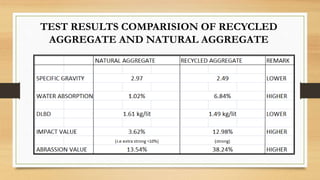
TEST RESULTS COMPARISION OF RECYCLED
AGGREGATE AND NATURAL AGGREGATE
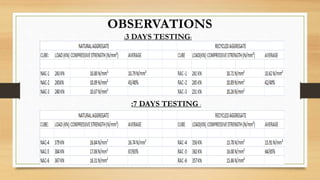
:3 DAYS TESTING:
:7 DAYS TESTING :
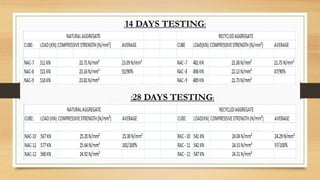
OBSERVATIONS
:14 DAYS TESTING:
:28 DAYS TESTING:
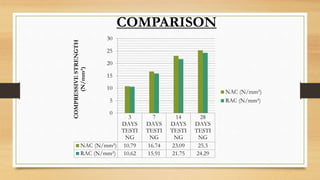
COMPARISON
3
DAYS
TESTI
NG
7
DAYS
TESTI
NG
14
DAYS
TESTI
NG
28
DAYS
TESTI
NG
NAC (N/mm²) 10.79 16.74 23.09 25.3
RAC (N/mm²) 10.62 15.91 21.75 24.29
0
5
10
15
20
25
30
COMPRESSIVESTRENGTH
(N/mm²)
NAC (N/mm²)
RAC (N/mm²)
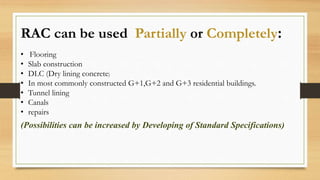
RAC can be used Partially or Completely:
• Flooring
• Slab construction
• DLC (Dry lining concrete)
• In most commonly constructed G+1,G+2 and G+3 residential buildings.
• Tunnel lining
• Canals
• repairs
(Possibilities can be increased by Developing of Standard Specifications)
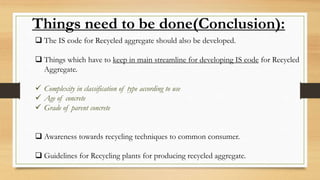
Things need to be done(Conclusion):
 The IS code for Recycled aggregate should also be developed.
 Things which have to keep in main streamline for developing IS code for Recycled
Aggregate.
 Complexity in classification of type according to use
 Age of concrete
 Grade of parent concrete
 Awareness towards recycling techniques to common consumer.
 Guidelines for Recycling plants for producing recycled aggregate.
THANK YOU!!!

Recycled Aggregate Concrete (RAC)

  • 1.
    RECYCLED AGGREGATE CONCRETE (RAC) Mohammad Aquib ChaitradipSarkar Parikshit Chauhan Naved Khan Sufiyan Khan (Diploma in Civil Engineering M.S.B.T.E., Mumbai)
  • 2.
    CONCRETE • 9000 yearold construction material. • Most used man made material in world. • India is using more amount of concrete per annum compare to any other countries in the world.
  • 3.
    RECYCLED AGGREGATE Dry stateSSD Condition “Recycled aggregates are the product obtained by crushed concrete and then sieving to separating different sized particles”. Recycled aggregates are graded inorganic particles processed from the materials which have been used in the concreting operations.
  • 4.
    HISTORY  The researchon recycled aggregate concrete started from the year 1945 just after second world war in a fragmented manner.  In 1977, Nixon prepared a report compiling all the works of recycled aggregate between 1945 to 1977.  The studies in the 1980’s were at a time when recycling of concrete aggregates was in it’s initial stage of development.  In 2008 a company named Recreate Materials of Denver, Colombia provided 7900 cubic yards of ready mix concrete containing recycled aggregate concrete for use in foundation successfully.
  • 5.
    INTERNATIONAL STATUS  Thereare number of aggregate recycling plants which is operational in various European countries : United Kingdom 120+ Netherlands 70+, Germany 220+ Italy 43+, Denmark 20+ Belgium about 60 France 50+
  • 6.
    ……INTERNATIONAL STATUS  InAsian continent only Russia, China and Japan have numbers of Aggregate Recycling Plants.  Some countries like United States, Japan, European countries are on to develop standards on Recycled aggregates.
  • 7.
    INDIAN STATUS  Accordingto a survey 70% Indians are not aware of recycling techniques of aggregate.  And remaining 30% are even not aware of recycling possibilities.  Very few plants to recycle aggregate.  No IS code for guidance for recycled aggregate concrete.
  • 8.
    NECESSITY IN INDIA(concrete production is maximum in India)  As per report of Hindu online in March 2007, India generates 23.75 million tons demolition waste annually.  According to a report 302 million tons of demolished concrete will be till 2020.  This gives solution to dumping of demolished concrete.  For Reduction in amount of CO₂ (5% of total produced by waste concrete only).
  • 9.
    Lets take alook If we start storing!
  • 10.
    If not adoptednow; then:  Continuous effect on quality of air.  Continuous exploitation of natural stone.  Cost of concrete will increase continuously.  Old concrete will stored as solid waste in environment.
  • 11.
    If we adoptnow, then; (will be beneficial as per economical, environmental prospective)  Economical concrete production  The natural stone can be preserved.  Decrease the amount of concrete waste in the environment .  Reduction of CO₂.  Balance the ecological system by reducing the CO₂ i.e. Greenhouse gas  Lead the environmental trend in society and in CIVIL ENGINEERING.
  • 12.
    NATURAL AGGREGATE RECYCLEDAGGREGATE 1.NoC required 1.NoC NOT required 2.Blasting (costly) 2.Demolition 3.Transportation to plant 3.Transportation to plant 4.Crushing i. Primary Crushing ii. Secondary Crushing iii. Tertiary Crushing 4.Crushing i. Primary Crushing ii. Secondary Crushing 5.Mechanical Sieving 5.Mechanical Sieving 6.Transportation to Site 6.Transportation to Site How Recycled Aggregate is Economical?
  • 13.
    Practical Implementation AndConfirmation:  The detailed information of our project can be access at The International Organization of Scientific Research Journal (IOSR-JEN)  https://www.iosrjen.org/Papers/vol8_issue6/Version-3/  The analysis of practical outcomes implies that recycled aggregate can replace the natural aggregate at various stages.
  • 14.
    TEST RESULTS COMPARISIONOF RECYCLED AGGREGATE AND NATURAL AGGREGATE
  • 15.
    :3 DAYS TESTING: :7DAYS TESTING : OBSERVATIONS
  • 16.
    :14 DAYS TESTING: :28DAYS TESTING:
  • 17.
    COMPARISON 3 DAYS TESTI NG 7 DAYS TESTI NG 14 DAYS TESTI NG 28 DAYS TESTI NG NAC (N/mm²) 10.7916.74 23.09 25.3 RAC (N/mm²) 10.62 15.91 21.75 24.29 0 5 10 15 20 25 30 COMPRESSIVESTRENGTH (N/mm²) NAC (N/mm²) RAC (N/mm²)
  • 18.
    RAC can beused Partially or Completely: • Flooring • Slab construction • DLC (Dry lining concrete) • In most commonly constructed G+1,G+2 and G+3 residential buildings. • Tunnel lining • Canals • repairs (Possibilities can be increased by Developing of Standard Specifications)
  • 19.
    Things need tobe done(Conclusion):  The IS code for Recycled aggregate should also be developed.  Things which have to keep in main streamline for developing IS code for Recycled Aggregate.  Complexity in classification of type according to use  Age of concrete  Grade of parent concrete  Awareness towards recycling techniques to common consumer.  Guidelines for Recycling plants for producing recycled aggregate.
  • 20.