Material Management
Presented by
Dr. Ravi Prakash
JR-III
Department of Community Medicine
Katihar Medical College
MATERIALS
Materials may be defined as equipments, apparatus and
supplies procured, stocked and utilized by an organization.
These are the things needed for smooth functioning of an
activity in the organization.
- process of management concerned with planning,
organizing and controlling of the flow of materials to,
through, and out of an organization in an integrated
fashion
Material Management
MATERIAL MANAGEMENT
It is planning, directing, controlling and coordinating all
those activities concerned with material and inventory from
the inception to their introduction into the manufacturing
processes.
It includes all the activities of store from stage of
forecasting of requirements to utilization to the final
disposal. Store required by the hospital varies from simple
housekeeping materials to sophisticated equipment.
It is concerned with providing the drugs, supplies and
equipment by the personnel to deliver health care services.
It is also viewed as a scientific technique concerned with
planning, organizing and controlling the flow of materials
from their initial purchase, internal operations to the
distribution at service point.
.
Sound purchasing methods
Skillful and hard poised negotiations
Effective purchase system
Should be simple
Must not increase other costs
Simple inventory control programme
AIM
 Right quality of material
 Right quantity of supplies of materials
 Right time
 Right place
 Right cost.
OBJECTIVES
To avoid surplus of material
To have appropriate storage and easy to retrieve
To ensure distribution to the point of usage whenever required
To ensure effective and efficient utilization of available resources
To optimizing the use of resources to meet the needs in an
efficient manner
To obtain correct quality of materials at lowest possible price.
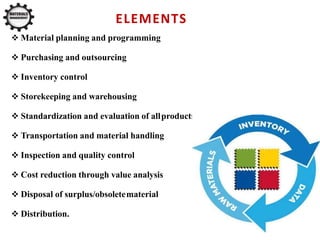
ELEMENTS
 Material planning and programming
 Purchasing and outsourcing
 Inventory control
 Storekeeping and warehousing
 Standardization and evaluation of allproducts
 Transportation and material handling
 Inspection and quality control
 Cost reduction through value analysis
 Disposal of surplus/obsoletematerial
 Distribution.
MANAGEMENT TECHNIQUES USED
Right Item
Right Quantity
Right Price
Right Source
Right Method
Right Delivery
Value analysis, Standardization
Inventory control
Cost/Benefit analysis, Value analysis
Vendor research
ABC, VED etc. analysis
Operation research
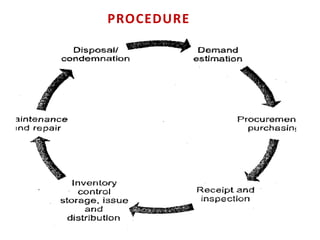
PROCEDURE
.
PROCUREMENT
Procurement is the sourcing and purchasing of goods and services
for business use. It is the acquisition of goods or commodities by a
company, organization, institution, or a person. This simply means
the purchase of goods from suppliers at the lowest possiblecost.
 Selecting the vendors
 Arranging upon the purchase price
 Time and place of delivery
 Verifying deliveries
 Settlement and payment of vendors remuneration claim
OBJECTIVES
Acquire needed supplies
Obtain high quality supplies
Assure prompt and dependable delivery
Distribute the procurement workload
Optimize inventory management
.
Review
selection
Determine
needed quantities
Reconcile
needs and
funds
Choose
procurement
method
Select
suppliers
Specify
contract
terms
Monitor order
status
Receipt and
inspection
Procurement methods
The Open tender method
The limited restricted tender method
Negotiated tender
Direct procurement
Rate contract
Spot purchase
INVENTORY
It is the stock to ensure uninterrupted supplies, the idle resources
which have future economic value and cushion between estimated
and actual demand of materials.
Inventory is ‘anything that is bought and held prior to use.
-method where all stocks of goods are properly
and promptly issued, accorded and preserved in
the best interest of the firm.
-monitor the stock of goods used for
production, distribution and captive (self)
consumption.
Inventory control is the method of maintenance of
stock at a level at which purchasing and stocking
costs are the lowest possible without interference
with supply.
Inventory Control
OBJECTIVES
To supply the materials in time
To give maximum clients service
To reduce or minimize investment in inventories
To minimize idle time
To avoid shortage of stock
To minimize the losses
To meet unforeseen future demand
To average out demand fluctuations
To balance various inventory costs
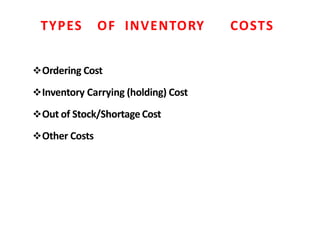
TYPES OF INVENTORY COSTS
Ordering Cost
Inventory Carrying (holding) Cost
Out of Stock/Shortage Cost
Other Costs
Major Activities Of Inventory Control
Planning
Procurement
Receiving and inspection
Storing and issuing the inventories
Recording the receipt and issuing of inventories
Physical verification
Follow up functions
Material standardization and substitution.
Setting up of various stock levels
Minimum Level
MaximumLevel
Reorder Level
Reserve Stock
Minimum Level
 Minimum level is the minimum stock to be maintained for
smooth production
Minimum level = Reorder level - Average usage per period X average
time to obtain delivery
Maximum Level
It is the level of stock, beyond which the stock is not maintained
Maximum level = Reordering level - Expected minimum consumption
in units during the least time to obtain delivery + Reorder quantity
Reorder Level
It is the stock level at which an order should be placed
 Reorder level = Maximum reorder period X maximum
usage
Equal to consumption o expected during lead time,
in addition to buffer stock.
Reserve Stock
Excess usage requirement during normal lead
time
Basic principles of inventor y
control
Safety Stock (SS)
Lead Time (LT)
Average Inventory: INVAVG
Reorder Point
TECHNIQUES OF INVENTORY CONTROL
Items Quality: Value analysis, standardization, codification
Quantity: Purchasing balancing of inventories EOQ
Price: Cost price value analysis
Source; Market research, purchasing techniques selection
Delivery: Procurement technique, Follow up
PERT/Operational research
Methods: Work study system analysis: ABC Analysis etc
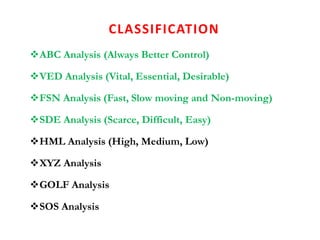
CLASSIFICATION
ABC Analysis (Always Better Control)
VED Analysis (Vital, Essential, Desirable)
FSN Analysis (Fast, Slow moving and Non-moving)
SDE Analysis (Scarce, Difficult, Easy)
HML Analysis (High, Medium, Low)
XYZ Analysis
GOLF Analysis
SOS Analysis
ABC Analysis
Basic supply chain technique
“Always Better Control”
10% items consume about 70% of budget (Group A). The next
20% consume 20 % of financial resources (Group B) and
remaining 70 % items account for just 10% of budget (GroupC)
‘A’ Items
 small in number
 consume large amount of resources
 managed by top management.
 tight control, rigid estimate of requirements, strict &closer
watch
 require low safety stocks.
 consume major portions of funds.
‘B’ Items
moderate control.
purchased based on rigid requirements
strict watch and control.
management is done by middle level managers.
‘C’ Items
 larger in number
 consume lesser amount of resources
 ordinary control measures.
 purchase is based on usage estimates
 require high safety stocks.
Advanta ges
Investment in inventory can be maintained
Easy to control the wastage of costlyitems
Helps in maintaining safety to the total cost
Easy to maintain stock and turnover rate
Manager is able to control the inventories specially controlling ‘A’
items.
Disadvantages
Considers only the money value not the importance
of items for functioning.
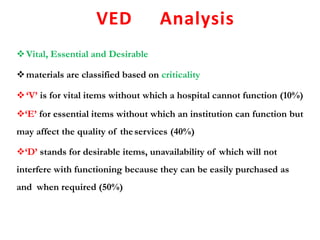
VED Analysis
Vital, Essential and Desirable
materials are classified based on criticality
‘V’ is for vital items without which a hospital cannot function (10%)
‘E’ for essential items without which an institution can function but
may affect the quality of theservices (40%)
‘D’ stands for desirable items, unavailability of which will not
interfere with functioning because they can be easily purchased as
and when required (50%)
Advantages
 Useful for monitoring and control of stores and spares inventory by
classifying them into 3 categories viz., Vital, Essential and Desirable.
 Determine the criticality of an item and its effect on production and
other services.
It is specially used for classification of spareparts/items.
It is useful in controlling and maintaining the stock of various types.
Combination of ABC and VED Analysis
V E D
A AV AE AD 10%
B BV BE BD 20%
C CV CE CD 70%
10% 40% 50% 100%
Category 1 Maximum attention 15%
Category 2 Moderate control 40%
Category 3 Lower level of
management
45%
FSN Analysis
‘Fast moving, Slow moving, and Non-moving’
based on the consumption pattern of theitems
Method
Date of receipt or last date of issue whichever is later, is taken to
determine the number of months which has lapsed since the last
transaction. The items are usually grouped in periods of 12 months.
Non-moving items must be periodically reviewed to prevent expiry.
Analysis
For analysis, the issuing of items in past two or three years
are considered
If there is no issuing of item during that period, it is
labeled ‘N’ item
Then up to certain limit say 10-15 issues in that period, the
item is ‘S’ Item
The items exceeding such limits of numbers of issues
during that period is ‘F’ Item
Advanta ges
Helps to avoid investment in non-moving or slow items
Facilitates timely control
SDE Analysis
Scarce, difficult, easy to obtain
'S’ stands for ‘scarce’ items, those which are difficult to obtain and
generally require source development, generally imported, and those
which are in short supply, managed by top level management.
‘D’ stands for ‘difficult’ items which are available indigenously but
are difficult items to procure.
'E’ stands for ‘Easily available ’ items which are easy to acquire and
which are readily available in the local markets.
Advantages
Vital to the lead time analysis
Useful in the context of scarcity of supply
To determine the method of buying and to fix up the
responsibilities of buyers.
HML ANALYSIS
High, medium, low
The basic criteria of HML classification is the unit value
of the item.
Advantages
Used to keep control over consumption at departmental
level
For deciding the frequency of physicalverification.
XYZ ANALYSIS
based on the value of the inventorystored
X items are those whose inventory values are high
Y items are those which have moderate inventory stocks
Z items are those whose inventory values are low
GOLF ANALYSIS
Government, Ordinary, Local, Foreign.
basis of source of material.
SOS ANALYSIS
Seasonal and Off Seasonalitems
Type of items Strategy
Seasonal items(s) which are available
only for a limited period
Procure and stock for meeting the
needs of the full year.
Seasonalitems available throughout the
year
The quantity required should be
compared with the cost savings on
account of lower prices, if purchased
during season.
Off-seasonal items (OS) Quantity is considered.
IN VE NTORY ACCOUN TIN G SY ST EM
Perpetual Inventory System
Periodic Inventory System
Perpetual Inventory System
Perpetual inventory system may be defined as a method of
recording stores balances after every receipt and issue to
facilitate regular checking and to obviate closing down for
stock taking
Parts
 Bin Card
 Store Ledgers
 Continues Stock Taking
Periodic Inventory System
A periodic inventory system implies when the quantity of
inventory on hand is determined on periodically such as once a
month, quarterly or at the beginning and end of each year, and
does not have an accurate record of the inventories in between
these points.
Features
All acquisitions of inventory during the accounting period are
recorded by debits to a purchases account.
The total in the purchases account in the end of the accounting
period added to the cost of the inventory on hand at the beginning of
the period.
Inventory subsidiary ledger is not updated after each purchase of
inventory.
Inventory quantities are not updated continuously rather
updated on a periodic basis.
Social Marketing
• Application of commercial marketing concepts, tools,
resources, skills to encourage socially beneficial behavior
among those segment of population not served or not
adequately served.
Establish management and operating procedure.
Select the products to be marketed.
Identify the consumer population.
Decide on brand names and packaging.
Fix appropriate price.
Identify the distribution system.
Recruit sales outlets/shops.
Implement sales promotion programmes.
Thank you..

Material management

  • 1.
    Material Management Presented by Dr.Ravi Prakash JR-III Department of Community Medicine Katihar Medical College
  • 2.
    MATERIALS Materials may bedefined as equipments, apparatus and supplies procured, stocked and utilized by an organization. These are the things needed for smooth functioning of an activity in the organization.
  • 3.
    - process ofmanagement concerned with planning, organizing and controlling of the flow of materials to, through, and out of an organization in an integrated fashion Material Management
  • 4.
    MATERIAL MANAGEMENT It isplanning, directing, controlling and coordinating all those activities concerned with material and inventory from the inception to their introduction into the manufacturing processes. It includes all the activities of store from stage of forecasting of requirements to utilization to the final disposal. Store required by the hospital varies from simple housekeeping materials to sophisticated equipment.
  • 5.
    It is concernedwith providing the drugs, supplies and equipment by the personnel to deliver health care services. It is also viewed as a scientific technique concerned with planning, organizing and controlling the flow of materials from their initial purchase, internal operations to the distribution at service point.
  • 6.
    . Sound purchasing methods Skillfuland hard poised negotiations Effective purchase system Should be simple Must not increase other costs Simple inventory control programme
  • 7.
    AIM  Right qualityof material  Right quantity of supplies of materials  Right time  Right place  Right cost.
  • 8.
    OBJECTIVES To avoid surplusof material To have appropriate storage and easy to retrieve To ensure distribution to the point of usage whenever required To ensure effective and efficient utilization of available resources To optimizing the use of resources to meet the needs in an efficient manner To obtain correct quality of materials at lowest possible price.
  • 9.
    ELEMENTS  Material planningand programming  Purchasing and outsourcing  Inventory control  Storekeeping and warehousing  Standardization and evaluation of allproducts  Transportation and material handling  Inspection and quality control  Cost reduction through value analysis  Disposal of surplus/obsoletematerial  Distribution.
  • 10.
    MANAGEMENT TECHNIQUES USED RightItem Right Quantity Right Price Right Source Right Method Right Delivery Value analysis, Standardization Inventory control Cost/Benefit analysis, Value analysis Vendor research ABC, VED etc. analysis Operation research
  • 11.
  • 12.
  • 13.
    PROCUREMENT Procurement is thesourcing and purchasing of goods and services for business use. It is the acquisition of goods or commodities by a company, organization, institution, or a person. This simply means the purchase of goods from suppliers at the lowest possiblecost.  Selecting the vendors  Arranging upon the purchase price  Time and place of delivery  Verifying deliveries  Settlement and payment of vendors remuneration claim
  • 14.
    OBJECTIVES Acquire needed supplies Obtainhigh quality supplies Assure prompt and dependable delivery Distribute the procurement workload Optimize inventory management
  • 15.
  • 16.
    Procurement methods The Opentender method The limited restricted tender method Negotiated tender Direct procurement Rate contract Spot purchase
  • 17.
    INVENTORY It is thestock to ensure uninterrupted supplies, the idle resources which have future economic value and cushion between estimated and actual demand of materials. Inventory is ‘anything that is bought and held prior to use.
  • 18.
    -method where allstocks of goods are properly and promptly issued, accorded and preserved in the best interest of the firm. -monitor the stock of goods used for production, distribution and captive (self) consumption. Inventory control is the method of maintenance of stock at a level at which purchasing and stocking costs are the lowest possible without interference with supply. Inventory Control
  • 19.
    OBJECTIVES To supply thematerials in time To give maximum clients service To reduce or minimize investment in inventories To minimize idle time To avoid shortage of stock To minimize the losses To meet unforeseen future demand To average out demand fluctuations To balance various inventory costs
  • 20.
    TYPES OF INVENTORYCOSTS Ordering Cost Inventory Carrying (holding) Cost Out of Stock/Shortage Cost Other Costs
  • 21.
    Major Activities OfInventory Control Planning Procurement Receiving and inspection Storing and issuing the inventories Recording the receipt and issuing of inventories Physical verification Follow up functions Material standardization and substitution.
  • 22.
    Setting up ofvarious stock levels Minimum Level MaximumLevel Reorder Level Reserve Stock
  • 23.
    Minimum Level  Minimumlevel is the minimum stock to be maintained for smooth production Minimum level = Reorder level - Average usage per period X average time to obtain delivery Maximum Level It is the level of stock, beyond which the stock is not maintained Maximum level = Reordering level - Expected minimum consumption in units during the least time to obtain delivery + Reorder quantity
  • 24.
    Reorder Level It isthe stock level at which an order should be placed  Reorder level = Maximum reorder period X maximum usage Equal to consumption o expected during lead time, in addition to buffer stock.
  • 25.
    Reserve Stock Excess usagerequirement during normal lead time
  • 26.
    Basic principles ofinventor y control Safety Stock (SS) Lead Time (LT) Average Inventory: INVAVG Reorder Point
  • 27.
    TECHNIQUES OF INVENTORYCONTROL Items Quality: Value analysis, standardization, codification Quantity: Purchasing balancing of inventories EOQ Price: Cost price value analysis Source; Market research, purchasing techniques selection Delivery: Procurement technique, Follow up PERT/Operational research Methods: Work study system analysis: ABC Analysis etc
  • 28.
    CLASSIFICATION ABC Analysis (AlwaysBetter Control) VED Analysis (Vital, Essential, Desirable) FSN Analysis (Fast, Slow moving and Non-moving) SDE Analysis (Scarce, Difficult, Easy) HML Analysis (High, Medium, Low) XYZ Analysis GOLF Analysis SOS Analysis
  • 29.
    ABC Analysis Basic supplychain technique “Always Better Control” 10% items consume about 70% of budget (Group A). The next 20% consume 20 % of financial resources (Group B) and remaining 70 % items account for just 10% of budget (GroupC)
  • 30.
    ‘A’ Items  smallin number  consume large amount of resources  managed by top management.  tight control, rigid estimate of requirements, strict &closer watch  require low safety stocks.  consume major portions of funds.
  • 31.
    ‘B’ Items moderate control. purchasedbased on rigid requirements strict watch and control. management is done by middle level managers.
  • 32.
    ‘C’ Items  largerin number  consume lesser amount of resources  ordinary control measures.  purchase is based on usage estimates  require high safety stocks.
  • 33.
    Advanta ges Investment ininventory can be maintained Easy to control the wastage of costlyitems Helps in maintaining safety to the total cost Easy to maintain stock and turnover rate Manager is able to control the inventories specially controlling ‘A’ items.
  • 34.
    Disadvantages Considers only themoney value not the importance of items for functioning.
  • 35.
    VED Analysis Vital, Essentialand Desirable materials are classified based on criticality ‘V’ is for vital items without which a hospital cannot function (10%) ‘E’ for essential items without which an institution can function but may affect the quality of theservices (40%) ‘D’ stands for desirable items, unavailability of which will not interfere with functioning because they can be easily purchased as and when required (50%)
  • 36.
    Advantages  Useful formonitoring and control of stores and spares inventory by classifying them into 3 categories viz., Vital, Essential and Desirable.  Determine the criticality of an item and its effect on production and other services. It is specially used for classification of spareparts/items. It is useful in controlling and maintaining the stock of various types.
  • 37.
    Combination of ABCand VED Analysis V E D A AV AE AD 10% B BV BE BD 20% C CV CE CD 70% 10% 40% 50% 100%
  • 38.
    Category 1 Maximumattention 15% Category 2 Moderate control 40% Category 3 Lower level of management 45%
  • 39.
    FSN Analysis ‘Fast moving,Slow moving, and Non-moving’ based on the consumption pattern of theitems Method Date of receipt or last date of issue whichever is later, is taken to determine the number of months which has lapsed since the last transaction. The items are usually grouped in periods of 12 months. Non-moving items must be periodically reviewed to prevent expiry.
  • 40.
    Analysis For analysis, theissuing of items in past two or three years are considered If there is no issuing of item during that period, it is labeled ‘N’ item Then up to certain limit say 10-15 issues in that period, the item is ‘S’ Item The items exceeding such limits of numbers of issues during that period is ‘F’ Item
  • 41.
    Advanta ges Helps toavoid investment in non-moving or slow items Facilitates timely control
  • 42.
    SDE Analysis Scarce, difficult,easy to obtain 'S’ stands for ‘scarce’ items, those which are difficult to obtain and generally require source development, generally imported, and those which are in short supply, managed by top level management. ‘D’ stands for ‘difficult’ items which are available indigenously but are difficult items to procure. 'E’ stands for ‘Easily available ’ items which are easy to acquire and which are readily available in the local markets.
  • 43.
    Advantages Vital to thelead time analysis Useful in the context of scarcity of supply To determine the method of buying and to fix up the responsibilities of buyers.
  • 44.
    HML ANALYSIS High, medium,low The basic criteria of HML classification is the unit value of the item.
  • 45.
    Advantages Used to keepcontrol over consumption at departmental level For deciding the frequency of physicalverification.
  • 46.
    XYZ ANALYSIS based onthe value of the inventorystored X items are those whose inventory values are high Y items are those which have moderate inventory stocks Z items are those whose inventory values are low
  • 47.
    GOLF ANALYSIS Government, Ordinary,Local, Foreign. basis of source of material.
  • 48.
    SOS ANALYSIS Seasonal andOff Seasonalitems Type of items Strategy Seasonal items(s) which are available only for a limited period Procure and stock for meeting the needs of the full year. Seasonalitems available throughout the year The quantity required should be compared with the cost savings on account of lower prices, if purchased during season. Off-seasonal items (OS) Quantity is considered.
  • 49.
    IN VE NTORYACCOUN TIN G SY ST EM Perpetual Inventory System Periodic Inventory System
  • 50.
    Perpetual Inventory System Perpetualinventory system may be defined as a method of recording stores balances after every receipt and issue to facilitate regular checking and to obviate closing down for stock taking Parts  Bin Card  Store Ledgers  Continues Stock Taking
  • 53.
    Periodic Inventory System Aperiodic inventory system implies when the quantity of inventory on hand is determined on periodically such as once a month, quarterly or at the beginning and end of each year, and does not have an accurate record of the inventories in between these points.
  • 54.
    Features All acquisitions ofinventory during the accounting period are recorded by debits to a purchases account. The total in the purchases account in the end of the accounting period added to the cost of the inventory on hand at the beginning of the period. Inventory subsidiary ledger is not updated after each purchase of inventory. Inventory quantities are not updated continuously rather updated on a periodic basis.
  • 55.
    Social Marketing • Applicationof commercial marketing concepts, tools, resources, skills to encourage socially beneficial behavior among those segment of population not served or not adequately served.
  • 56.
    Establish management andoperating procedure. Select the products to be marketed. Identify the consumer population. Decide on brand names and packaging. Fix appropriate price. Identify the distribution system. Recruit sales outlets/shops. Implement sales promotion programmes.
  • 57.