Gynaecological & Genitourinary causes of acute
abdomen
PRESENTED BY--
Ravi Prakash
Roll no.-56
Shri B.M.Patil Medical College
….
[A].Gynaecological & obstetrical causes of acute abdomen….
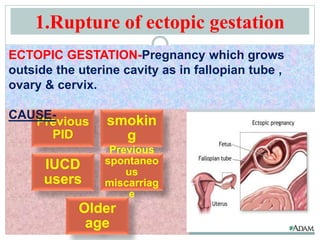
1.Rupture of ectopic gestation
Previous
PID
smokin
g
IUCD
users
Previous
spontaneo
us
miscarriag
e
Older
age
ECTOPIC GESTATION-Pregnancy which grows
outside the uterine cavity as in fallopian tube ,
ovary & cervix.
CAUSE-
Clinical feature
SYMPTOM
lower
acute
abdominal
pain
vaginal
bleedin
g shoulde
r pain &
epigast
ric pain
SIGN
cervical
excitation
tenderness
in all
vaginal
fornices
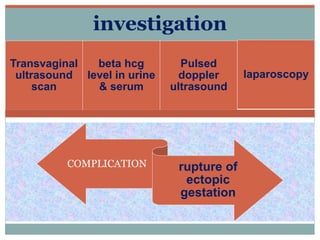
investigation
Transvaginal
ultrasound
scan
beta hcg
level in urine
& serum
Pulsed
doppler
ultrasound
laparoscopy
COMPLICATION rupture of
ectopic
gestation
Diagnostic feature for rupture of ectopic
gestation
Following history & examination
should be carried out –to
diagnose the case of rupture of
ectopic gestation–
 Sudden onset of acute pain
over the hypogastrium with
tremendous shock or collapse in
a woman of child bearing age
having h/o one or two missed
period(may or may not) is
suggestive of rupture.
 Pain-very severe ,located in
hypogastrium which radiate
towards backward & downward,
gradually involve whole abdomen
& tip of shoulder
 Distension of abdomen
 Bluish discoloration of
Differential diagnosis
D/D miscarri
age
ovarian
acciden
t
pain
unrelated
to
pregnancy
in acute
appendicit
is
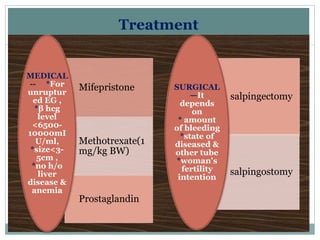
Treatment
Mifepristone
Methotrexate(1
mg/kg BW)
Prostaglandin
MEDICAL
-- *For
unruptur
ed EG ,
*β hcg
level
<6500-
10000mI
U/ml,
*size<3-
5cm ,
*no h/o
liver
disease &
anemia
salpingectomy
salpingostomy
SURGICAL
—It
depends
on
* amount
of bleeding
*state of
diseased &
other tube
*woman's
fertility
intention
2.Acute PID
DEFINITION-
characterized by the infection & inflammation
of upper genital tract involving the
endometrium, fallopian tube, ovaries & pelvic
peritoneum.
INCIDENCE 1-2% per year among
sexually active
woman
Etiology
& risk
factors-
by
ascending
infection
multiple
sexual
partner
IUCD
users
menstrua
ting
teenagers
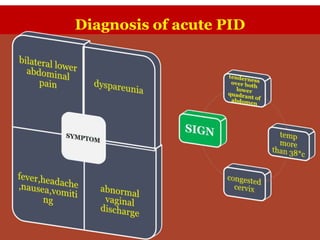
Diagnosis of acute PID
Investigation
Discharge from endocervix
inflammable/friable cervix
blood examination-
leucocytosis
ESR increased
ultrasonography
pus examination
collected from FT
during
laparoscopy
Woman with suspected PID-
screened for chlamydia t. & Neisseria g.(endocervical
screening) by NAAT.
Antibiotic treatment-
 ofloxacin 400mg BD oral+metronidazole 400mg BD-
14days
 ceftriaxone 250mg i.m.+probeneci 1gm oral
 cefoxitin 2gm i.v.TDS+doxycycline 100mg i.v.BD followed
by doxycycline 100mg BD oral+metronidazole 400mg BD
oral-for 14 days
Hospital admission-
*PID in pregnancy
*tubo-ovarian abscess
*lack of response to oral treatment
3.Torsion of ovarian cyst
Cyst is the small fluid filled sac which develop in
woman’s ovaries.
TORSION-
total or partial rotation of adnexa around its
vascular axis or pedicle
CAUSE-
slight axial
rotation of
pedicle
venous
occlusion &
partial
arterial
compression
intermittent
forcible
arterial
pulsation
further
aggravating the
axial rotation
until it become
complete
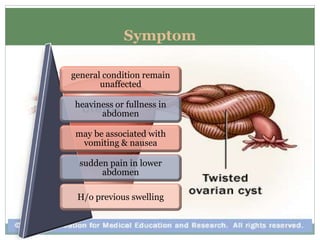
Symptom
general condition remain
unaffected
heaviness or fullness in
abdomen
may be associated with
vomiting & nausea
sudden pain in lower
abdomen
H/o previous swelling
sign
fainting attack-absent
woman with colicky abd pain associated
with vomiting at frequent interval
if lump present-tender,tense,cystic with
definite smooth margin moving in lower
abdomen is suggestive of ovarian cyst
internal examination reveals a cystic mass
felt ,separated from uterus
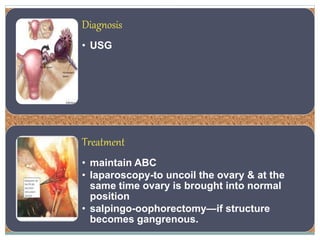
Diagnosis
• USG
Treatment
• maintain ABC
• laparoscopy-to uncoil the ovary & at the
same time ovary is brought into normal
position
• salpingo-oophorectomy—if structure
becomes gangrenous.
4.Red degeneration
It mainly occurs in large fibroid during 2nd half
of pregnancy or puerperium .
Cause Probably
vascular in
origin
Tumour appear as dark red areas with cut
section reveals raw-beef appearance with
cystic spaces often
Odour-fishy
Colour-due to haemolysed red cells &
haemoglobin
Microscopically evidence of
necrosis present
Vessels are thrombosed
Clinical feature
Acute onset
of pain over
tumour
Rise of
temperature
malaise Dry tongue
Rapid pulse
constipation
Tenderness
over tumour
rigidity
leucocytosis
Diagnosis
• Often confused with acute appendicitis
or twisted ovarian tumour
• Diagnosis is confirmed by Ultrasound.
Treatment
• Bed rest , I.V. Fluid , antibiotics
• Ampicillin 500mg TDS for 7 days
• Analgesics & sedatives frequently needed
• Symptom clears off within 10 days
DEFINITION- Disruption in the continuity of all
uterine layers any
time beyond 28 week of pregnancy.
INCIDENCE- 1 in 2000 to 1 in 200
5.Rupture
of
uterus
cause
SPONTANEOUS
• During
pregnancy-
damage to
uterine
wall,congenital
malformation
• During labour-
obstructive &
non obstructive
SCAR RUPTURE
• During
pregnancy-
caessarian or
hysterotomy scar
• During labour-
Iatrogenic
• During pregnancy-
injudiciouc infusion
of oxytocin,fall or
blow on
abd,prostaglandin
use
• During labour-
internal podalic
version,application
of forceps through
incompletly dilated
cervix
Type
• INCOMPLETE - usually rupture of lower segment scar.
• COMPLETE - usually disruption of scar in upper
segment.
Sign & symptom
• Abdominal pain & tenderness
• Chest pain
• Hypovolemic shock
• Low BP , pallor , tachycardia, cool & clammy skin
• Cessation of uterine contraction
• Absent fetal heart sound
Diagnosis
During pregnancy
• Scar rupture-dull abdominal pain over scar area,FHS
may absent,later acute pain, collapse
• Spontaneous rupture-acute pain abdomen with fainting
attack,shock feature present
• Rupture after fall, blow-acute abd pain,slight vaginal
bleeding,rapid pulse tender uterus
During labour
• Scar rupture-sos
• Spontaneous obstructive rupture-severe pain at quick
interval,continuous,dehydrated,exhausted,rise in PR &
temp
• Spontaneous nonobstructive rupture-rare , bursting
pain followed by relief, cessation of contraction, shock,
evidence of int hemorrhage
Management
PROPHYLAXIS-
 hospital delivery
 general anesthesia- should not be used
 undue delay in the progress of labour
TREATMENT-
 Resuscitation
 laparotomy---
 hysterectomy
 repair
 repair & sterlisation
6.Abruptio placentae(concealed type)
A type of antepartum hemorrhage where bleeding
ocurrs due to premature seperation of normally
situated placenta.
 In concealed type blood collect behind the
seperated placenta or collected in between the
membranes & decidua.
Etiology-
 high birth order
 advancing age of mother
 malnutrition , smoking
 hypertension in pregnancy
 trauma
 short cord
 folic acid deficiency
 cocaine abuse
Clinical feature
Abdo
minal
acute
inten
se
pain
Bleedin
g-dark
colour
or
blood
stained
serous
dischar
ge
shock
Sever
e
pallor
Uteru
s-
tense
,
tender
, rigid
FHS-
usuall
y
absen
t
Urine
output-
diminished
Lab finding-
Blood Hb%--markedly low
proteinuria
coagulation profile—clotting time increase
com
plica
tion
mate
rnal
haemorrhage
Shock
Oliguria ,
anuria
PPH
Blood
coagulation
disorder
fetal
Death due to
prematurity &
anoxia
Diagnosis by—
 USG
 shock out of
proportion to external
bleeding
 Uterus –tender
,tense woody hard
 FHS- absent
 urine output-
decreased
 extereme
Management
prevention
Early
detectio
n &
treatmen
t
Needle
puncture
—should
be done
under
ultrasound
guidance
Avoidance
of trauma
Administr
ation of
folic acid
Avoid sudden
decompression
of uterus
Treatment
 Shift the pt to an equipped maternity unit as early
as possible.
 Blood examination-ABO,Rh typing,Hb% &
haematocrit estimation.
 Immediate delivery-
a].pt is in labour-vaginal delivery
 accelerated by low rupture of membrane.
 amniotomy which accelerate the myometrial
contraction
b].pt is not in labour-
 Induction of labour- inj. Oxytocin 10IU(slow) or
methergin 0.2mg i.v.
7.Mittelschmerz
Abdominal pain in middle of the menstrual cycle
with abdominal tightness & tenderness.
 CAUSE-
tension of
graffian
follicle just
prior to
rupture
peritoneal
irritation by
follicular fluid
following
ovulation
contraction of
tube & uterus
SYMPTOM
• acute abdominal pain
• recurrent or similar
pain in past which
may be one side &
switch to other side in
next month
SIGN
• pain in hypogastrium
or to one iliac fossa
TREATMENT
• analgesics
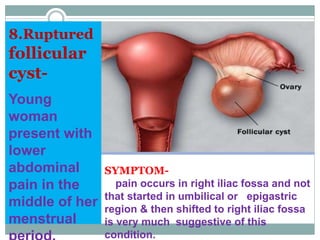
SYMPTOM-
pain occurs in right iliac fossa and not
that started in umbilical or epigastric
region & then shifted to right iliac fossa
is very much suggestive of this
condition.
8.Ruptured
follicular
cyst-
Young
woman
present with
lower
abdominal
pain in the
middle of her
menstrual
9.Endometriosis
Presence of endometrial tissue in extrauterine
sites.
Cause
Coelomic
metaplasia theory
Implantation
theory
Metastatic theory
Harmonal factor
Immunological
factor
Clinical
feature
Dull ache to grinding or
crushing type of pain
Dysmenorrhea,Dys
pareunia
Irritable bowel
syndrome
Menorrhagia
Frequency,dysuria
Site
Pelvic organ-
ovary,pouch of
douglas,sigmoid
colon,back of uterus
Peritoneum
lungs
• USG
• CA-125
estimation(>35U/ml)
• Cystoscopy
• Sigmoidoscopy
• Endometrial antibody in
serum
Investigation
• Drug –OC,
oral progestogen(norethisterone-5-
20mg daily,medroxyprog esterone
acetate-50mg i.m.weekly 100mg
i.m.every 2 week for 3 month), Danazol-
200-800mg daily 3-6 monthfrom 1st day
of menses, Aromatose inhibitor-
letrozole2.5mg,anastrozole1-2mg
• Surgery- Laparoscopy-destruction by
cautery ,excision of cyst,adhesiolysis
Laparotomy-salpingo
oophorectomy,hysterectomy,excision of
scar endometriosis
Treatment
[B]. Genitourinarycauses of acute
abdomen
10.Testicular torsion
Characterized by twisting of spermatic cord
which cut off the blood supply to the testicle
& surrounding structure within the scrotum.
CAUSE-
These above
condition occurs by—
trauma to scrotum ,
after strenuous
exercise
inversion of testis
separation of
epididymis from
body of testis
2.high investment of tunica
vaginalis cause the testis
to hang within tunica like a
clapper in a bell
SYMPTOM
SIGN
• sudden onset of
severe pain in
one testicle
• light
headedness
• nausea,vomitin
g,fever
• may referred to
lower
abdominal pain
• extremely
tender &
enlarge
testicular
region
Investigation
• Urinalysis
• blood count
• radiologic study of scrotum
• Doppler ultrasound of testicles
Treatment
• Orchiopexy
• orchiectomy-testicle is removed
11.Cystitis
Inflammation of urinary bladder
INCIDENCE- 10-20% of woman have had at least
one episode of
cystitis.
TYPE-
Traumatic
Interstitial
Hemorrh
agic
etiology
UTI
congenital deformity in
urinary system
people with catheter
man with enlarged
prostate
pregnant woman
Sign
Nocturia Urgency
polyuria
symptom
lower
abdomin
al pain
painful
urinati
on
freque
nt
urinati
on
feeling
of
pressure
in lower
pelvis
abnormal
cloudy
urine with
foul
smelling
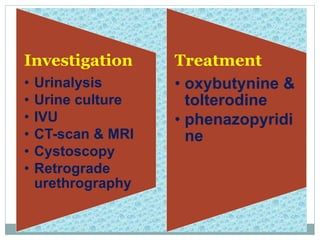
Investigation
• Urinalysis
• Urine culture
• IVU
• CT-scan & MRI
• Cystoscopy
• Retrograde
urethrography
Treatment
• oxybutynine &
tolterodine
• phenazopyridi
ne
12.Renal calculi
INCIDENCE- 30-50 years
etiology
dietar
y
cause
altere
d
urinar
y
solute
&
colloi
d
decrea
sed
urinary
citrate
renal
infectio
n
inadequa
te
urinary
drainage
& urine
stasis
prolon
g
immobi
lization
hyperp
arathyr
oidism
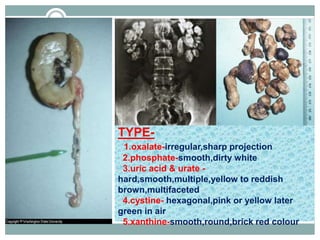
TYPE-
1.oxalate-irregular,sharp projection
2.phosphate-smooth,dirty white
3.uric acid & urate -
hard,smooth,multiple,yellow to reddish
brown,multifaceted
4.cystine- hexagonal,pink or yellow later
green in air
5.xanthine-smooth,round,brick red colour
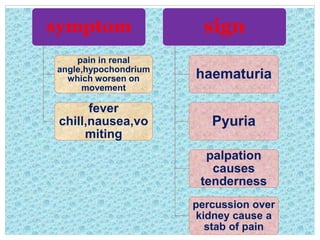
symptom
pain in renal
angle,hypochondrium
which worsen on
movement
fever
chill,nausea,vo
miting
sign
haematuria
Pyuria
palpation
causes
tenderness
percussion over
kidney cause a
stab of pain
Investigation
Radiography
CT-scan &
kidney
ultrasound
Abdomen
/kidney
MRI
Urinalys
is
IVP
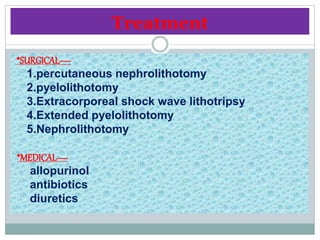
Treatment
*SURGICAL—
1.percutaneous nephrolithotomy
2.pyelolithotomy
3.Extracorporeal shock wave lithotripsy
4.Extended pyelolithotomy
5.Nephrolithotomy
*MEDICAL—
allopurinol
antibiotics
diuretics
13.Ureteric calculi
Usually comes from the kidney.
SYMPTOM-
*dull pain in the
lower abdomen
which may be
increased on
exercise
SIGN- *colicky type of
pain referred from loin
to groin , external
genitalia , & ant surface
of thigh
*haematuria
*tenderness over
Impaction
severe renal
pain may be
due to
complete
ureter
obstruction
pain may
referred
to tip of
penis if
stone
comes in
intramural
part
distensi
on of
pelvis
may
cause
pain
investigation-
 plain abdominal X-ray
 intravenous urography
 retrograde ureterography
treatment
Medical
• Diclofenac , indomethacin ,
propantheline
Surgical -aim is to remove the stone if—
• repeated attack of pain
• enlarging stone
• urine is infected
• stone too large to pass
• complete obstruction to kidney
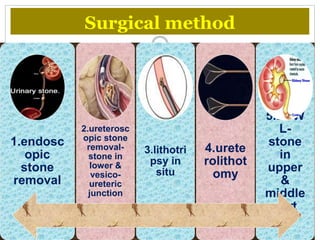
Surgical method
1.endosc
opic
stone
removal
2.ureterosc
opic stone
removal-
stone in
lower &
vesico-
ureteric
junction
3.lithotri
psy in
situ
4.urete
rolithot
omy
5.ESW
L-
stone
in
upper
&
middle
part
References..
1.Text book of Gynaecology-
D.C.DUTTA
2.Shaw’s textbook of Gynaecology
3.Text book of obstetrics-
D.C.DUTTA
4.Short practice of surgery-
BAILEY & LOVES
5.Clinical surgery-S.DAS
55
Thank

Surgery