VED ANALYSIS
SUBMITTED TO: SUBMITTED BY:
Dr. Mrs. K. Suganthi, M.Sc (N), Ph.D., E. Kalpana,
Nursing tutor M.Sc Nursing IIyear,
Govt. College of Nursing, Govt. College of Nursing,
Cuddalore. Cuddalore.
INTRODUCTION
๏ƒ˜Material are the major source cost factor in an organisation
๏ƒ˜ It is very important in functions of management
๏ƒ˜In health care institution about 40% ,of budgetary allocations is
on procurement and management of stores
๏ƒ˜It requires planned and progressive provisioning and
procurement to keep machine running
๏ƒ˜Traditionally nursing unit,laboratories ,x-ray and other
department made purchase and maintained their own inventory.
๏ƒ˜Now-a-days,in practice there are decentralised and centralised
supplies of material management.
MEANING OF MATERIAL
โ€ข According to Webster,
The word material relating to production and distribution
of goods, economics, social relationship between owner and
labor.
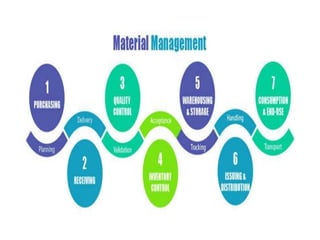
DEFINITION OF MATERIAL MANAGEMENT
โ€ข Material management can be regarded as the function
responsible for co-ordination of planning sourcing
purchasing, moving, storing and controlling materials in an
optimum manner, so us to provide service to the consumer at
minimum cost.
- vati .J
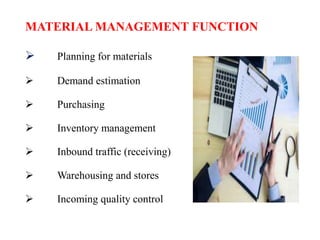
MATERIAL MANAGEMENT FUNCTION
๏ƒ˜ Planning for materials
๏ƒ˜ Demand estimation
๏ƒ˜ Purchasing
๏ƒ˜ Inventory management
๏ƒ˜ Inbound traffic (receiving)
๏ƒ˜ Warehousing and stores
๏ƒ˜ Incoming quality control
MATERIAL MANAGEMENT
FUNCTION(contโ€ฆ.)
โ€ข Material planning and programing
โ€ข Purchasing and outsourcing
โ€ข Cost reduction the value analysis
โ€ข Good vendor relationship
โ€ข Codification
โ€ข Standardization and evaluation of all products
โ€ข Transportation of material handling
โ€ข Inspect and quality control, Elimination of losses
DEFINITION OF MATERIAL PLANNING
Material planning is the scientific way of determining
the requirements that goes into meeting production needs
within the economic investment policies.
-Gopalakrishnan & Sunderasan
๏ƒผ Right quality
๏ƒผ Right quantity
๏ƒผ Right time
๏ƒผ Right place
๏ƒผ Right cost
AIMS OF MATERIAL MANAGEMENT PLANNING
PURPOSE OF MATERIAL MANAGEMENT
PLANNING
๏ƒ˜To gain economy in purchasing.
๏ƒ˜To satisfy the demand during period of replenishment.
๏ƒ˜To carry reserve stock to avoid stock out.
๏ƒ˜To stabilize fluctuations in consumption.
๏ƒ˜To provide reasonable level of client services.
OBJECTIVES OF MATERIAL MANAGEMENT
PLANNING
PRIMARY OBJECTIVES
๏ƒ˜Right price
๏ƒ˜High turnover
๏ƒ˜Low procurement and
storage cost
๏ƒ˜Continuity of supply
๏ƒ˜Consistency in quality
๏ƒ˜Good supplier relations
SECONDAY OBJECTIVES
๏ƒ˜Development of personnel
๏ƒ˜Good information system
๏ƒ˜Forecasting
๏ƒ˜Inter-departmental harmony
๏ƒ˜Product improvement
๏ƒ˜Standardization
๏ƒ˜Make or buy decision
๏ƒ˜New materials and products
๏ƒ˜Favourable reciprocal
relationships
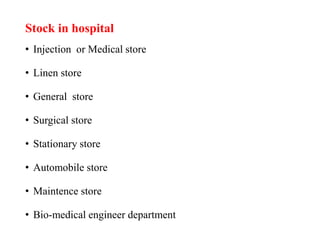
Stock in hospital
โ€ข Injection or Medical store
โ€ข Linen store
โ€ข General store
โ€ข Surgical store
โ€ข Stationary store
โ€ข Automobile store
โ€ข Maintence store
โ€ข Bio-medical engineer department
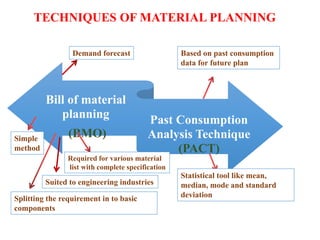
TECHNIQUES OF MATERIAL PLANNING
Bill of material
planning
(BMO)
Past Consumption
Analysis Technique
(PACT)
Simple
method
Splitting the requirement in to basic
components
Suited to engineering industries
Demand forecast
Required for various material
list with complete specification
Based on past consumption
data for future plan
Statistical tool like mean,
median, mode and standard
deviation
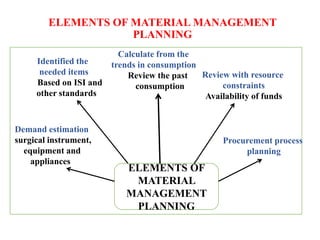
ELEMENTS OF MATERIAL MANAGEMENT
PLANNING
ELEMENTS OF
MATERIAL
MANAGEMENT
PLANNING
Demand estimation
surgical instrument,
equipment and
appliances
Identified the
needed items
Based on ISI and
other standards
Calculate from the
trends in consumption
Review the past
consumption
Review with resource
constraints
Availability of funds
Procurement process
planning
Inventory
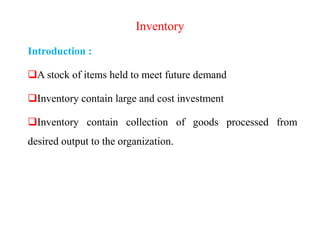
Introduction :
๏ฑA stock of items held to meet future demand
๏ฑInventory contain large and cost investment
๏ฑInventory contain collection of goods processed from
desired output to the organization.
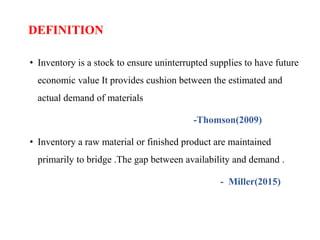
DEFINITION
โ€ข Inventory is a stock to ensure uninterrupted supplies to have future
economic value It provides cushion between the estimated and
actual demand of materials
-Thomson(2009)
โ€ข Inventory a raw material or finished product are maintained
primarily to bridge .The gap between availability and demand .
- Miller(2015)
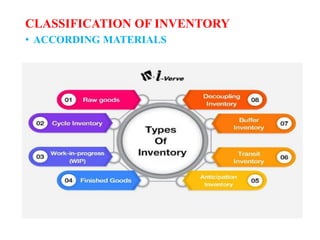
โ€ข ACCORDING MATERIALS
CLASSIFICATION OF INVENTORY
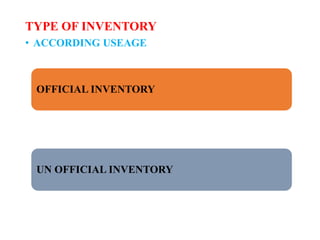
TYPE OF INVENTORY
โ€ข ACCORDING USEAGE
OFFICIAL INVENTORY
UN OFFICIAL INVENTORY
TYPE OF INVENTORY(contโ€ฆ.)
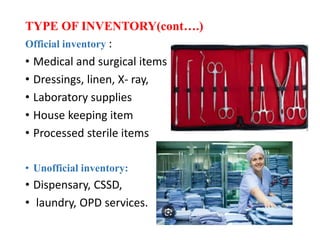
Official inventory :
โ€ข Medical and surgical items
โ€ข Dressings, linen, X- ray,
โ€ข Laboratory supplies
โ€ข House keeping item
โ€ข Processed sterile items
โ€ข Unofficial inventory:
โ€ข Dispensary, CSSD,
โ€ข laundry, OPD services.
Function of inventory management
โ€ข Take advantage quantity discount
โ€ข Permit operation
โ€ข Hedge against price increase
โ€ข Take advantage order cycle
โ€ข Meet anticipated customer demand
โ€ข Smooth production requirements
โ€ข Decouple operation
โ€ข Protect against stock out
โ€ข Element of surprise
โ€ข Easy detection of errors
โ€ข No interruption in production goods
โ€ข Act as a internal check
โ€ข Accurate and up to date accounting records
โ€ข Investment material kept under control
โ€ข Availability of correct data
โ€ข Avoid stock out and shortage
Importance of inventory
Inventory control
โ€ข Inventory control is the process of measuring and regulating
inventory
โ€ข According to the pre determined criteria such as size of
order, safe stock, mini level, maximum level, order level etc
โ€ข Inventory control minimize the total cost
โ€ข Inventory includes physical control of materials, presenting
essential minimizing obsolescence damaged through safety
disposal
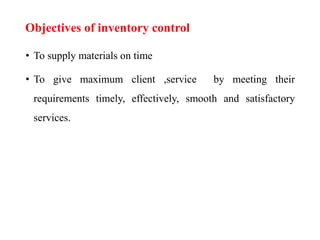
Objectives of inventory control
โ€ข To supply materials on time
โ€ข To give maximum client ,service by meeting their
requirements timely, effectively, smooth and satisfactory
services.
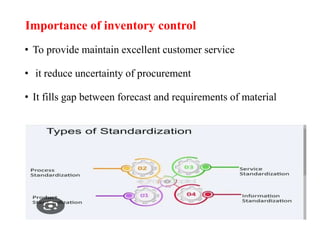
Importance of inventory control
โ€ข To provide maintain excellent customer service
โ€ข it reduce uncertainty of procurement
โ€ข It fills gap between forecast and requirements of material
Functions of inventory control
โ€ข To carry adequate stock to avoid stock out
โ€ข To order sufficient quantity per order
โ€ข To make judicial selection of limiting the quantity of
perishable items and costly items
โ€ข To ensure optimum level of inventory holding to minimize
the inventory cost
โ€ข To provide safety stock
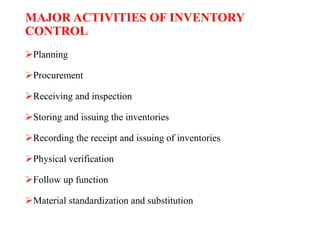
MAJOR ACTIVITIES OF INVENTORY
CONTROL
๏ƒ˜Planning
๏ƒ˜Procurement
๏ƒ˜Receiving and inspection
๏ƒ˜Storing and issuing the inventories
๏ƒ˜Recording the receipt and issuing of inventories
๏ƒ˜Physical verification
๏ƒ˜Follow up function
๏ƒ˜Material standardization and substitution
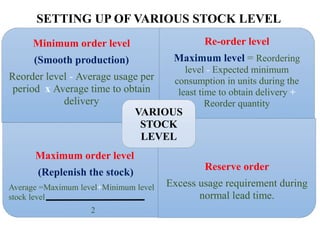
SETTING UP OF VARIOUS STOCK LEVEL
Minimum order level
(Smooth production)
Reorder level - Average usage per
period x Average time to obtain
delivery
Re-order level
Maximum level = Reordering
level - Expected minimum
consumption in units during the
least time to obtain delivery +
Reorder quantity
Maximum order level
(Replenish the stock)
Average =Maximum level+Minimum level
stock level
2
Reserve order
Excess usage requirement during
normal lead time.
VARIOUS
STOCK
LEVEL
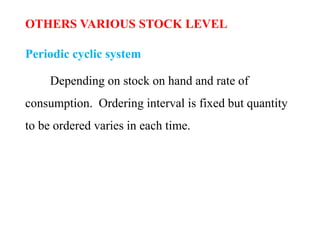
OTHERS VARIOUS STOCK LEVEL
Periodic cyclic system
Depending on stock on hand and rate of
consumption. Ordering interval is fixed but quantity
to be ordered varies in each time.
OTHERS VARIOUS STOCK LEVEL(contโ€ฆ.)
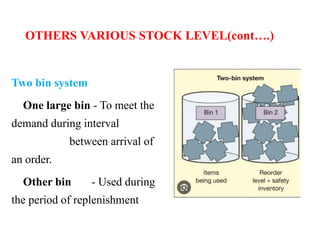
Two bin system
One large bin - To meet the
demand during interval
between arrival of
an order.
Other bin - Used during
the period of replenishment
OTHERS VARIOUS STOCK LEVEL(contโ€ฆ.)
โ€ข Lead time: this is period required to obtain the
supply once, need is determined average number
of days between placing indent and receiving
material
LEAD TIME TYPES(CONTโ€ฆ)
โ€ข administratorโ€™s lead time;
โ€ข Purchase requisition obtain quotation raising
purchase order
โ€ข Suppliers lead time
โ€ข Time required for manufacture, packing
forwarding, delay in transit.
INVENTORY CONTROL
ADVANTAGES
๏ƒผDelivery on time.
๏ƒผPossibility for discount for bulk purchase.
๏ƒผHandling of unforeseen circumstances to some extent.
๏ƒผWorkers and machinery need not be idle.
DISADVANTAGES
๏ƒผWorking capital is tied up.
๏ƒผMore space is required.
๏ƒผIncrease in insurance charges & overhead expenses.
๏ƒผIncrease in charges for damage, pilferage, replacement, etc.
๏ƒผIncrease in charges for obsolescence.
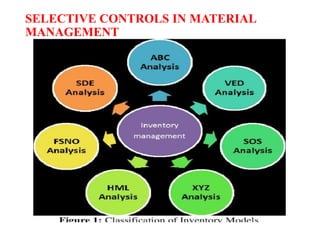
SELECTIVE CONTROLS IN MATERIAL
MANAGEMENT
VED ANALYSIS
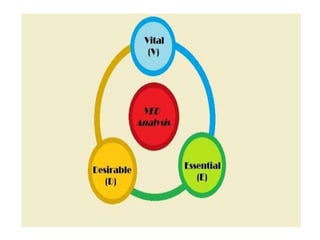
โ€ข VED analysis means vital, essential and desirable analysis
โ€ข The material s are classified based criticality that on
functional basis.
โ€ข The degree of criticality can be stated as whether a material
vital to the process, essential on desirable items .
โ€ข The stores when subjected to analysis based on their
criticality can be classified as vital,essential,desirable item
โ€ข This analysis is termed as VED-analysis
โ€ข โ€œVEDโ€-stocks can be different from hospital to hospital
depending upon type and quantity of work load
โ€ข Average vital items -10%
โ€ข Average essential items-40%
โ€ข Average desirable items-50%
โ€œVEDโ€-stocks
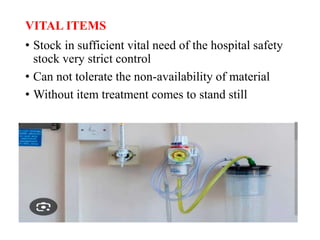
VITAL ITEMS
โ€ข Stock in sufficient vital need of the hospital safety
stock very strict control
โ€ข Can not tolerate the non-availability of material
โ€ข Without item treatment comes to stand still
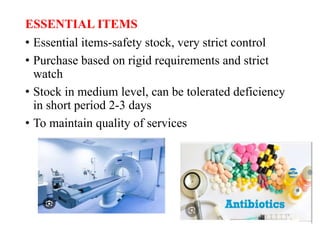
ESSENTIAL ITEMS
โ€ข Essential items-safety stock, very strict control
โ€ข Purchase based on rigid requirements and strict
watch
โ€ข Stock in medium level, can be tolerated deficiency
in short period 2-3 days
โ€ข To maintain quality of services
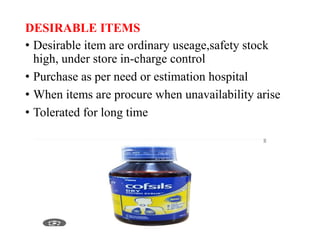
DESIRABLE ITEMS
โ€ข Desirable item are ordinary useage,safety stock
high, under store in-charge control
โ€ข Purchase as per need or estimation hospital
โ€ข When items are procure when unavailability arise
โ€ข Tolerated for long time
Purpose
โ€ข Manufacturing organization there are number of items which
are very vital or critical in production
โ€ข Availability must ensure at all times for smooth production
need to be strictly controlled
โ€ข Essential items follow vital item in hierarchical manner
โ€ข Desirable item are least importance
โ€ข It is possible to conduct two dimentional analysis
IMPORTANCE OF VED ANALYSIS
โ€ข Organization maintain optimum level of inventory
โ€ข Maintenance of inventory cost and stock
โ€ข Bifurcate inventory into 3 parts
โ€ข (vital,essential,desirable)
CONTROL OF VED ANALYSIS
Category โ€“I
โ€ข This are most important ones required controlled by
administrative staff
โ€ข Eg:defibrillator
Category-ii
โ€ข These items are intermediate, importance(usual control by
office in charge
Category-iii
โ€ข These item least importance,which can be later, under
control of store keeper.
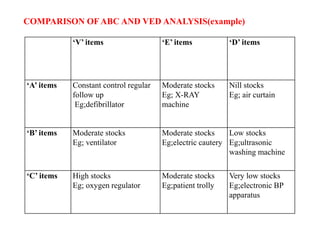
COMPARISON OFABC AND VED ANALYSIS(example)
โ€˜Vโ€™ items โ€˜Eโ€™ items โ€˜Dโ€™ items
โ€˜Aโ€™ items Constant control regular
follow up
Eg;defibrillator
Moderate stocks
Eg; X-RAY
machine
Nill stocks
Eg; air curtain
โ€˜Bโ€™ items Moderate stocks
Eg; ventilator
Moderate stocks
Eg;electric cautery
Low stocks
Eg;ultrasonic
washing machine
โ€˜Cโ€™ items High stocks
Eg; oxygen regulator
Moderate stocks
Eg;patient trolly
Very low stocks
Eg;electronic BP
apparatus
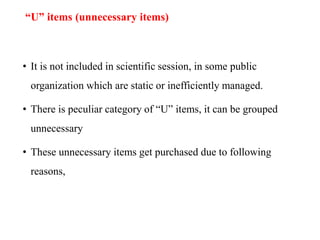
โ€œUโ€ items (unnecessary items)
โ€ข It is not included in scientific session, in some public
organization which are static or inefficiently managed.
โ€ข There is peculiar category of โ€œUโ€ items, it can be grouped
unnecessary
โ€ข These unnecessary items get purchased due to following
reasons,
โ€œUโ€ items(contโ€ฆ)
โ€ข Thoughtless continuation of previous purchase
โ€ข Indifferent attitude towards hospital formulary
โ€ข Fear of change
โ€ข Poor supervision and control
โ€ข Unfair practices due to vested interest
โ€ข Vital items stocked in abundance
โ€ข Essential items stocked in medium amount
โ€ข Desirable items are stocked in small amount
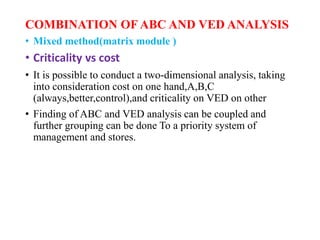
COMBINATION OF ABC AND VED ANALYSIS
โ€ข Mixed method(matrix module )
โ€ข Criticality vs cost
โ€ข It is possible to conduct a two-dimensional analysis, taking
into consideration cost on one hand,A,B,C
(always,better,control),and criticality on VED on other
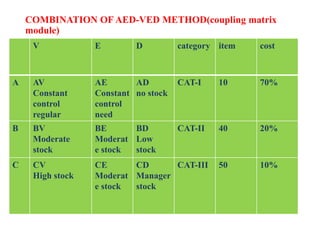
โ€ข Finding of ABC and VED analysis can be coupled and
further grouping can be done To a priority system of
management and stores.
COMBINATION OF AED-VED METHOD(coupling matrix
module)
V E D category item cost
A AV
Constant
control
regular
AE
Constant
control
need
AD
no stock
CAT-I 10 70%
B BV
Moderate
stock
BE
Moderat
e stock
BD
Low
stock
CAT-II 40 20%
C CV
High stock
CE
Moderat
e stock
CD
Manager
stock
CAT-III 50 10%
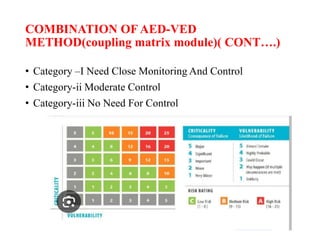
COMBINATION OF AED-VED
METHOD(coupling matrix module)( CONTโ€ฆ.)
โ€ข Category โ€“I Need Close Monitoring And Control
โ€ข Category-ii Moderate Control
โ€ข Category-iii No Need For Control
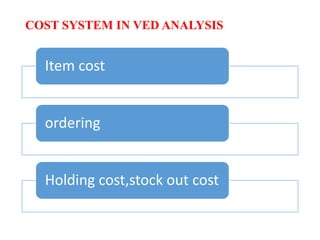
COST SYSTEM IN VED ANALYSIS
Item cost
ordering
Holding cost,stock out cost
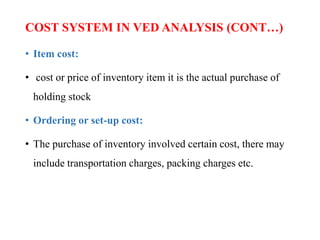
COST SYSTEM IN VED ANALYSIS (CONTโ€ฆ)
โ€ข Item cost:
โ€ข cost or price of inventory item it is the actual purchase of
holding stock
โ€ข Ordering or set-up cost:
โ€ข The purchase of inventory involved certain cost, there may
include transportation charges, packing charges etc.
COST SYSTEM IN VED ANALYSIS (CONTโ€ฆ)
โ€ข Holding cost :
โ€ข After purchase of inventory item, there are few cost too
โ€ข There may be related to storage, insurance charge of stock,
labor cost, more over leakage,damage,pilferage of the in
hand.
โ€ข Stock out cost
โ€ข Delay in production
โ€ข spare parts are getting stock out
ADVANTAGE OF VED ANALYSIS
โ€ข It is useful for monitoring and control of stores and spares
โ€ข Determine the criticality of an item and itโ€™s effect on
production
โ€ข It is specifically used for classification of items such as
vital,essential,desirable
โ€ข It is usually controlling of various stock
โ€ข Helps the management to decide material policy
โ€ข To control the stock levels by inventory control.
Role of nurse manager in inventory system
โ€ข Inventory control is a scientific system nurse must know
what to order, when to order, how much order, how much on
stock
โ€ข So purchasing, storing cost are kept in possible
โ€ข Overseeing entire life cycle of inventory, including
procurement, storage supplies, sales, replenishment
โ€ข To enhances the quality of service.Efficient monitoring and
controlling over the staff
โ€ข It promote communication between administrative staff,
other health care team members.
Summary
โ€ข Till now we have discussed about material management and
its importance inventory control purpose objectives
,function, specific inventory control method and VED
analysis purpose, importance, mixed methods of analysis etc.
Conclusion
โ€ข Through this seminar have you all gained knowledge about
inventory material management and various supplies in
health care delivery system
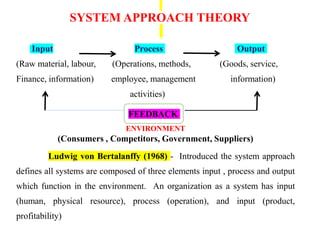
SYSTEM APPROACH THEORY
Input Process Output
(Raw material, labour, (Operations, methods, (Goods, service,
Finance, information) employee, management information)
activities)
ENVIRONMENT
(Consumers , Competitors, Government, Suppliers)
Ludwig von Bertalanffy (1968) - Introduced the system approach
defines all systems are composed of three elements input , process and output
which function in the environment. An organization as a system has input
(human, physical resource), process (operation), and input (product,
profitability)
FEEDBACK
JOURNALARTICLES:
Patel. H, Pitroda.J, Bhavsar. J.J.,(2015).A Review on Material
Management through Inventory management.Journal of International
Academic Research for multidisciplinary.2(12).ISSN:2320-5083.
This study results shows that use of ABC-VED matrix helped Al-zawra state
company to control organize,manage its own inventory of raw material spare
parts in more-efficient,by classifying it categories according to criteria of
cost,crit ical Importance by focusing on first category giving more attention
and care. Because it is high cost greater importance in organisation
material management- inventory control in NSG management

material management- inventory control in NSG management

  • 2.
    VED ANALYSIS SUBMITTED TO:SUBMITTED BY: Dr. Mrs. K. Suganthi, M.Sc (N), Ph.D., E. Kalpana, Nursing tutor M.Sc Nursing IIyear, Govt. College of Nursing, Govt. College of Nursing, Cuddalore. Cuddalore.
  • 4.
    INTRODUCTION ๏ƒ˜Material are themajor source cost factor in an organisation ๏ƒ˜ It is very important in functions of management ๏ƒ˜In health care institution about 40% ,of budgetary allocations is on procurement and management of stores ๏ƒ˜It requires planned and progressive provisioning and procurement to keep machine running ๏ƒ˜Traditionally nursing unit,laboratories ,x-ray and other department made purchase and maintained their own inventory. ๏ƒ˜Now-a-days,in practice there are decentralised and centralised supplies of material management.
  • 5.
    MEANING OF MATERIAL โ€ขAccording to Webster, The word material relating to production and distribution of goods, economics, social relationship between owner and labor.
  • 7.
    DEFINITION OF MATERIALMANAGEMENT โ€ข Material management can be regarded as the function responsible for co-ordination of planning sourcing purchasing, moving, storing and controlling materials in an optimum manner, so us to provide service to the consumer at minimum cost. - vati .J
  • 8.
    MATERIAL MANAGEMENT FUNCTION ๏ƒ˜Planning for materials ๏ƒ˜ Demand estimation ๏ƒ˜ Purchasing ๏ƒ˜ Inventory management ๏ƒ˜ Inbound traffic (receiving) ๏ƒ˜ Warehousing and stores ๏ƒ˜ Incoming quality control
  • 9.
    MATERIAL MANAGEMENT FUNCTION(contโ€ฆ.) โ€ข Materialplanning and programing โ€ข Purchasing and outsourcing โ€ข Cost reduction the value analysis โ€ข Good vendor relationship โ€ข Codification โ€ข Standardization and evaluation of all products โ€ข Transportation of material handling โ€ข Inspect and quality control, Elimination of losses
  • 10.
    DEFINITION OF MATERIALPLANNING Material planning is the scientific way of determining the requirements that goes into meeting production needs within the economic investment policies. -Gopalakrishnan & Sunderasan
  • 12.
    ๏ƒผ Right quality ๏ƒผRight quantity ๏ƒผ Right time ๏ƒผ Right place ๏ƒผ Right cost AIMS OF MATERIAL MANAGEMENT PLANNING
  • 13.
    PURPOSE OF MATERIALMANAGEMENT PLANNING ๏ƒ˜To gain economy in purchasing. ๏ƒ˜To satisfy the demand during period of replenishment. ๏ƒ˜To carry reserve stock to avoid stock out. ๏ƒ˜To stabilize fluctuations in consumption. ๏ƒ˜To provide reasonable level of client services.
  • 14.
    OBJECTIVES OF MATERIALMANAGEMENT PLANNING PRIMARY OBJECTIVES ๏ƒ˜Right price ๏ƒ˜High turnover ๏ƒ˜Low procurement and storage cost ๏ƒ˜Continuity of supply ๏ƒ˜Consistency in quality ๏ƒ˜Good supplier relations SECONDAY OBJECTIVES ๏ƒ˜Development of personnel ๏ƒ˜Good information system ๏ƒ˜Forecasting ๏ƒ˜Inter-departmental harmony ๏ƒ˜Product improvement ๏ƒ˜Standardization ๏ƒ˜Make or buy decision ๏ƒ˜New materials and products ๏ƒ˜Favourable reciprocal relationships
  • 16.
    Stock in hospital โ€ขInjection or Medical store โ€ข Linen store โ€ข General store โ€ข Surgical store โ€ข Stationary store โ€ข Automobile store โ€ข Maintence store โ€ข Bio-medical engineer department
  • 17.
    TECHNIQUES OF MATERIALPLANNING Bill of material planning (BMO) Past Consumption Analysis Technique (PACT) Simple method Splitting the requirement in to basic components Suited to engineering industries Demand forecast Required for various material list with complete specification Based on past consumption data for future plan Statistical tool like mean, median, mode and standard deviation
  • 18.
    ELEMENTS OF MATERIALMANAGEMENT PLANNING ELEMENTS OF MATERIAL MANAGEMENT PLANNING Demand estimation surgical instrument, equipment and appliances Identified the needed items Based on ISI and other standards Calculate from the trends in consumption Review the past consumption Review with resource constraints Availability of funds Procurement process planning
  • 20.
    Inventory Introduction : ๏ฑA stockof items held to meet future demand ๏ฑInventory contain large and cost investment ๏ฑInventory contain collection of goods processed from desired output to the organization.
  • 21.
    DEFINITION โ€ข Inventory isa stock to ensure uninterrupted supplies to have future economic value It provides cushion between the estimated and actual demand of materials -Thomson(2009) โ€ข Inventory a raw material or finished product are maintained primarily to bridge .The gap between availability and demand . - Miller(2015)
  • 22.
  • 23.
    TYPE OF INVENTORY โ€ขACCORDING USEAGE OFFICIAL INVENTORY UN OFFICIAL INVENTORY
  • 24.
    TYPE OF INVENTORY(contโ€ฆ.) Officialinventory : โ€ข Medical and surgical items โ€ข Dressings, linen, X- ray, โ€ข Laboratory supplies โ€ข House keeping item โ€ข Processed sterile items โ€ข Unofficial inventory: โ€ข Dispensary, CSSD, โ€ข laundry, OPD services.
  • 25.
    Function of inventorymanagement โ€ข Take advantage quantity discount โ€ข Permit operation โ€ข Hedge against price increase โ€ข Take advantage order cycle โ€ข Meet anticipated customer demand โ€ข Smooth production requirements โ€ข Decouple operation โ€ข Protect against stock out
  • 26.
    โ€ข Element ofsurprise โ€ข Easy detection of errors โ€ข No interruption in production goods โ€ข Act as a internal check โ€ข Accurate and up to date accounting records โ€ข Investment material kept under control โ€ข Availability of correct data โ€ข Avoid stock out and shortage Importance of inventory
  • 27.
    Inventory control โ€ข Inventorycontrol is the process of measuring and regulating inventory โ€ข According to the pre determined criteria such as size of order, safe stock, mini level, maximum level, order level etc โ€ข Inventory control minimize the total cost โ€ข Inventory includes physical control of materials, presenting essential minimizing obsolescence damaged through safety disposal
  • 28.
    Objectives of inventorycontrol โ€ข To supply materials on time โ€ข To give maximum client ,service by meeting their requirements timely, effectively, smooth and satisfactory services.
  • 29.
    Importance of inventorycontrol โ€ข To provide maintain excellent customer service โ€ข it reduce uncertainty of procurement โ€ข It fills gap between forecast and requirements of material
  • 30.
    Functions of inventorycontrol โ€ข To carry adequate stock to avoid stock out โ€ข To order sufficient quantity per order โ€ข To make judicial selection of limiting the quantity of perishable items and costly items โ€ข To ensure optimum level of inventory holding to minimize the inventory cost โ€ข To provide safety stock
  • 31.
    MAJOR ACTIVITIES OFINVENTORY CONTROL ๏ƒ˜Planning ๏ƒ˜Procurement ๏ƒ˜Receiving and inspection ๏ƒ˜Storing and issuing the inventories ๏ƒ˜Recording the receipt and issuing of inventories ๏ƒ˜Physical verification ๏ƒ˜Follow up function ๏ƒ˜Material standardization and substitution
  • 32.
    SETTING UP OFVARIOUS STOCK LEVEL Minimum order level (Smooth production) Reorder level - Average usage per period x Average time to obtain delivery Re-order level Maximum level = Reordering level - Expected minimum consumption in units during the least time to obtain delivery + Reorder quantity Maximum order level (Replenish the stock) Average =Maximum level+Minimum level stock level 2 Reserve order Excess usage requirement during normal lead time. VARIOUS STOCK LEVEL
  • 33.
    OTHERS VARIOUS STOCKLEVEL Periodic cyclic system Depending on stock on hand and rate of consumption. Ordering interval is fixed but quantity to be ordered varies in each time.
  • 34.
    OTHERS VARIOUS STOCKLEVEL(contโ€ฆ.) Two bin system One large bin - To meet the demand during interval between arrival of an order. Other bin - Used during the period of replenishment
  • 35.
    OTHERS VARIOUS STOCKLEVEL(contโ€ฆ.) โ€ข Lead time: this is period required to obtain the supply once, need is determined average number of days between placing indent and receiving material
  • 36.
    LEAD TIME TYPES(CONTโ€ฆ) โ€ขadministratorโ€™s lead time; โ€ข Purchase requisition obtain quotation raising purchase order โ€ข Suppliers lead time โ€ข Time required for manufacture, packing forwarding, delay in transit.
  • 37.
    INVENTORY CONTROL ADVANTAGES ๏ƒผDelivery ontime. ๏ƒผPossibility for discount for bulk purchase. ๏ƒผHandling of unforeseen circumstances to some extent. ๏ƒผWorkers and machinery need not be idle. DISADVANTAGES ๏ƒผWorking capital is tied up. ๏ƒผMore space is required. ๏ƒผIncrease in insurance charges & overhead expenses. ๏ƒผIncrease in charges for damage, pilferage, replacement, etc. ๏ƒผIncrease in charges for obsolescence.
  • 38.
    SELECTIVE CONTROLS INMATERIAL MANAGEMENT
  • 40.
    VED ANALYSIS โ€ข VEDanalysis means vital, essential and desirable analysis โ€ข The material s are classified based criticality that on functional basis. โ€ข The degree of criticality can be stated as whether a material vital to the process, essential on desirable items . โ€ข The stores when subjected to analysis based on their criticality can be classified as vital,essential,desirable item โ€ข This analysis is termed as VED-analysis
  • 41.
    โ€ข โ€œVEDโ€-stocks canbe different from hospital to hospital depending upon type and quantity of work load โ€ข Average vital items -10% โ€ข Average essential items-40% โ€ข Average desirable items-50% โ€œVEDโ€-stocks
  • 42.
    VITAL ITEMS โ€ข Stockin sufficient vital need of the hospital safety stock very strict control โ€ข Can not tolerate the non-availability of material โ€ข Without item treatment comes to stand still
  • 43.
    ESSENTIAL ITEMS โ€ข Essentialitems-safety stock, very strict control โ€ข Purchase based on rigid requirements and strict watch โ€ข Stock in medium level, can be tolerated deficiency in short period 2-3 days โ€ข To maintain quality of services
  • 44.
    DESIRABLE ITEMS โ€ข Desirableitem are ordinary useage,safety stock high, under store in-charge control โ€ข Purchase as per need or estimation hospital โ€ข When items are procure when unavailability arise โ€ข Tolerated for long time
  • 45.
    Purpose โ€ข Manufacturing organizationthere are number of items which are very vital or critical in production โ€ข Availability must ensure at all times for smooth production need to be strictly controlled โ€ข Essential items follow vital item in hierarchical manner โ€ข Desirable item are least importance โ€ข It is possible to conduct two dimentional analysis
  • 46.
    IMPORTANCE OF VEDANALYSIS โ€ข Organization maintain optimum level of inventory โ€ข Maintenance of inventory cost and stock โ€ข Bifurcate inventory into 3 parts โ€ข (vital,essential,desirable)
  • 47.
    CONTROL OF VEDANALYSIS Category โ€“I โ€ข This are most important ones required controlled by administrative staff โ€ข Eg:defibrillator Category-ii โ€ข These items are intermediate, importance(usual control by office in charge Category-iii โ€ข These item least importance,which can be later, under control of store keeper.
  • 48.
    COMPARISON OFABC ANDVED ANALYSIS(example) โ€˜Vโ€™ items โ€˜Eโ€™ items โ€˜Dโ€™ items โ€˜Aโ€™ items Constant control regular follow up Eg;defibrillator Moderate stocks Eg; X-RAY machine Nill stocks Eg; air curtain โ€˜Bโ€™ items Moderate stocks Eg; ventilator Moderate stocks Eg;electric cautery Low stocks Eg;ultrasonic washing machine โ€˜Cโ€™ items High stocks Eg; oxygen regulator Moderate stocks Eg;patient trolly Very low stocks Eg;electronic BP apparatus
  • 49.
    โ€œUโ€ items (unnecessaryitems) โ€ข It is not included in scientific session, in some public organization which are static or inefficiently managed. โ€ข There is peculiar category of โ€œUโ€ items, it can be grouped unnecessary โ€ข These unnecessary items get purchased due to following reasons,
  • 50.
    โ€œUโ€ items(contโ€ฆ) โ€ข Thoughtlesscontinuation of previous purchase โ€ข Indifferent attitude towards hospital formulary โ€ข Fear of change โ€ข Poor supervision and control โ€ข Unfair practices due to vested interest โ€ข Vital items stocked in abundance โ€ข Essential items stocked in medium amount โ€ข Desirable items are stocked in small amount
  • 51.
    COMBINATION OF ABCAND VED ANALYSIS โ€ข Mixed method(matrix module ) โ€ข Criticality vs cost โ€ข It is possible to conduct a two-dimensional analysis, taking into consideration cost on one hand,A,B,C (always,better,control),and criticality on VED on other โ€ข Finding of ABC and VED analysis can be coupled and further grouping can be done To a priority system of management and stores.
  • 52.
    COMBINATION OF AED-VEDMETHOD(coupling matrix module) V E D category item cost A AV Constant control regular AE Constant control need AD no stock CAT-I 10 70% B BV Moderate stock BE Moderat e stock BD Low stock CAT-II 40 20% C CV High stock CE Moderat e stock CD Manager stock CAT-III 50 10%
  • 53.
    COMBINATION OF AED-VED METHOD(couplingmatrix module)( CONTโ€ฆ.) โ€ข Category โ€“I Need Close Monitoring And Control โ€ข Category-ii Moderate Control โ€ข Category-iii No Need For Control
  • 54.
    COST SYSTEM INVED ANALYSIS Item cost ordering Holding cost,stock out cost
  • 55.
    COST SYSTEM INVED ANALYSIS (CONTโ€ฆ) โ€ข Item cost: โ€ข cost or price of inventory item it is the actual purchase of holding stock โ€ข Ordering or set-up cost: โ€ข The purchase of inventory involved certain cost, there may include transportation charges, packing charges etc.
  • 56.
    COST SYSTEM INVED ANALYSIS (CONTโ€ฆ) โ€ข Holding cost : โ€ข After purchase of inventory item, there are few cost too โ€ข There may be related to storage, insurance charge of stock, labor cost, more over leakage,damage,pilferage of the in hand. โ€ข Stock out cost โ€ข Delay in production โ€ข spare parts are getting stock out
  • 57.
    ADVANTAGE OF VEDANALYSIS โ€ข It is useful for monitoring and control of stores and spares โ€ข Determine the criticality of an item and itโ€™s effect on production โ€ข It is specifically used for classification of items such as vital,essential,desirable โ€ข It is usually controlling of various stock โ€ข Helps the management to decide material policy โ€ข To control the stock levels by inventory control.
  • 58.
    Role of nursemanager in inventory system โ€ข Inventory control is a scientific system nurse must know what to order, when to order, how much order, how much on stock โ€ข So purchasing, storing cost are kept in possible โ€ข Overseeing entire life cycle of inventory, including procurement, storage supplies, sales, replenishment โ€ข To enhances the quality of service.Efficient monitoring and controlling over the staff โ€ข It promote communication between administrative staff, other health care team members.
  • 59.
    Summary โ€ข Till nowwe have discussed about material management and its importance inventory control purpose objectives ,function, specific inventory control method and VED analysis purpose, importance, mixed methods of analysis etc.
  • 60.
    Conclusion โ€ข Through thisseminar have you all gained knowledge about inventory material management and various supplies in health care delivery system
  • 61.
    SYSTEM APPROACH THEORY InputProcess Output (Raw material, labour, (Operations, methods, (Goods, service, Finance, information) employee, management information) activities) ENVIRONMENT (Consumers , Competitors, Government, Suppliers) Ludwig von Bertalanffy (1968) - Introduced the system approach defines all systems are composed of three elements input , process and output which function in the environment. An organization as a system has input (human, physical resource), process (operation), and input (product, profitability) FEEDBACK
  • 62.
    JOURNALARTICLES: Patel. H, Pitroda.J,Bhavsar. J.J.,(2015).A Review on Material Management through Inventory management.Journal of International Academic Research for multidisciplinary.2(12).ISSN:2320-5083. This study results shows that use of ABC-VED matrix helped Al-zawra state company to control organize,manage its own inventory of raw material spare parts in more-efficient,by classifying it categories according to criteria of cost,crit ical Importance by focusing on first category giving more attention and care. Because it is high cost greater importance in organisation