Chapter 1 Introduction: Basics of
Materials Handling Equipment
1.1 Meaning:
Material Handling refers to the total managements of all
materials & process involved in the entire manufacturing
procedure. This includes sourcing, Delivering, movement,
protection & storage of product.
Material Handling is the movement & storage materials at
the lowest possible cost through the use of proper methods
and equipment. Getting the right part to the right place
involves a tight synchronization of work cells.
Material handling plays a vital part in all type of industry
towards increase the productivity, reduce the in-process cost
and safety procedure at the work place.
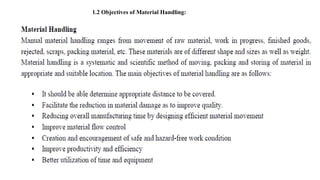
1.2 Objectives of Material Handling:
1.3 Role of Material Handling in Logistics:
Unloading the incoming material from vehicles
Moving the unloaded material to the assigned storage place
Lifting the material from its storage place during order picking
Moving the material for inspection and packing
Loading the packages, boxes or cartons on to the vehicles
1. Planning Principle. All MH should be the result of a deliberate plan where the needs,
performance objectives, and functional specification of the proposed methods are
completely defined at the outset.
2.Standardization Principle. MH methods, equipment, controls and software should be
standardized within the limits of achieving overall performance objectives and without
sacrificing needed flexibility, modularity, and throughput.
3.Work Principle. MH work (defined as material flow multiplied by the distance moved)
should be minimized without sacrificing productivity or the level of service required of the
operation.
4.Ergonomic Principle. Human capabilities and limitations must be recognized and
respected in the design of MH tasks and equipment to ensure safe and effective operations.
1.4 Guidelines developed by MHIOA or Principles of Material Handling:
5.Unit Load Principle. Maximum load which can be safely and efficiently handled by the existing handling
equipment in that industry. (Unitization of load)
6.Space Utilization Principle. Effective and efficient use must be made of all available (cubic) space.
7.System Principle. Material movement and storage activities should be fully integrated to form a coordinated,
operational system which spans receiving, inspection, storage, production, assembly, packaging, unitizing,
order selection, shipping, and transportation, and the handling of returns.
8.Automation Principle. MH operations should be mechanized and/or automated where feasible to improve
operational efficiency, increase responsiveness, improve consistency and predictability, decrease operating
costs, and to eliminate repetitive or potentially unsafe manual labor.
9.Environmental Principle. Environmental impact and energy consumption should be considered as criteria
when designing or selecting alternative equipment and MHS.
10.Life Cycle Cost Principle. A thorough economic analysis should account for the entire life cycle of all
MHE and resulting systems.
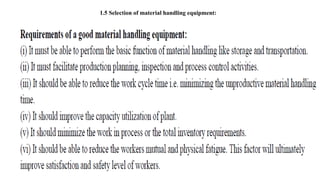
1.5 Selection of material handling equipment:
Factors affecting selection of material handling equipment:
1.6 Types of Material Handling Equipment:
There are four categories of material handling
equipment
I. Material Transport Equipment
II. Storage systems
III. Unitizing equipment
IV. Identification and Tracking systems
I.MATERIAL TRANSPORT EQUIPMENT:
It includes equipment that is used to move materials
inside a factory or warehouse.
1. Industrial trucks
2. Automated Guided Vehicles (AGV)
3. Monorails
4. Conveyers
5. Cranes and hoists
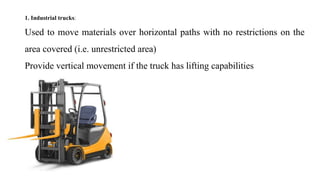
1. Industrial trucks:
Used to move materials over horizontal paths with no restrictions on the
area covered (i.e. unrestricted area)
Provide vertical movement if the truck has lifting capabilities
2. Automated Guided Vehicles (AGV):
An automated guided vehicle (AGV) is a mobile robot that follows
markers or wires in the floor, or uses vision or lasers.
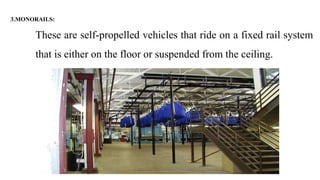
3.MONORAILS:
These are self-propelled vehicles that ride on a fixed rail system
that is either on the floor or suspended from the ceiling.
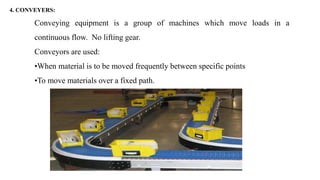
4. CONVEYERS:
Conveying equipment is a group of machines which move loads in a
continuous flow. No lifting gear.
Conveyors are used:
•When material is to be moved frequently between specific points
•To move materials over a fixed path.
5. CRANES AND HOISTING EQUIPMENT:
These are handling devices for lifting, lowering and transporting materials. They are having lifting gears.
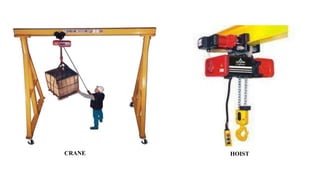
Cranes are used to lift loads or objects generally by one or more hoists
and can also move horizontally on a rail or pair of rail fitted under a
beam.
Hoisting equipment are Lifting, lowering or elevating equipment.
Hoisting equipment is a group of machines with lifting gear intended for
vertical lifting of loads only.
HOIST
CRANE
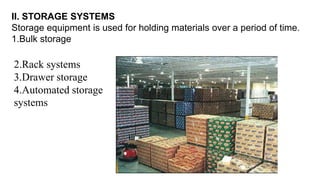
II. STORAGE SYSTEMS
Storage equipment is used for holding materials over a period of time.
1.Bulk storage
2.Rack systems
3.Drawer storage
4.Automated storage
systems
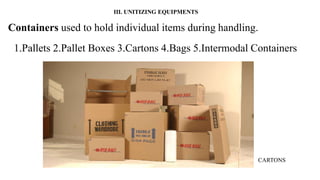
III. UNITIZING EQUIPMENTS
Containers used to hold individual items during handling.
1.Pallets 2.Pallet Boxes 3.Cartons 4.Bags 5.Intermodal Containers
CARTONS
IV. IDENTIFICATION AND TRACKING SYSTEMS
Identification and tracking equipment is used to collect and communicate
the information that is used to coordinate the flow of materials within a
facility and between a facility and its suppliers and customers.
1. Manual 2. Bar codes 3. Radio frequency tag 4.Magnetic stripes
RF TAG MAGNETIC STRIPES

MHE UNIT 1.pptx

  • 1.
    Chapter 1 Introduction:Basics of Materials Handling Equipment 1.1 Meaning: Material Handling refers to the total managements of all materials & process involved in the entire manufacturing procedure. This includes sourcing, Delivering, movement, protection & storage of product. Material Handling is the movement & storage materials at the lowest possible cost through the use of proper methods and equipment. Getting the right part to the right place involves a tight synchronization of work cells. Material handling plays a vital part in all type of industry towards increase the productivity, reduce the in-process cost and safety procedure at the work place.
  • 2.
    1.2 Objectives ofMaterial Handling:
  • 3.
    1.3 Role ofMaterial Handling in Logistics: Unloading the incoming material from vehicles Moving the unloaded material to the assigned storage place Lifting the material from its storage place during order picking Moving the material for inspection and packing Loading the packages, boxes or cartons on to the vehicles
  • 4.
    1. Planning Principle.All MH should be the result of a deliberate plan where the needs, performance objectives, and functional specification of the proposed methods are completely defined at the outset. 2.Standardization Principle. MH methods, equipment, controls and software should be standardized within the limits of achieving overall performance objectives and without sacrificing needed flexibility, modularity, and throughput. 3.Work Principle. MH work (defined as material flow multiplied by the distance moved) should be minimized without sacrificing productivity or the level of service required of the operation. 4.Ergonomic Principle. Human capabilities and limitations must be recognized and respected in the design of MH tasks and equipment to ensure safe and effective operations. 1.4 Guidelines developed by MHIOA or Principles of Material Handling:
  • 5.
    5.Unit Load Principle.Maximum load which can be safely and efficiently handled by the existing handling equipment in that industry. (Unitization of load) 6.Space Utilization Principle. Effective and efficient use must be made of all available (cubic) space. 7.System Principle. Material movement and storage activities should be fully integrated to form a coordinated, operational system which spans receiving, inspection, storage, production, assembly, packaging, unitizing, order selection, shipping, and transportation, and the handling of returns. 8.Automation Principle. MH operations should be mechanized and/or automated where feasible to improve operational efficiency, increase responsiveness, improve consistency and predictability, decrease operating costs, and to eliminate repetitive or potentially unsafe manual labor. 9.Environmental Principle. Environmental impact and energy consumption should be considered as criteria when designing or selecting alternative equipment and MHS. 10.Life Cycle Cost Principle. A thorough economic analysis should account for the entire life cycle of all MHE and resulting systems.
  • 6.
    1.5 Selection ofmaterial handling equipment:
  • 7.
    Factors affecting selectionof material handling equipment:
  • 8.
    1.6 Types ofMaterial Handling Equipment: There are four categories of material handling equipment I. Material Transport Equipment II. Storage systems III. Unitizing equipment IV. Identification and Tracking systems
  • 9.
    I.MATERIAL TRANSPORT EQUIPMENT: Itincludes equipment that is used to move materials inside a factory or warehouse. 1. Industrial trucks 2. Automated Guided Vehicles (AGV) 3. Monorails 4. Conveyers 5. Cranes and hoists
  • 10.
    1. Industrial trucks: Usedto move materials over horizontal paths with no restrictions on the area covered (i.e. unrestricted area) Provide vertical movement if the truck has lifting capabilities
  • 11.
    2. Automated GuidedVehicles (AGV): An automated guided vehicle (AGV) is a mobile robot that follows markers or wires in the floor, or uses vision or lasers.
  • 12.
    3.MONORAILS: These are self-propelledvehicles that ride on a fixed rail system that is either on the floor or suspended from the ceiling.
  • 13.
    4. CONVEYERS: Conveying equipmentis a group of machines which move loads in a continuous flow. No lifting gear. Conveyors are used: •When material is to be moved frequently between specific points •To move materials over a fixed path.
  • 14.
    5. CRANES ANDHOISTING EQUIPMENT: These are handling devices for lifting, lowering and transporting materials. They are having lifting gears. Cranes are used to lift loads or objects generally by one or more hoists and can also move horizontally on a rail or pair of rail fitted under a beam. Hoisting equipment are Lifting, lowering or elevating equipment. Hoisting equipment is a group of machines with lifting gear intended for vertical lifting of loads only.
  • 15.
  • 16.
    II. STORAGE SYSTEMS Storageequipment is used for holding materials over a period of time. 1.Bulk storage 2.Rack systems 3.Drawer storage 4.Automated storage systems
  • 17.
    III. UNITIZING EQUIPMENTS Containersused to hold individual items during handling. 1.Pallets 2.Pallet Boxes 3.Cartons 4.Bags 5.Intermodal Containers CARTONS
  • 18.
    IV. IDENTIFICATION ANDTRACKING SYSTEMS Identification and tracking equipment is used to collect and communicate the information that is used to coordinate the flow of materials within a facility and between a facility and its suppliers and customers. 1. Manual 2. Bar codes 3. Radio frequency tag 4.Magnetic stripes RF TAG MAGNETIC STRIPES