MATERIAL HANDLING
Definition of Material Handling
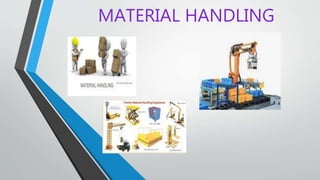
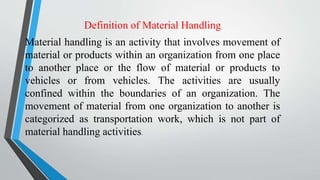
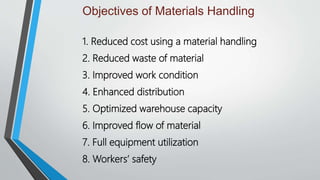
Material handling is an activity that involves movement of
material or products within an organization from one place
to another place or the flow of material or products to
vehicles or from vehicles. The activities are usually
confined within the boundaries of an organization. The
movement of material from one organization to another is
categorized as transportation work, which is not part of
material handling activities.
Objectives of Materials Handling
1. Reduced cost using a material handling
2. Reduced waste of material
3. Improved work condition
4. Enhanced distribution
5. Optimized warehouse capacity
6. Improved flow of material
7. Full equipment utilization
8. Workers’ safety
Principlesof Materials Handling
A.Principles Related to Planning
B.Principles Related to Equipment
C.Principles Related to Operation
A.PrinciplesRelatedto Planning
1. Planning Principle
2. Systems Principle
3. Simplification Principle
4. Material Flow Principle
5. Gravity Principle
6. Unit Size Principle
7. Space Utilisation Principle
8. Safety Principle
B. Principles Related to Equipment
1. Mechanisation Principle
2. Flexibility Principle
3. Equipment Selection Principle
4. Standardisation Principle
5. Light Weight Principle
6. Motion Principle
7. Idle-time Principle
8. Obsolescence Principle
9. Maintenance Principle
C. PrinciplesRelatedtoOperation
1.Control Principle
2.Capacity Principle
3.Performance Principle
Costs Included in Material Handling :
Materials handling includes following costs:
Materials handling cost = cost of handling +
cost of transportation + cost of packaging +
cost of space + cost of handling equipment
including operation, maintenance and
depreciation etc.
Activities of Materials Handling
1. Packaging and packing of raw material for the
industry.
2. Loading and transportation to the plant.
3. Unloading activities.
4. Receiving, storage and issue of material for
production.
5. In-process handling.
6. In-process storage.
7. Work-place handling.
Activities of Materials Handling
8. Infra-departmental handling.
9. Inter-departmental handling.
10. Intra plant handling.
11. Packaging.
12. Warehousing.
13. Packing.
14. Loading and transportation to
customers/distributors/dealers place.
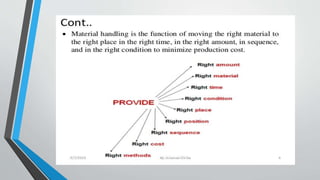
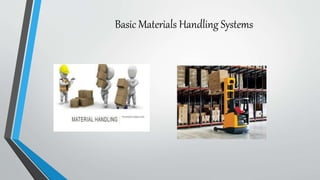
Basic Materials Handling Systems
1. Equipment Oriented Systems:
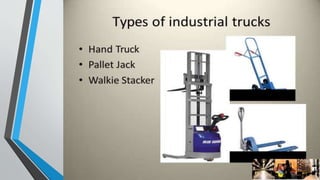
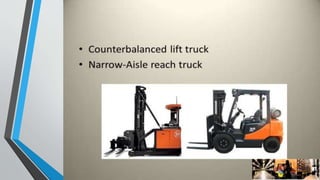
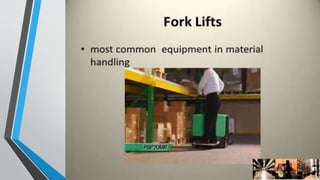
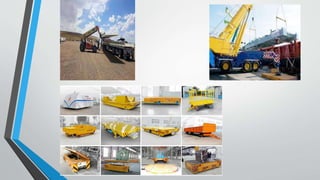
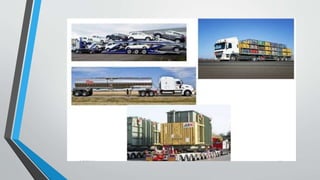
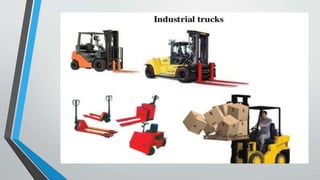
(a) Industrial Truck Systems: Platform trucks
and skids, fork trucks and pallets, and
tractor-trailers.
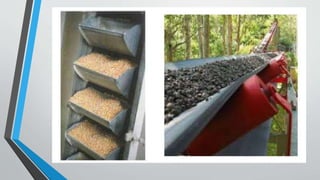
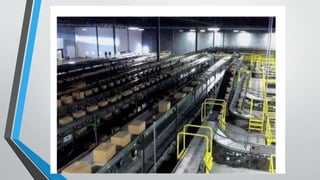
(b) Conveyor systems
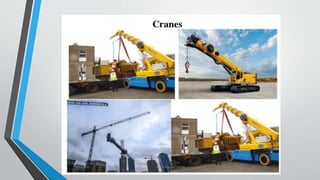
(c) Overhead systems: Overhead cranes, and
monorails
2. Material (Load) Oriented Systems:
(a) Unit handling system.
(b) Bulk handling systems: conveyors,
power shovels, scoops, cranes,
draglines, and construction
equipment.
(c) Liquid material handling systems.
3. Method (Production) Oriented
Systems:
(a) Manual system.
(b) Mechanised or automated systems,
(c) Mass production handling systems.
(d) Job shop handling systems.
4. Function Oriented Handling Systems:
(a) Transportation systems: For horizontal motion.
(b) Elevating systems: For vertical motion over
vertical or steeply inclined routes.
(c) Conveying systems: Horizontal, vertical or
combined motions.
(d) Transferring systems: Horizontal, inclined or
declined motions through the air.
(e) Self-loading systems: Intermittent motion with
machines that pick up, move and set down, i.e., unit
load systems.
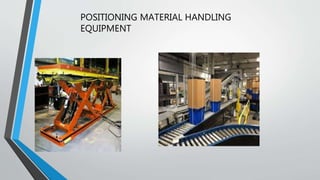
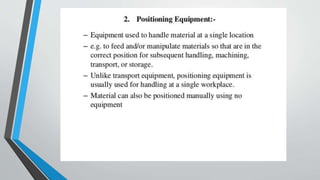
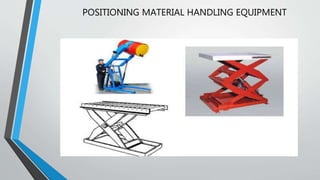
POSITIONING MATERIAL HANDLING EQUIPMENT
POSITIONING MATERIAL HANDLING
EQUIPMENT
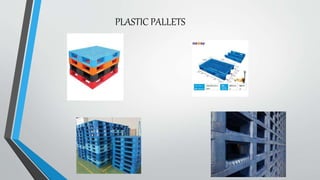
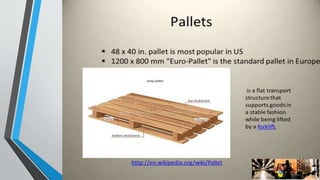
PLASTIC PALLETS
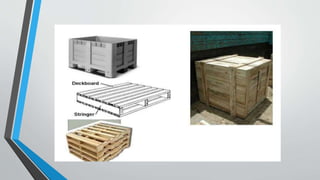
WOODEN PALLETS
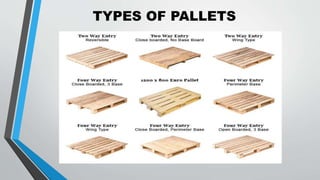
TYPES OF PALLETS
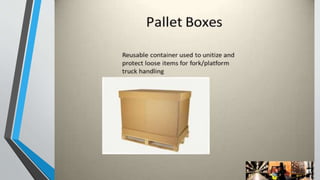
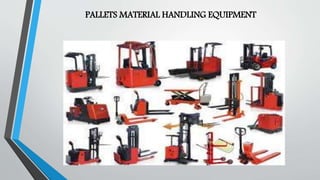
PALLETS MATERIAL HANDLING EQUIPMENT
Material Handling
Material Handling
Material Handling
Material Handling
Material Handling
Material Handling
Material Handling
Material Handling
Material Handling
Material Handling
Material Handling

Material Handling

  • 1.
  • 2.
    Definition of MaterialHandling Material handling is an activity that involves movement of material or products within an organization from one place to another place or the flow of material or products to vehicles or from vehicles. The activities are usually confined within the boundaries of an organization. The movement of material from one organization to another is categorized as transportation work, which is not part of material handling activities.
  • 4.
    Objectives of MaterialsHandling 1. Reduced cost using a material handling 2. Reduced waste of material 3. Improved work condition 4. Enhanced distribution 5. Optimized warehouse capacity 6. Improved flow of material 7. Full equipment utilization 8. Workers’ safety
  • 5.
    Principlesof Materials Handling A.PrinciplesRelated to Planning B.Principles Related to Equipment C.Principles Related to Operation
  • 6.
    A.PrinciplesRelatedto Planning 1. PlanningPrinciple 2. Systems Principle 3. Simplification Principle 4. Material Flow Principle 5. Gravity Principle 6. Unit Size Principle 7. Space Utilisation Principle 8. Safety Principle
  • 7.
    B. Principles Relatedto Equipment 1. Mechanisation Principle 2. Flexibility Principle 3. Equipment Selection Principle 4. Standardisation Principle 5. Light Weight Principle 6. Motion Principle 7. Idle-time Principle 8. Obsolescence Principle 9. Maintenance Principle
  • 8.
  • 9.
    Costs Included inMaterial Handling : Materials handling includes following costs: Materials handling cost = cost of handling + cost of transportation + cost of packaging + cost of space + cost of handling equipment including operation, maintenance and depreciation etc.
  • 10.
    Activities of MaterialsHandling 1. Packaging and packing of raw material for the industry. 2. Loading and transportation to the plant. 3. Unloading activities. 4. Receiving, storage and issue of material for production. 5. In-process handling. 6. In-process storage. 7. Work-place handling.
  • 11.
    Activities of MaterialsHandling 8. Infra-departmental handling. 9. Inter-departmental handling. 10. Intra plant handling. 11. Packaging. 12. Warehousing. 13. Packing. 14. Loading and transportation to customers/distributors/dealers place.
  • 12.
  • 13.
    1. Equipment OrientedSystems: (a) Industrial Truck Systems: Platform trucks and skids, fork trucks and pallets, and tractor-trailers. (b) Conveyor systems (c) Overhead systems: Overhead cranes, and monorails
  • 14.
    2. Material (Load)Oriented Systems: (a) Unit handling system. (b) Bulk handling systems: conveyors, power shovels, scoops, cranes, draglines, and construction equipment. (c) Liquid material handling systems.
  • 15.
    3. Method (Production)Oriented Systems: (a) Manual system. (b) Mechanised or automated systems, (c) Mass production handling systems. (d) Job shop handling systems.
  • 16.
    4. Function OrientedHandling Systems: (a) Transportation systems: For horizontal motion. (b) Elevating systems: For vertical motion over vertical or steeply inclined routes. (c) Conveying systems: Horizontal, vertical or combined motions. (d) Transferring systems: Horizontal, inclined or declined motions through the air. (e) Self-loading systems: Intermittent motion with machines that pick up, move and set down, i.e., unit load systems.
  • 36.
  • 37.
  • 42.
  • 43.
  • 44.
  • 45.