UNIVERSITY OF CALDAS
SCHOOL OF ARTS AND HUMANITIES
MASTER’S DEGREE IN ENGLISH LANGUAGE TEACHING
LANGUAGE LEARNING RESOURCES
YAMITH JOSÉ FANDIÑO
Didactics and language learning
resources
According to Oerbaek (2008), the term “didactics” originates
from the Greek Didaskein, which means to teach, to educate.
In EFL, didactics is a major component of teacher education
because it revolves around the answers to the questions
“what”, “how”, and “why”.
Navarro and Piñeiro (2012) define didactics as the discipline
that studies techniques, procedures, strategies, and methods
to enhance the teaching process for students to approach in a
wide, deep, and significant way knowledge… (p. 234).
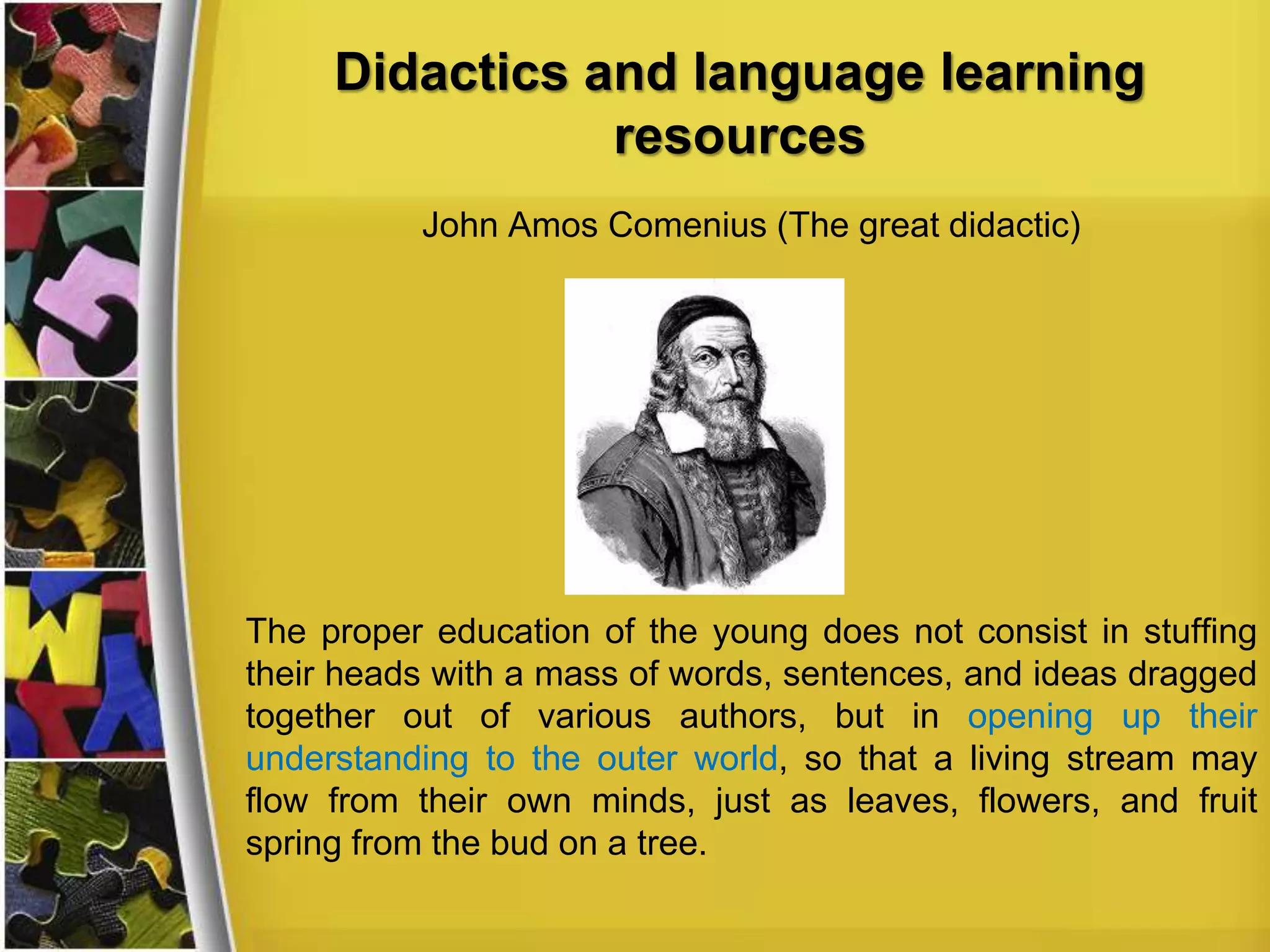
John Amos Comenius (The great didactic)
The proper education of the young does not consist in stuffing
their heads with a mass of words, sentences, and ideas dragged
together out of various authors, but in opening up their
understanding to the outer world, so that a living stream may
flow from their own minds, just as leaves, flowers, and fruit
spring from the bud on a tree.
Didactics and language learning
resources
Language learning resources
Managing resources: equipment and teaching aids
How Ts can use different resources to make lessons more interesting and
effective.
• The board
• The OHP
• Visuals
• Worksheets & workcards
• The Cassette recorder (The CD player)
• Video
• Computers
• The photocopier
Published materials: coursebooks, skills books, readers, supplementary books,
references books, resources books, CALL.
Authentic materials: theater programs, newspapers, magazines, songs,
brochures, info. leaflets, menus, news broadcasts, films, etc.
(Gower, Walters & Philips, 2005)
Language learning resources
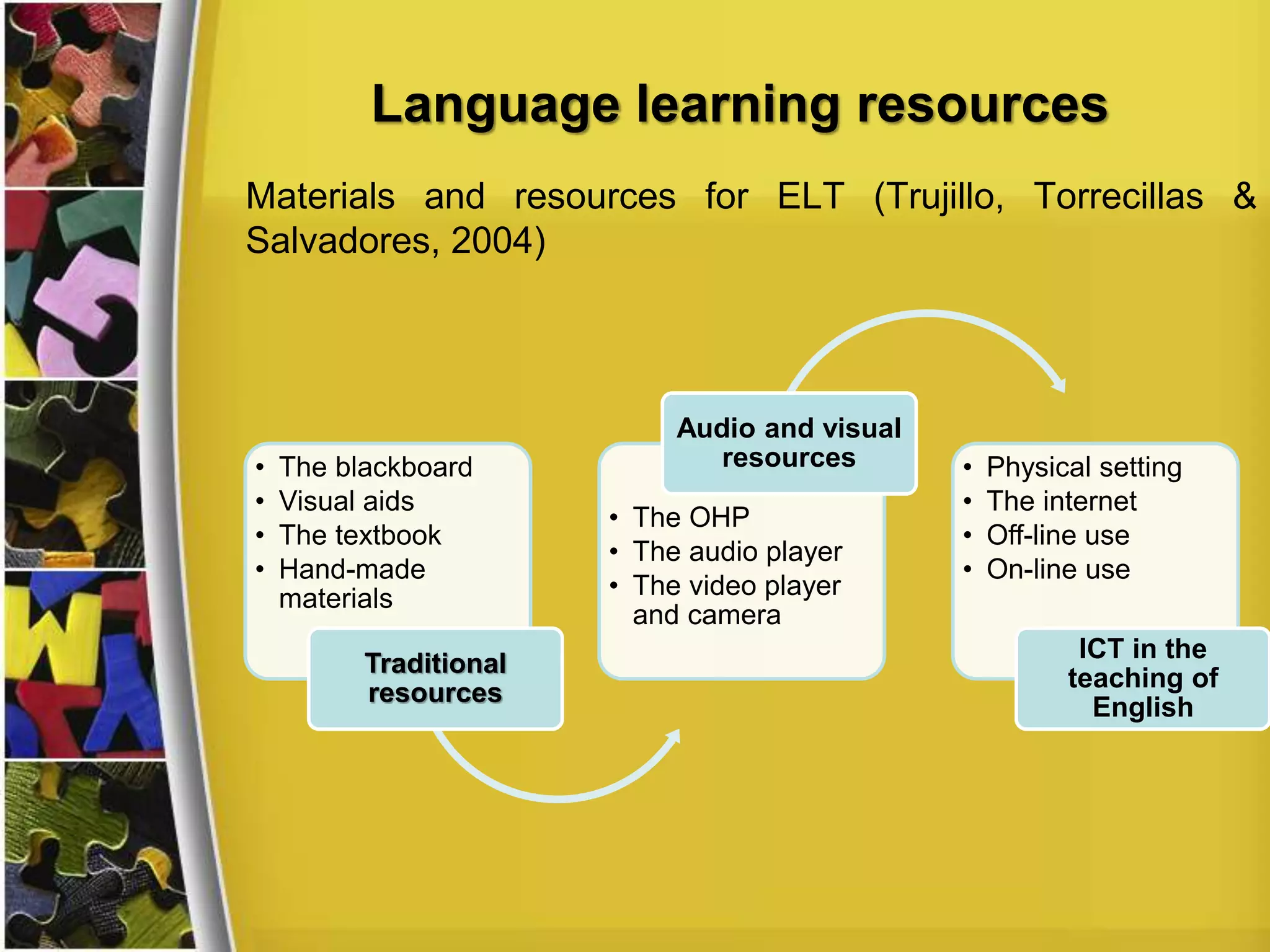
Materials and resources for ELT (Trujillo, Torrecillas &
Salvadores, 2004)
• The blackboard
• Visual aids
• The textbook
• Hand-made
materials
Traditional
resources
• The OHP
• The audio player
• The video player
and camera
Audio and visual
resources • Physical setting
• The internet
• Off-line use
• On-line use
ICT in the
teaching of
English
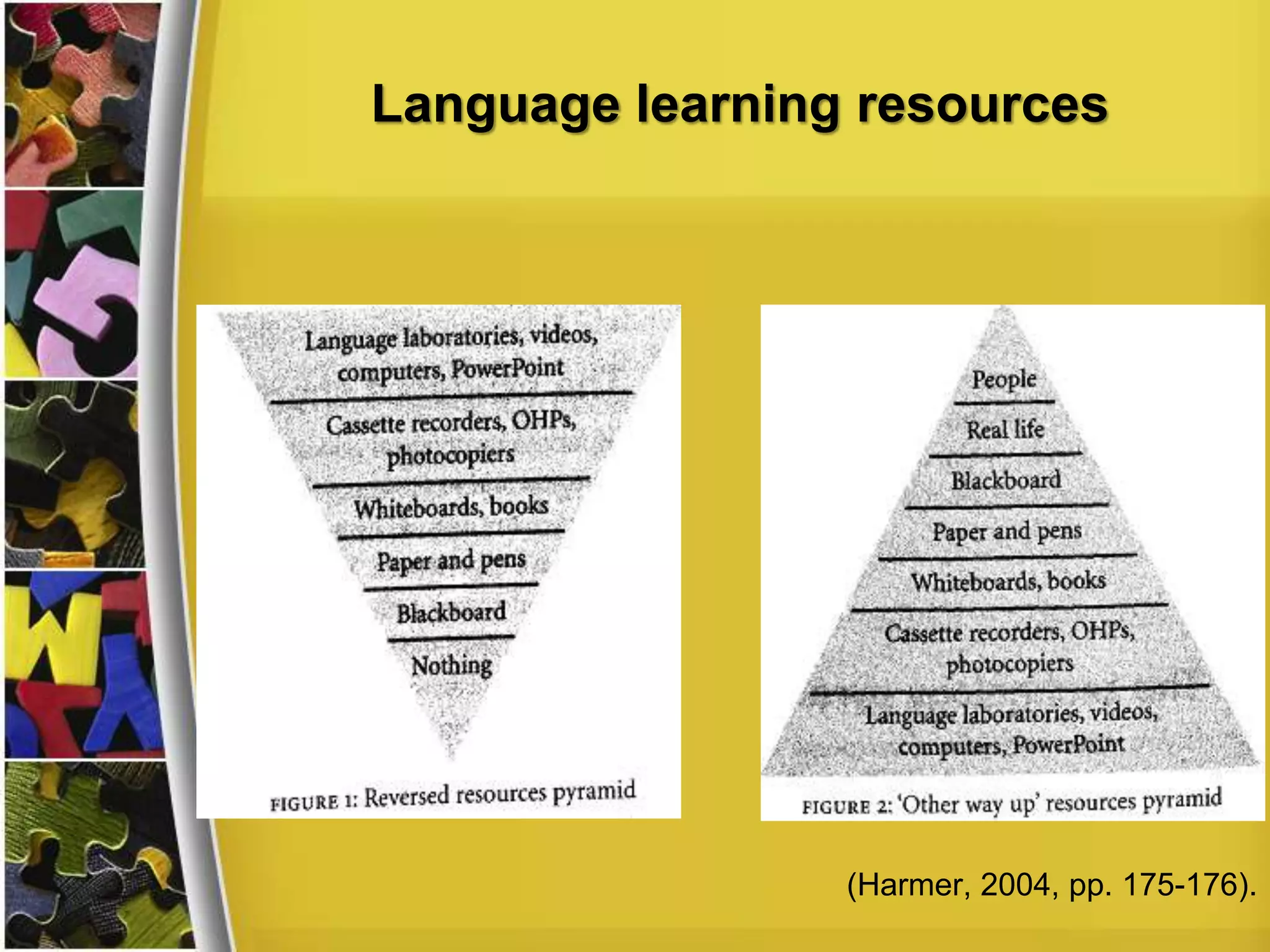
Language learning resources
(Harmer, 2004, pp. 175-176).
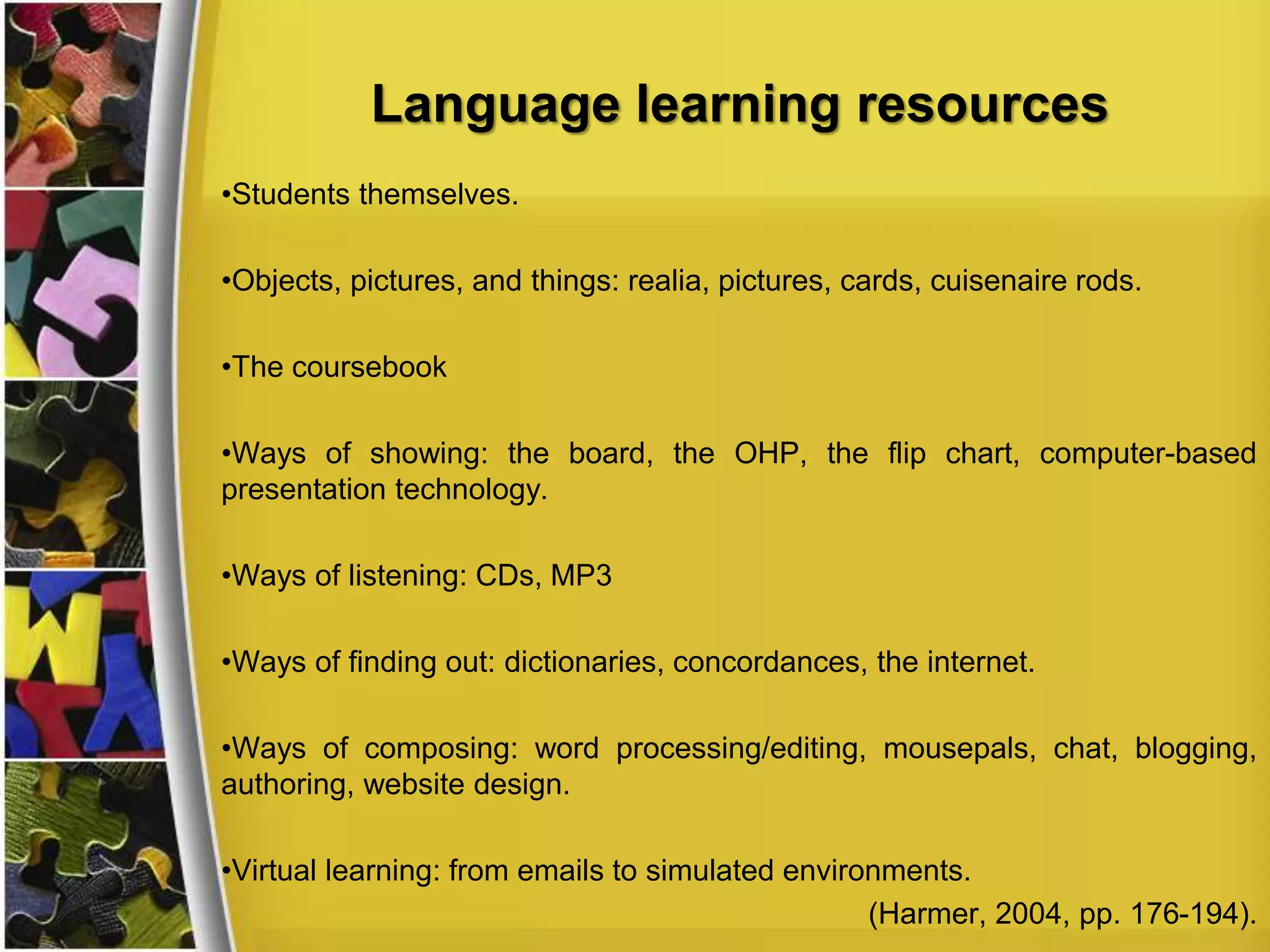
Language learning resources
•Students themselves.
•Objects, pictures, and things: realia, pictures, cards, cuisenaire rods.
•The coursebook
•Ways of showing: the board, the OHP, the flip chart, computer-based
presentation technology.
•Ways of listening: CDs, MP3
•Ways of finding out: dictionaries, concordances, the internet.
•Ways of composing: word processing/editing, mousepals, chat, blogging,
authoring, website design.
•Virtual learning: from emails to simulated environments.
(Harmer, 2004, pp. 176-194).
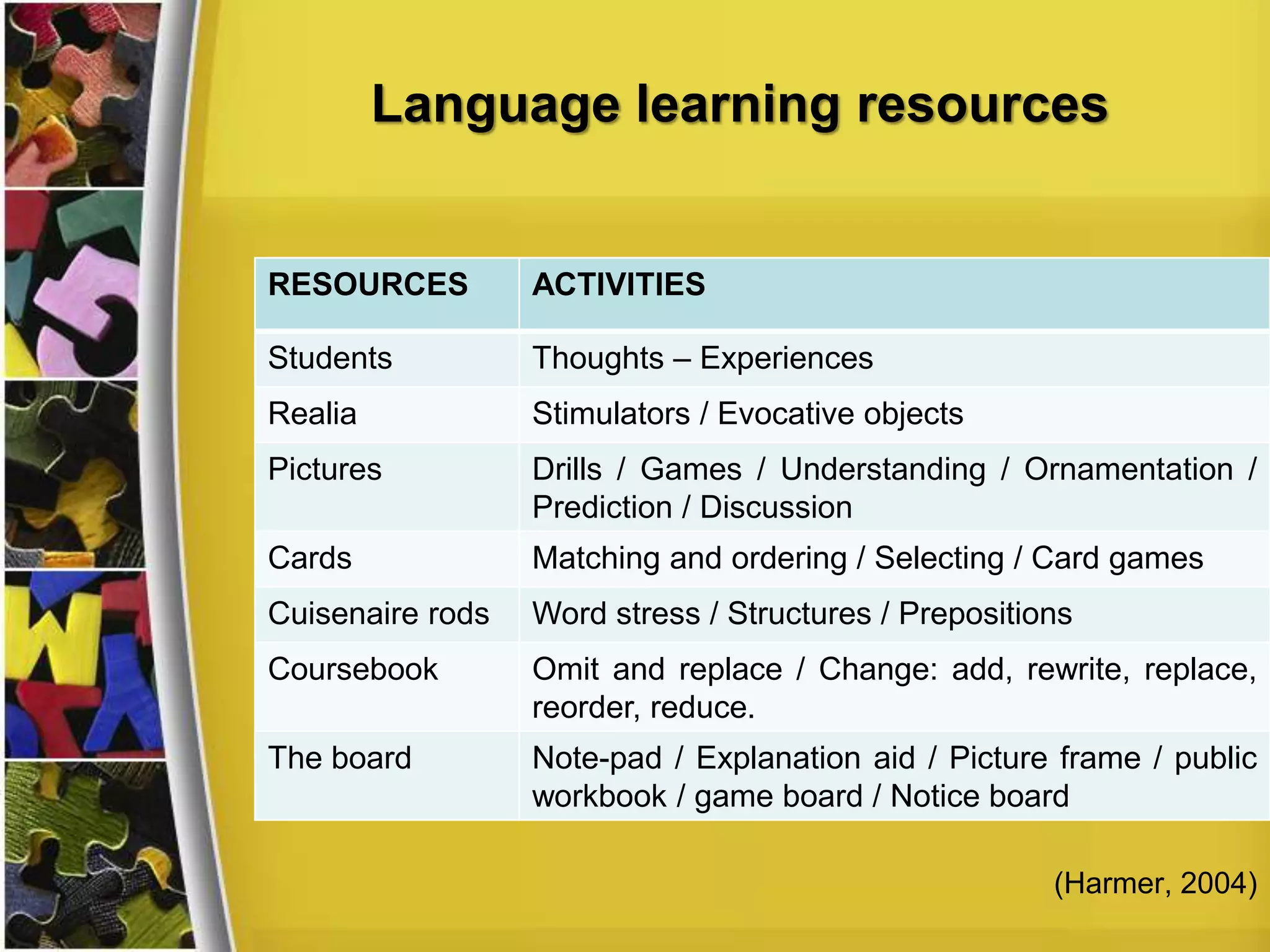
Language learning resources
(Harmer, 2004)
RESOURCES ACTIVITIES
Students Thoughts – Experiences
Realia Stimulators / Evocative objects
Pictures Drills / Games / Understanding / Ornamentation /
Prediction / Discussion
Cards Matching and ordering / Selecting / Card games
Cuisenaire rods Word stress / Structures / Prepositions
Coursebook Omit and replace / Change: add, rewrite, replace,
reorder, reduce.
The board Note-pad / Explanation aid / Picture frame / public
workbook / game board / Notice board
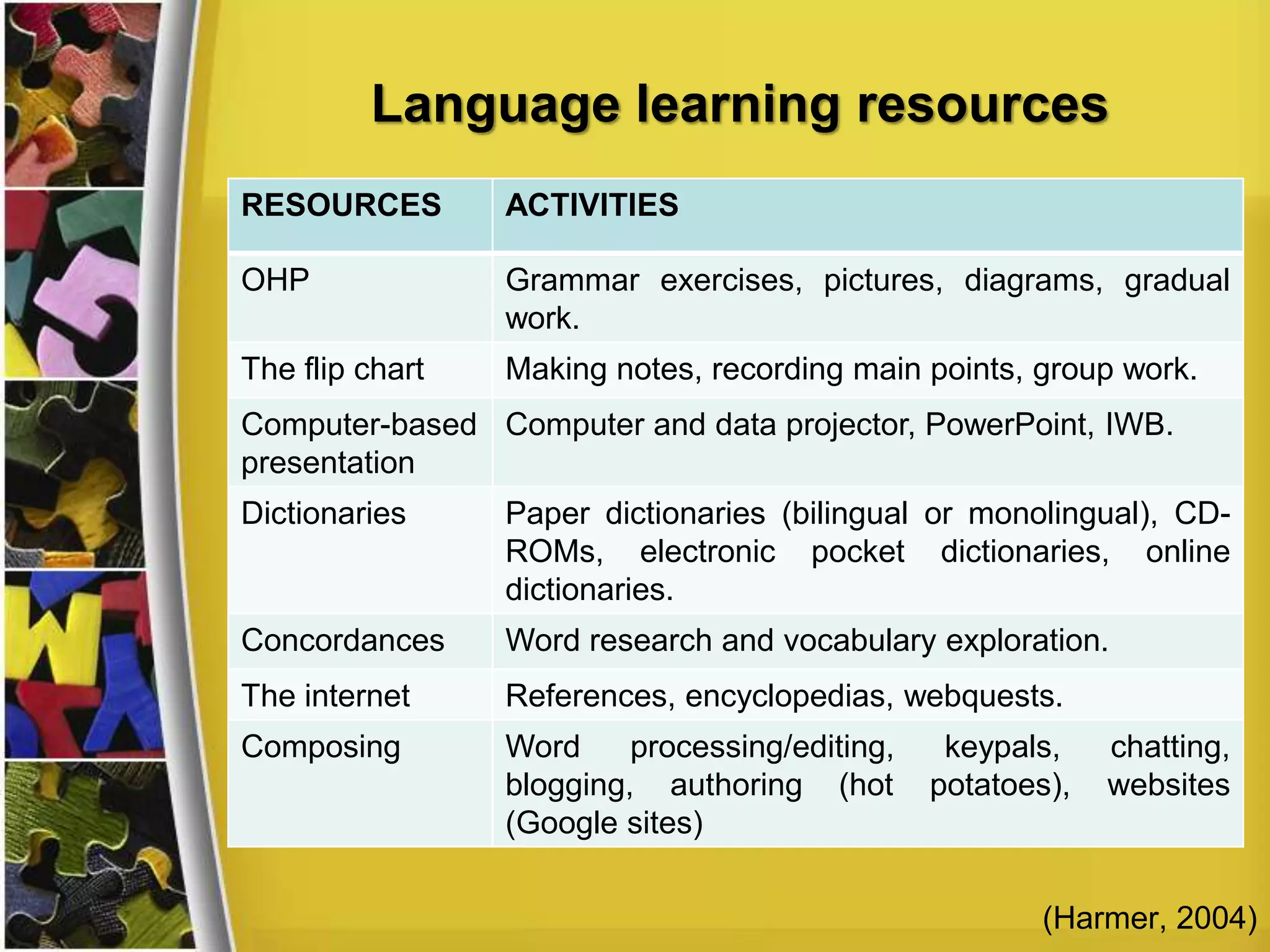
Language learning resources
(Harmer, 2004)
RESOURCES ACTIVITIES
OHP Grammar exercises, pictures, diagrams, gradual
work.
The flip chart Making notes, recording main points, group work.
Computer-based
presentation
Computer and data projector, PowerPoint, IWB.
Dictionaries Paper dictionaries (bilingual or monolingual), CD-
ROMs, electronic pocket dictionaries, online
dictionaries.
Concordances Word research and vocabulary exploration.
The internet References, encyclopedias, webquests.
Composing Word processing/editing, keypals, chatting,
blogging, authoring (hot potatoes), websites
(Google sites)
Language learning resources
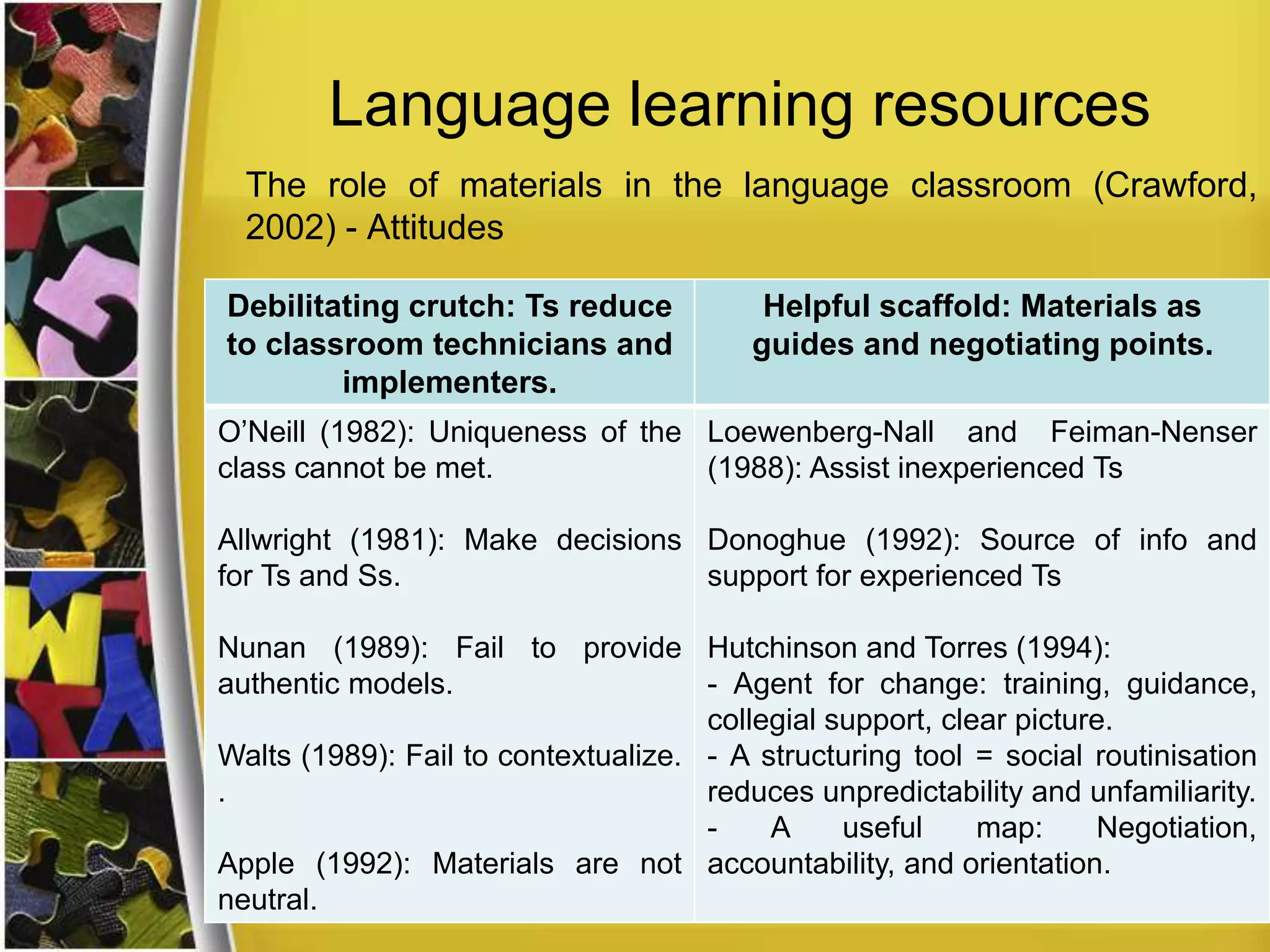
The role of materials in the language classroom (Crawford,
2002) - Attitudes
Debilitating crutch: Ts reduce
to classroom technicians and
implementers.
Helpful scaffold: Materials as
guides and negotiating points.
O’Neill (1982): Uniqueness of the
class cannot be met.
Allwright (1981): Make decisions
for Ts and Ss.
Nunan (1989): Fail to provide
authentic models.
Walts (1989): Fail to contextualize.
Apple (1992): Materials are not
neutral.
Loewenberg-Nall and Feiman-Nenser
(1988): Assist inexperienced Ts.
Donoghue (1992): Source of info and
support for experienced Ts.
Hutchinson and Torres (1994):
- Agent for change: training, guidance,
collegial support, clear picture.
- A structuring tool = social routinisation
reduces unpredictability and unfamiliarity.
- A useful map: Negotiation,
accountability, and orientation.
Language learning resources
Resource What? How? Why?
The learner
The board
Visuals
Worksheets and
workcards
Computers
References
Crawford, J. (2002). Role of materials in language classroom: Finding the
balance. In J. Richards & W. Renandya (eds), Anthology of current practice
(pp. 84-87). Australia: Cambridge University Press.
Harmer, J. (2004). The practice of English language teaching (4th edition).
USA: Pearson Longman.
Gower, R., Walters, S., & Phillips, D. (2005). Teaching Practice: A Handbook
for Teachers in Training. Oxford: Macmillan education.
Navarro, D., & Piñeiro, M. (2012). Didactic strategies for teaching English as a
foreign language in seventh and eighth grades in secondary schools in
Costa Rica. Káñina, Revista de Artes y Letras, Univ. Costa Rica, 36(2),
233-251.
Oerbaek, K. (2009). Didactics and didactisizing. (Unpublished PhD’s
dissertation). University of Southern Denmark-Odense, Denmark.
Trujillo, F., Torrecilla, J., & Salvadores, C. (2004). Materials and resources for
ELT. In D. Madrid & N. McLaren (Eds) TEFL in Primary Education (pp.
310-339). Granada: Editorial Universidad de Granada.

Language learning resources (short version 2015)

  • 1.
    UNIVERSITY OF CALDAS SCHOOLOF ARTS AND HUMANITIES MASTER’S DEGREE IN ENGLISH LANGUAGE TEACHING LANGUAGE LEARNING RESOURCES YAMITH JOSÉ FANDIÑO
  • 2.
    Didactics and languagelearning resources According to Oerbaek (2008), the term “didactics” originates from the Greek Didaskein, which means to teach, to educate. In EFL, didactics is a major component of teacher education because it revolves around the answers to the questions “what”, “how”, and “why”. Navarro and Piñeiro (2012) define didactics as the discipline that studies techniques, procedures, strategies, and methods to enhance the teaching process for students to approach in a wide, deep, and significant way knowledge… (p. 234).
  • 3.
    John Amos Comenius(The great didactic) The proper education of the young does not consist in stuffing their heads with a mass of words, sentences, and ideas dragged together out of various authors, but in opening up their understanding to the outer world, so that a living stream may flow from their own minds, just as leaves, flowers, and fruit spring from the bud on a tree. Didactics and language learning resources
  • 4.
    Language learning resources Managingresources: equipment and teaching aids How Ts can use different resources to make lessons more interesting and effective. • The board • The OHP • Visuals • Worksheets & workcards • The Cassette recorder (The CD player) • Video • Computers • The photocopier Published materials: coursebooks, skills books, readers, supplementary books, references books, resources books, CALL. Authentic materials: theater programs, newspapers, magazines, songs, brochures, info. leaflets, menus, news broadcasts, films, etc. (Gower, Walters & Philips, 2005)
  • 5.
    Language learning resources Materialsand resources for ELT (Trujillo, Torrecillas & Salvadores, 2004) • The blackboard • Visual aids • The textbook • Hand-made materials Traditional resources • The OHP • The audio player • The video player and camera Audio and visual resources • Physical setting • The internet • Off-line use • On-line use ICT in the teaching of English
  • 6.
  • 7.
    Language learning resources •Studentsthemselves. •Objects, pictures, and things: realia, pictures, cards, cuisenaire rods. •The coursebook •Ways of showing: the board, the OHP, the flip chart, computer-based presentation technology. •Ways of listening: CDs, MP3 •Ways of finding out: dictionaries, concordances, the internet. •Ways of composing: word processing/editing, mousepals, chat, blogging, authoring, website design. •Virtual learning: from emails to simulated environments. (Harmer, 2004, pp. 176-194).
  • 8.
    Language learning resources (Harmer,2004) RESOURCES ACTIVITIES Students Thoughts – Experiences Realia Stimulators / Evocative objects Pictures Drills / Games / Understanding / Ornamentation / Prediction / Discussion Cards Matching and ordering / Selecting / Card games Cuisenaire rods Word stress / Structures / Prepositions Coursebook Omit and replace / Change: add, rewrite, replace, reorder, reduce. The board Note-pad / Explanation aid / Picture frame / public workbook / game board / Notice board
  • 9.
    Language learning resources (Harmer,2004) RESOURCES ACTIVITIES OHP Grammar exercises, pictures, diagrams, gradual work. The flip chart Making notes, recording main points, group work. Computer-based presentation Computer and data projector, PowerPoint, IWB. Dictionaries Paper dictionaries (bilingual or monolingual), CD- ROMs, electronic pocket dictionaries, online dictionaries. Concordances Word research and vocabulary exploration. The internet References, encyclopedias, webquests. Composing Word processing/editing, keypals, chatting, blogging, authoring (hot potatoes), websites (Google sites)
  • 10.
    Language learning resources Therole of materials in the language classroom (Crawford, 2002) - Attitudes Debilitating crutch: Ts reduce to classroom technicians and implementers. Helpful scaffold: Materials as guides and negotiating points. O’Neill (1982): Uniqueness of the class cannot be met. Allwright (1981): Make decisions for Ts and Ss. Nunan (1989): Fail to provide authentic models. Walts (1989): Fail to contextualize. Apple (1992): Materials are not neutral. Loewenberg-Nall and Feiman-Nenser (1988): Assist inexperienced Ts. Donoghue (1992): Source of info and support for experienced Ts. Hutchinson and Torres (1994): - Agent for change: training, guidance, collegial support, clear picture. - A structuring tool = social routinisation reduces unpredictability and unfamiliarity. - A useful map: Negotiation, accountability, and orientation.
  • 11.
    Language learning resources ResourceWhat? How? Why? The learner The board Visuals Worksheets and workcards Computers
  • 12.
    References Crawford, J. (2002).Role of materials in language classroom: Finding the balance. In J. Richards & W. Renandya (eds), Anthology of current practice (pp. 84-87). Australia: Cambridge University Press. Harmer, J. (2004). The practice of English language teaching (4th edition). USA: Pearson Longman. Gower, R., Walters, S., & Phillips, D. (2005). Teaching Practice: A Handbook for Teachers in Training. Oxford: Macmillan education. Navarro, D., & Piñeiro, M. (2012). Didactic strategies for teaching English as a foreign language in seventh and eighth grades in secondary schools in Costa Rica. Káñina, Revista de Artes y Letras, Univ. Costa Rica, 36(2), 233-251. Oerbaek, K. (2009). Didactics and didactisizing. (Unpublished PhD’s dissertation). University of Southern Denmark-Odense, Denmark. Trujillo, F., Torrecilla, J., & Salvadores, C. (2004). Materials and resources for ELT. In D. Madrid & N. McLaren (Eds) TEFL in Primary Education (pp. 310-339). Granada: Editorial Universidad de Granada.