L ANGUAGE LEARNING
(MATERIAL DEVELOPMENT)
CONTENT
• Introduction
• What’s material ?
• What is Material development ?
• Forms of Material
• The Rule of Materials
• Authentic vs Non-Authentic Materials
• Advantages and Disadvantages of Authentic Materials
• Advantages and Disadvantages of textbook Material
• Evaluating Textbook
• Significant consideration in Evaluating textbook
• Factor Involve in the development of textbook
• Criteria for textbook evaluation
• Adapting textbooks and significant consideration
• The Nature of Material development
• Preparing a Material for a Program : Adv &disadv
• Final Word and Conclusion
INTRODUCTION
MATERIAL(S) PROF. BRIAN TOMLINSON :
- The Matter of Substances from which something can be made
- Tool or apparatus for the performance of a given task
- Having a logical connection with a subject matter or consequential
event of the knowledge of which would significantly affect of
decision or course of action
MATERIALS (JAMES D. BROWN, 2007)
• Any Systematic description of the techniques and exercises to
be used in classroom learning
• The key in developing sound materials is to ensure that they
are described and organized well enough so that teacher can
use them with no confusion and with a minimum of
preparation time
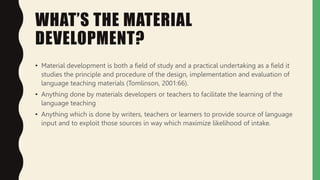
WHAT’S THE MATERIAL
DEVELOPMENT?
• Material development is both a field of study and a practical undertaking as a field it
studies the principle and procedure of the design, implementation and evaluation of
language teaching materials (Tomlinson, 2001:66).
• Anything done by materials developers or teachers to facilitate the learning of the
language teaching
• Anything which is done by writers, teachers or learners to provide source of language
input and to exploit those sources in way which maximize likelihood of intake.
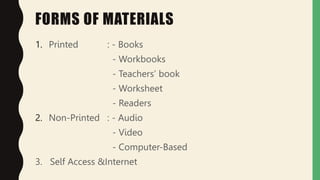
FORMS OF MATERIALS
1. Printed : - Books
- Workbooks
- Teachers’ book
- Worksheet
- Readers
2. Non-Printed : - Audio
- Video
- Computer-Based
3. Self Access &Internet
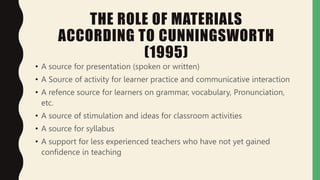
THE ROLE OF MATERIALS
ACCORDING TO CUNNINGSWORTH
(1995)
• A source for presentation (spoken or written)
• A Source of activity for learner practice and communicative interaction
• A refence source for learners on grammar, vocabulary, Pronunciation,
etc.
• A source of stimulation and ideas for classroom activities
• A source for syllabus
• A support for less experienced teachers who have not yet gained
confidence in teaching
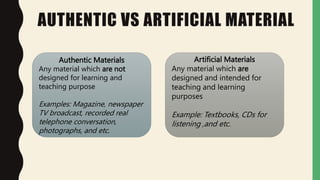
AUTHENTIC VS ARTIFICIAL MATERIAL
Authentic Materials
Any material which are not
designed for learning and
teaching purpose
Examples: Magazine, newspaper
TV broadcast, recorded real
telephone conversation,
photographs, and etc.
Artificial Materials
Any material which are
designed and intended for
teaching and learning
purposes
Example: Textbooks, CDs for
listening ,and etc.
THE ADVANTAGES OF AUTHENTICITY
• The have a positive effect on learner motivation
• They provide authentic cultural into about teaching and learning
• They provide exposure to real language
• They relate more closely to learner’ needs
• They support a more creative approach to teach
(Phillips & Shettlesworth, 1978; peacock, 1997)
THE DISADVANTAGES OF
AUTHENTICITY
• Artificial (created) material can also be motivating
• Authentic materials often contain difficult language
• Artificial materials may be superior to authentic materials as tyey
are generally built around a grade syllabus
• Authentic materials preparation is time consuming
• Authentic materials may contain culturally inappropriate content
• Authentic reading texts are usually quite long, which usually leads
to demotivate
ADVANTAGES OF TEXTBOOKS
• They provide structure and syllabus for a program
• The help standardize instruction
• They maintain quality
• They provide a variety of resources
• They are efficient
• They can provide effective language models and input
• They can train teachers
DISADVANTAGES OF TEXTBOOKS
• The may contain inauthentic language
• They may distort content
• The may not reflect students’ needs
• They can deskill the teacher
• They are expensive
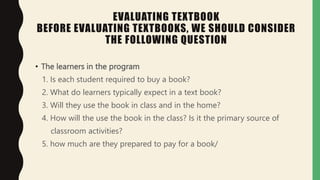
EVALUATING TEXTBOOK
BEFORE EVALUATING TEXTBOOKS, WE SHOULD CONSIDER
THE FOLLOWING QUESTION
• The role of the textbooks in the program
A textbook mostly determines the syllabus and objectives
1. will it be employed with small or big class?
2. will learners be expected to buy a workbook as well or should
the textbook provide all the practice students need?
• The teacher in the program
1. are teacher free to adapt and supplement the book?
2. are the native speakers of English? If not, how well do they speak
English?
EVALUATING TEXTBOOK
BEFORE EVALUATING TEXTBOOKS, WE SHOULD CONSIDER
THE FOLLOWING QUESTION
• The learners in the program
1. Is each student required to buy a book?
2. What do learners typically expect in a text book?
3. Will they use the book in class and in the home?
4. How will the use the book in the class? Is it the primary source of
classroom activities?
5. how much are they prepared to pay for a book/
THE FACTORS INVOLVE IN THE DEVELOPMENT
OF COMMERCIAL TEXTBOOKS
• The books are representing the interest of the authors
• The books are representing the interest of the publishers
(Byrd, 1995; Warner, et.at., 1995)
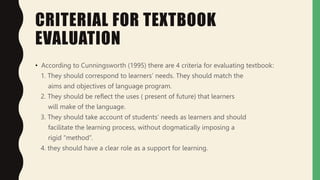
CRITERIAL FOR TEXTBOOK
EVALUATION
• According to Cunningsworth (1995) there are 4 criteria for evaluating textbook:
1. They should correspond to learners’ needs. They should match the
aims and objectives of language program.
2. They should be reflect the uses ( present of future) that learners
will make of the language.
3. They should take account of students’ needs as learners and should
facilitate the learning process, without dogmatically imposing a
rigid “method”.
4. they should have a clear role as a support for learning.
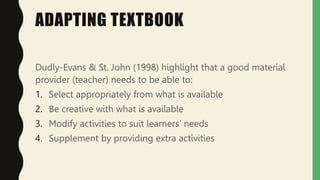
ADAPTING TEXTBOOK
Dudly-Evans & St. John (1998) highlight that a good material
provider (teacher) needs to be able to:
1. Select appropriately from what is available
2. Be creative with what is available
3. Modify activities to suit learners’ needs
4. Supplement by providing extra activities
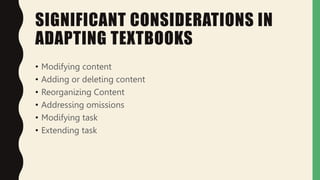
SIGNIFICANT CONSIDERATIONS IN
ADAPTING TEXTBOOKS
• Modifying content
• Adding or deleting content
• Reorganizing Content
• Addressing omissions
• Modifying task
• Extending task
THE NATURE OF MATERIAL
DEVELOPMENT
The goal is create materials that can serve as resources for effective
teaching. The writer start a learning goal in mind and then seeks to create
set of activities that enable the goal to be reached. Shulman (1987)
describe that transformation phase of this process as consist of:
1. Preparation
2. Representation
3. Adapting and tailoring to students’ characteristics
ROWNTREE (1997)
Rowntree (1997) point out that a good material should:
1. Arose the learners’ interest
2. Remind them of earlier learning
3. Tell the what they will be learning next
4. Explain new learning content to them
5. Relate these ideas to learners’ previous learning
6. Get learners to think about new content
7. Help them get feedback on their learning
8. Encourage them to practice
9. Enable them to check their progress
10. Help the to do better

Language-Learning-Material-Development.pptx

  • 1.
  • 2.
    CONTENT • Introduction • What’smaterial ? • What is Material development ? • Forms of Material • The Rule of Materials • Authentic vs Non-Authentic Materials • Advantages and Disadvantages of Authentic Materials • Advantages and Disadvantages of textbook Material • Evaluating Textbook • Significant consideration in Evaluating textbook • Factor Involve in the development of textbook • Criteria for textbook evaluation • Adapting textbooks and significant consideration • The Nature of Material development • Preparing a Material for a Program : Adv &disadv • Final Word and Conclusion
  • 3.
    INTRODUCTION MATERIAL(S) PROF. BRIANTOMLINSON : - The Matter of Substances from which something can be made - Tool or apparatus for the performance of a given task - Having a logical connection with a subject matter or consequential event of the knowledge of which would significantly affect of decision or course of action
  • 4.
    MATERIALS (JAMES D.BROWN, 2007) • Any Systematic description of the techniques and exercises to be used in classroom learning • The key in developing sound materials is to ensure that they are described and organized well enough so that teacher can use them with no confusion and with a minimum of preparation time
  • 5.
    WHAT’S THE MATERIAL DEVELOPMENT? •Material development is both a field of study and a practical undertaking as a field it studies the principle and procedure of the design, implementation and evaluation of language teaching materials (Tomlinson, 2001:66). • Anything done by materials developers or teachers to facilitate the learning of the language teaching • Anything which is done by writers, teachers or learners to provide source of language input and to exploit those sources in way which maximize likelihood of intake.
  • 6.
    FORMS OF MATERIALS 1.Printed : - Books - Workbooks - Teachers’ book - Worksheet - Readers 2. Non-Printed : - Audio - Video - Computer-Based 3. Self Access &Internet
  • 7.
    THE ROLE OFMATERIALS ACCORDING TO CUNNINGSWORTH (1995) • A source for presentation (spoken or written) • A Source of activity for learner practice and communicative interaction • A refence source for learners on grammar, vocabulary, Pronunciation, etc. • A source of stimulation and ideas for classroom activities • A source for syllabus • A support for less experienced teachers who have not yet gained confidence in teaching
  • 8.
    AUTHENTIC VS ARTIFICIALMATERIAL Authentic Materials Any material which are not designed for learning and teaching purpose Examples: Magazine, newspaper TV broadcast, recorded real telephone conversation, photographs, and etc. Artificial Materials Any material which are designed and intended for teaching and learning purposes Example: Textbooks, CDs for listening ,and etc.
  • 9.
    THE ADVANTAGES OFAUTHENTICITY • The have a positive effect on learner motivation • They provide authentic cultural into about teaching and learning • They provide exposure to real language • They relate more closely to learner’ needs • They support a more creative approach to teach (Phillips & Shettlesworth, 1978; peacock, 1997)
  • 10.
    THE DISADVANTAGES OF AUTHENTICITY •Artificial (created) material can also be motivating • Authentic materials often contain difficult language • Artificial materials may be superior to authentic materials as tyey are generally built around a grade syllabus • Authentic materials preparation is time consuming • Authentic materials may contain culturally inappropriate content • Authentic reading texts are usually quite long, which usually leads to demotivate
  • 11.
    ADVANTAGES OF TEXTBOOKS •They provide structure and syllabus for a program • The help standardize instruction • They maintain quality • They provide a variety of resources • They are efficient • They can provide effective language models and input • They can train teachers
  • 12.
    DISADVANTAGES OF TEXTBOOKS •The may contain inauthentic language • They may distort content • The may not reflect students’ needs • They can deskill the teacher • They are expensive
  • 13.
    EVALUATING TEXTBOOK BEFORE EVALUATINGTEXTBOOKS, WE SHOULD CONSIDER THE FOLLOWING QUESTION • The role of the textbooks in the program A textbook mostly determines the syllabus and objectives 1. will it be employed with small or big class? 2. will learners be expected to buy a workbook as well or should the textbook provide all the practice students need? • The teacher in the program 1. are teacher free to adapt and supplement the book? 2. are the native speakers of English? If not, how well do they speak English?
  • 14.
    EVALUATING TEXTBOOK BEFORE EVALUATINGTEXTBOOKS, WE SHOULD CONSIDER THE FOLLOWING QUESTION • The learners in the program 1. Is each student required to buy a book? 2. What do learners typically expect in a text book? 3. Will they use the book in class and in the home? 4. How will the use the book in the class? Is it the primary source of classroom activities? 5. how much are they prepared to pay for a book/
  • 15.
    THE FACTORS INVOLVEIN THE DEVELOPMENT OF COMMERCIAL TEXTBOOKS • The books are representing the interest of the authors • The books are representing the interest of the publishers (Byrd, 1995; Warner, et.at., 1995)
  • 16.
    CRITERIAL FOR TEXTBOOK EVALUATION •According to Cunningsworth (1995) there are 4 criteria for evaluating textbook: 1. They should correspond to learners’ needs. They should match the aims and objectives of language program. 2. They should be reflect the uses ( present of future) that learners will make of the language. 3. They should take account of students’ needs as learners and should facilitate the learning process, without dogmatically imposing a rigid “method”. 4. they should have a clear role as a support for learning.
  • 17.
    ADAPTING TEXTBOOK Dudly-Evans &St. John (1998) highlight that a good material provider (teacher) needs to be able to: 1. Select appropriately from what is available 2. Be creative with what is available 3. Modify activities to suit learners’ needs 4. Supplement by providing extra activities
  • 18.
    SIGNIFICANT CONSIDERATIONS IN ADAPTINGTEXTBOOKS • Modifying content • Adding or deleting content • Reorganizing Content • Addressing omissions • Modifying task • Extending task
  • 19.
    THE NATURE OFMATERIAL DEVELOPMENT The goal is create materials that can serve as resources for effective teaching. The writer start a learning goal in mind and then seeks to create set of activities that enable the goal to be reached. Shulman (1987) describe that transformation phase of this process as consist of: 1. Preparation 2. Representation 3. Adapting and tailoring to students’ characteristics
  • 20.
    ROWNTREE (1997) Rowntree (1997)point out that a good material should: 1. Arose the learners’ interest 2. Remind them of earlier learning 3. Tell the what they will be learning next 4. Explain new learning content to them 5. Relate these ideas to learners’ previous learning 6. Get learners to think about new content 7. Help them get feedback on their learning 8. Encourage them to practice 9. Enable them to check their progress 10. Help the to do better