Downloaded 12 times
![Standard Deviation of Data in a Frequency Table
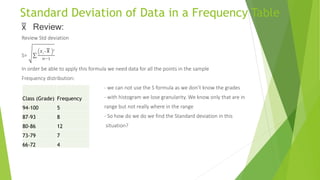
It can be proven for frequency distribution that :
S=
[𝑛 𝑓∗𝑥2
− 𝑓∗𝑥 2
]
𝑛(𝑛−1)
n - sample size
f – frequency
X – midpoint of the class
n=36
One way to solve that equation (other than algorithms or specialised programing language like R) is to create additional rows
in the initial table
S=
36 253989 − 3009 2
36(36−1)
= 8.43
Class (Grade) Frequency Class midpoint (f*X) f*x2
94-100 5 97 485 47045
87-93 8 90 720 64800
80-86 12 83 996 82668
73-79 7 76 532 40432
66-72 4 69 276 19044
3009 253989
∑1 = 3009
∑2= 253989](https://image.slidesharecdn.com/masterstatistics109standarddeviationofdatainafrequencytable-180907041136/85/Master-statistics-1-09_-Standard-Deviation-of-Data-in-a-Frequency-Table-3-320.jpg)
The document explains how to calculate the standard deviation for data presented in a frequency table, highlighting the limitations of using basic formulas due to lack of detailed data. It provides a specific formula for frequency distributions and includes a worked example with class ranges and calculations. The final computed standard deviation for the given data set is approximately 8.43.


![Ogives wps office [autosaved]](https://cdn.slidesharecdn.com/ss_thumbnails/ogives-wpsofficeautosaved-190822094751-thumbnail.jpg?width=640&height=640&fit=bounds)


