Mastering Statistics
Mean, Std Deviation, Variance, Z-score, Sampling
Relative and Cumulative Frequency Distribution
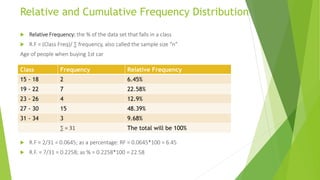
 Relative Frequency: the % of the data set that falls in a class
 R.F = (Class Freq)/ ∑ frequency, also called the sample size “n”
Age of people when buying 1st car
 R.F = 2/31 = 0.0645; as a percentage: RF = 0.0645*100 = 6.45
 R.F. = 7/31 = 0.2258; as % = 0.2258*100 = 22.58
Class Frequency Relative Frequency
15 - 18 2 6.45%
19 - 22 7 22.58%
23 - 26 4 12.9%
27 - 30 15 48.39%
31 - 34 3 9.68%
∑ = 31 The total will be 100%
Relative and Cumulative Frequency Distribution
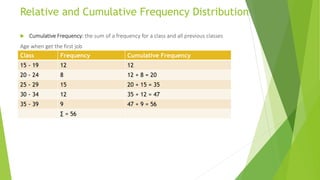
 Cumulative Frequency: the sum of a frequency for a class and all previous classes
Age when get the first job
Class Frequency Cumulative Frequency
15 - 19 12 12
20 - 24 8 12 + 8 = 20
25 - 29 15 20 + 15 = 35
30 - 34 12 35 + 12 = 47
35 - 39 9 47 + 9 = 56
∑ = 56

Master statistics 1#3 _relative and cumulative frequency distribution

  • 1.
    Mastering Statistics Mean, StdDeviation, Variance, Z-score, Sampling
  • 2.
    Relative and CumulativeFrequency Distribution  Relative Frequency: the % of the data set that falls in a class  R.F = (Class Freq)/ ∑ frequency, also called the sample size “n” Age of people when buying 1st car  R.F = 2/31 = 0.0645; as a percentage: RF = 0.0645*100 = 6.45  R.F. = 7/31 = 0.2258; as % = 0.2258*100 = 22.58 Class Frequency Relative Frequency 15 - 18 2 6.45% 19 - 22 7 22.58% 23 - 26 4 12.9% 27 - 30 15 48.39% 31 - 34 3 9.68% ∑ = 31 The total will be 100%
  • 3.
    Relative and CumulativeFrequency Distribution  Cumulative Frequency: the sum of a frequency for a class and all previous classes Age when get the first job Class Frequency Cumulative Frequency 15 - 19 12 12 20 - 24 8 12 + 8 = 20 25 - 29 15 20 + 15 = 35 30 - 34 12 35 + 12 = 47 35 - 39 9 47 + 9 = 56 ∑ = 56