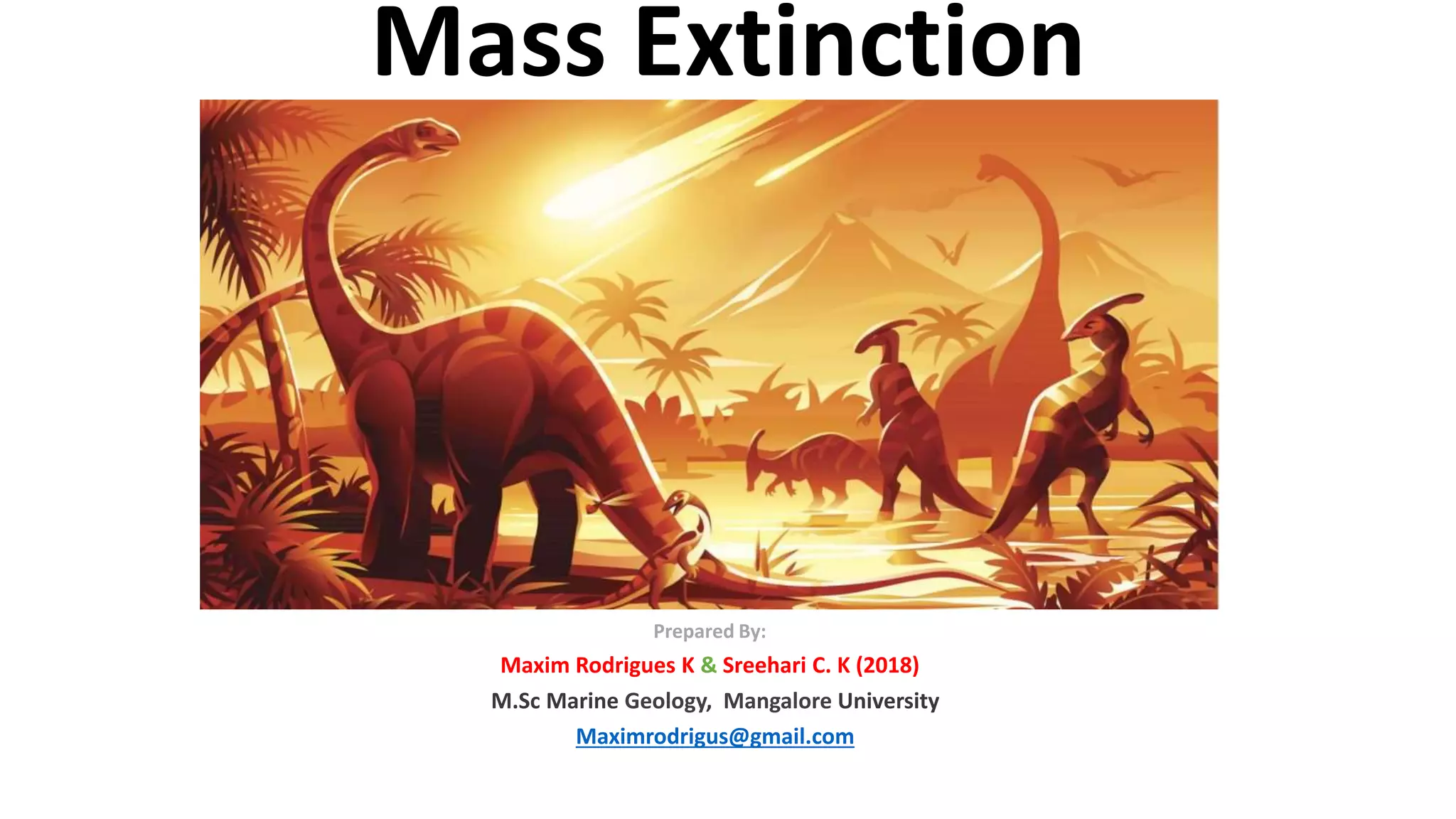
Mass Extinction
Prepared By:
Maxim Rodrigues K & Sreehari C. K (2018)
M.Sc Marine Geology, Mangalore University
Maximrodrigus@gmail.com
Introduction
• Extinction is an integral part of evolution
• Death is a fact of life, exticntion is a fact of evolution (Leakey).
• Extinction:=where an organism or species last member Dies.
• If birth rate is less than death rate there is a chance of exticntion.
• Darwin- theory of Evolution- a species goes extinct if it is not able to
adopt change in its environment or compete with others.
Causes
• *Terrestrial * extraterrestrial
• Climatic variation
• Volcanism
• Invasive new sp
• Ecology complexity
• Celestial bodies (comets, asteroids, meteriotes)
• Sea level rise, glaciation
• Global warming, acid rain , disease epedemic
• Global cooling, super continent formation(pangea) methane hydrate,
wildfire
Super continent formation
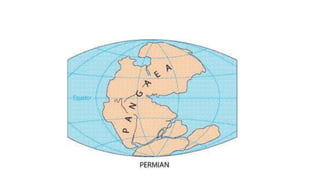
• Pangaea end of permian
• Result= few continental Shelves, lack of habitat for Shallow Marine
organisms= decline in those sp
• Caused rapid fluctuation in climate
• Pangea reduced input of nutrients to ocean from river estuaries
• Decrease in nutrients
• Glacial effect- decrease/rise in sea level
Flood Basalt eruptions
• Billions of tonnes Co2 and sulphate dioxide released to atm
• Both are powerful
• Green house gas- rapid global warming
Acid Rain
• More acidic than normal 4.5 ph. (5.6 normal)
• Major source= Sulfur dioxide and Nitrogen oxide
• weather, soil, life cycle, plant, animals, diseases, ecosystem damage.
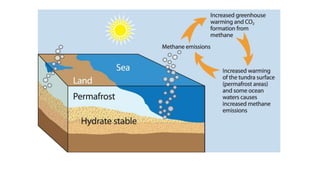
Methane hydrates
• Global warming-result-deep Ocean temp rise-result-release large vol
of methane from Ocean sediments= accelerated global warming.
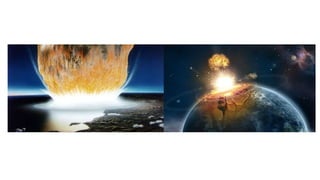
• End of crataceaous= large asteroids, meteorites (10 km diameter)
collide 65 ma
The BIG 5 Mass extinction
• 1. Late Ordovician
• 2. Late Devonian
• 3. Late Permian
• 4. Late Triassic
• 5. Crataceous-Tertiary
• 6. Holocene (ongoing)
Ordovian Exticntion
• 440 my – drop in sea level – formation of Glaciers- followed by
melting and rise in sea level.
• Corals badly affect trilobites, echiniondes, brachipodes
Devonian Exticntion
• 364 my
• Cause unknown
• Available evidence suport- warm water marine sp affected so
paleontologists believe episode of global cooling similar to Ordo-E
• Glaciation in gondwana evidence in North Brazil.
• Cephalopodes, fish, corals.
Permian Extinction
• 250 my
• Earth’s most worst Extinction
• 95% of all sp
• 70% land plant insect vertebrate catastrophic event
• Direct evidence not available
• Many scientist belive- comet, asteriod impact
• Others- volcanic eruptions.
• Largest mass extinction – trilobites, cephalopodes, corals
Triassic Extinction
• 199 my
• Massive floods of lava from central atlantic magmatic provinces
triggered to breakup pangea and opened atlantic ocean.
• Volcanism led to deadly global warming.
• Rocks from eruption found in US, Brazil, N Africa Spain
• 95% corals wiped out
Crataceaous Extinction
• 65 my
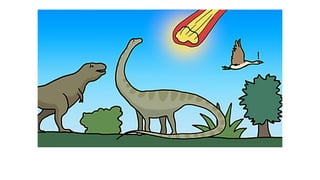
• Asteriod- chicxulub crater- hidden- yucatan peninsula- beneathe gulf
of Mexico
• Some Scientist believe gradual climate change, flood volcanic
eruption of basaltic lava from deccan trap of central India.
• Land invertebrate including Dinosaurs, reptiles, ammonites,
brachiopods, bivalves, foraminifera
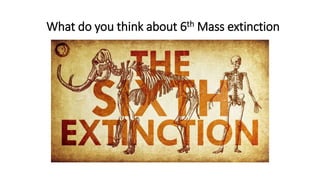
What do you think about 6th Mass extinction
Holocene Extinction
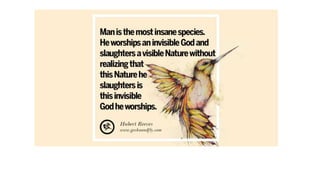
• 6th extinction/ Anthropocene extinction. (Human activity)
• Loss of plants, animals, reptiles, amphibians, athropods etc..
• Degradation of rain forest and corals.
• Much exticntions are undocumented
• Not aware of sp before they go extinct.
• Arrival of humans on different continent caused megafaunal extinction.
• Holocene extinction continued with meat consumption, over fishing, ocean acidification.
• Human colonisation-extinction- dodo- calvaria major- Mauritius.
• Invasive sp- plants fishes etc….
• “The future of Life” (2002) E.O. Wilson- calculated if the current rate of human disruption
of the biosphere continues one half of earth’s higher forns will be extinct by 2100.
• Passenger pigeons, Dodo, tasmanian tiger, turtles breed sea shore,
pelagic birds, lost breeding grounds,
• Amphiabians king of each ecosystem.
• 3 of major 5 occurred in Paleozoic era
• Animals are fragile & easily killed than microbes so mass exticntion
more damaging to animals than microbes
• Microbes-widely-distribution-single event-not affect/ destroy all- vast
habitat
• Gaps between exricntion vary from 51 ma to 135 ma with an average
gap of 95 ma
• Aateriod 1km diameter strike earth every 500,000 years.
• Large collision 5 km diameter asteriod occur approximatly about once
in 10 ma
• Last known impact 10km diameter 65my
Impact
• Object of 40 km diameter would be sufficient for mass extinction on
earth
Evidences
• Chixulub- circular depression 180 km diameter- Yucatan peninsula in
mexico (Gulf)
• K-T boundary layer
• Presence of thin 2cm later of iridium rich clay found all over the world
within sed rock
• India???
• Iridium transition element rare on earth but found in meteorites
• Proposed first Luiz Alvare in 1980
Shocked Quartz
• Found worldwide, thin layer boundary b/w boundary K-T rock
• First discovered at nuclear testing sites & later craters caused by
meterorites impact. Eg: Barringer crater, Arizona USA
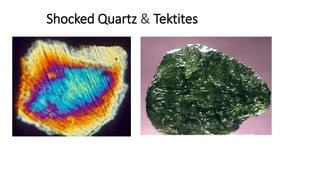
• Shocked quartz had different microscopic structure than normal quartz
• Tektites
• 1-8 mm diameter
• Tektots= molten natural glass rocks
• Most scientist agree that they turned due to meteoritic impact.
• Black to Olive green colour.
Shocked Quartz & Tektites
Evidence- wild fires
• K-T layer high concentration of carbon in many locations. May be
asteroid impact.
• Possibility of Tsunami
• Due to meteoritic impact. Large scale sed deposition thought to be a
result of huge tsunami at Texas, ….
• Estimated 300 km inland large deposition by tsunami.
• Flood Basalt Eruption Deccan trap- 66 ma Dust blocked sunlight
reduced photosynthesis, emitted co2
• Term trap-dutch-for stairs-referes-step like landforms.
• Erupted over a period of 30,000 yrs over 2000 mtr thick.
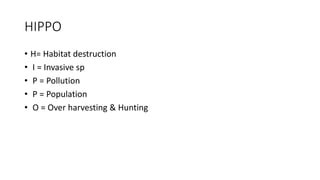
HIPPO
• H= Habitat destruction
• I = Invasive sp
• P = Pollution
• P = Population
• O = Over harvesting & Hunting
References
1. Barnosky, A. D, Matzke, N., Tomiya, S., Wogan, G. O. V., Swartz, B.,
Quental, T. B., Marshall, C., McGuire, J. L., Lindsey, E. M., Maguire, K. C.,
Mersey, B., & Ferrer, E. A. (2011) Has the earth’s sixth mass extinction
already arrived? Nature. Vol:471, 51-57.
2. Elewa, A. M. T. (2014) Cause of mass extinctions with special
refetence to vanishing of Dinosaurs. Greener Journal of Physical
Sciences. Vol:4(2), pp. 013-021. ISSN: 2276-7851.
3. Hull, P. M. & Darroch.S.A.F. (2013). Mass extinction and the structure
and function of ecosystems. The Paleontological Society Papers, Vol:19.
4.https://www.slideshare.net/mobile/angelabentley/massextinctions.
[Accessed 15th Nov 2018].
5. https://www.slideshare.net/mobile/BIDYUTJYOTIMALAKAR/mass-
extinction-52903770. [Accessed 30th Nov 2018].
6. https://www.slideshare.net/mobile/markreyesvillamartin/species-
extinction-54606911. [Accessed 04th Dec 2018].
Thank you….

Mass Extinction Seminar Geology

  • 1.
    Mass Extinction Prepared By: MaximRodrigues K & Sreehari C. K (2018) M.Sc Marine Geology, Mangalore University Maximrodrigus@gmail.com
  • 2.
    Introduction • Extinction isan integral part of evolution • Death is a fact of life, exticntion is a fact of evolution (Leakey). • Extinction:=where an organism or species last member Dies. • If birth rate is less than death rate there is a chance of exticntion. • Darwin- theory of Evolution- a species goes extinct if it is not able to adopt change in its environment or compete with others.
  • 3.
    Causes • *Terrestrial *extraterrestrial • Climatic variation • Volcanism • Invasive new sp • Ecology complexity • Celestial bodies (comets, asteroids, meteriotes) • Sea level rise, glaciation • Global warming, acid rain , disease epedemic • Global cooling, super continent formation(pangea) methane hydrate, wildfire
  • 4.
    Super continent formation •Pangaea end of permian • Result= few continental Shelves, lack of habitat for Shallow Marine organisms= decline in those sp • Caused rapid fluctuation in climate • Pangea reduced input of nutrients to ocean from river estuaries • Decrease in nutrients • Glacial effect- decrease/rise in sea level
  • 6.
    Flood Basalt eruptions •Billions of tonnes Co2 and sulphate dioxide released to atm • Both are powerful • Green house gas- rapid global warming
  • 7.
    Acid Rain • Moreacidic than normal 4.5 ph. (5.6 normal) • Major source= Sulfur dioxide and Nitrogen oxide • weather, soil, life cycle, plant, animals, diseases, ecosystem damage.
  • 8.
    Methane hydrates • Globalwarming-result-deep Ocean temp rise-result-release large vol of methane from Ocean sediments= accelerated global warming. • End of crataceaous= large asteroids, meteorites (10 km diameter) collide 65 ma
  • 10.
    The BIG 5Mass extinction • 1. Late Ordovician • 2. Late Devonian • 3. Late Permian • 4. Late Triassic • 5. Crataceous-Tertiary • 6. Holocene (ongoing)
  • 11.
    Ordovian Exticntion • 440my – drop in sea level – formation of Glaciers- followed by melting and rise in sea level. • Corals badly affect trilobites, echiniondes, brachipodes
  • 12.
    Devonian Exticntion • 364my • Cause unknown • Available evidence suport- warm water marine sp affected so paleontologists believe episode of global cooling similar to Ordo-E • Glaciation in gondwana evidence in North Brazil. • Cephalopodes, fish, corals.
  • 13.
    Permian Extinction • 250my • Earth’s most worst Extinction • 95% of all sp • 70% land plant insect vertebrate catastrophic event • Direct evidence not available • Many scientist belive- comet, asteriod impact • Others- volcanic eruptions. • Largest mass extinction – trilobites, cephalopodes, corals
  • 14.
    Triassic Extinction • 199my • Massive floods of lava from central atlantic magmatic provinces triggered to breakup pangea and opened atlantic ocean. • Volcanism led to deadly global warming. • Rocks from eruption found in US, Brazil, N Africa Spain • 95% corals wiped out
  • 15.
    Crataceaous Extinction • 65my • Asteriod- chicxulub crater- hidden- yucatan peninsula- beneathe gulf of Mexico • Some Scientist believe gradual climate change, flood volcanic eruption of basaltic lava from deccan trap of central India. • Land invertebrate including Dinosaurs, reptiles, ammonites, brachiopods, bivalves, foraminifera
  • 17.
    What do youthink about 6th Mass extinction
  • 18.
    Holocene Extinction • 6thextinction/ Anthropocene extinction. (Human activity) • Loss of plants, animals, reptiles, amphibians, athropods etc.. • Degradation of rain forest and corals. • Much exticntions are undocumented • Not aware of sp before they go extinct. • Arrival of humans on different continent caused megafaunal extinction. • Holocene extinction continued with meat consumption, over fishing, ocean acidification. • Human colonisation-extinction- dodo- calvaria major- Mauritius. • Invasive sp- plants fishes etc…. • “The future of Life” (2002) E.O. Wilson- calculated if the current rate of human disruption of the biosphere continues one half of earth’s higher forns will be extinct by 2100.
  • 19.
    • Passenger pigeons,Dodo, tasmanian tiger, turtles breed sea shore, pelagic birds, lost breeding grounds, • Amphiabians king of each ecosystem.
  • 20.
    • 3 ofmajor 5 occurred in Paleozoic era • Animals are fragile & easily killed than microbes so mass exticntion more damaging to animals than microbes • Microbes-widely-distribution-single event-not affect/ destroy all- vast habitat
  • 21.
    • Gaps betweenexricntion vary from 51 ma to 135 ma with an average gap of 95 ma • Aateriod 1km diameter strike earth every 500,000 years. • Large collision 5 km diameter asteriod occur approximatly about once in 10 ma • Last known impact 10km diameter 65my
  • 22.
    Impact • Object of40 km diameter would be sufficient for mass extinction on earth
  • 23.
    Evidences • Chixulub- circulardepression 180 km diameter- Yucatan peninsula in mexico (Gulf) • K-T boundary layer • Presence of thin 2cm later of iridium rich clay found all over the world within sed rock • India??? • Iridium transition element rare on earth but found in meteorites • Proposed first Luiz Alvare in 1980
  • 25.
    Shocked Quartz • Foundworldwide, thin layer boundary b/w boundary K-T rock • First discovered at nuclear testing sites & later craters caused by meterorites impact. Eg: Barringer crater, Arizona USA • Shocked quartz had different microscopic structure than normal quartz • Tektites • 1-8 mm diameter • Tektots= molten natural glass rocks • Most scientist agree that they turned due to meteoritic impact. • Black to Olive green colour.
  • 26.
  • 27.
    Evidence- wild fires •K-T layer high concentration of carbon in many locations. May be asteroid impact. • Possibility of Tsunami • Due to meteoritic impact. Large scale sed deposition thought to be a result of huge tsunami at Texas, …. • Estimated 300 km inland large deposition by tsunami. • Flood Basalt Eruption Deccan trap- 66 ma Dust blocked sunlight reduced photosynthesis, emitted co2 • Term trap-dutch-for stairs-referes-step like landforms. • Erupted over a period of 30,000 yrs over 2000 mtr thick.
  • 28.
    HIPPO • H= Habitatdestruction • I = Invasive sp • P = Pollution • P = Population • O = Over harvesting & Hunting
  • 30.
    References 1. Barnosky, A.D, Matzke, N., Tomiya, S., Wogan, G. O. V., Swartz, B., Quental, T. B., Marshall, C., McGuire, J. L., Lindsey, E. M., Maguire, K. C., Mersey, B., & Ferrer, E. A. (2011) Has the earth’s sixth mass extinction already arrived? Nature. Vol:471, 51-57. 2. Elewa, A. M. T. (2014) Cause of mass extinctions with special refetence to vanishing of Dinosaurs. Greener Journal of Physical Sciences. Vol:4(2), pp. 013-021. ISSN: 2276-7851. 3. Hull, P. M. & Darroch.S.A.F. (2013). Mass extinction and the structure and function of ecosystems. The Paleontological Society Papers, Vol:19.
  • 31.
    4.https://www.slideshare.net/mobile/angelabentley/massextinctions. [Accessed 15th Nov2018]. 5. https://www.slideshare.net/mobile/BIDYUTJYOTIMALAKAR/mass- extinction-52903770. [Accessed 30th Nov 2018]. 6. https://www.slideshare.net/mobile/markreyesvillamartin/species- extinction-54606911. [Accessed 04th Dec 2018].
  • 32.