FOSSIL
Mr suren N Kamble
P.G. Department of Geology
Deogiri College, Aurangabad.
(Palaios- Ancient, ontos-life, Logy-Study)
(Palaeontology was proposed by the de Blanville & don Waldhelm in1834)
Fossil - Remains or traces of a once-living organism.
“Fossil” (Latin prefix “Fodere” refers to digging/excavation) in its most general sense refers to
any preserved evidence of ancient biological organisms in the rock record that is obtained
through digging/extraction from the host rock.
Palaeontology…..?
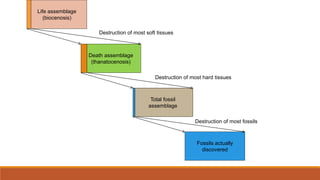
Life assemblage
(biocenosis)
Death assemblage
(thanatocenosis)
Total fossil
assemblage
Fossils actually
discovered
Destruction of most soft tissues
Destruction of most hard tissues
Destruction of most fossils
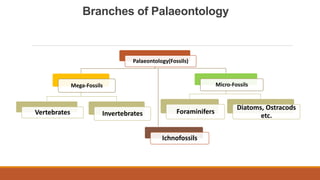
Branches of Palaeontology
Palaeontology(Fossils)
Mega-Fossils
Vertebrates Invertebrates
Micro-Fossils
Foraminifers
Diatoms, Ostracods
etc.
Ichnofossils
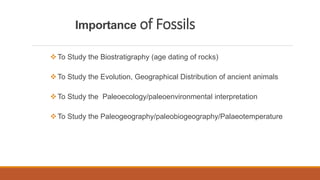
Importance of Fossils
To Study the Biostratigraphy (age dating of rocks)
To Study the Evolution, Geographical Distribution of ancient animals
To Study the Paleoecology/paleoenvironmental interpretation
To Study the Paleogeography/paleobiogeography/Palaeotemperature
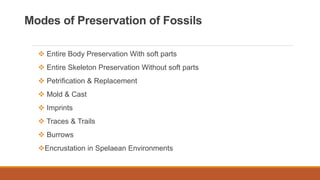
Modes of Preservation of Fossils
 Entire Body Preservation With soft parts
 Entire Skeleton Preservation Without soft parts
 Petrification & Replacement
 Mold & Cast
 Imprints
 Traces & Trails
 Burrows
Encrustation in Spelaean Environments
Entire Body Preservation
This is very rare mode of preservation of fossil
In this mode the entire body of the animal is
preserved with the skin in extremely dry and cold
climate
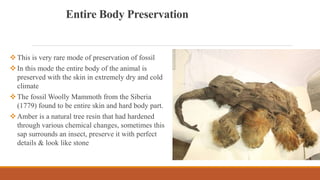
The fossil Woolly Mammoth from the Siberia
(1779) found to be entire skin and hard body part.
Amber is a natural tree resin that had hardened
through various chemical changes, sometimes this
sap surrounds an insect, preserve it with perfect
details & look like stone
World’s oldest baby snake found preserved in amber
 100-million-year-old baby snake preserved inside a
piece of amber from Myanmar.
 The new species—dubbed Xiaophis myanmarensis—lived
in the mid-Cretaceous period
 The fossil, which was just 5 centimeters in length
Entire Skeleton Preservation
This is also an rare mode of preservation of fossil
In this mode the entire Skeleton of the animal is
preserved
For preservation of this type fossils the climatic
condition should be extremely Dry or extremely Cold
A new species of South American fossil terror bird
called Llallawavis scagliai ("Scaglia's Magnificent
Bird“) more than 90% of the skeleton exquisitely
preserved (Cenozoic Age)
Petrification & Replacement
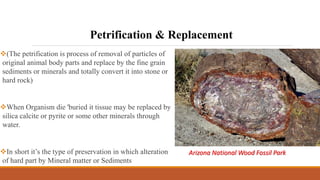
(The petrification is process of removal of particles of
original animal body parts and replace by the fine grain
sediments or minerals and totally convert it into stone or
hard rock)
When Organism die 'buried it tissue may be replaced by
silica calcite or pyrite or some other minerals through
water.
In short it’s the type of preservation in which alteration
of hard part by Mineral matter or Sediments
Arizona National Wood Fossil Park
Petrification & Replacement
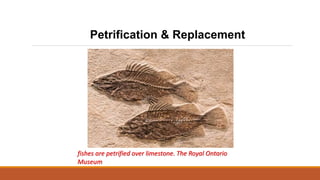
fishes are petrified over limestone. The Royal Ontario
Museum
Mold & Cast
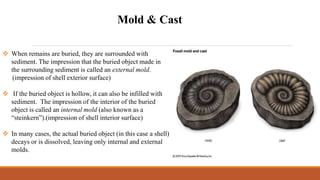
 When remains are buried, they are surrounded with
sediment. The impression that the buried object made in
the surrounding sediment is called an external mold.
(impression of shell exterior surface)
 If the buried object is hollow, it can also be infilled with
sediment. The impression of the interior of the buried
object is called an internal mold (also known as a
“steinkern”).(impression of shell interior surface)
 In many cases, the actual buried object (in this case a shell)
decays or is dissolved, leaving only internal and external
molds.
Mold & Cast
Turritela
External mould
Internal mould
Turritela
Imprints
These fossilized Australian Glossopteris leaves are the same ones found on
Antarctica.
These imprints basically we get in the very fine
grain sedimentary rock i.e. Shale
The leaf is sandwich between the two strata,
after the decomposition of the strata only the
replica of the glossopteris leaf remains
Traces & Trails
Ichnofossils
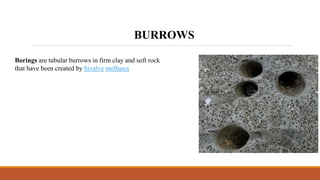
BURROWS
Borings are tubular burrows in firm clay and soft rock
that have been created by bivalve molluscs
THANK YOU

Fossil ppt

  • 1.
    FOSSIL Mr suren NKamble P.G. Department of Geology Deogiri College, Aurangabad.
  • 2.
    (Palaios- Ancient, ontos-life,Logy-Study) (Palaeontology was proposed by the de Blanville & don Waldhelm in1834) Fossil - Remains or traces of a once-living organism. “Fossil” (Latin prefix “Fodere” refers to digging/excavation) in its most general sense refers to any preserved evidence of ancient biological organisms in the rock record that is obtained through digging/extraction from the host rock. Palaeontology…..?
  • 3.
    Life assemblage (biocenosis) Death assemblage (thanatocenosis) Totalfossil assemblage Fossils actually discovered Destruction of most soft tissues Destruction of most hard tissues Destruction of most fossils
  • 4.
    Branches of Palaeontology Palaeontology(Fossils) Mega-Fossils VertebratesInvertebrates Micro-Fossils Foraminifers Diatoms, Ostracods etc. Ichnofossils
  • 5.
    Importance of Fossils ToStudy the Biostratigraphy (age dating of rocks) To Study the Evolution, Geographical Distribution of ancient animals To Study the Paleoecology/paleoenvironmental interpretation To Study the Paleogeography/paleobiogeography/Palaeotemperature
  • 6.
    Modes of Preservationof Fossils  Entire Body Preservation With soft parts  Entire Skeleton Preservation Without soft parts  Petrification & Replacement  Mold & Cast  Imprints  Traces & Trails  Burrows Encrustation in Spelaean Environments
  • 7.
    Entire Body Preservation Thisis very rare mode of preservation of fossil In this mode the entire body of the animal is preserved with the skin in extremely dry and cold climate The fossil Woolly Mammoth from the Siberia (1779) found to be entire skin and hard body part. Amber is a natural tree resin that had hardened through various chemical changes, sometimes this sap surrounds an insect, preserve it with perfect details & look like stone
  • 8.
    World’s oldest babysnake found preserved in amber  100-million-year-old baby snake preserved inside a piece of amber from Myanmar.  The new species—dubbed Xiaophis myanmarensis—lived in the mid-Cretaceous period  The fossil, which was just 5 centimeters in length
  • 9.
    Entire Skeleton Preservation Thisis also an rare mode of preservation of fossil In this mode the entire Skeleton of the animal is preserved For preservation of this type fossils the climatic condition should be extremely Dry or extremely Cold A new species of South American fossil terror bird called Llallawavis scagliai ("Scaglia's Magnificent Bird“) more than 90% of the skeleton exquisitely preserved (Cenozoic Age)
  • 10.
    Petrification & Replacement (Thepetrification is process of removal of particles of original animal body parts and replace by the fine grain sediments or minerals and totally convert it into stone or hard rock) When Organism die 'buried it tissue may be replaced by silica calcite or pyrite or some other minerals through water. In short it’s the type of preservation in which alteration of hard part by Mineral matter or Sediments Arizona National Wood Fossil Park
  • 11.
    Petrification & Replacement fishesare petrified over limestone. The Royal Ontario Museum
  • 12.
    Mold & Cast When remains are buried, they are surrounded with sediment. The impression that the buried object made in the surrounding sediment is called an external mold. (impression of shell exterior surface)  If the buried object is hollow, it can also be infilled with sediment. The impression of the interior of the buried object is called an internal mold (also known as a “steinkern”).(impression of shell interior surface)  In many cases, the actual buried object (in this case a shell) decays or is dissolved, leaving only internal and external molds.
  • 13.
    Mold & Cast Turritela Externalmould Internal mould Turritela
  • 14.
    Imprints These fossilized AustralianGlossopteris leaves are the same ones found on Antarctica. These imprints basically we get in the very fine grain sedimentary rock i.e. Shale The leaf is sandwich between the two strata, after the decomposition of the strata only the replica of the glossopteris leaf remains
  • 15.
  • 16.
    BURROWS Borings are tubularburrows in firm clay and soft rock that have been created by bivalve molluscs
  • 17.