EXTINCTION
 Extinction is the total disappearance of a lineage from
earth or death of all members of a species.
 The moment of extinction is generally considered to be
the death of the last individual of the species, although the
capacity to breed and recover may have been lost before
this point.
 During process of evolution continual turnover of species
occurs, new species arise and old ones get extinct.
 Extinction plays an important role in the evolution of life
because it opens up opportunities for new species to
emerge.
 Extinction occurs when species are diminished because of
environmental forces (habitat fragmentation, global
change, natural disaster, overexploitation of species for
human use) or because of evolutionary changes in their
members (genetic inbreeding, poor reproduction, decline
in population numbers).
 Macroevolution causes lineages to become distributed
locally and over specialized making them vulnerable to
extinction during environmental change or destruction of
habitats.
 Intraspecific and interspecific competition also drive
species to extinction.
Causes extinction:
 Habitat loss is the primary cause of higher extinction
rates.
 Other causes include habitat changes, over-exploitation of
wildlife for commercial purposes, the introduction of
harmful non-native species, pollution and the spread of
diseases.
Types of extinction:
 Extinction is of 2 types
a. Background extinction
b. Mass extinction
a. Background extinction:
 The on-going extinction of individual species due to
environmental or ecological factors such as climate
change, disease, loss of habitat or competitive
disadvantage in relation to other species is known as
background extinction or normal extinction.
 Occurs regularly at low or average rate and are caused by
normal environmental changes like emerging disease or
competition among species.
 Declining reproductive fitness and decreasing ability to
adapt to environmental changes.
b. Mass extinction:
 The extinction of a large number of species within a relatively
short period of geological time is called as Mass extinction or
Biotic crisis
 It is a widespread and rapid decrease in the biodiversity on
Earth.
 These rapid extinctions occurring at mass scale and has
catastrophic episodes that wipe out huge number of species
and lineages in a short period of time.
 A mass extinction event is when species vanish much faster
than they are replaced.
 In a mass extinction at least 75% of species go extinct within a
relatively (by geological standard) short period of time.
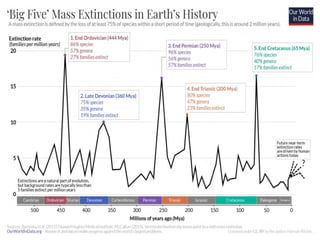
 In the last 500 million years, five great mass extinction
events have changed the face of life on Earth. The five
mass extinctions in Earth’s history are called the ‘Big
Five’.
 They are:
• End Ordovician (444 million years ago; mya)
• Late Devonian (360 mya)
• End Permian (250 mya)
• End Triassic (200 mya)
• End Cretaceous (65 mya)
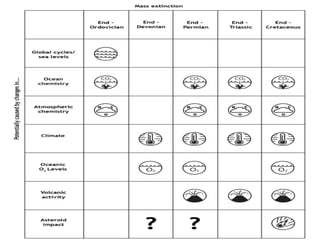
 In the following chart the timing of events in Earth’s
history clearly mentioned. It shows the changing extinction
 The Ordovician-Silurian mass extinction: Occurred 444
million years ago and wiped out approximately 86% of all
species. Many small marine species died out. Scientists think it
was caused by temperatures plummeting and huge glaciers
forming, which caused sea levels to drop dramatically. This was
followed by a period of rapid warming.
 The Devonian mass extinction: Event took place 360 million
years ago and killed about three-quarters of the world's species,
most of which were marine invertebrates that lived at the bottom
of the sea. This was a period of many environmental changes,
including global warming and cooling, a rise and fall of sea
levels and a reduction in oxygen and carbon dioxide in the
atmosphere.
 The Permian mass extinction: Happened 250 million
years ago, was the largest and most devastating event of
the five. The Permian-Triassic extinction event is also
known as the Great Dying. It eradicated more than 96%
of all species, including most of the vertebrates which had
begun to evolve by this time. Some scientists think Earth
was hit by a large asteroid which filled the air with dust
particles that blocked out the Sun and caused acid rain.
Others think there was a large volcanic explosion which
increased carbon dioxide and made the oceans toxic.
 The Triassic mass extinction: Event occurred 200
million years ago, eliminating about 80% of Earth's
species, including many types of dinosaurs. This was
probably caused by colossal geological activity that
increased carbon dioxide levels and global temperatures,
as well as ocean acidification.
 The Cretaceous mass extinction: Event occurred 65
million years ago, killing 76% of all species, including the
remaining non-avian dinosaurs. This was most likely
caused by an asteroid hitting the Earth and Volcanic
activity.
Causes mass extinctions:
 All of the ‘Big Five’ were caused by some combination of
rapid and dramatic changes in climate, combined with
significant changes in the composition of environments
on land or in the ocean (such as ocean acidification or
acid rain from intense volcanic activity).
 Past mass extinctions were caused by extreme
temperature changes,
 Rising or falling sea levels and catastrophic,
 One-off events like a huge volcano erupting or an asteroid
hitting Earth.
 Although the best-known cause of a mass extinction is the
asteroid impact that killed off the non-avian dinosaurs, in
fact, volcanic activity seems to have wreaked much more
havoc on Earth’s biota.
 Here are some hypothesized causes for each of Earth’s
biggest mass extinctions:
End-Ordovician:
• Beginning of glacial cycles on Earth, and corresponding
changes in sea level
• Changes in atmospheric and oceanic chemistry relating to
the rise of the Appalachian mountains
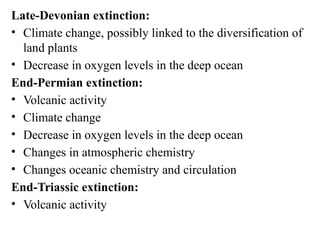
Late-Devonian extinction:
• Climate change, possibly linked to the diversification of
land plants
• Decrease in oxygen levels in the deep ocean
End-Permian extinction:
• Volcanic activity
• Climate change
• Decrease in oxygen levels in the deep ocean
• Changes in atmospheric chemistry
• Changes oceanic chemistry and circulation
End-Triassic extinction:
• Volcanic activity
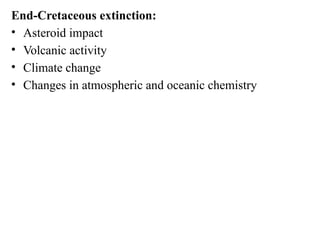
End-Cretaceous extinction:
• Asteroid impact
• Volcanic activity
• Climate change
• Changes in atmospheric and oceanic chemistry
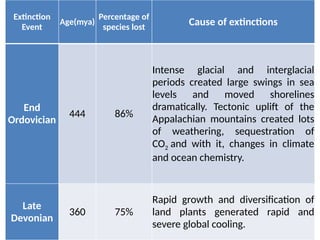
Extinction
Event
Age(mya)
Percentage of
species lost
Cause of extinctions
End
Ordovician
444 86%
Intense glacial and interglacial
periods created large swings in sea
levels and moved shorelines
dramatically. Tectonic uplift of the
Appalachian mountains created lots
of weathering, sequestration of
CO2 and with it, changes in climate
and ocean chemistry.
Late
Devonian
360 75%
Rapid growth and diversification of
land plants generated rapid and
severe global cooling.
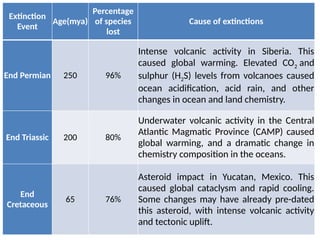
Extinction
Event
Age(mya)
Percentage
of species
lost
Cause of extinctions
End Permian 250 96%
Intense volcanic activity in Siberia. This
caused global warming. Elevated CO2 and
sulphur (H2S) levels from volcanoes caused
ocean acidification, acid rain, and other
changes in ocean and land chemistry.
End Triassic 200 80%
Underwater volcanic activity in the Central
Atlantic Magmatic Province (CAMP) caused
global warming, and a dramatic change in
chemistry composition in the oceans.
End
Cretaceous
65 76%
Asteroid impact in Yucatan, Mexico. This
caused global cataclysm and rapid cooling.
Some changes may have already pre-dated
this asteroid, with intense volcanic activity
and tectonic uplift.
K-T extinction
 The K-T extinction is characterized by the mass extinction of
three-quarters of the plant and animal species present during
that time on Earth.
 KT extinction stands for Cretaceous-Tertiary Extinction.
 It occurred at the end of the Cretaceous period and the
beginning of the Tertiary period.
 Also called K–Pg extinction or Cretaceous–Paleogene
extinction.
 This is a global extinction event that witnessed the elimination
of about 70-80% of the species living on the earth within a
very short period of time i.e., 66 million years ago (between
the Cretaceous and Paleogene periods). This mass extinction
is known as KT extinction.
 The K–T extinction was characterized by the elimination
of many lines of animals that were important elements of
the Mesozoic Era
 The K–T extinction ranks third in severity of the five
major extinction episodes.
 The K-T Extinction event is the extinction event known
for the fall of dinosaurs.
 The species that survived the K-T mass extinction
included some ectothermic species like the sea turtles and
crocodilians.
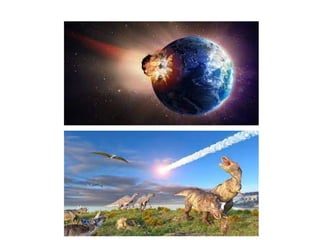
 The theory about the K-T mass extinction was proposed
by Louis Alvarez and his son Luis Walter Alvarez. It is
widely accepted theory. They stated that an asteroid about
15 km in diameter hit the earth forming a crater at the tip
of the Yucatan Peninsula in Mexico. This crater is known
as Chicxulub crater.
 The impact of the crater is believed to have penetrated the
earth’s crust which released a large amount of dust and
debris into the atmosphere and led to tsunami, fires, wind
storms, acid rains and volcanic activities. The dust must
have blocked the sunlight coming to the earth which
would have lowered the earth’s temperature.
 90% marine species, 50% of marine genera, 85% of land
species and 56% of land genera got extinct as a result of K-
T extinction. This catastrophic event marked the advent of
the mammalian age.
 Dinosaurs form the major group of animals that got extinct
during this period. However, it is not proved that the
asteroid attack killed the dinosaurs. Many species of
dinosaurs have diminished millions of years after the K-T
extinction.
 The group of reptiles comprising birds, dinosaurs and
crocodilians survived the extinction and evolved into
modern birds and crocodiles. Among the marine flora and
fauna, only 13% of the planktons remained alive.
Role of extinction in evolution
 Extinctions are a normal part of evolution: they occur
naturally and periodically over time.
 There’s a natural background rate to the timing and
frequency of extinctions: 10% of species are lost every
million years; 30% every 10 million years; and 65% every
100 million years.
 Evolution occurs through the balance of extinction – the
end of species – and speciation – the creation of new
ones.
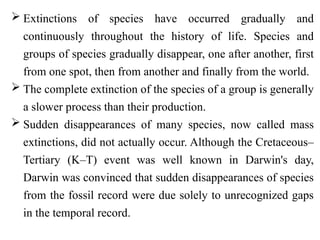
 Extinctions of species have occurred gradually and
continuously throughout the history of life. Species and
groups of species gradually disappear, one after another, first
from one spot, then from another and finally from the world.
 The complete extinction of the species of a group is generally
a slower process than their production.
 Sudden disappearances of many species, now called mass
extinctions, did not actually occur. Although the Cretaceous–
Tertiary (K–T) event was well known in Darwin's day,
Darwin was convinced that sudden disappearances of species
from the fossil record were due solely to unrecognized gaps
in the temporal record.
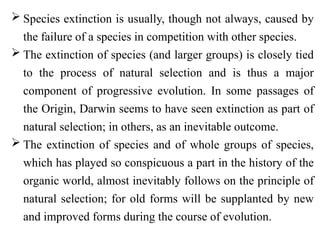
 Species extinction is usually, though not always, caused by
the failure of a species in competition with other species.
 The extinction of species (and larger groups) is closely tied
to the process of natural selection and is thus a major
component of progressive evolution. In some passages of
the Origin, Darwin seems to have seen extinction as part of
natural selection; in others, as an inevitable outcome.
 The extinction of species and of whole groups of species,
which has played so conspicuous a part in the history of the
organic world, almost inevitably follows on the principle of
natural selection; for old forms will be supplanted by new
and improved forms during the course of evolution.
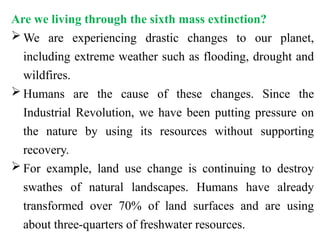
Are we living through the sixth mass extinction?
 We are experiencing drastic changes to our planet,
including extreme weather such as flooding, drought and
wildfires.
 Humans are the cause of these changes. Since the
Industrial Revolution, we have been putting pressure on
the nature by using its resources without supporting
recovery.
 For example, land use change is continuing to destroy
swathes of natural landscapes. Humans have already
transformed over 70% of land surfaces and are using
about three-quarters of freshwater resources.
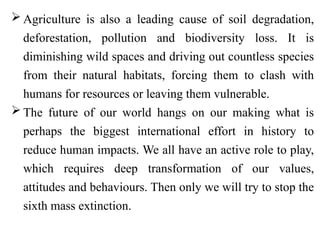
 Agriculture is also a leading cause of soil degradation,
deforestation, pollution and biodiversity loss. It is
diminishing wild spaces and driving out countless species
from their natural habitats, forcing them to clash with
humans for resources or leaving them vulnerable.
 The future of our world hangs on our making what is
perhaps the biggest international effort in history to
reduce human impacts. We all have an active role to play,
which requires deep transformation of our values,
attitudes and behaviours. Then only we will try to stop the
sixth mass extinction.
Thank U

Causes, various types of Extinction.pptx

  • 1.
  • 2.
     Extinction isthe total disappearance of a lineage from earth or death of all members of a species.  The moment of extinction is generally considered to be the death of the last individual of the species, although the capacity to breed and recover may have been lost before this point.  During process of evolution continual turnover of species occurs, new species arise and old ones get extinct.  Extinction plays an important role in the evolution of life because it opens up opportunities for new species to emerge.
  • 3.
     Extinction occurswhen species are diminished because of environmental forces (habitat fragmentation, global change, natural disaster, overexploitation of species for human use) or because of evolutionary changes in their members (genetic inbreeding, poor reproduction, decline in population numbers).  Macroevolution causes lineages to become distributed locally and over specialized making them vulnerable to extinction during environmental change or destruction of habitats.  Intraspecific and interspecific competition also drive species to extinction.
  • 4.
    Causes extinction:  Habitatloss is the primary cause of higher extinction rates.  Other causes include habitat changes, over-exploitation of wildlife for commercial purposes, the introduction of harmful non-native species, pollution and the spread of diseases. Types of extinction:  Extinction is of 2 types a. Background extinction b. Mass extinction
  • 5.
    a. Background extinction: The on-going extinction of individual species due to environmental or ecological factors such as climate change, disease, loss of habitat or competitive disadvantage in relation to other species is known as background extinction or normal extinction.  Occurs regularly at low or average rate and are caused by normal environmental changes like emerging disease or competition among species.  Declining reproductive fitness and decreasing ability to adapt to environmental changes.
  • 6.
    b. Mass extinction: The extinction of a large number of species within a relatively short period of geological time is called as Mass extinction or Biotic crisis  It is a widespread and rapid decrease in the biodiversity on Earth.  These rapid extinctions occurring at mass scale and has catastrophic episodes that wipe out huge number of species and lineages in a short period of time.  A mass extinction event is when species vanish much faster than they are replaced.  In a mass extinction at least 75% of species go extinct within a relatively (by geological standard) short period of time.
  • 7.
     In thelast 500 million years, five great mass extinction events have changed the face of life on Earth. The five mass extinctions in Earth’s history are called the ‘Big Five’.  They are: • End Ordovician (444 million years ago; mya) • Late Devonian (360 mya) • End Permian (250 mya) • End Triassic (200 mya) • End Cretaceous (65 mya)  In the following chart the timing of events in Earth’s history clearly mentioned. It shows the changing extinction
  • 9.
     The Ordovician-Silurianmass extinction: Occurred 444 million years ago and wiped out approximately 86% of all species. Many small marine species died out. Scientists think it was caused by temperatures plummeting and huge glaciers forming, which caused sea levels to drop dramatically. This was followed by a period of rapid warming.  The Devonian mass extinction: Event took place 360 million years ago and killed about three-quarters of the world's species, most of which were marine invertebrates that lived at the bottom of the sea. This was a period of many environmental changes, including global warming and cooling, a rise and fall of sea levels and a reduction in oxygen and carbon dioxide in the atmosphere.
  • 10.
     The Permianmass extinction: Happened 250 million years ago, was the largest and most devastating event of the five. The Permian-Triassic extinction event is also known as the Great Dying. It eradicated more than 96% of all species, including most of the vertebrates which had begun to evolve by this time. Some scientists think Earth was hit by a large asteroid which filled the air with dust particles that blocked out the Sun and caused acid rain. Others think there was a large volcanic explosion which increased carbon dioxide and made the oceans toxic.
  • 11.
     The Triassicmass extinction: Event occurred 200 million years ago, eliminating about 80% of Earth's species, including many types of dinosaurs. This was probably caused by colossal geological activity that increased carbon dioxide levels and global temperatures, as well as ocean acidification.  The Cretaceous mass extinction: Event occurred 65 million years ago, killing 76% of all species, including the remaining non-avian dinosaurs. This was most likely caused by an asteroid hitting the Earth and Volcanic activity.
  • 12.
    Causes mass extinctions: All of the ‘Big Five’ were caused by some combination of rapid and dramatic changes in climate, combined with significant changes in the composition of environments on land or in the ocean (such as ocean acidification or acid rain from intense volcanic activity).  Past mass extinctions were caused by extreme temperature changes,  Rising or falling sea levels and catastrophic,  One-off events like a huge volcano erupting or an asteroid hitting Earth.
  • 13.
     Although thebest-known cause of a mass extinction is the asteroid impact that killed off the non-avian dinosaurs, in fact, volcanic activity seems to have wreaked much more havoc on Earth’s biota.  Here are some hypothesized causes for each of Earth’s biggest mass extinctions: End-Ordovician: • Beginning of glacial cycles on Earth, and corresponding changes in sea level • Changes in atmospheric and oceanic chemistry relating to the rise of the Appalachian mountains
  • 14.
    Late-Devonian extinction: • Climatechange, possibly linked to the diversification of land plants • Decrease in oxygen levels in the deep ocean End-Permian extinction: • Volcanic activity • Climate change • Decrease in oxygen levels in the deep ocean • Changes in atmospheric chemistry • Changes oceanic chemistry and circulation End-Triassic extinction: • Volcanic activity
  • 15.
    End-Cretaceous extinction: • Asteroidimpact • Volcanic activity • Climate change • Changes in atmospheric and oceanic chemistry
  • 17.
    Extinction Event Age(mya) Percentage of species lost Causeof extinctions End Ordovician 444 86% Intense glacial and interglacial periods created large swings in sea levels and moved shorelines dramatically. Tectonic uplift of the Appalachian mountains created lots of weathering, sequestration of CO2 and with it, changes in climate and ocean chemistry. Late Devonian 360 75% Rapid growth and diversification of land plants generated rapid and severe global cooling.
  • 18.
    Extinction Event Age(mya) Percentage of species lost Cause ofextinctions End Permian 250 96% Intense volcanic activity in Siberia. This caused global warming. Elevated CO2 and sulphur (H2S) levels from volcanoes caused ocean acidification, acid rain, and other changes in ocean and land chemistry. End Triassic 200 80% Underwater volcanic activity in the Central Atlantic Magmatic Province (CAMP) caused global warming, and a dramatic change in chemistry composition in the oceans. End Cretaceous 65 76% Asteroid impact in Yucatan, Mexico. This caused global cataclysm and rapid cooling. Some changes may have already pre-dated this asteroid, with intense volcanic activity and tectonic uplift.
  • 19.
  • 20.
     The K-Textinction is characterized by the mass extinction of three-quarters of the plant and animal species present during that time on Earth.  KT extinction stands for Cretaceous-Tertiary Extinction.  It occurred at the end of the Cretaceous period and the beginning of the Tertiary period.  Also called K–Pg extinction or Cretaceous–Paleogene extinction.  This is a global extinction event that witnessed the elimination of about 70-80% of the species living on the earth within a very short period of time i.e., 66 million years ago (between the Cretaceous and Paleogene periods). This mass extinction is known as KT extinction.
  • 21.
     The K–Textinction was characterized by the elimination of many lines of animals that were important elements of the Mesozoic Era  The K–T extinction ranks third in severity of the five major extinction episodes.  The K-T Extinction event is the extinction event known for the fall of dinosaurs.  The species that survived the K-T mass extinction included some ectothermic species like the sea turtles and crocodilians.
  • 22.
     The theoryabout the K-T mass extinction was proposed by Louis Alvarez and his son Luis Walter Alvarez. It is widely accepted theory. They stated that an asteroid about 15 km in diameter hit the earth forming a crater at the tip of the Yucatan Peninsula in Mexico. This crater is known as Chicxulub crater.  The impact of the crater is believed to have penetrated the earth’s crust which released a large amount of dust and debris into the atmosphere and led to tsunami, fires, wind storms, acid rains and volcanic activities. The dust must have blocked the sunlight coming to the earth which would have lowered the earth’s temperature.
  • 24.
     90% marinespecies, 50% of marine genera, 85% of land species and 56% of land genera got extinct as a result of K- T extinction. This catastrophic event marked the advent of the mammalian age.  Dinosaurs form the major group of animals that got extinct during this period. However, it is not proved that the asteroid attack killed the dinosaurs. Many species of dinosaurs have diminished millions of years after the K-T extinction.  The group of reptiles comprising birds, dinosaurs and crocodilians survived the extinction and evolved into modern birds and crocodiles. Among the marine flora and fauna, only 13% of the planktons remained alive.
  • 25.
    Role of extinctionin evolution  Extinctions are a normal part of evolution: they occur naturally and periodically over time.  There’s a natural background rate to the timing and frequency of extinctions: 10% of species are lost every million years; 30% every 10 million years; and 65% every 100 million years.  Evolution occurs through the balance of extinction – the end of species – and speciation – the creation of new ones.
  • 26.
     Extinctions ofspecies have occurred gradually and continuously throughout the history of life. Species and groups of species gradually disappear, one after another, first from one spot, then from another and finally from the world.  The complete extinction of the species of a group is generally a slower process than their production.  Sudden disappearances of many species, now called mass extinctions, did not actually occur. Although the Cretaceous– Tertiary (K–T) event was well known in Darwin's day, Darwin was convinced that sudden disappearances of species from the fossil record were due solely to unrecognized gaps in the temporal record.
  • 27.
     Species extinctionis usually, though not always, caused by the failure of a species in competition with other species.  The extinction of species (and larger groups) is closely tied to the process of natural selection and is thus a major component of progressive evolution. In some passages of the Origin, Darwin seems to have seen extinction as part of natural selection; in others, as an inevitable outcome.  The extinction of species and of whole groups of species, which has played so conspicuous a part in the history of the organic world, almost inevitably follows on the principle of natural selection; for old forms will be supplanted by new and improved forms during the course of evolution.
  • 28.
    Are we livingthrough the sixth mass extinction?  We are experiencing drastic changes to our planet, including extreme weather such as flooding, drought and wildfires.  Humans are the cause of these changes. Since the Industrial Revolution, we have been putting pressure on the nature by using its resources without supporting recovery.  For example, land use change is continuing to destroy swathes of natural landscapes. Humans have already transformed over 70% of land surfaces and are using about three-quarters of freshwater resources.
  • 29.
     Agriculture isalso a leading cause of soil degradation, deforestation, pollution and biodiversity loss. It is diminishing wild spaces and driving out countless species from their natural habitats, forcing them to clash with humans for resources or leaving them vulnerable.  The future of our world hangs on our making what is perhaps the biggest international effort in history to reduce human impacts. We all have an active role to play, which requires deep transformation of our values, attitudes and behaviours. Then only we will try to stop the sixth mass extinction.
  • 30.