MASS
EXTINCTION
PRESENTED BY-
Bhagabati Prasad Padhi
PG Second Year
Roll No.-521Z-022
Dept. of Zoology
S.C.S (Auto) College
DEFINATION- An event in which a considerable
portion of the world’s biodiversity is lost.
Not only the evolution of life on Earth, but also about
the effects of extreme changes in our planet's
atmosphere, and how life finds ways to rebound.
Rate of extinction ∝
1
Rate of Speciation
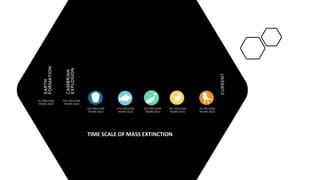
TIME SCALE OF MASS EXTINCTION
The Ordovician
- Silurian
Extinction
This consists of two consecutive mass extinctions.
When combined together ,O-S is widely considered to
be the second most catastrophic event in history.
TIME PERIOD- About 450–440 million years ago.
EFFECTS- 60% to 70% of all species were vanquished.
This included 85% of marine species that died.
CAUSES- Massive glaciation and sea-level drop.
The Late
Devonian
Extinction
The Late Devonian Extinction was less severe than the
other mass extinctions
TIME PERIOD- It occurred 375–360 million years ago at
the end of the Devonian Period.
EFFECTS- At least 70% of all species went extinct. This
mass extinction lasted for over 20 million years.
CAUSES- Though opinions vary, the biggest evidence is
attributed to global anoxia. The oxygen shortage was
possibly triggered by global cooling or oceanic volcanism.
The Permian -
Triassic
Extinction
The Permian-Triassic Extinction was such a devastating
event that it had the nickname the “Great Dying” because
of its significance.
TIME PERIOD- The Permian-Triassic Extinction happened
252 million years ago.
EFFECTS- Earth’s largest extinction event in history killed
96% of all marine species and about 70% of land species. It
took 30 million years for vertebrates to fully recover. Highly
successful marine arthropod and trilobite also went extinct.
CAUSES- Severe volcanic activity, environmental change and
long-term methane release.
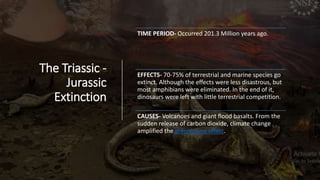
The Triassic -
Jurassic
Extinction
TIME PERIOD- Occurred 201.3 Million years ago.
EFFECTS- 70-75% of terrestrial and marine species go
extinct. Although the effects were less disastrous, but
most amphibians were eliminated. In the end of it,
dinosaurs were left with little terrestrial competition.
CAUSES- Volcanoes and giant flood basalts. From the
sudden release of carbon dioxide, climate change
amplified the greenhouse effect.
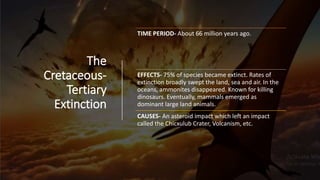
The
Cretaceous-
Tertiary
Extinction
TIME PERIOD- About 66 million years ago.
EFFECTS- 75% of species became extinct. Rates of
extinction broadly swept the land, sea and air. In the
oceans, ammonites disappeared. Known for killing
dinosaurs. Eventually, mammals emerged as
dominant large land animals.
CAUSES- An asteroid impact which left an impact
called the Chicxulub Crater, Volcanism, etc.
Sixth Mass
Extinction
We are at present in the middle of the sixth mass extinction,
and humans are the causative. They have already killed
most of the animal species for their own recreational
activities and benefits.
The invasive species were transported from one part of the
world to other part that eliminated the native species
resided in that part. Immigration and emigration of humans
and animals have spread several diseases in different parts
of the world where they were absent.
Biomagnification harmed marine life to a greater extent.
The natural available resources are depleting because of the
growing population. The heavy pollution led to an increase
in the temperatures and water levels in oceans that would
have several catastrophic effects in the coming future.
CONCLUSION
 In effect, a mass extinction cleans the slate, creating new evolutionary niches which
promote a wide range of species, increasing biodiversity, competition.
 In some cases increasing complexity in organisms. We are an example of the aftermath of
mass extinctions.
 The rate of change is important because animals can only adapt over long periods of time.
 If a change happens too quickly, many animals will go extinct because they are not able to
adapt in time.
 We are already seeing major groups of animals suffering, such as amphibians and coral
reefs, both of which rely on specific amounts of water and temperatures to survive.
BIBLIOGRAPHY
 https://www.nationalgeographic.com/science/article/mass-extinction
 https://www.researchgate.net/publication/253584386_The_History_Origins_and_Causes_o
f_Mass_Extinctions#:~:text=Mass%20extinctions%20during%20the%20Ordovician,to%2058
0%20mya)%2C%20and%20the
 https://www.vedantu.com/biology/mass-extinction
 https://biologydictionary.net/mass-extinction/
MASS EXTINCTION

MASS EXTINCTION

  • 1.
    MASS EXTINCTION PRESENTED BY- Bhagabati PrasadPadhi PG Second Year Roll No.-521Z-022 Dept. of Zoology S.C.S (Auto) College
  • 2.
    DEFINATION- An eventin which a considerable portion of the world’s biodiversity is lost. Not only the evolution of life on Earth, but also about the effects of extreme changes in our planet's atmosphere, and how life finds ways to rebound. Rate of extinction ∝ 1 Rate of Speciation
  • 3.
    TIME SCALE OFMASS EXTINCTION
  • 4.
    The Ordovician - Silurian Extinction Thisconsists of two consecutive mass extinctions. When combined together ,O-S is widely considered to be the second most catastrophic event in history. TIME PERIOD- About 450–440 million years ago. EFFECTS- 60% to 70% of all species were vanquished. This included 85% of marine species that died. CAUSES- Massive glaciation and sea-level drop.
  • 5.
    The Late Devonian Extinction The LateDevonian Extinction was less severe than the other mass extinctions TIME PERIOD- It occurred 375–360 million years ago at the end of the Devonian Period. EFFECTS- At least 70% of all species went extinct. This mass extinction lasted for over 20 million years. CAUSES- Though opinions vary, the biggest evidence is attributed to global anoxia. The oxygen shortage was possibly triggered by global cooling or oceanic volcanism.
  • 6.
    The Permian - Triassic Extinction ThePermian-Triassic Extinction was such a devastating event that it had the nickname the “Great Dying” because of its significance. TIME PERIOD- The Permian-Triassic Extinction happened 252 million years ago. EFFECTS- Earth’s largest extinction event in history killed 96% of all marine species and about 70% of land species. It took 30 million years for vertebrates to fully recover. Highly successful marine arthropod and trilobite also went extinct. CAUSES- Severe volcanic activity, environmental change and long-term methane release.
  • 7.
    The Triassic - Jurassic Extinction TIMEPERIOD- Occurred 201.3 Million years ago. EFFECTS- 70-75% of terrestrial and marine species go extinct. Although the effects were less disastrous, but most amphibians were eliminated. In the end of it, dinosaurs were left with little terrestrial competition. CAUSES- Volcanoes and giant flood basalts. From the sudden release of carbon dioxide, climate change amplified the greenhouse effect.
  • 8.
    The Cretaceous- Tertiary Extinction TIME PERIOD- About66 million years ago. EFFECTS- 75% of species became extinct. Rates of extinction broadly swept the land, sea and air. In the oceans, ammonites disappeared. Known for killing dinosaurs. Eventually, mammals emerged as dominant large land animals. CAUSES- An asteroid impact which left an impact called the Chicxulub Crater, Volcanism, etc.
  • 9.
    Sixth Mass Extinction We areat present in the middle of the sixth mass extinction, and humans are the causative. They have already killed most of the animal species for their own recreational activities and benefits. The invasive species were transported from one part of the world to other part that eliminated the native species resided in that part. Immigration and emigration of humans and animals have spread several diseases in different parts of the world where they were absent. Biomagnification harmed marine life to a greater extent. The natural available resources are depleting because of the growing population. The heavy pollution led to an increase in the temperatures and water levels in oceans that would have several catastrophic effects in the coming future.
  • 11.
    CONCLUSION  In effect,a mass extinction cleans the slate, creating new evolutionary niches which promote a wide range of species, increasing biodiversity, competition.  In some cases increasing complexity in organisms. We are an example of the aftermath of mass extinctions.  The rate of change is important because animals can only adapt over long periods of time.  If a change happens too quickly, many animals will go extinct because they are not able to adapt in time.  We are already seeing major groups of animals suffering, such as amphibians and coral reefs, both of which rely on specific amounts of water and temperatures to survive.
  • 12.