GS303: Biostratigraphy & Paleoecology
Dr. Abu Sadat Md. Sayem
Jahangirnagar University
Lecture 6: Major Mass Extinctions
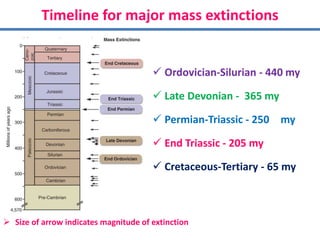
Timeline for major mass extinctions
 Ordovician-Silurian - 440 my
 Late Devonian - 365 my
 Permian-Triassic - 250 my
 End Triassic - 205 my
 Cretaceous-Tertiary - 65 my
 Size of arrow indicates magnitude of extinction
Agent of mass extinction
Catastrophic
– Extraterrestrial impacts such as meteorites or
comet showers
– Gamma ray bombardment
Geologic
– Volcanism,
– Glaciation,
– Global climate change (warming or cooling),
– Sea level change etc.
Ordovician-Silurian Extinction
 The earliest of the five mass extinctions.
 Happened about 440 million years ago.
 The Ordovician era lasted from 510 to 440 mya, and ended
with a mass extinction, know as Ordovician/Ordovician-
Silurian mass extinction.
 It is the second largest/devastating of the five major
extinction events in Earth’s history in terms of percentage of
genera.
 Started at a major extinction, called Cambrian-Ordovician
extinction (488.3 +/- 1.7 Ma) lasted about 44.6 million years.
 Ended with the Ordovician-Silurian event, about 443.7 +/- 1.5
Ma).
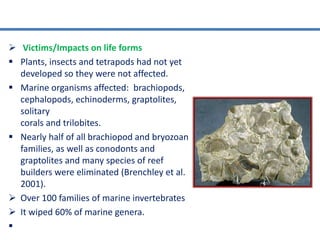
 Victims/Impacts on life forms
 Plants, insects and tetrapods had not yet
developed so they were not affected.
 Marine organisms affected: brachiopods,
cephalopods, echinoderms, graptolites,
solitary
corals and trilobites.
 Nearly half of all brachiopod and bryozoan
families, as well as conodonts and
graptolites and many species of reef
builders were eliminated (Brenchley et al.
2001).
 Over 100 families of marine invertebrates
 It wiped 60% of marine genera.

 Suggested causes include:
 Climate change - global cooling and glaciation
 A drop in sea level and shorelines disappeared
 Asteroid or comet impacts,
 A gamma ray burst.
 Contributing factors included plate tectonics and continental
drift; i.e. the passage of the giant supercontinent,
Gondwana, over the north pole (Brenchley et al. 2001)
Late Devonian Extinction
 The Devonian age (410 mya to 360 mya) also ended
with another mass extinction.
 The second of the five mass extinctions.
 Happened about 365 million years ago.
 This event eliminate 70-80% of animal species.
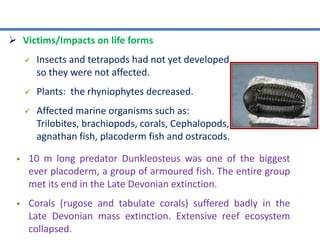
 Victims/Impacts on life forms
 Insects and tetrapods had not yet developed
so they were not affected.
 Plants: the rhyniophytes decreased.
 Affected marine organisms such as:
Trilobites, brachiopods, corals, Cephalopods,
agnathan fish, placoderm fish and ostracods.
 10 m long predator Dunkleosteus was one of the biggest
ever placoderm, a group of armoured fish. The entire group
met its end in the Late Devonian extinction.
 Corals (rugose and tabulate corals) suffered badly in the
Late Devonian mass extinction. Extensive reef ecosystem
collapsed.
 Suggested causes include:
– The causes of these extinctions are unclear.
– Leading hypotheses include changes in sea level and
ocean anoxia.
– Possibility of climate change - a global ice age
– oceanic volcanism.
– Perhaps triggered by multiple asteroid/bolide
impacts.
The End Permian/Permian Mass Extinction
 The Permian era ranged from 290 mya to 251 mya, and
ended with yet another spectacular mass extinction.
 It is the third and biggest of the five mass extinctions
happened about 251 million years ago.
 It was most devastating mass extinction in the history
of our planet bringing death to a terrifying 83% of all
genera.
 Nearly 96% of all species of marine animal were
destroyed (Raup 1992).
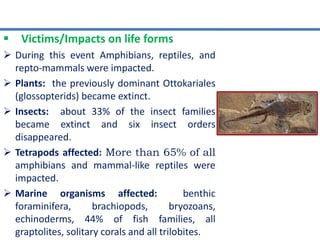
 Victims/Impacts on life forms
 During this event Amphibians, reptiles, and
repto-mammals were impacted.
 Plants: the previously dominant Ottokariales
(glossopterids) became extinct.
 Insects: about 33% of the insect families
became extinct and six insect orders
disappeared.
 Tetrapods affected: More than 65% of all
amphibians and mammal-like reptiles were
impacted.
 Marine organisms affected: benthic
foraminifera, brachiopods, bryozoans,
echinoderms, 44% of fish families, all
graptolites, solitary corals and all trilobites.
• Suggested/speculated causes include:
 Numerous theories abound as to the causes, which
may have been multiple. These include:
 Bolide/metoritic impact, volcanic eruptions (Benton
and Twitchett 2003).
 Climate change - Glaciation followed by global
warming (Kidder and Worsley 2004).
 A drop in sea level, oceanic anoxia.
 Massive carbon dioxide (CO2) poisoning.
 The explosion of a supernov.,
 Plate tectonics during the formation of Pangea
The end Triassic mass extinction
 The Triassic period extends from about 250 to 200
Ma and marked by the fourth of the five mass
extinctions.
 It happened around 205 million years ago.
 Triassic is also marked by the evolution of the
mammal-like therapsids, the first flying vertebrates
and the pterosaurs.
 The Triassic climate is believed to have been
generally hot and dry.
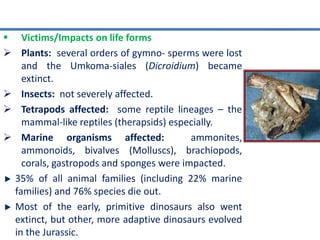
 Victims/Impacts on life forms
 Plants: several orders of gymno- sperms were lost
and the Umkoma-siales (Dicroidium) became
extinct.
 Insects: not severely affected.
 Tetrapods affected: some reptile lineages – the
mammal-like reptiles (therapsids) especially.
 Marine organisms affected: ammonites,
ammonoids, bivalves (Molluscs), brachiopods,
corals, gastropods and sponges were impacted.
35% of all animal families (including 22% marine
families) and 76% species die out.
Most of the early, primitive dinosaurs also went
extinct, but other, more adaptive dinosaurs evolved
in the Jurassic.
• Suggested/speculated causes include:
 The possible causes are many, including:
 Asteroid impacts which may have contributed to the breaking
up of the Pangaea supercontinent (Joseph 2000).
 The planet was also plagued by huge volcanic eruptions which
coincided with the fracturing of Pangea (Tanner et al. 2004).
 Associated factors include continental flood and flood basalts,
increases in carbon dioxide and depletion of oxygen levels and
increased anoxia (Ward et al. 2004).
 Global cooling perhaps secondary to sunlight blocking debris
tossed into the atmosphere following bolide impact or
widespread volcanic emissions.
The end Cretaceous mass extinction
 The Cretaceous period began around 135 mya and
came to a sudden and catastrophic end ~65 million
years ago with the extinction of the dinosaurs and
many, many other prehistoric life forms.
 This is the final extensive extinction event in the
history of the Earth.
 The first placental mammals appeared at the
beginning of the Cretaceous.
 The Cretaceous saw the rise and extinction of the
toothed birds.
 During the Cretaceous, primitive flowering plants
(anthophytes, also called angiosperms) continued to
develop.
 The Cretaceous–Tertiary boundary is usually marked by a
thin band of rock and is simply know as K-T boundary.
 This boundary is also know known as the Cretaceous–Paleogene
(K–Pg) boundary.
 The K-T boundary is formerly known as the end of the Mesozoic
Era (Cretaceous Period) and the beginning of the Cenozoic Era
(Paleogene Period).
 The K-T boundary is estimate around 65 Ma of age.
 The K–T boundary is associated with the end Cretaceous
extinction event, a mass extinction which destroyed a majority of
the world's Mesozoic species, including all dinosaurs except
for birds.
 The end Cretaceous extinction is also know as K-T extinction
event to many researcher.
K-T boundary! What is it?
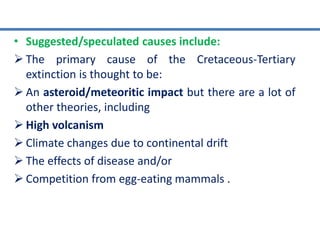
• Victims/Impacts on life forms
 Although the Cretaceous Extinction is associated
with elimination of the dinosaurs, there are
estimates that up to 76% of all species were nearly
destroyed.
 The victims included a variety of plants, marine
reptiles, diatoms, dinoflagellates, and
nannoplankton.
 Plants: debatably up to 75% of species impacted.
 Insects: not severely affected.
 Tetrapods affected: 36 families from 3 groups (all
dinosaurs , plesiosaurs and pterosaurs).
 Marine organisms affected: ammonites,
ammonoids, cephalopods, bivalves, foraminifera,
icthyosaurs, mosasaurs, plackton and rudists.
• Suggested/speculated causes include:
 The primary cause of the Cretaceous-Tertiary
extinction is thought to be:
 An asteroid/meteoritic impact but there are a lot of
other theories, including
 High volcanism
 Climate changes due to continental drift
 The effects of disease and/or
 Competition from egg-eating mammals .
 Two major catastrophes may have caused K/T extinction. These are:
– Asteroid impact and
– Volcanic eruptions
 For example sediment dated to the K-T extinction event contains
unusually high concentrations of Iridium, shocked quartz, and
basalt.
 All of which are associated with meteor impact (Alvarez 2008).
 Iridium has two major sources: the earth's mantle, and meteors and
asteroids.
 Therefore, the widespread distribution of Iridium, the presence of
shocked quartz which is indicative of high pressure of impact,
coupled with small droplets of basalt which usually result when the
Earth's crust has been melted, indicate the Earth was struck by an
asteroid, probably in the area which today is known as Yucatan
Peninsula of Mexico (Alvarez 2008).
Meteoritic impact and Volcanism hypothesis for K-T
extinction
 On the other hand, since Iridium is also associated with the
Earth's mantle, and given the extensive volcanic deposits dated
to the K/T boundary, it has been argued that volcanic eruptions
ejected tremendous amounts of ash into the atmosphere,
blocking sunlight, and causing temperatures to fall and altering
the chemistry of the Earth's ocean's and atmosphere.
 In addition, iridium is an element that is very rare in Earth rocks
and very common in meteorites. The layer of rocks above the
last dinosaur bones contains ~160 times ‘normal’ levels of
iridium.
 Therefore, it may have been surmise that a confluence of
catastrophes, asteroid impact and volcanoes which triggered
the K/T extinction event.
 Out-dated Hypotheses of K-T extinction
 Hay Fever - caused by flowering plants
 Dinosaurs were so big, that they crushed themselves
 Mammals out-competed the dinosaurs
 Mammals ate all the dinosaur eggs
 Cosmic rays killed the dinosaurs
 Some species of dinosaurs became too bulky and lost their
breeding ability.
Thank You

GS303_L6_Major-Mass-Extinction.pptx

  • 1.
    GS303: Biostratigraphy &Paleoecology Dr. Abu Sadat Md. Sayem Jahangirnagar University Lecture 6: Major Mass Extinctions
  • 2.
    Timeline for majormass extinctions  Ordovician-Silurian - 440 my  Late Devonian - 365 my  Permian-Triassic - 250 my  End Triassic - 205 my  Cretaceous-Tertiary - 65 my  Size of arrow indicates magnitude of extinction
  • 3.
    Agent of massextinction Catastrophic – Extraterrestrial impacts such as meteorites or comet showers – Gamma ray bombardment Geologic – Volcanism, – Glaciation, – Global climate change (warming or cooling), – Sea level change etc.
  • 4.
    Ordovician-Silurian Extinction  Theearliest of the five mass extinctions.  Happened about 440 million years ago.  The Ordovician era lasted from 510 to 440 mya, and ended with a mass extinction, know as Ordovician/Ordovician- Silurian mass extinction.  It is the second largest/devastating of the five major extinction events in Earth’s history in terms of percentage of genera.  Started at a major extinction, called Cambrian-Ordovician extinction (488.3 +/- 1.7 Ma) lasted about 44.6 million years.  Ended with the Ordovician-Silurian event, about 443.7 +/- 1.5 Ma).
  • 5.
     Victims/Impacts onlife forms  Plants, insects and tetrapods had not yet developed so they were not affected.  Marine organisms affected: brachiopods, cephalopods, echinoderms, graptolites, solitary corals and trilobites.  Nearly half of all brachiopod and bryozoan families, as well as conodonts and graptolites and many species of reef builders were eliminated (Brenchley et al. 2001).  Over 100 families of marine invertebrates  It wiped 60% of marine genera. 
  • 6.
     Suggested causesinclude:  Climate change - global cooling and glaciation  A drop in sea level and shorelines disappeared  Asteroid or comet impacts,  A gamma ray burst.  Contributing factors included plate tectonics and continental drift; i.e. the passage of the giant supercontinent, Gondwana, over the north pole (Brenchley et al. 2001)
  • 7.
    Late Devonian Extinction The Devonian age (410 mya to 360 mya) also ended with another mass extinction.  The second of the five mass extinctions.  Happened about 365 million years ago.  This event eliminate 70-80% of animal species.
  • 8.
     Victims/Impacts onlife forms  Insects and tetrapods had not yet developed so they were not affected.  Plants: the rhyniophytes decreased.  Affected marine organisms such as: Trilobites, brachiopods, corals, Cephalopods, agnathan fish, placoderm fish and ostracods.  10 m long predator Dunkleosteus was one of the biggest ever placoderm, a group of armoured fish. The entire group met its end in the Late Devonian extinction.  Corals (rugose and tabulate corals) suffered badly in the Late Devonian mass extinction. Extensive reef ecosystem collapsed.
  • 9.
     Suggested causesinclude: – The causes of these extinctions are unclear. – Leading hypotheses include changes in sea level and ocean anoxia. – Possibility of climate change - a global ice age – oceanic volcanism. – Perhaps triggered by multiple asteroid/bolide impacts.
  • 10.
    The End Permian/PermianMass Extinction  The Permian era ranged from 290 mya to 251 mya, and ended with yet another spectacular mass extinction.  It is the third and biggest of the five mass extinctions happened about 251 million years ago.  It was most devastating mass extinction in the history of our planet bringing death to a terrifying 83% of all genera.  Nearly 96% of all species of marine animal were destroyed (Raup 1992).
  • 11.
     Victims/Impacts onlife forms  During this event Amphibians, reptiles, and repto-mammals were impacted.  Plants: the previously dominant Ottokariales (glossopterids) became extinct.  Insects: about 33% of the insect families became extinct and six insect orders disappeared.  Tetrapods affected: More than 65% of all amphibians and mammal-like reptiles were impacted.  Marine organisms affected: benthic foraminifera, brachiopods, bryozoans, echinoderms, 44% of fish families, all graptolites, solitary corals and all trilobites.
  • 12.
    • Suggested/speculated causesinclude:  Numerous theories abound as to the causes, which may have been multiple. These include:  Bolide/metoritic impact, volcanic eruptions (Benton and Twitchett 2003).  Climate change - Glaciation followed by global warming (Kidder and Worsley 2004).  A drop in sea level, oceanic anoxia.  Massive carbon dioxide (CO2) poisoning.  The explosion of a supernov.,  Plate tectonics during the formation of Pangea
  • 13.
    The end Triassicmass extinction  The Triassic period extends from about 250 to 200 Ma and marked by the fourth of the five mass extinctions.  It happened around 205 million years ago.  Triassic is also marked by the evolution of the mammal-like therapsids, the first flying vertebrates and the pterosaurs.  The Triassic climate is believed to have been generally hot and dry.
  • 14.
     Victims/Impacts onlife forms  Plants: several orders of gymno- sperms were lost and the Umkoma-siales (Dicroidium) became extinct.  Insects: not severely affected.  Tetrapods affected: some reptile lineages – the mammal-like reptiles (therapsids) especially.  Marine organisms affected: ammonites, ammonoids, bivalves (Molluscs), brachiopods, corals, gastropods and sponges were impacted. 35% of all animal families (including 22% marine families) and 76% species die out. Most of the early, primitive dinosaurs also went extinct, but other, more adaptive dinosaurs evolved in the Jurassic.
  • 15.
    • Suggested/speculated causesinclude:  The possible causes are many, including:  Asteroid impacts which may have contributed to the breaking up of the Pangaea supercontinent (Joseph 2000).  The planet was also plagued by huge volcanic eruptions which coincided with the fracturing of Pangea (Tanner et al. 2004).  Associated factors include continental flood and flood basalts, increases in carbon dioxide and depletion of oxygen levels and increased anoxia (Ward et al. 2004).  Global cooling perhaps secondary to sunlight blocking debris tossed into the atmosphere following bolide impact or widespread volcanic emissions.
  • 16.
    The end Cretaceousmass extinction  The Cretaceous period began around 135 mya and came to a sudden and catastrophic end ~65 million years ago with the extinction of the dinosaurs and many, many other prehistoric life forms.  This is the final extensive extinction event in the history of the Earth.  The first placental mammals appeared at the beginning of the Cretaceous.  The Cretaceous saw the rise and extinction of the toothed birds.  During the Cretaceous, primitive flowering plants (anthophytes, also called angiosperms) continued to develop.
  • 17.
     The Cretaceous–Tertiaryboundary is usually marked by a thin band of rock and is simply know as K-T boundary.  This boundary is also know known as the Cretaceous–Paleogene (K–Pg) boundary.  The K-T boundary is formerly known as the end of the Mesozoic Era (Cretaceous Period) and the beginning of the Cenozoic Era (Paleogene Period).  The K-T boundary is estimate around 65 Ma of age.  The K–T boundary is associated with the end Cretaceous extinction event, a mass extinction which destroyed a majority of the world's Mesozoic species, including all dinosaurs except for birds.  The end Cretaceous extinction is also know as K-T extinction event to many researcher. K-T boundary! What is it?
  • 18.
    • Victims/Impacts onlife forms  Although the Cretaceous Extinction is associated with elimination of the dinosaurs, there are estimates that up to 76% of all species were nearly destroyed.  The victims included a variety of plants, marine reptiles, diatoms, dinoflagellates, and nannoplankton.  Plants: debatably up to 75% of species impacted.  Insects: not severely affected.  Tetrapods affected: 36 families from 3 groups (all dinosaurs , plesiosaurs and pterosaurs).  Marine organisms affected: ammonites, ammonoids, cephalopods, bivalves, foraminifera, icthyosaurs, mosasaurs, plackton and rudists.
  • 19.
    • Suggested/speculated causesinclude:  The primary cause of the Cretaceous-Tertiary extinction is thought to be:  An asteroid/meteoritic impact but there are a lot of other theories, including  High volcanism  Climate changes due to continental drift  The effects of disease and/or  Competition from egg-eating mammals .
  • 20.
     Two majorcatastrophes may have caused K/T extinction. These are: – Asteroid impact and – Volcanic eruptions  For example sediment dated to the K-T extinction event contains unusually high concentrations of Iridium, shocked quartz, and basalt.  All of which are associated with meteor impact (Alvarez 2008).  Iridium has two major sources: the earth's mantle, and meteors and asteroids.  Therefore, the widespread distribution of Iridium, the presence of shocked quartz which is indicative of high pressure of impact, coupled with small droplets of basalt which usually result when the Earth's crust has been melted, indicate the Earth was struck by an asteroid, probably in the area which today is known as Yucatan Peninsula of Mexico (Alvarez 2008). Meteoritic impact and Volcanism hypothesis for K-T extinction
  • 21.
     On theother hand, since Iridium is also associated with the Earth's mantle, and given the extensive volcanic deposits dated to the K/T boundary, it has been argued that volcanic eruptions ejected tremendous amounts of ash into the atmosphere, blocking sunlight, and causing temperatures to fall and altering the chemistry of the Earth's ocean's and atmosphere.  In addition, iridium is an element that is very rare in Earth rocks and very common in meteorites. The layer of rocks above the last dinosaur bones contains ~160 times ‘normal’ levels of iridium.  Therefore, it may have been surmise that a confluence of catastrophes, asteroid impact and volcanoes which triggered the K/T extinction event.
  • 22.
     Out-dated Hypothesesof K-T extinction  Hay Fever - caused by flowering plants  Dinosaurs were so big, that they crushed themselves  Mammals out-competed the dinosaurs  Mammals ate all the dinosaur eggs  Cosmic rays killed the dinosaurs  Some species of dinosaurs became too bulky and lost their breeding ability.
  • 23.

Editor's Notes

  • #3 Mention the timeline for the major mass extinction in the history of earth.
  • #21 How could a meteorite impact cause a mass extinction?
  • #24 Mention the percentage of species wiped out during the massive mass extinctions in the geologic history.