CHOICE
THEORY/REALITY
THERAPY
Chapter 12
Dr. Kim Mason
Choice Theory/Reality Therapy
Background
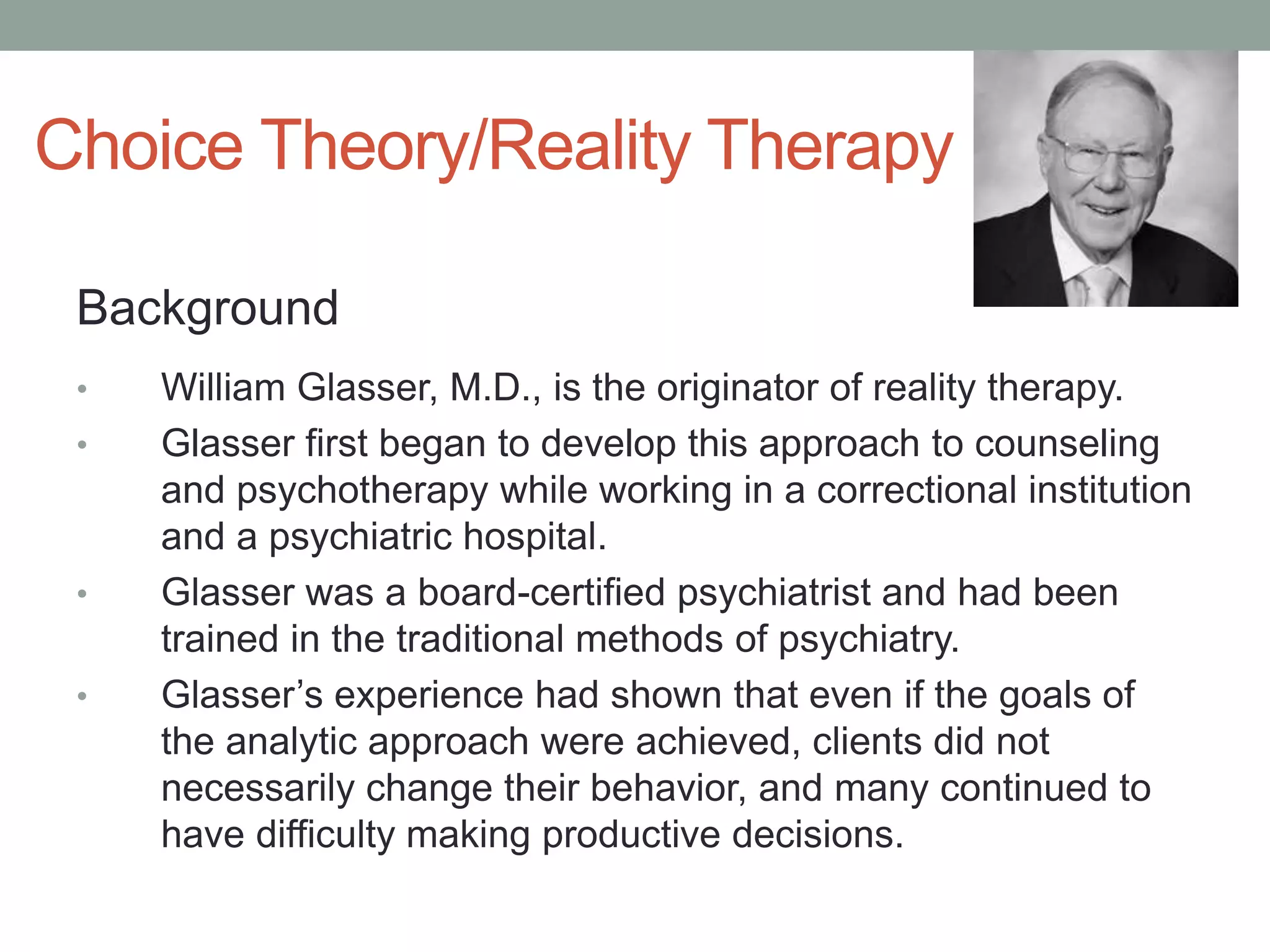
• William Glasser, M.D., is the originator of reality therapy.
• Glasser first began to develop this approach to counseling
and psychotherapy while working in a correctional institution
and a psychiatric hospital.
• Glasser was a board-certified psychiatrist and had been
trained in the traditional methods of psychiatry.
• Glasser’s experience had shown that even if the goals of
the analytic approach were achieved, clients did not
necessarily change their behavior, and many continued to
have difficulty making productive decisions.
Choice Theory/Reality Therapy
Background
• Glasser emphasized that people are responsible for
their own behavior and that they cannot blame the past,
or outside forces, and at the same time achieve a high
degree of mental health.
• Glasser asserted that behavior involves choices and
that there are always options open to most people.
• Though not greeted enthusiastically by the medical
profession, Glasser’s theory was well received by many,
including corrections personnel, youth workers,
counselors, therapists, and educators.
Choice Theory/Reality Therapy
Background
• Glasser felt that three gradual, but important changes,
facilitated the arrival of the “identity society”— a world in
which persons are more focused on their identity needs
than on their survival needs:
1. The passage of laws that guaranteed human rights.
2. Increased affluence that satisfied the basic need of survival.
3. The advent of instant communication via electronic media.
Choice Theory/Reality Therapy
Background
• Reality therapy found acceptance because it is a theory
that facilitates personal empowerment by means of self-
evaluation and positive planning for the future.
• Powers described the brain as an input control system
similar to a thermostat that controls the temperature of a
room.
• Glasser extended Powers’ control theory (or control
system theory) by incorporating a system of needs to
explain human motivation and then molded the theory
to the clinical setting and the practice of counseling and
psychotherapy.
Choice Theory/Reality Therapy
Background
• With the addition of these and many other ideas, it was
no longer appropriate to call Glasser’s theory “control
theory” and consequently the recognized name is now
choice theory. The delivery system is reality therapy.
• Another major development in reality therapy is the
extended application described by Robert Wubbolding.
• The WDEP formulation provides a pedagogical tool for
learning and practicing the process of reality therapy.
Choice Theory/Reality Therapy
Background
• Wubbolding has also extended the theory to
multicultural counseling based on his experience
working in Asia, Europe, and the Middle East.
Additionally, he has provided credibility for the system
by emphasizing research data and scientific validation.
Choice Theory/Reality Therapy
Background
• In 2008 the European Association for
Psychotherapy recognized reality therapy
as a scientific and valid system after an
eight-year effort by the European
Association for Reality Therapy. This
recognition is founded on two
requirements: Empirical validation and the
existence of six national European reality
therapy organizations.
Choice Theory/Reality Therapy
WDEP
• W = Implies that the counselor helps clients explore their wants.
• D = Means that clients describe the direction of their lives as well
as what they are currently doing or how they spend their time.
• E = Indicates that the counselor or therapist helps in the client’s
self-Evaluation by asking such questions as “Are your current
actions effective?”
• P = Clients are then helped to make simple and attainable action
plans.
Choice Theory/Reality Therapy
Human Nature: A Developmental Perspective
• As people grow, they develop specific wants unique to
themselves.
• Though the behavior of all human beings is designed to
fulfill inner needs, it differs according to age and culture.
• Human behavior has an impact on the external world
and, in a sense, shapes it as a sculptor molds clay.
• As a result, the input or perception that one gets from
the world—a person’s worldview (perception)—is
dynamic, always changing, and unique to each person
depending on age and culture.
•
Choice Theory/Reality Therapy
Human Nature: A Developmental Perspective
• Wubbolding emphasizes the necessity of interpersonal
quality time as a facilitative component of healthy
development.
• In order for quality time to serve as a solid support for
effective growth and development, it must be
characterized by the following traits…
• Effort
• Awareness
• Repetition
• Free of Criticism and Complaint
• Need-Fulfilling for all Persons
• Performed for a Limited Time
•
Choice Theory/Reality Therapy
Major Constructs
• Choice Theory: Human beings act on the world around them for
a purpose, to satisfy their needs and wants.
• Total Behavior: Glasser speaks of total behavior, which is
comprised of action, thinking, feelings, and physiology.
• All behaviors contain these four elements, although one element
or another is more obvious at a given moment.
• Such behaviors, negative or positive, are the output generated
from within a person in order to gain a sense of control or to
satisfy needs.
Choice Theory/Reality Therapy
Major Constructs
• Symptoms are the result of choices we’ve made
• We can choose to think, feel and behave differently
• Reality therapy is based on Choice Theory
• Emphasis is on personal responsibility
• Therapist’s function is to keep therapy focused on the
present and not on symptoms
• The notion of transference is rejected by reality
therapists.
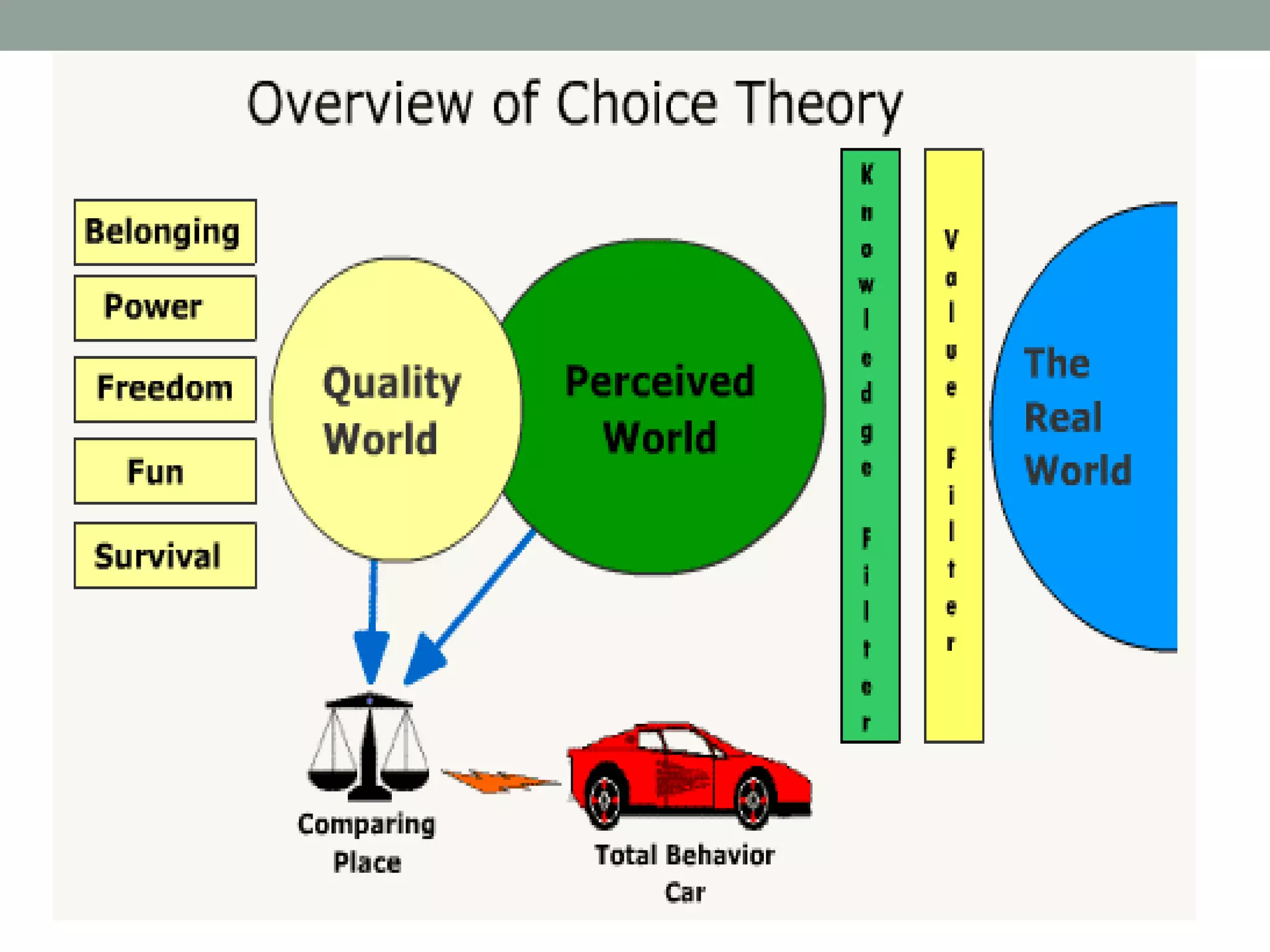
• Basic Needs
• Quality World
• Perceived World (Perceptual System)
• Total Behavior
Four Components of Choice Theory
Basic Human Needs
• Human beings are born with five needs. These needs
are general and universal.
• All internally motivated behavior is geared toward
meeting one or more of our basic genetically
encoded needs:
• Belonging
• Power
• Freedom
• Fun
• Survival (Physiological needs)
Basic Human Needs Assumptions
• We often mistakenly choose misery in our best
attempt to meet our needs.
• We act responsibly when we meet our needs without
keeping others from meeting their needs.
• Preeminent among these general and universal
human needs is that of belonging.
• Along with wants, which are specific and unique for
each person, needs serve as the motivators or
sources of all behavior.
Basic Human Needs Assumptions
• The difference between what a person wants and
what one perceives one is getting (input) is the
immediate source of specific behaviors at any given
moment.
• Thus, reality therapy rests on the principle that
human behavior springs from internal motivation,
producing behavior from moment to moment.
• Choice Theory (and the Seven Caring Habits) is offered to
replace external control psychology (and the Seven Deadly
Habits), the present psychology of almost all the people in the
world.
• When used in a relationship punishing psychology will always
destroy the ability of one or both to find satisfaction in that
relationship, and will result in people becoming disconnected
from those with whom they want to be connected.
• Disconnectedness is the source of almost all human
problems, such as what is called mental illness, drug
addiction, violence, crime, school failure, spousal and child
abuse, to mention a few.
7 Caring & Deadly Habits
Seven Caring Habits
1. Supporting
2. Encouraging
3. Listening
4. Accepting
5. Trusting
6. Respecting
7. Negotiating differences
Seven Deadly Habits
1. Criticizing
2. Blaming
3. Complaining
4. Nagging
5. Threatening
6. Punishing
7. Bribing or rewarding to
control
Our Quality World
• Our quality world consists of our visions of specific
people, activities, events, beliefs and situations that
will fulfill our needs
• Our quality world is like a picture album of specific
wants as well as precise ways to satisfy these wants
• Getting into the clients’ quality world is the art of
therapy
• Ideal world – how we want our life to be
• Who would we put in that world?
(people/activities/beliefs)
• Can conflict with other pictures thus; help
clients prioritize their pictures; teach them how
to balance their quality worlds
Quality World
• Human beings see the world through a perceptual system
that functions as a set of lenses.
• The only way we experience the real world is through our
perceptual system.
• When information passes through our knowledge filter, one
of three things happens:
• We decide that the information is not meaningful to us and the
perception stops there,
• We do not immediately recognize the information, but believe it may
be meaningful to us so we have some incentive to gain more
information
• The information is meaningful to us and therefore passes through the
next filter, the valuing filter.
Perceived World (Perceptual World)
• At a high level of perception, the person puts a
positive or negative value on the perception.
• Wubbolding & Brickell (2009) suggest that a middle
level filter exists whereby human beings see
relationships between people, things, ideas, etc., a
necessary pre-requisite for placing a value on the
perception.
Perceived World (Perceptual World)
• Our Perceived Worlds are, for each of us, our reality.
Because they are made up of perceptions, our Perceived
Worlds are:
• Highly subjective: based on one's culture, education,
experience, gender, age, etc.
• Unique
• Subject to constant change (new information, new experiences
= new perceptions)
• Frequently inaccurate
• We can frequently choose to perceive people, places, and
situations in a number of ways.
Perceived World (Perceptual World)
Total Behavior
All human behaviors are composed of doing (actions),
thinking, feelings, and physiology.
Behaviors are identified by the most obvious aspect of this
total behavior
• Doing – active behaviors
• Thinking – thoughts, self-statements
• Feelings – anger, joy, pain, anxiety
• Physiology – bodily reactions
Total Behavior
• We choose all of our behaviors.
• The component we have the most control over is our acting.
• The next most easily controlled component is our thinking.
• Therefore, if we want to change the way we are feeling
emotionally or physically, the most effective thing to do is to
change what we are doing.
• If, because of the situation, we can't change what we are
doing, we can change what we are thinking.
Reality Therapy Basic Beliefs
• Human choices are not aimless or random. They are all
teleological; in other words, they serve a purpose, which
is to close the gap between the perception of what a
person is getting and what he or she wants at any given
moment.
• Because behavior originates from within, human beings
are responsible for their behavior. In other words, we are
all capable of change.
• This change is brought about by choosing more effective
behaviors, especially the action component which is more
easily controlled than the other components.
Reality Therapy Basic Beliefs
• Emphasis is on responsibility
• Rejection of Transference-welcome responsible involvement
with clients
• Therapist’s function is to keep therapy focused on the present
• Avoid focusing on symptoms
• We often mistakenly choose misery in our best attempt to meet
our needs
• We act responsibly when we meet our needs without keeping
others from meeting their needs
Goals in Reality Therapy
• The goal of reality therapy is to help clients fulfill their needs.
• The precise wants related to each need are examined so as to
help clients fulfill their specific objectives or their quality world
wants.
• Help clients to get connected or reconnected with people they
have chosen to place in their quality world
• To teach clients choice theory
• Help people extremely resistant to therapy to get involved-
disconnected pleasure seeking people-goal is to get therapist
connected with these people
Process of Change
• Change occurs when clients decide to change.
• To understand how change can occur in the life of a client, it
is necessary to understand the following principles in the
theory and practice of reality therapy.
• Present Orientation: Human behavior springs from
current inner motivation and is neither an attempt to resolve
past conflicts nor a mere response to an external stimulus.
• Emphasis on Choice. It is useful to see behavior as a
result of one’s choices, to treat it as such, and to talk to
clients as if they have choices.
• The work of the counselor is to reveal more choices to
clients and to help clients see that better choices are
possible.
Process of Change
• Control of Action. Choice is the action element. Because
people have the most control over the action element,
helping them change their actions is more efficacious than
helping them think differently or helping them feel better.
•
• Importance of Relationship. The specific procedures of
the WDEP system are based on the establishment of an
empathic relationship. As is abundantly clear from research,
the relationship between the client and the counselor is
critical in effecting change.
The “WDEP” System
• W - Wants: What do you want to be and do? Your
“picture album”
• D - Doing and Direction: What are you doing? Where
do you want to go?
• E - Evaluation: Does your present behavior have a
reasonable chance of getting you what you want?
• P - Planning – “SAMIC3”
Procedures That Lead to Change:
Wants
• Explore wants of client
• If you were the person you wish you were, what
kind of person would you be?
• What do you think stops you from making the
changes you would like to?
• Define clients wants and needs
Direction & Doing
• What are you currently doing and how well is it
working?
• See where there present behaviors are taking them
• Help client make better choices
• What do you see for yourself now and in the future?
• What did you do different last week?
• What will you do tomorrow?
Evaluation
• Confront them with the consequences of their behavior
• Get them to judge their actions and thoughts
• Have client evaluate all aspects of behavior
• Does your present behavior get you what you want?
• Is your behavior helping or hurting you?
• Is your behavior taking you in the direction you want to go?
• Self-evaluate, then help them make effective choices
Planning For Change- SAMIC3
• S Simple: Easy to understand, specific and concrete
• A Attainable: Within the capacities and motivation of the
client
• M Measurable: Are the changes observable and helpful?
• I² Immediate & Involved: What can be done today? What
can you do?
• C3 Controlled by the client: Can you do this by yourself or
will you be dependent on others?
• Committed to creating and carrying out plans helps people
to take control; Consistent
• If a plan doesn’t work, try a new one
Qualities of a Good Change Plan
• Flexible & open to modification
• Stated positively in terms client willing to do
• Plan capable of being done independent of
others help or assistance
• Repetitive & performed daily
• Carried out as soon as possible
• Plans contain process-centered activities
• Evaluate plan if realistic & attainable & if relates
to what client needs & wants
• Firm plan up in writing to help client commit to it
Traditional Intervention Strategies
• Clients are encouraged to take action in an effort to satisfy
their five needs regardless of their history, insight, or even
whether they feel good about taking action.
Brief Intervention Strategies
• Reality therapy had been criticized as merely a short term
problem-solving method.
• The methodology employed in reality therapy consists of
establishing an appropriate environment or psychological
atmosphere and then applying the procedures that lead to
change. Together these constitute the “cycle of counseling.”
Cycle of Counseling (i.e., Change)
Brief Intervention Strategies
Two major components:
1. Creating the counseling environment
• supportive, challenging, and noncoercive
2. Implementing specific procedures that lead to
changes in behavior
• WDEP
Cycle of Counseling (i.e., Change)
Brief Intervention Strategies
• Create a Positive Environment. A positive
environment, the basis for the WDEP system, is
built not only on avoiding the uncongenial
behaviors of arguing, criticizing, or giving up.
Rather, it rests on “tonic” behaviors such as the
global admonition to “be friends” in a professional
manner.
Cycle of Counseling (i.e., Change)
Brief Intervention Strategies
• Suspend Judgment. All behavior is a person’s
best effort at any given time to fulfill his or her
needs. Consequently, a counselor who keeps this
principle in mind can more easily see quite
harmful choices from a low level of perception,
without approval or disapproval.
Cycle of Counseling (i.e., Change)
Brief Intervention Strategies
• Do the Unexpected. Unpredictability is a quality
that facilitates a helpful counseling or
psychotherapy environment. Focusing on a
strength, a success, or a time when the client felt
good often generates the type of discussion that
clients do not expect.
Cycle of Counseling (i.e., Change)
Brief Intervention Strategies
• Use Humor. A healthy and democratic sense of
humor is a curative factor for the mental health
specialist. Victor Borge once remarked that
laughter is the shortest distance between two
people.
Cycle of Counseling (i.e., Change)
Brief Intervention Strategies
• Be Yourself. Though it is to be expected that
students learning counseling skills will adopt the
style of their teachers, or that of the leaders in
each theory, they also need to adapt the skills
that fit their own personality and core beliefs.
Cycle of Counseling (i.e., Change)
Brief Intervention Strategies
• Share Yourself. The creation and maintenance
of a trusting relationship is facilitated by
appropriate self-disclosure. While self-disclosure
by a counselor can be helpful, it is best used
moderately.
Cycle of Counseling (i.e., Change)
Brief Intervention Strategies
• Listen for Metaphors. Metaphors in this context
are figures of speech, analogies, similes, and
anecdotes that serve to quantify problems and
thereby make them manageable. Their judicious
and careful use by counselors can provide clients
with more behavioral choices.
Cycle of Counseling (i.e., Change)
Brief Intervention Strategies
• Listen for Themes. Tying together the ideas,
feelings, and actions of clients help them to gain
a sense of direction and control. The practitioner
using reality therapy listens carefully for themes
such as previous attempts to solve problems,
wants that are fulfilled, and what has helped, and
not helped, the client.
Cycle of Counseling (i.e., Change)
Brief Intervention Strategies
• Summarize and Focus. Similar to the
identification of themes, this technique helps the
counselor listen carefully and communicate to
clients that they are being heard. Unlike
summaries used in other theories, this one
concentrates on components of the WDEP
system.
Cycle of Counseling (i.e., Change)
Brief Intervention Strategies
• Allow or Impose Consequences. It is assumed
that the consequence is reasonable and not
punitive, and also, that it is imposed to help rather
than merely control the client.
Cycle of Counseling (i.e., Change)
Brief Intervention Strategies
• Allow Silence. The use of silence in reality
therapy, if timed properly, allows the client to
conduct inner self-evaluation, reassess wants,
think about what is controllable and, therefore,
uncontrollable, and in general take responsibility
for the direction of the session.
Cycle of Counseling (i.e., Change)
Brief Intervention Strategies
• Be Ethical. A trusting relationship and a
professional atmosphere conducive to helping
are built around solid ethical principles. Anyone
using reality therapy properly knows,
understands, and practices the ethical standards
of various professional organizations.
Cycle of Counseling (i.e., Change)
Brief Intervention Strategies
• Be Redundant or Repetitious. Often the same
questions are asked in various ways. When a
client is defensive and offering excuses in the
form of denial, the counselor or therapist
sometimes repeats the same question in a
different way. It becomes a theme aimed at
helping clients evaluate their own behavior.
Cycle of Counseling (i.e., Change)
Brief Intervention Strategies
• Create Suspense and Anticipation. In a
counselor’s effective use of reality therapy there
can be an element of drama. The ability to
communicate a sense of optimism is an
advanced skill and is developed with practice and
training.
Cycle of Counseling (i.e., Change)
Brief Intervention Strategies
• Establish Boundaries. There are limits within
which a counselor operates, and these should be
clarified. In addition, a useful question for
counselors or therapists to ask clients is, “Is there
any topic you would prefer we not discuss?” Such
questioning empowers clients to choose what
they want to work on.
Cycle of Counseling (i.e., Change)
Brief Intervention Strategies
• WDEP System: The WDEP system should not
be seen as steps to be used sequentially or
mechanically; and although they are described in
simple, jargon-free language, they can be difficult
to implement.
Cycle of Counseling (i.e., Change)
Brief Intervention Strategies
Procedure: WDEP
W: Discussing Wants, Needs, and Perceptions.
Because human beings are motivated to fulfill their
wants and needs, it is important for the counselor
or therapist to take the time to explore the specific
wants of the client.
Cycle of Counseling (i.e., Change)
Brief Intervention Strategies
Procedure: WDEP
1. “What do you want that you are getting?”
2. “What do you want that you are not getting?”
3. “What are you getting that you don’t want?”
Cycle of Counseling (i.e., Change)
Brief Intervention Strategies
Procedure: WDEP
• All wants are related to the five needs: belonging,
power or achievement, fun or enjoyment,
freedom or independence, and survival.
• Discussing perceptions is also an important part
of W. Questions about clients’ perceptions are
slightly different from those specifically relating to
wants.
Cycle of Counseling (i.e., Change)
Brief Intervention Strategies
Procedure: WDEP
• Getting a Commitment to Counseling.
• Change and growth will occur only if the client is
committed to making changes in his or her actions.
Thus, it is imperative that the counselor discuss the
client’s level of commitment to the process and its
outcomes.
Cycle of Counseling (i.e., Change)
Brief Intervention Strategies
Wubbolding has identified and developed five
levels of commitment as described by clients.
1. “I don’t want to be here.”
2. “I want the outcome, but not the effort.”
3. “I’ll try; I might.”
4. “I will do my best.”
5. “I will do whatever it takes.”
Cycle of Counseling (i.e., Change)
Brief Intervention Strategies
Procedure: WDEP
D: Discussing Behavioral Direction and Doing
(Total Behavior).
• The counselor or therapist helps the client review
his or her overall direction by using inquiries.
Cycle of Counseling (i.e., Change)
Brief Intervention Strategies
Procedure: WDEP
• “Where do you think you’re going if you
continue on the same path?”
• “If you continue to flunk in school, resist your
parents’ requests, and continue on the same
pathway, where will you be in 2 or 3 or 12
months?”
Cycle of Counseling (i.e., Change)
Brief Intervention Strategies
Procedure: WDEP
E: Helping Clients Conduct Evaluations.
• Clients look inward and examine the
effectiveness of their lifestyle and its specific
aspects.
Cycle of Counseling (i.e., Change)
Brief Intervention Strategies
Procedure: WDEP
• “Whose behavior can the client control?”
• “Is their life style taking them closer or farther
away from the people around them?”
Cycle of Counseling (i.e., Change)
Brief Intervention Strategies
Evaluation contains the following elements:
1. Evaluation of behavioral direction.
2. Evaluation of specific actions.
3. Evaluation of wants.
• 4.Evaluation of perceptions or viewpoints.
5. Evaluation of new direction.
• 6.Evaluation of plans.
Cycle of Counseling (i.e., Change)
Brief Intervention Strategies
Procedure: WDEP
P: Planning:
• “To fail to plan is to plan to fail!” Glasser states
that plans vary. Some are detailed, while others
are quite simple, yet he emphasizes that “there
must always be a plan.”
Cycle of Counseling (i.e., Change)
Brief Intervention Strategies
SAMI2C3:
• S = Simple
• A = Attainable
• M = Measurable
• I = Immediate
• I = Involved
• C = Controlled by the client
• C = Committed to
• C = Consistent
Planning For Change- SAMI2C3:
• S Simple: Easy to understand, specific and concrete
• A Attainable: Within the capacities and motivation of the
client
• M Measurable: Are the changes observable and helpful?
• I² Immediate & Involved: What can be done today? What
can you do?
• C3 Controlled by the client: Can you do this by yourself or
will you be dependent on others?
• Committed to creating and carrying out plans helps people to take
control; Consistent
• If a plan doesn’t work, try a new one
Cycle of Counseling (i.e., Change)
Brief Intervention Strategies
• The cycle of counseling or psychotherapy is a
design for understanding reality therapy and
an outline for knowing how to apply it. The
WDEP formulation is not a system that is
intended to be followed in a mechanical
manner, but rather a system from which the
proper intervention is selected at a given time
because of its apparent appropriateness.
Reality Therapy
Clients with Serious Mental Health Issues
• From the point of view of reality therapy, the
diagnostic labels described in the Diagnostic
Statistical Manual are not static conditions.
• Mental disorders are seen as negative
symptoms (i.e., behaviors generated for a
purpose—to fulfill wants and needs).
Reality Therapy
Clients with Serious Mental Health Issues
• As goal-directed behaviors, negative
symptoms can be replaced by more effective
behaviors (i.e., positive symptoms).
• The skilled reality counselor or therapist
spends little time discussing diagnostic
symptoms such as hallucinations,
compulsions, psychoses, or depression.
Reality Therapy
Clients with Serious Mental Health Issues
• The counselor and client search for specific
solutions related to effective need and want
satisfaction especially directed toward a better
sense of belonging and healthier relationships.
• The reality counselor or therapist treats all
behaviors as if some element of choice is
present. In this way, clients feel both hope and
empowerment.
•
Reality Therapy
Cross Cultural Considerations
• Reality therapy is an eminently cross cultural
method.
• Based on universal psychological principles,
the method has been applied to cultures as
diverse as Asian, Middle Eastern, South
American, African, European, as well as those
represented in North America.
Reality Therapy
Cross Cultural Considerations
• Practitioners using the principles of reality
therapy are aware of their own beliefs and
attitudes, about their own culture, and the
cultures of their clients.
• Their application of the WDEP system is based
on their knowledge of the particular group they
are working with, and like any counselor, need
to be aware of their own biases as well as the
strengths and cultural differences of the
individual clients
Reality Therapy
Supporting Research
• While researchers continue to conduct studies
validating the use of reality therapy, the
widespread interest in the theory indicates that
many practitioners have confidence in its efficacy.
• Research studies illustrate the value of reality
therapy as a reliable tool for counselors and
therapists.
• Reality therapy has also been shown efficacious
with a variety of clients and client concerns.
Reality Therapy
Limitations
• Many clients believe that in order to make changes in
their lives or to feel better, they need to gain insight
into their past, resolve early conflicts, describe the
negative aspects of their lives, or tell how they arrived
at their present state. Reality therapy doesn’t provide
for this.
• The concrete language of reality therapy may be
another limitation. It contains little jargon or technical
terminology.
• Because the language of reality therapy is easily
understood, its practice can appear to be easily
implemented. Nevertheless, the effective use of reality
therapy requires practice, supervision, and continuous
learning.

Choice Theory Reality Therapy-KLM Mason

  • 1.
  • 2.
    Choice Theory/Reality Therapy Background •William Glasser, M.D., is the originator of reality therapy. • Glasser first began to develop this approach to counseling and psychotherapy while working in a correctional institution and a psychiatric hospital. • Glasser was a board-certified psychiatrist and had been trained in the traditional methods of psychiatry. • Glasser’s experience had shown that even if the goals of the analytic approach were achieved, clients did not necessarily change their behavior, and many continued to have difficulty making productive decisions.
  • 3.
    Choice Theory/Reality Therapy Background •Glasser emphasized that people are responsible for their own behavior and that they cannot blame the past, or outside forces, and at the same time achieve a high degree of mental health. • Glasser asserted that behavior involves choices and that there are always options open to most people. • Though not greeted enthusiastically by the medical profession, Glasser’s theory was well received by many, including corrections personnel, youth workers, counselors, therapists, and educators.
  • 4.
    Choice Theory/Reality Therapy Background •Glasser felt that three gradual, but important changes, facilitated the arrival of the “identity society”— a world in which persons are more focused on their identity needs than on their survival needs: 1. The passage of laws that guaranteed human rights. 2. Increased affluence that satisfied the basic need of survival. 3. The advent of instant communication via electronic media.
  • 5.
    Choice Theory/Reality Therapy Background •Reality therapy found acceptance because it is a theory that facilitates personal empowerment by means of self- evaluation and positive planning for the future. • Powers described the brain as an input control system similar to a thermostat that controls the temperature of a room. • Glasser extended Powers’ control theory (or control system theory) by incorporating a system of needs to explain human motivation and then molded the theory to the clinical setting and the practice of counseling and psychotherapy.
  • 6.
    Choice Theory/Reality Therapy Background •With the addition of these and many other ideas, it was no longer appropriate to call Glasser’s theory “control theory” and consequently the recognized name is now choice theory. The delivery system is reality therapy. • Another major development in reality therapy is the extended application described by Robert Wubbolding. • The WDEP formulation provides a pedagogical tool for learning and practicing the process of reality therapy.
  • 7.
    Choice Theory/Reality Therapy Background •Wubbolding has also extended the theory to multicultural counseling based on his experience working in Asia, Europe, and the Middle East. Additionally, he has provided credibility for the system by emphasizing research data and scientific validation.
  • 8.
    Choice Theory/Reality Therapy Background •In 2008 the European Association for Psychotherapy recognized reality therapy as a scientific and valid system after an eight-year effort by the European Association for Reality Therapy. This recognition is founded on two requirements: Empirical validation and the existence of six national European reality therapy organizations.
  • 9.
    Choice Theory/Reality Therapy WDEP •W = Implies that the counselor helps clients explore their wants. • D = Means that clients describe the direction of their lives as well as what they are currently doing or how they spend their time. • E = Indicates that the counselor or therapist helps in the client’s self-Evaluation by asking such questions as “Are your current actions effective?” • P = Clients are then helped to make simple and attainable action plans.
  • 10.
    Choice Theory/Reality Therapy HumanNature: A Developmental Perspective • As people grow, they develop specific wants unique to themselves. • Though the behavior of all human beings is designed to fulfill inner needs, it differs according to age and culture. • Human behavior has an impact on the external world and, in a sense, shapes it as a sculptor molds clay. • As a result, the input or perception that one gets from the world—a person’s worldview (perception)—is dynamic, always changing, and unique to each person depending on age and culture. •
  • 11.
    Choice Theory/Reality Therapy HumanNature: A Developmental Perspective • Wubbolding emphasizes the necessity of interpersonal quality time as a facilitative component of healthy development. • In order for quality time to serve as a solid support for effective growth and development, it must be characterized by the following traits… • Effort • Awareness • Repetition • Free of Criticism and Complaint • Need-Fulfilling for all Persons • Performed for a Limited Time •
  • 12.
    Choice Theory/Reality Therapy MajorConstructs • Choice Theory: Human beings act on the world around them for a purpose, to satisfy their needs and wants. • Total Behavior: Glasser speaks of total behavior, which is comprised of action, thinking, feelings, and physiology. • All behaviors contain these four elements, although one element or another is more obvious at a given moment. • Such behaviors, negative or positive, are the output generated from within a person in order to gain a sense of control or to satisfy needs.
  • 13.
    Choice Theory/Reality Therapy MajorConstructs • Symptoms are the result of choices we’ve made • We can choose to think, feel and behave differently • Reality therapy is based on Choice Theory • Emphasis is on personal responsibility • Therapist’s function is to keep therapy focused on the present and not on symptoms • The notion of transference is rejected by reality therapists.
  • 14.
    • Basic Needs •Quality World • Perceived World (Perceptual System) • Total Behavior Four Components of Choice Theory
  • 16.
    Basic Human Needs •Human beings are born with five needs. These needs are general and universal. • All internally motivated behavior is geared toward meeting one or more of our basic genetically encoded needs: • Belonging • Power • Freedom • Fun • Survival (Physiological needs)
  • 17.
    Basic Human NeedsAssumptions • We often mistakenly choose misery in our best attempt to meet our needs. • We act responsibly when we meet our needs without keeping others from meeting their needs. • Preeminent among these general and universal human needs is that of belonging. • Along with wants, which are specific and unique for each person, needs serve as the motivators or sources of all behavior.
  • 18.
    Basic Human NeedsAssumptions • The difference between what a person wants and what one perceives one is getting (input) is the immediate source of specific behaviors at any given moment. • Thus, reality therapy rests on the principle that human behavior springs from internal motivation, producing behavior from moment to moment.
  • 19.
    • Choice Theory(and the Seven Caring Habits) is offered to replace external control psychology (and the Seven Deadly Habits), the present psychology of almost all the people in the world. • When used in a relationship punishing psychology will always destroy the ability of one or both to find satisfaction in that relationship, and will result in people becoming disconnected from those with whom they want to be connected. • Disconnectedness is the source of almost all human problems, such as what is called mental illness, drug addiction, violence, crime, school failure, spousal and child abuse, to mention a few. 7 Caring & Deadly Habits
  • 20.
    Seven Caring Habits 1.Supporting 2. Encouraging 3. Listening 4. Accepting 5. Trusting 6. Respecting 7. Negotiating differences Seven Deadly Habits 1. Criticizing 2. Blaming 3. Complaining 4. Nagging 5. Threatening 6. Punishing 7. Bribing or rewarding to control
  • 21.
    Our Quality World •Our quality world consists of our visions of specific people, activities, events, beliefs and situations that will fulfill our needs • Our quality world is like a picture album of specific wants as well as precise ways to satisfy these wants • Getting into the clients’ quality world is the art of therapy
  • 22.
    • Ideal world– how we want our life to be • Who would we put in that world? (people/activities/beliefs) • Can conflict with other pictures thus; help clients prioritize their pictures; teach them how to balance their quality worlds Quality World
  • 23.
    • Human beingssee the world through a perceptual system that functions as a set of lenses. • The only way we experience the real world is through our perceptual system. • When information passes through our knowledge filter, one of three things happens: • We decide that the information is not meaningful to us and the perception stops there, • We do not immediately recognize the information, but believe it may be meaningful to us so we have some incentive to gain more information • The information is meaningful to us and therefore passes through the next filter, the valuing filter. Perceived World (Perceptual World)
  • 24.
    • At ahigh level of perception, the person puts a positive or negative value on the perception. • Wubbolding & Brickell (2009) suggest that a middle level filter exists whereby human beings see relationships between people, things, ideas, etc., a necessary pre-requisite for placing a value on the perception. Perceived World (Perceptual World)
  • 25.
    • Our PerceivedWorlds are, for each of us, our reality. Because they are made up of perceptions, our Perceived Worlds are: • Highly subjective: based on one's culture, education, experience, gender, age, etc. • Unique • Subject to constant change (new information, new experiences = new perceptions) • Frequently inaccurate • We can frequently choose to perceive people, places, and situations in a number of ways. Perceived World (Perceptual World)
  • 26.
    Total Behavior All humanbehaviors are composed of doing (actions), thinking, feelings, and physiology. Behaviors are identified by the most obvious aspect of this total behavior • Doing – active behaviors • Thinking – thoughts, self-statements • Feelings – anger, joy, pain, anxiety • Physiology – bodily reactions
  • 27.
    Total Behavior • Wechoose all of our behaviors. • The component we have the most control over is our acting. • The next most easily controlled component is our thinking. • Therefore, if we want to change the way we are feeling emotionally or physically, the most effective thing to do is to change what we are doing. • If, because of the situation, we can't change what we are doing, we can change what we are thinking.
  • 28.
    Reality Therapy BasicBeliefs • Human choices are not aimless or random. They are all teleological; in other words, they serve a purpose, which is to close the gap between the perception of what a person is getting and what he or she wants at any given moment. • Because behavior originates from within, human beings are responsible for their behavior. In other words, we are all capable of change. • This change is brought about by choosing more effective behaviors, especially the action component which is more easily controlled than the other components.
  • 29.
    Reality Therapy BasicBeliefs • Emphasis is on responsibility • Rejection of Transference-welcome responsible involvement with clients • Therapist’s function is to keep therapy focused on the present • Avoid focusing on symptoms • We often mistakenly choose misery in our best attempt to meet our needs • We act responsibly when we meet our needs without keeping others from meeting their needs
  • 30.
    Goals in RealityTherapy • The goal of reality therapy is to help clients fulfill their needs. • The precise wants related to each need are examined so as to help clients fulfill their specific objectives or their quality world wants. • Help clients to get connected or reconnected with people they have chosen to place in their quality world • To teach clients choice theory • Help people extremely resistant to therapy to get involved- disconnected pleasure seeking people-goal is to get therapist connected with these people
  • 31.
    Process of Change •Change occurs when clients decide to change. • To understand how change can occur in the life of a client, it is necessary to understand the following principles in the theory and practice of reality therapy. • Present Orientation: Human behavior springs from current inner motivation and is neither an attempt to resolve past conflicts nor a mere response to an external stimulus. • Emphasis on Choice. It is useful to see behavior as a result of one’s choices, to treat it as such, and to talk to clients as if they have choices. • The work of the counselor is to reveal more choices to clients and to help clients see that better choices are possible.
  • 32.
    Process of Change •Control of Action. Choice is the action element. Because people have the most control over the action element, helping them change their actions is more efficacious than helping them think differently or helping them feel better. • • Importance of Relationship. The specific procedures of the WDEP system are based on the establishment of an empathic relationship. As is abundantly clear from research, the relationship between the client and the counselor is critical in effecting change.
  • 33.
    The “WDEP” System •W - Wants: What do you want to be and do? Your “picture album” • D - Doing and Direction: What are you doing? Where do you want to go? • E - Evaluation: Does your present behavior have a reasonable chance of getting you what you want? • P - Planning – “SAMIC3” Procedures That Lead to Change:
  • 34.
    Wants • Explore wantsof client • If you were the person you wish you were, what kind of person would you be? • What do you think stops you from making the changes you would like to? • Define clients wants and needs
  • 35.
    Direction & Doing •What are you currently doing and how well is it working? • See where there present behaviors are taking them • Help client make better choices • What do you see for yourself now and in the future? • What did you do different last week? • What will you do tomorrow?
  • 36.
    Evaluation • Confront themwith the consequences of their behavior • Get them to judge their actions and thoughts • Have client evaluate all aspects of behavior • Does your present behavior get you what you want? • Is your behavior helping or hurting you? • Is your behavior taking you in the direction you want to go? • Self-evaluate, then help them make effective choices
  • 37.
    Planning For Change-SAMIC3 • S Simple: Easy to understand, specific and concrete • A Attainable: Within the capacities and motivation of the client • M Measurable: Are the changes observable and helpful? • I² Immediate & Involved: What can be done today? What can you do? • C3 Controlled by the client: Can you do this by yourself or will you be dependent on others? • Committed to creating and carrying out plans helps people to take control; Consistent • If a plan doesn’t work, try a new one
  • 38.
    Qualities of aGood Change Plan • Flexible & open to modification • Stated positively in terms client willing to do • Plan capable of being done independent of others help or assistance • Repetitive & performed daily • Carried out as soon as possible • Plans contain process-centered activities • Evaluate plan if realistic & attainable & if relates to what client needs & wants • Firm plan up in writing to help client commit to it
  • 39.
    Traditional Intervention Strategies •Clients are encouraged to take action in an effort to satisfy their five needs regardless of their history, insight, or even whether they feel good about taking action. Brief Intervention Strategies • Reality therapy had been criticized as merely a short term problem-solving method. • The methodology employed in reality therapy consists of establishing an appropriate environment or psychological atmosphere and then applying the procedures that lead to change. Together these constitute the “cycle of counseling.”
  • 40.
    Cycle of Counseling(i.e., Change) Brief Intervention Strategies Two major components: 1. Creating the counseling environment • supportive, challenging, and noncoercive 2. Implementing specific procedures that lead to changes in behavior • WDEP
  • 41.
    Cycle of Counseling(i.e., Change) Brief Intervention Strategies • Create a Positive Environment. A positive environment, the basis for the WDEP system, is built not only on avoiding the uncongenial behaviors of arguing, criticizing, or giving up. Rather, it rests on “tonic” behaviors such as the global admonition to “be friends” in a professional manner.
  • 42.
    Cycle of Counseling(i.e., Change) Brief Intervention Strategies • Suspend Judgment. All behavior is a person’s best effort at any given time to fulfill his or her needs. Consequently, a counselor who keeps this principle in mind can more easily see quite harmful choices from a low level of perception, without approval or disapproval.
  • 43.
    Cycle of Counseling(i.e., Change) Brief Intervention Strategies • Do the Unexpected. Unpredictability is a quality that facilitates a helpful counseling or psychotherapy environment. Focusing on a strength, a success, or a time when the client felt good often generates the type of discussion that clients do not expect.
  • 44.
    Cycle of Counseling(i.e., Change) Brief Intervention Strategies • Use Humor. A healthy and democratic sense of humor is a curative factor for the mental health specialist. Victor Borge once remarked that laughter is the shortest distance between two people.
  • 45.
    Cycle of Counseling(i.e., Change) Brief Intervention Strategies • Be Yourself. Though it is to be expected that students learning counseling skills will adopt the style of their teachers, or that of the leaders in each theory, they also need to adapt the skills that fit their own personality and core beliefs.
  • 46.
    Cycle of Counseling(i.e., Change) Brief Intervention Strategies • Share Yourself. The creation and maintenance of a trusting relationship is facilitated by appropriate self-disclosure. While self-disclosure by a counselor can be helpful, it is best used moderately.
  • 47.
    Cycle of Counseling(i.e., Change) Brief Intervention Strategies • Listen for Metaphors. Metaphors in this context are figures of speech, analogies, similes, and anecdotes that serve to quantify problems and thereby make them manageable. Their judicious and careful use by counselors can provide clients with more behavioral choices.
  • 48.
    Cycle of Counseling(i.e., Change) Brief Intervention Strategies • Listen for Themes. Tying together the ideas, feelings, and actions of clients help them to gain a sense of direction and control. The practitioner using reality therapy listens carefully for themes such as previous attempts to solve problems, wants that are fulfilled, and what has helped, and not helped, the client.
  • 49.
    Cycle of Counseling(i.e., Change) Brief Intervention Strategies • Summarize and Focus. Similar to the identification of themes, this technique helps the counselor listen carefully and communicate to clients that they are being heard. Unlike summaries used in other theories, this one concentrates on components of the WDEP system.
  • 50.
    Cycle of Counseling(i.e., Change) Brief Intervention Strategies • Allow or Impose Consequences. It is assumed that the consequence is reasonable and not punitive, and also, that it is imposed to help rather than merely control the client.
  • 51.
    Cycle of Counseling(i.e., Change) Brief Intervention Strategies • Allow Silence. The use of silence in reality therapy, if timed properly, allows the client to conduct inner self-evaluation, reassess wants, think about what is controllable and, therefore, uncontrollable, and in general take responsibility for the direction of the session.
  • 52.
    Cycle of Counseling(i.e., Change) Brief Intervention Strategies • Be Ethical. A trusting relationship and a professional atmosphere conducive to helping are built around solid ethical principles. Anyone using reality therapy properly knows, understands, and practices the ethical standards of various professional organizations.
  • 53.
    Cycle of Counseling(i.e., Change) Brief Intervention Strategies • Be Redundant or Repetitious. Often the same questions are asked in various ways. When a client is defensive and offering excuses in the form of denial, the counselor or therapist sometimes repeats the same question in a different way. It becomes a theme aimed at helping clients evaluate their own behavior.
  • 54.
    Cycle of Counseling(i.e., Change) Brief Intervention Strategies • Create Suspense and Anticipation. In a counselor’s effective use of reality therapy there can be an element of drama. The ability to communicate a sense of optimism is an advanced skill and is developed with practice and training.
  • 55.
    Cycle of Counseling(i.e., Change) Brief Intervention Strategies • Establish Boundaries. There are limits within which a counselor operates, and these should be clarified. In addition, a useful question for counselors or therapists to ask clients is, “Is there any topic you would prefer we not discuss?” Such questioning empowers clients to choose what they want to work on.
  • 56.
    Cycle of Counseling(i.e., Change) Brief Intervention Strategies • WDEP System: The WDEP system should not be seen as steps to be used sequentially or mechanically; and although they are described in simple, jargon-free language, they can be difficult to implement.
  • 57.
    Cycle of Counseling(i.e., Change) Brief Intervention Strategies Procedure: WDEP W: Discussing Wants, Needs, and Perceptions. Because human beings are motivated to fulfill their wants and needs, it is important for the counselor or therapist to take the time to explore the specific wants of the client.
  • 58.
    Cycle of Counseling(i.e., Change) Brief Intervention Strategies Procedure: WDEP 1. “What do you want that you are getting?” 2. “What do you want that you are not getting?” 3. “What are you getting that you don’t want?”
  • 59.
    Cycle of Counseling(i.e., Change) Brief Intervention Strategies Procedure: WDEP • All wants are related to the five needs: belonging, power or achievement, fun or enjoyment, freedom or independence, and survival. • Discussing perceptions is also an important part of W. Questions about clients’ perceptions are slightly different from those specifically relating to wants.
  • 60.
    Cycle of Counseling(i.e., Change) Brief Intervention Strategies Procedure: WDEP • Getting a Commitment to Counseling. • Change and growth will occur only if the client is committed to making changes in his or her actions. Thus, it is imperative that the counselor discuss the client’s level of commitment to the process and its outcomes.
  • 61.
    Cycle of Counseling(i.e., Change) Brief Intervention Strategies Wubbolding has identified and developed five levels of commitment as described by clients. 1. “I don’t want to be here.” 2. “I want the outcome, but not the effort.” 3. “I’ll try; I might.” 4. “I will do my best.” 5. “I will do whatever it takes.”
  • 62.
    Cycle of Counseling(i.e., Change) Brief Intervention Strategies Procedure: WDEP D: Discussing Behavioral Direction and Doing (Total Behavior). • The counselor or therapist helps the client review his or her overall direction by using inquiries.
  • 63.
    Cycle of Counseling(i.e., Change) Brief Intervention Strategies Procedure: WDEP • “Where do you think you’re going if you continue on the same path?” • “If you continue to flunk in school, resist your parents’ requests, and continue on the same pathway, where will you be in 2 or 3 or 12 months?”
  • 64.
    Cycle of Counseling(i.e., Change) Brief Intervention Strategies Procedure: WDEP E: Helping Clients Conduct Evaluations. • Clients look inward and examine the effectiveness of their lifestyle and its specific aspects.
  • 65.
    Cycle of Counseling(i.e., Change) Brief Intervention Strategies Procedure: WDEP • “Whose behavior can the client control?” • “Is their life style taking them closer or farther away from the people around them?”
  • 66.
    Cycle of Counseling(i.e., Change) Brief Intervention Strategies Evaluation contains the following elements: 1. Evaluation of behavioral direction. 2. Evaluation of specific actions. 3. Evaluation of wants. • 4.Evaluation of perceptions or viewpoints. 5. Evaluation of new direction. • 6.Evaluation of plans.
  • 67.
    Cycle of Counseling(i.e., Change) Brief Intervention Strategies Procedure: WDEP P: Planning: • “To fail to plan is to plan to fail!” Glasser states that plans vary. Some are detailed, while others are quite simple, yet he emphasizes that “there must always be a plan.”
  • 68.
    Cycle of Counseling(i.e., Change) Brief Intervention Strategies SAMI2C3: • S = Simple • A = Attainable • M = Measurable • I = Immediate • I = Involved • C = Controlled by the client • C = Committed to • C = Consistent
  • 69.
    Planning For Change-SAMI2C3: • S Simple: Easy to understand, specific and concrete • A Attainable: Within the capacities and motivation of the client • M Measurable: Are the changes observable and helpful? • I² Immediate & Involved: What can be done today? What can you do? • C3 Controlled by the client: Can you do this by yourself or will you be dependent on others? • Committed to creating and carrying out plans helps people to take control; Consistent • If a plan doesn’t work, try a new one
  • 70.
    Cycle of Counseling(i.e., Change) Brief Intervention Strategies • The cycle of counseling or psychotherapy is a design for understanding reality therapy and an outline for knowing how to apply it. The WDEP formulation is not a system that is intended to be followed in a mechanical manner, but rather a system from which the proper intervention is selected at a given time because of its apparent appropriateness.
  • 71.
    Reality Therapy Clients withSerious Mental Health Issues • From the point of view of reality therapy, the diagnostic labels described in the Diagnostic Statistical Manual are not static conditions. • Mental disorders are seen as negative symptoms (i.e., behaviors generated for a purpose—to fulfill wants and needs).
  • 72.
    Reality Therapy Clients withSerious Mental Health Issues • As goal-directed behaviors, negative symptoms can be replaced by more effective behaviors (i.e., positive symptoms). • The skilled reality counselor or therapist spends little time discussing diagnostic symptoms such as hallucinations, compulsions, psychoses, or depression.
  • 73.
    Reality Therapy Clients withSerious Mental Health Issues • The counselor and client search for specific solutions related to effective need and want satisfaction especially directed toward a better sense of belonging and healthier relationships. • The reality counselor or therapist treats all behaviors as if some element of choice is present. In this way, clients feel both hope and empowerment. •
  • 74.
    Reality Therapy Cross CulturalConsiderations • Reality therapy is an eminently cross cultural method. • Based on universal psychological principles, the method has been applied to cultures as diverse as Asian, Middle Eastern, South American, African, European, as well as those represented in North America.
  • 75.
    Reality Therapy Cross CulturalConsiderations • Practitioners using the principles of reality therapy are aware of their own beliefs and attitudes, about their own culture, and the cultures of their clients. • Their application of the WDEP system is based on their knowledge of the particular group they are working with, and like any counselor, need to be aware of their own biases as well as the strengths and cultural differences of the individual clients
  • 76.
    Reality Therapy Supporting Research •While researchers continue to conduct studies validating the use of reality therapy, the widespread interest in the theory indicates that many practitioners have confidence in its efficacy. • Research studies illustrate the value of reality therapy as a reliable tool for counselors and therapists. • Reality therapy has also been shown efficacious with a variety of clients and client concerns.
  • 77.
    Reality Therapy Limitations • Manyclients believe that in order to make changes in their lives or to feel better, they need to gain insight into their past, resolve early conflicts, describe the negative aspects of their lives, or tell how they arrived at their present state. Reality therapy doesn’t provide for this. • The concrete language of reality therapy may be another limitation. It contains little jargon or technical terminology. • Because the language of reality therapy is easily understood, its practice can appear to be easily implemented. Nevertheless, the effective use of reality therapy requires practice, supervision, and continuous learning.