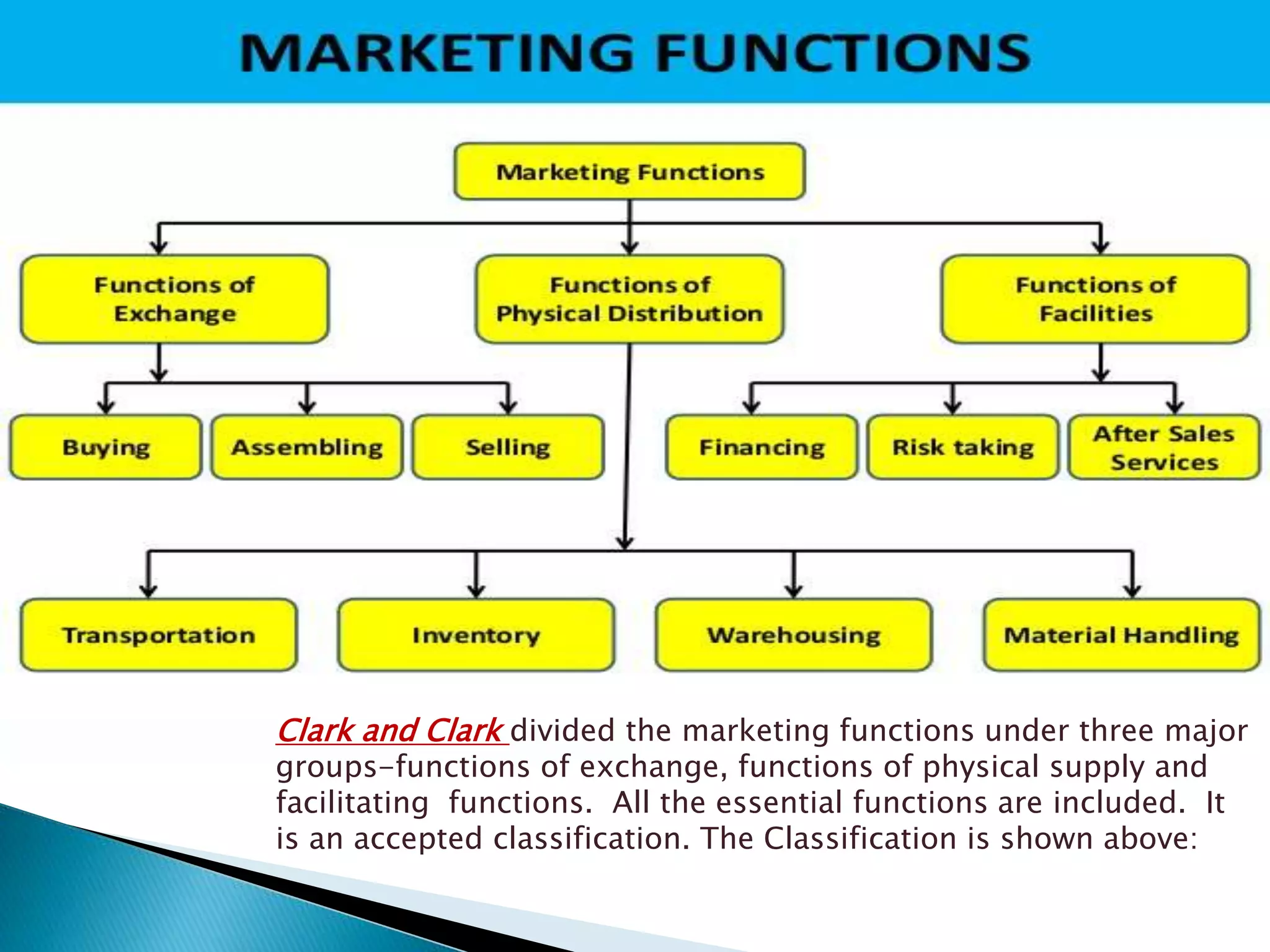
Clark and Clark divided the marketing functions under three major
groups-functions of exchange, functions of physical supply and
facilitating functions. All the essential functions are included. It
is an accepted classification. The Classification is shown above:
Exchange brings about changes in the
ownership of productions. In the process of
changes transfer in the ownership, the two
important functions are buying and selling
are complementary to each other but not
contradictory with a different view-point.
For better understanding of the activities, this
function is sub-divided into buying and
assembling and selling.
It is the first step of marketing functions. It is
carried out by all marketers- the manufacturers,
the wholesalers, the retailers etc. Buying and
selling are inseparable. Both happen at the same
time. For example, if any one buy a thing, then
there should be someone to sells the product. The
buying function is over, the buyer gets the title to
the product. Buying may be done either directly or
throught middlemen.
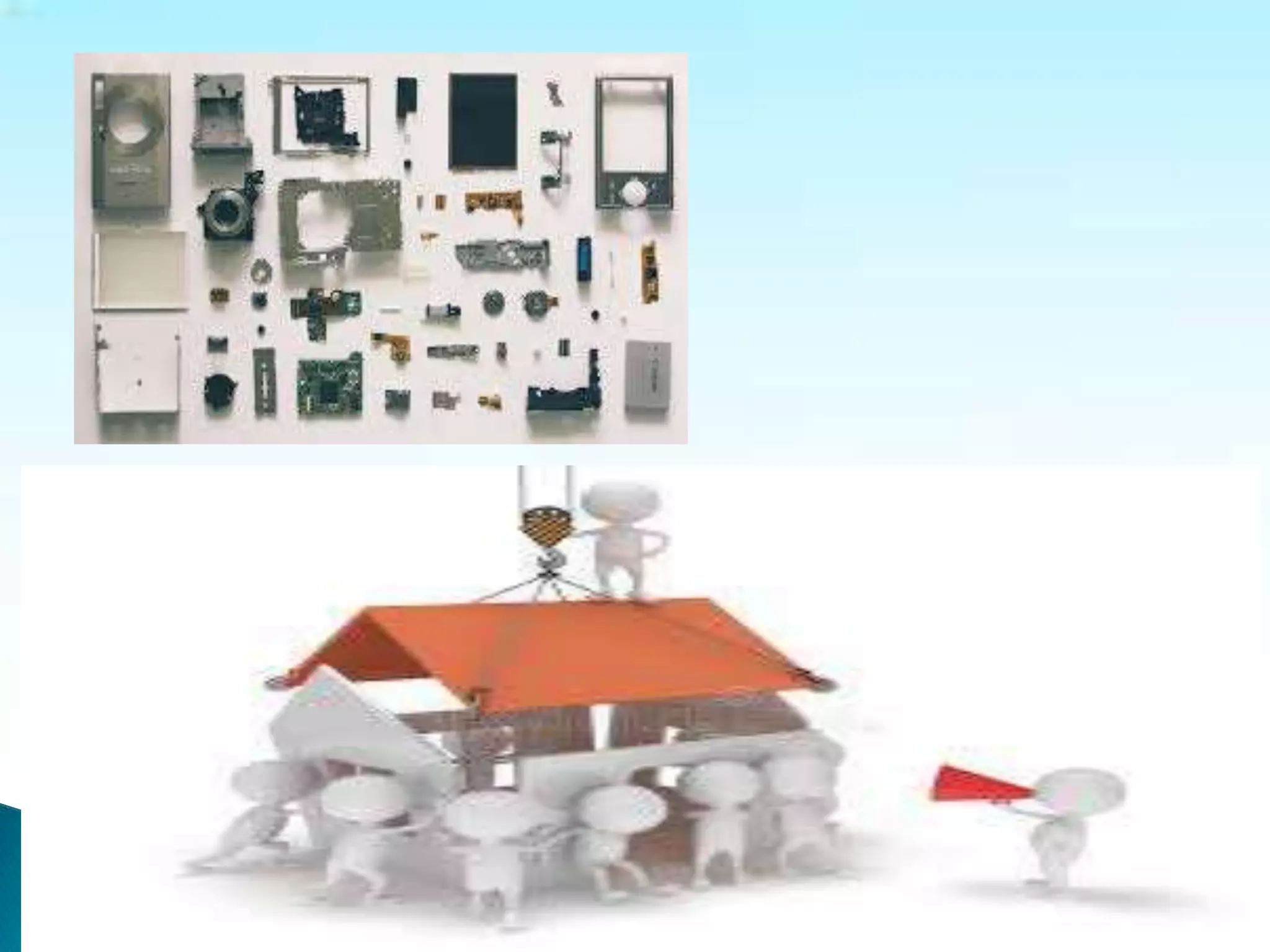
Assembling of goods the process of
keeping the goods, purchased from
different places, at the particular place.
For example, retailers buy different
commodities of different sized in
different quantity, in different quality for
their further movement. The main aim of
assembling is to bring the procedure at a
central place in order to disperse them
either for production or consumption
purpose.
The process of transferring ownership f goods
from the seller to the buyer is what is known
as selling. The primary objective of
marketing is to sell the products at a profit.
Sales are cocerned with the activities,
whichconvert the desire into demand.
Creation of demand its maintenance,
expansion etc. In this modern period, with
mass productions, stiff competitions in
market etc., the process of selling is a
complicated functions.
The second group of marketing
process is the physical supply.
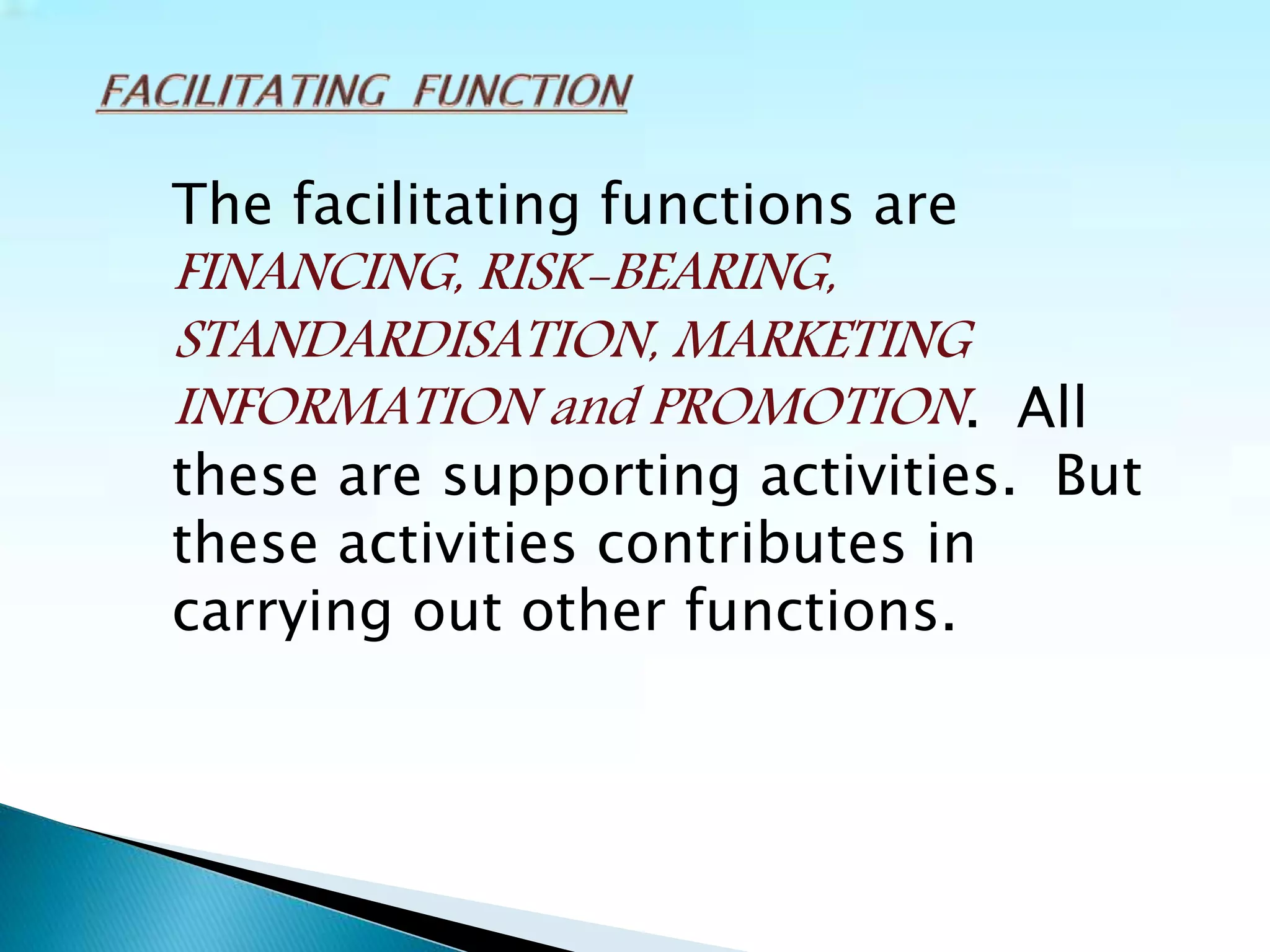
These are the functions that are
related with creatio of place and
time utilities. Physical transfer of
goods from the manufacturer to
consumer takes place by means of
Transporation and storage.
The goods produced in a particular place are
not consumed there itself. From the place of
production the goods need to be taken to the various
consumption centers which are scattered throughout
the country are even throughout the world.
The good from a place where they are not
needed, are transferred to place where they are
needed. The function of transport can be as that of a
nerve system, through which the blood circulates and
keeps the body working at ease. Goods are sent to
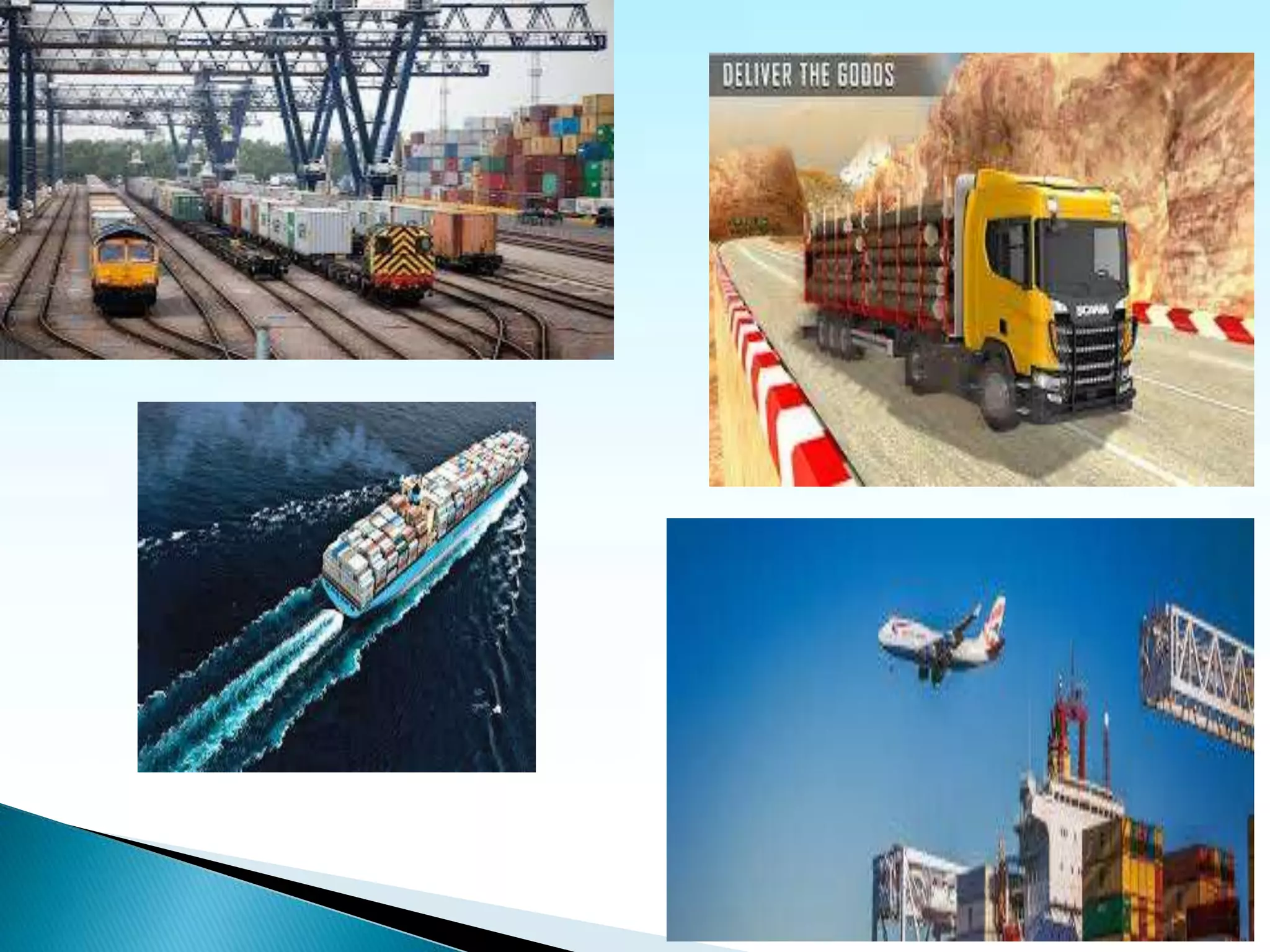
the markets through land, sea and air. The cost of
transport is justified by the creation of place utility.
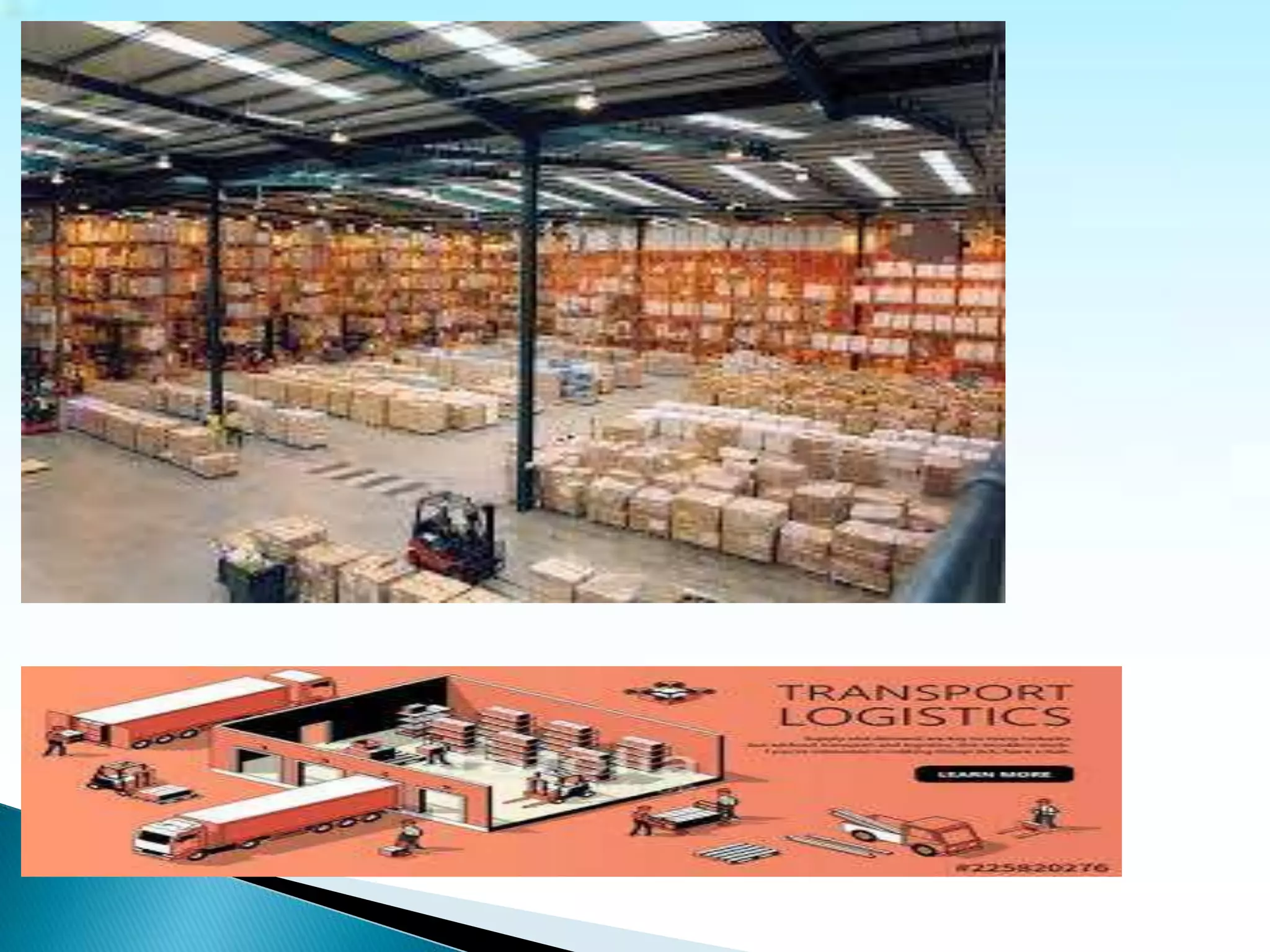
A manufacturer needs to keep adequate stock of
raw materials to ensure smooth production. A trader has
to maintain adequate stock of the products he sells to
meet the demand.
Storage functions is necessary in concentration as
well as in dispersion. The function is done by the
manufacturers, wholesalers, and professional warehouse
keepers. Marketers can easily adjust the supply with
demand through warehousing and transportation.
The facilitating functions are
FINANCING, RISK-BEARING,
STANDARDISATION, MARKETING
INFORMATION and PROMOTION. All
these are supporting activities. But
these activities contributes in
carrying out other functions.
Finance is the most fundamental aspect for any
merchandise transactions. Funds are required to
hold the stock and to meet the cost of marketing.
Finance is needed for production as well as for
marketing and production of finished goods. It
means that the manufacturer who invests in raw
materials has to wait till the consumers pay for
the finished goods.
The waiting period is undertaken by
financial institutions by granting loans.
Merchandising machines are lubricated
constantly by such financial institutions. There
are various kinds of finance needed- short term,
medium term, long term etc., and the source are
commercial banks, co-operative credit societies,
other agencies etc.
In marketing , there arise numerous damages to
goods, Physical loss, changes in economic values of goods,
mismanagement , credit losses etc, There are loss on
account of fire, flood, deterioration, bad debts etc. On all
these occasions, all intelligent businessman reduces the
possibility of risks. Thus the risks are to be shouldered,
shifted or reduced. Some of the risks are insurable, while
others are not. Eg: loss on account of fire, accident etc.
Can be insured with insurance companies. But the loss on
account of fall in demand, prices, competitions etc.
Risks due to natural calamities
Physical risks
Economics risks
Risks due to technological development
Political risks.
Standardization is related with the division of commodities
into distinct groups. Standard is used in providing certain
basic qualities to the goods for their use. Standard is a
specification. It help mainly to know whether a product
conforms to the expected quality and the price paid is
justified
Grading it refers to the process of agricultural goods, these
will be variations between products of the same variety. The
size, shape, colour and taste of two or more pieces of
tomato or beetroot will not be the same. Buying and selling
become easier.
The desired success of marketing
depends on correct and timely decisions.
These decisions are based on market
information or market intelligence. Modern
marketing must have information of size
location, characteristics of markets etc.
The customer’s wants, habits,
purchasing power etc., are to be considered,
the strength or weakness of competitors,
trend in market, supply and demand etc. are
also to be taken into account.
Promotion is a wide term including advertising,
personal selling, sales promotions etc., Marketing
communications are essential for both sellers and
buyers. Sale promotions are marketing device to
stimulate or restimulate demand for products.
The behavior of buyers can favorably be
influenced only through promotion. Promotional
programmes are needed for both consumer
goods and industrial goods. Persuasive
communication or effective promotion will
facilitate the marketers to increase and maintain
their market share.
The functions classified above
provide a bird’s eye-view of the area
of marketing. They provide a basic
knowledge, before proceeding
further for a deeper study. The
selection of classification really
depends on the necessity,
circumstances of each case.
Marketing functions

Marketing functions

  • 2.
    Clark and Clarkdivided the marketing functions under three major groups-functions of exchange, functions of physical supply and facilitating functions. All the essential functions are included. It is an accepted classification. The Classification is shown above:
  • 3.
    Exchange brings aboutchanges in the ownership of productions. In the process of changes transfer in the ownership, the two important functions are buying and selling are complementary to each other but not contradictory with a different view-point. For better understanding of the activities, this function is sub-divided into buying and assembling and selling.
  • 4.
    It is thefirst step of marketing functions. It is carried out by all marketers- the manufacturers, the wholesalers, the retailers etc. Buying and selling are inseparable. Both happen at the same time. For example, if any one buy a thing, then there should be someone to sells the product. The buying function is over, the buyer gets the title to the product. Buying may be done either directly or throught middlemen.
  • 6.
    Assembling of goodsthe process of keeping the goods, purchased from different places, at the particular place. For example, retailers buy different commodities of different sized in different quantity, in different quality for their further movement. The main aim of assembling is to bring the procedure at a central place in order to disperse them either for production or consumption purpose.
  • 8.
    The process oftransferring ownership f goods from the seller to the buyer is what is known as selling. The primary objective of marketing is to sell the products at a profit. Sales are cocerned with the activities, whichconvert the desire into demand. Creation of demand its maintenance, expansion etc. In this modern period, with mass productions, stiff competitions in market etc., the process of selling is a complicated functions.
  • 10.
    The second groupof marketing process is the physical supply. These are the functions that are related with creatio of place and time utilities. Physical transfer of goods from the manufacturer to consumer takes place by means of Transporation and storage.
  • 12.
    The goods producedin a particular place are not consumed there itself. From the place of production the goods need to be taken to the various consumption centers which are scattered throughout the country are even throughout the world. The good from a place where they are not needed, are transferred to place where they are needed. The function of transport can be as that of a nerve system, through which the blood circulates and keeps the body working at ease. Goods are sent to the markets through land, sea and air. The cost of transport is justified by the creation of place utility.
  • 14.
    A manufacturer needsto keep adequate stock of raw materials to ensure smooth production. A trader has to maintain adequate stock of the products he sells to meet the demand. Storage functions is necessary in concentration as well as in dispersion. The function is done by the manufacturers, wholesalers, and professional warehouse keepers. Marketers can easily adjust the supply with demand through warehousing and transportation.
  • 16.
    The facilitating functionsare FINANCING, RISK-BEARING, STANDARDISATION, MARKETING INFORMATION and PROMOTION. All these are supporting activities. But these activities contributes in carrying out other functions.
  • 18.
    Finance is themost fundamental aspect for any merchandise transactions. Funds are required to hold the stock and to meet the cost of marketing. Finance is needed for production as well as for marketing and production of finished goods. It means that the manufacturer who invests in raw materials has to wait till the consumers pay for the finished goods. The waiting period is undertaken by financial institutions by granting loans. Merchandising machines are lubricated constantly by such financial institutions. There are various kinds of finance needed- short term, medium term, long term etc., and the source are commercial banks, co-operative credit societies, other agencies etc.
  • 19.
    In marketing ,there arise numerous damages to goods, Physical loss, changes in economic values of goods, mismanagement , credit losses etc, There are loss on account of fire, flood, deterioration, bad debts etc. On all these occasions, all intelligent businessman reduces the possibility of risks. Thus the risks are to be shouldered, shifted or reduced. Some of the risks are insurable, while others are not. Eg: loss on account of fire, accident etc. Can be insured with insurance companies. But the loss on account of fall in demand, prices, competitions etc. Risks due to natural calamities Physical risks Economics risks Risks due to technological development Political risks.
  • 20.
    Standardization is relatedwith the division of commodities into distinct groups. Standard is used in providing certain basic qualities to the goods for their use. Standard is a specification. It help mainly to know whether a product conforms to the expected quality and the price paid is justified Grading it refers to the process of agricultural goods, these will be variations between products of the same variety. The size, shape, colour and taste of two or more pieces of tomato or beetroot will not be the same. Buying and selling become easier.
  • 21.
    The desired successof marketing depends on correct and timely decisions. These decisions are based on market information or market intelligence. Modern marketing must have information of size location, characteristics of markets etc. The customer’s wants, habits, purchasing power etc., are to be considered, the strength or weakness of competitors, trend in market, supply and demand etc. are also to be taken into account.
  • 22.
    Promotion is awide term including advertising, personal selling, sales promotions etc., Marketing communications are essential for both sellers and buyers. Sale promotions are marketing device to stimulate or restimulate demand for products. The behavior of buyers can favorably be influenced only through promotion. Promotional programmes are needed for both consumer goods and industrial goods. Persuasive communication or effective promotion will facilitate the marketers to increase and maintain their market share.
  • 23.
    The functions classifiedabove provide a bird’s eye-view of the area of marketing. They provide a basic knowledge, before proceeding further for a deeper study. The selection of classification really depends on the necessity, circumstances of each case.