Marketing and its
Functions
L. PRAKASH KANNAN, M.COM., M.PHIL.,(PH.D.), ASSISTANT PROFESSOR,
S.J. MONISHA, II B.COM.,
Marketing
 Marketing is one of the oldest professions of the world. The
term ‘market’ is derived from the Latin word ‘Mercatus’,
meaning to trade, merchandise, wares, traffic or a place
where business is conducted. The common usage ‘market’
means a place or locality where goods are bought or sold and
where buyers and sellers personally meet to affect purchase
and sales. It’s the initial stages where trade was simply a
barter system. During this period, local market was
developed.
Definition
 According to Clark and Clark “ a market is a centre about which or an area in
which the forces leading to exchange of title to a particular product operate
and towards which the actual goods tend to travel”.
 According to Pyle “ Market includes both place and region in which buyers
and sellers are in free competition wit one another”.
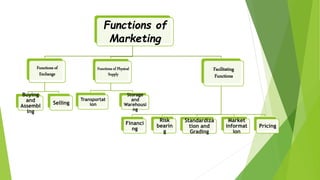
Functions of
Marketing
Functions of
Exchange
Buying
and
Assembl
ing
Selling
Functions of Physical
Supply
Transportat
ion
Storage
and
Warehousi
ng
Facilitating
Functions
Financi
ng
Risk
bearin
g
Standardiza
tion and
Grading
Market
informat
ion
Pricing
Function of Exchange
1. Buying and Assembling
 Buying is the first step in the process of marketing.
 It may be done directly or through middlemen. Manufactures buy raw materials for converting
them into finished products.
 Likewise wholesalers and retailers buy goods for the purpose of reselling the same.
 Assembling begins after the goods have been purchased already.
 Assembling means creation and maintenance of the stock of goods purchased from different
sources. It is primarily performed by middlemen.
 In case of retailing business, assembling is done by buying different goods, in different quantities
from different sources.
2. Selling
 Selling is the crucial function in the marketing process.
 It is the actual point where transfer of ownership occurs.
 The profit making object of a business enterprise is achieved only through sale of
goods.
 Now-a-days the selling activity involves the tackling of a number of problems such
as advertising, facing competition, creating demand for new products, conducting
market research, supplying goods in the right time and place, Selection of channel
for distribution etc.
Functions of Physical Supply
1. Transportation
 In modern days, transportation is an essential marketing activity because markets ae
geographically separated from the areas of production.
 Transportation involves the movement of goods from the point of production to the
place of consumption.
 Transportation provides place utility to the product. Land, Water, and Air are the
principal means of transport for transporting goods from one place to another.
2. Storage and Warehousing
 Storage involves the holding and preserving of goods between the time of their
manufacture and the time of their consumption.
 Most of the mass consumption goods are produced in the anticipation of demand. This
factor requires storage for atleast some time at the production centers and also at the
distribution point.
 Storage is also necessary for products with uneven demand period and with seasonal
demand. Further in some cases storage increases the value of the products.
Facilitating Functions
1. Financing
 Money is required at each stage in the process of marketing.
 Without adequate finance even the very existence of the business concern shall be
affected.
 Although procurement of funds is the responsibility of the Finance Department of the
business firm, yet the amount of capital required for marketing division is considerably
influenced by the decisions of the marketing manager.
2. Risk Bearing
 Risks are involved at almost all stages in the process of marketing.
 Risk is possible right form the product policy, due to the reasons like changes in
demand and supply conditions, loss in storage and transport and other natural hazard.
 The successful business man is one who takes a calculated risk. He can avoid or at
least minimize the risk by carefully anticipating the risks that may arise in future.
3. Standardization and Grading
 The term standardization refers to the establishment of standards for products.
 A standard is a measure which is generally recognized as having a fixed value.
 Standards are generally determined on the basis of weight, colour, quality and other
special or specific feature of a product.
 Grading is usually necessary for goods over which the producers can not exercise control
in terms of their physical properties.
4. Market Information
 For a rational formulation of marketing programmes, the marketing executive must be
adequately informed not only about the market for his firm’s product.
 But also the attitude of the customers using the product etc. For this, information
should be collected, analyzed and interpreted. I
 n face the success in marketing largely depends on the volume of information, the
management have.
5. Pricing
 Pricing is also an important function which is closely related to selling.
 Price policy of a business concern affects its successful functioning by
directly influencing the profit element.
 Therefore, price policy should be carefully determined by considering the
factors like cost of the goods, prices fixed by the competitors, marketing
policies etc.
Marketing and its Functions

Marketing and its Functions

  • 1.
    Marketing and its Functions L.PRAKASH KANNAN, M.COM., M.PHIL.,(PH.D.), ASSISTANT PROFESSOR, S.J. MONISHA, II B.COM.,
  • 2.
    Marketing  Marketing isone of the oldest professions of the world. The term ‘market’ is derived from the Latin word ‘Mercatus’, meaning to trade, merchandise, wares, traffic or a place where business is conducted. The common usage ‘market’ means a place or locality where goods are bought or sold and where buyers and sellers personally meet to affect purchase and sales. It’s the initial stages where trade was simply a barter system. During this period, local market was developed.
  • 3.
    Definition  According toClark and Clark “ a market is a centre about which or an area in which the forces leading to exchange of title to a particular product operate and towards which the actual goods tend to travel”.  According to Pyle “ Market includes both place and region in which buyers and sellers are in free competition wit one another”.
  • 4.
    Functions of Marketing Functions of Exchange Buying and Assembl ing Selling Functionsof Physical Supply Transportat ion Storage and Warehousi ng Facilitating Functions Financi ng Risk bearin g Standardiza tion and Grading Market informat ion Pricing
  • 5.
    Function of Exchange 1.Buying and Assembling  Buying is the first step in the process of marketing.  It may be done directly or through middlemen. Manufactures buy raw materials for converting them into finished products.  Likewise wholesalers and retailers buy goods for the purpose of reselling the same.  Assembling begins after the goods have been purchased already.  Assembling means creation and maintenance of the stock of goods purchased from different sources. It is primarily performed by middlemen.  In case of retailing business, assembling is done by buying different goods, in different quantities from different sources.
  • 6.
    2. Selling  Sellingis the crucial function in the marketing process.  It is the actual point where transfer of ownership occurs.  The profit making object of a business enterprise is achieved only through sale of goods.  Now-a-days the selling activity involves the tackling of a number of problems such as advertising, facing competition, creating demand for new products, conducting market research, supplying goods in the right time and place, Selection of channel for distribution etc.
  • 7.
    Functions of PhysicalSupply 1. Transportation  In modern days, transportation is an essential marketing activity because markets ae geographically separated from the areas of production.  Transportation involves the movement of goods from the point of production to the place of consumption.  Transportation provides place utility to the product. Land, Water, and Air are the principal means of transport for transporting goods from one place to another. 2. Storage and Warehousing  Storage involves the holding and preserving of goods between the time of their manufacture and the time of their consumption.  Most of the mass consumption goods are produced in the anticipation of demand. This factor requires storage for atleast some time at the production centers and also at the distribution point.  Storage is also necessary for products with uneven demand period and with seasonal demand. Further in some cases storage increases the value of the products.
  • 8.
    Facilitating Functions 1. Financing Money is required at each stage in the process of marketing.  Without adequate finance even the very existence of the business concern shall be affected.  Although procurement of funds is the responsibility of the Finance Department of the business firm, yet the amount of capital required for marketing division is considerably influenced by the decisions of the marketing manager. 2. Risk Bearing  Risks are involved at almost all stages in the process of marketing.  Risk is possible right form the product policy, due to the reasons like changes in demand and supply conditions, loss in storage and transport and other natural hazard.  The successful business man is one who takes a calculated risk. He can avoid or at least minimize the risk by carefully anticipating the risks that may arise in future.
  • 9.
    3. Standardization andGrading  The term standardization refers to the establishment of standards for products.  A standard is a measure which is generally recognized as having a fixed value.  Standards are generally determined on the basis of weight, colour, quality and other special or specific feature of a product.  Grading is usually necessary for goods over which the producers can not exercise control in terms of their physical properties. 4. Market Information  For a rational formulation of marketing programmes, the marketing executive must be adequately informed not only about the market for his firm’s product.  But also the attitude of the customers using the product etc. For this, information should be collected, analyzed and interpreted. I  n face the success in marketing largely depends on the volume of information, the management have.
  • 10.
    5. Pricing  Pricingis also an important function which is closely related to selling.  Price policy of a business concern affects its successful functioning by directly influencing the profit element.  Therefore, price policy should be carefully determined by considering the factors like cost of the goods, prices fixed by the competitors, marketing policies etc.