MI. Mujahid Hilal
Senior Lecturer in Marketing Management
Faculty of Management & Commerce
South Eastern University of Sri Lanka
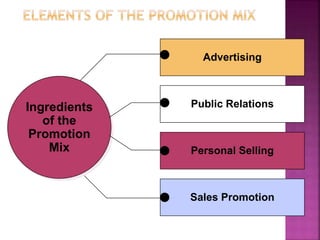
Advertising
Ingredients
of the
Promotion
Mix
Public Relations
Personal Selling
Sales Promotion
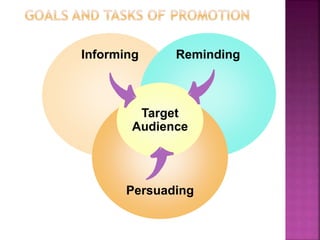
Informing Reminding
Persuading
Target
Audience
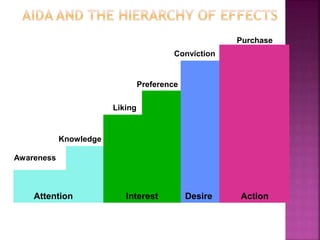
Attention Interest Desire Action
Awareness
Knowledge
Liking
Preference
Conviction
Purchase
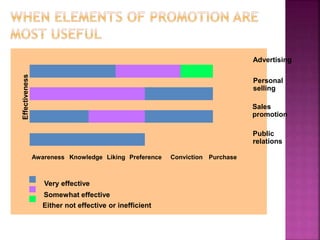
Advertising
Personal
selling
Sales
promotion
Public
relations
Either not effective or inefficient
Very effective
Somewhat effective
Awareness Knowledge Liking Preference Conviction
Effectiveness
Purchase
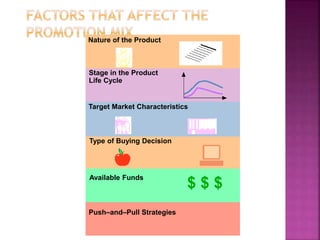
Push–and–Pull Strategies
Nature of the Product
Stage in the Product
Life Cycle
Target Market Characteristics
Type of Buying Decision
Available Funds
$ $ $
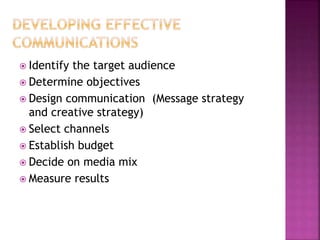
 Identify the target audience
 Determine objectives
 Design communication (Message strategy
and creative strategy)
 Select channels
 Establish budget
 Decide on media mix
 Measure results
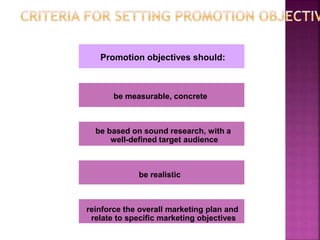
Promotion objectives should:
be measurable, concrete
be based on sound research, with a
well-defined target audience
be realistic
reinforce the overall marketing plan and
relate to specific marketing objectives
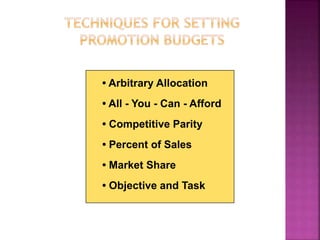
• Arbitrary Allocation
• All - You - Can - Afford
• Competitive Parity
• Percent of Sales
• Market Share
• Objective and Task
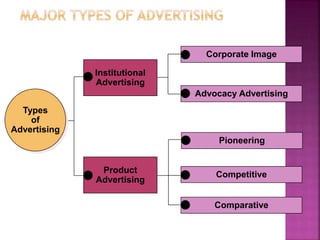
Corporate Image
Advocacy Advertising
Types
of
Advertising
Pioneering
Competitive
Comparative
Product
Advertising
Institutional
Advertising
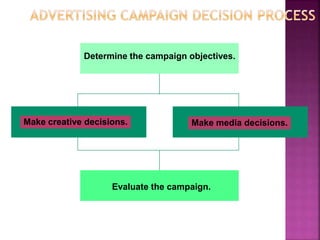
Determine the campaign objectives.
Make creative decisions. Make media decisions.
Evaluate the campaign.
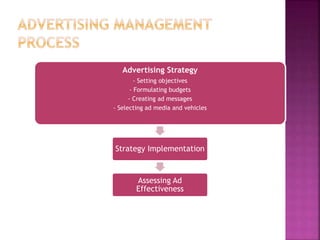
Advertising Strategy
- Setting objectives
- Formulating budgets
- Creating ad messages
- Selecting ad media and vehicles
Strategy Implementation
Assessing Ad
Effectiveness
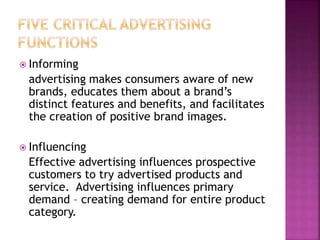
 Informing
advertising makes consumers aware of new
brands, educates them about a brand’s
distinct features and benefits, and facilitates
the creation of positive brand images.
 Influencing
Effective advertising influences prospective
customers to try advertised products and
service. Advertising influences primary
demand – creating demand for entire product
category.
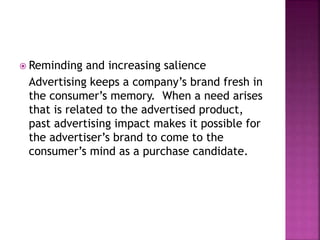
 Reminding and increasing salience
Advertising keeps a company’s brand fresh in
the consumer’s memory. When a need arises
that is related to the advertised product,
past advertising impact makes it possible for
the advertiser’s brand to come to the
consumer’s mind as a purchase candidate.
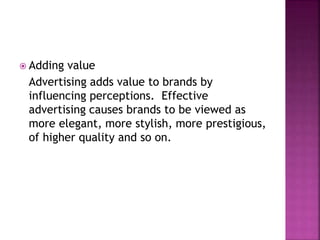
 Adding value
Advertising adds value to brands by
influencing perceptions. Effective
advertising causes brands to be viewed as
more elegant, more stylish, more prestigious,
of higher quality and so on.
 What is an effective advertising?
 An effective advertising satisfies the following
consideration
- it must extend from sound marketing strategy
- Effective advertising must take the consumer’s
view.
“consumers don’t want to be bombarded with
ads – they want to be inspired by ideas that will
change their lives. Ads create transactions.
Ideas create transformations. Ads reflect our
culture, ideas imagine our future”
- Advertising must find a unique way to break
through the clutter.
- Good advertising should never promise
more than it can deliver.
- Good advertising prevents the creative idea
from overwhelming the strategy.
 Most memorable advertisements make their
selling points in an entertaining, creative
fashion.
 Creative ads share two features such as
originality and appropriateness.
Advertising plans provide the framework for the
systematic execution of advertising agencies.
 Specify the key fact from the customer’s
viewpoint
 State the primary problem, or advertising
issue, from brand management's perspective.
 State the advertising objective
 Implement the creative message strategy
 Establish mandatory requirements
The key fact in an advertising strategy is a
single minded statement from the
consumer’s point of view that identifies why
consumers are or are not purchasing the
product, service or brand or are not giving it
proper consideration.
Extending from the key fact, this step states
the problem from the brand management’s
point of view. The primary problem may be
an image problem, a product perception
issue, or a competitive weakness.
This is a straightforward statement about
what effect the advertising is intended to
have on the target market.
Creative message strategy represents the
guts of the overall advertising strategy. The
creative platform for a brand is summarized
in a single statement called a value
proposition or positioning statement.
Implementing creative strategy requires;
- Defining the target market
- Identifying the primary competition
- Choosing the positioning statement
- Offering reasons why.
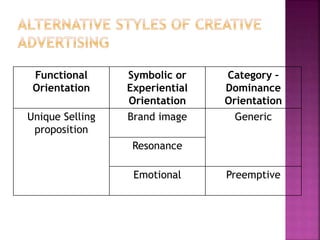
Functional
Orientation
Symbolic or
Experiential
Orientation
Category –
Dominance
Orientation
Unique Selling
proposition
Brand image Generic
Resonance
Emotional Preemptive
 Making a superiority claim based on a unique
product attribute that represents a meaningful,
distinctive consumer benefit.
 The translation of the unique product feature into a
relevant consumer benefit provides the USP.
 The USP approach is best suited for a company with
a brand that possess a relatively lasting competitive
advantage.
 USP style is the optimum creative technique,
because it gives the consumer a clearly
differentiated reason for selecting the advertiser’s
brand over competitive offerings
 Brand image style involves psychosocial,
rather than physical differentiation.
 Attempts to develop an image or identity for
a brand by associating the brand with
symbols.
 This style is important for brand that
competes in product categories where there
is little physical differentiation and all
brands are relatively homogeneous.
 Resonance advertising does not focus on
product claims or band images but rather
seeks to present circumstances or situations
that find counterparts in the real or imagined
experiences of the target audience.
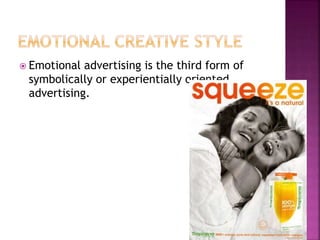
 Emotional advertising is the third form of
symbolically or experientially oriented
advertising.
The advertiser makes no attempt to
differentiate its brand from competitive
offerings or to claim superiority.
This strategy is most appropriate for a brand
that dominates a product category.
This approach is most often used by
advertisers in product or service categories
where there are few, if any, functional
differences among competitive brands.
Television stars, movie actors, famous athletes and
even dead personalities are widely used to endorse
products.
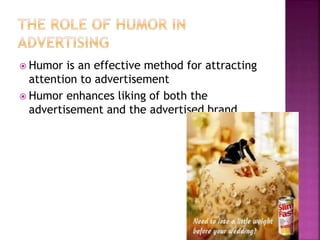
 Humor is an effective method for attracting
attention to advertisement
 Humor enhances liking of both the
advertisement and the advertised brand
 The appeal to fear is especially effective as a
means of enhancing motivation.
 People feel guilty when they break rules,
violate their own standards or beliefs, or
behave irresponsibly. Appeals to guilt are
powerful because they motivate emotionally
mature individuals to undertake responsible
action leading to a reduction in the level of
guilt.
 Products such as soft drinks, alcoholic
beverages, cosmetics, automobiles and many
others use sex appeals in hopes of drawing
attention to advertisements and making their
sales pitch.
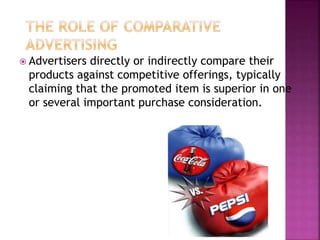
 Advertisers directly or indirectly compare their
products against competitive offerings, typically
claiming that the promoted item is superior in one
or several important purchase consideration.
An executional framework is the manner in
which an ad appeal is presented.
 Animation
 Slice of life
 Dramatization
 Testimonial
 Authoritative
 Demonstration
 Fantasy
 Informative
 In recent years, animation in advertising has
increased due to the greater sophistication
of computer graphics programs.
 Animation was originally a last resort
technique for advertisers who did not have
money to do a live commercial.
In slice of life commercials, advertisers
attempt to provide solutions to the everyday
problems consumers or business face. These
advertisements normally show common
things people experience, especially
problems they encounter. Then, the good or
service is made available to solve the
problem.
A dramatization is similar to slice of life
executional framework. It uses the same
format of presenting a problem then a
solution. The difference lies in the intensity
and story format. Dramatization uses a
higher level of excitement and suspense to
tell the story. A dramatization story normally
builds to a crisis point.
This is successful in business to business and
service sectors. When a customer in an
advertisement tells about a positive
experience with a product, this is a
testimonial.
A testimonial ad for a service simulates word
of mouth recommendations and enhance
company credibility.
 An advertiser seeks to convince viewers that
a given product is superior to other brand.
 Ads employ a physician, dentist, engineer or
chemist to state product’s advantages over
other products.
Advertisement using the demonstration
executional framework show how a product
works. A demonstration is an effective way
to communicate the attributes of a product
to viewers.
 Fantasy executions are designed to lift the
audience beyond the real world to a make
believe experience.
 Perfume and cologne industry use fantasy
execution.
 Public relations involve a variety of programs
designed to promote or protect a company’s
image or its individual products.
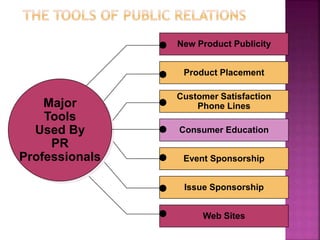
Major
Tools
Used By
PR
Professionals
New Product Publicity
Product Placement
Customer Satisfaction
Phone Lines
Consumer Education
Event Sponsorship
Issue Sponsorship
Web Sites
 A key ingredient in marketing campaigns,
consists of a collection of incentive tools,
mostly short term, designed to stimulate
quicker or greater purchase of particular
products or services by consumers or the
trade.
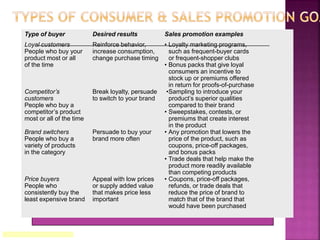
Type of buyer Desired results Sales promotion examples
Loyal customers Reinforce behavior, • Loyalty marketing programs,
People who buy your increase consumption, such as frequent-buyer cards
product most or all change purchase timing or frequent-shopper clubs
of the time • Bonus packs that give loyal
consumers an incentive to
stock up or premiums offered
in return for proofs-of-purchase
Competitor’s Break loyalty, persuade •Sampling to introduce your
customers to switch to your brand product’s superior qualities
People who buy a compared to their brand
competitor’s product • Sweepstakes, contests, or
most or all of the time premiums that create interest
in the product
Brand switchers Persuade to buy your • Any promotion that lowers the
People who buy a brand more often price of the product, such as
variety of products coupons, price-off packages,
in the category and bonus packs
• Trade deals that help make the
product more readily available
than competing products
Price buyers Appeal with low prices • Coupons, price-off packages,
People who or supply added value refunds, or trade deals that
consistently buy the that makes price less reduce the price of brand to
least expensive brand important match that of the brand that
would have been purchased
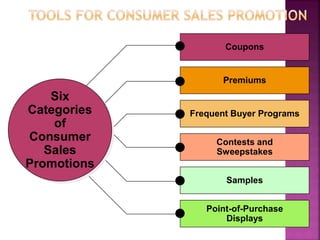
Coupons
Premiums
Frequent Buyer Programs
Contests and
Sweepstakes
Samples
Point-of-Purchase
Displays
Six
Categories
of
Consumer
Sales
Promotions
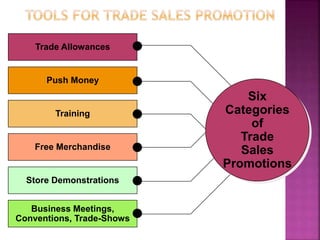
Trade Allowances
Push Money
Training
Free Merchandise
Store Demonstrations
Business Meetings,
Conventions, Trade-Shows
Six
Categories
of
Trade
Sales
Promotions
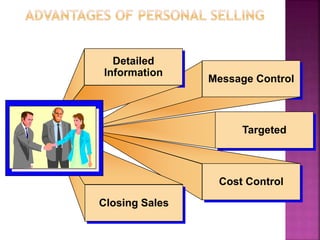
Cost Control
Message Control
Targeted
Detailed
Information
Closing Sales
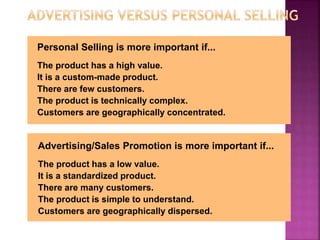
Personal Selling is more important if...
The product has a high value.
It is a custom-made product.
There are few customers.
The product is technically complex.
Customers are geographically concentrated.
Advertising/Sales Promotion is more important if...
The product has a low value.
It is a standardized product.
There are many customers.
The product is simple to understand.
Customers are geographically dispersed.
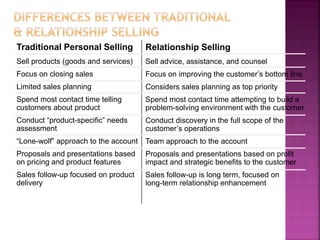
Traditional Personal Selling
Sell products (goods and services)
Focus on closing sales
Limited sales planning
Spend most contact time telling
customers about product
Conduct “product-specific” needs
assessment
“Lone-wolf” approach to the account
Proposals and presentations based
on pricing and product features
Sales follow-up focused on product
delivery
Relationship Selling
Sell advice, assistance, and counsel
Focus on improving the customer’s bottom line
Considers sales planning as top priority
Spend most contact time attempting to build a
problem-solving environment with the customer
Conduct discovery in the full scope of the
customer’s operations
Team approach to the account
Proposals and presentations based on profit
impact and strategic benefits to the customer
Sales follow-up is long term, focused on
long-term relationship enhancement
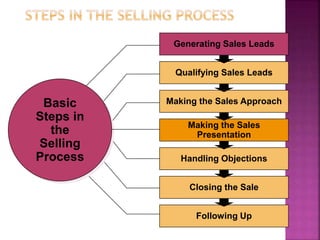
Basic
Steps in
the
Selling
Process
Generating Sales Leads
Qualifying Sales Leads
Making the Sales Approach
Making the Sales
Presentation
Handling Objections
Closing the Sale
Following Up
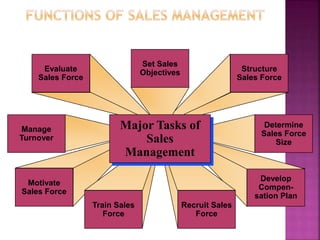
Motivate
Sales Force
Evaluate
Sales Force
Manage
Turnover
Train Sales
Force
Develop
Compen-
sation Plan
Structure
Sales Force
Determine
Sales Force
Size
Recruit Sales
Force
Set Sales
Objectives
Major Tasks of
Sales
Management
Marketing Communication mix

Marketing Communication mix

  • 1.
    MI. Mujahid Hilal SeniorLecturer in Marketing Management Faculty of Management & Commerce South Eastern University of Sri Lanka
  • 2.
  • 3.
  • 4.
    Attention Interest DesireAction Awareness Knowledge Liking Preference Conviction Purchase
  • 5.
    Advertising Personal selling Sales promotion Public relations Either not effectiveor inefficient Very effective Somewhat effective Awareness Knowledge Liking Preference Conviction Effectiveness Purchase
  • 6.
    Push–and–Pull Strategies Nature ofthe Product Stage in the Product Life Cycle Target Market Characteristics Type of Buying Decision Available Funds $ $ $
  • 7.
     Identify thetarget audience  Determine objectives  Design communication (Message strategy and creative strategy)  Select channels  Establish budget  Decide on media mix  Measure results
  • 8.
    Promotion objectives should: bemeasurable, concrete be based on sound research, with a well-defined target audience be realistic reinforce the overall marketing plan and relate to specific marketing objectives
  • 9.
    • Arbitrary Allocation •All - You - Can - Afford • Competitive Parity • Percent of Sales • Market Share • Objective and Task
  • 10.
  • 11.
    Determine the campaignobjectives. Make creative decisions. Make media decisions. Evaluate the campaign.
  • 12.
    Advertising Strategy - Settingobjectives - Formulating budgets - Creating ad messages - Selecting ad media and vehicles Strategy Implementation Assessing Ad Effectiveness
  • 13.
     Informing advertising makesconsumers aware of new brands, educates them about a brand’s distinct features and benefits, and facilitates the creation of positive brand images.  Influencing Effective advertising influences prospective customers to try advertised products and service. Advertising influences primary demand – creating demand for entire product category.
  • 14.
     Reminding andincreasing salience Advertising keeps a company’s brand fresh in the consumer’s memory. When a need arises that is related to the advertised product, past advertising impact makes it possible for the advertiser’s brand to come to the consumer’s mind as a purchase candidate.
  • 15.
     Adding value Advertisingadds value to brands by influencing perceptions. Effective advertising causes brands to be viewed as more elegant, more stylish, more prestigious, of higher quality and so on.
  • 16.
     What isan effective advertising?  An effective advertising satisfies the following consideration - it must extend from sound marketing strategy - Effective advertising must take the consumer’s view. “consumers don’t want to be bombarded with ads – they want to be inspired by ideas that will change their lives. Ads create transactions. Ideas create transformations. Ads reflect our culture, ideas imagine our future”
  • 17.
    - Advertising mustfind a unique way to break through the clutter. - Good advertising should never promise more than it can deliver. - Good advertising prevents the creative idea from overwhelming the strategy.
  • 18.
     Most memorableadvertisements make their selling points in an entertaining, creative fashion.  Creative ads share two features such as originality and appropriateness.
  • 19.
    Advertising plans providethe framework for the systematic execution of advertising agencies.
  • 20.
     Specify thekey fact from the customer’s viewpoint  State the primary problem, or advertising issue, from brand management's perspective.  State the advertising objective  Implement the creative message strategy  Establish mandatory requirements
  • 21.
    The key factin an advertising strategy is a single minded statement from the consumer’s point of view that identifies why consumers are or are not purchasing the product, service or brand or are not giving it proper consideration.
  • 22.
    Extending from thekey fact, this step states the problem from the brand management’s point of view. The primary problem may be an image problem, a product perception issue, or a competitive weakness.
  • 23.
    This is astraightforward statement about what effect the advertising is intended to have on the target market.
  • 24.
    Creative message strategyrepresents the guts of the overall advertising strategy. The creative platform for a brand is summarized in a single statement called a value proposition or positioning statement. Implementing creative strategy requires; - Defining the target market - Identifying the primary competition - Choosing the positioning statement - Offering reasons why.
  • 25.
    Functional Orientation Symbolic or Experiential Orientation Category – Dominance Orientation UniqueSelling proposition Brand image Generic Resonance Emotional Preemptive
  • 26.
     Making asuperiority claim based on a unique product attribute that represents a meaningful, distinctive consumer benefit.  The translation of the unique product feature into a relevant consumer benefit provides the USP.  The USP approach is best suited for a company with a brand that possess a relatively lasting competitive advantage.  USP style is the optimum creative technique, because it gives the consumer a clearly differentiated reason for selecting the advertiser’s brand over competitive offerings
  • 27.
     Brand imagestyle involves psychosocial, rather than physical differentiation.  Attempts to develop an image or identity for a brand by associating the brand with symbols.  This style is important for brand that competes in product categories where there is little physical differentiation and all brands are relatively homogeneous.
  • 28.
     Resonance advertisingdoes not focus on product claims or band images but rather seeks to present circumstances or situations that find counterparts in the real or imagined experiences of the target audience.
  • 29.
     Emotional advertisingis the third form of symbolically or experientially oriented advertising.
  • 30.
    The advertiser makesno attempt to differentiate its brand from competitive offerings or to claim superiority. This strategy is most appropriate for a brand that dominates a product category.
  • 31.
    This approach ismost often used by advertisers in product or service categories where there are few, if any, functional differences among competitive brands.
  • 32.
    Television stars, movieactors, famous athletes and even dead personalities are widely used to endorse products.
  • 33.
     Humor isan effective method for attracting attention to advertisement  Humor enhances liking of both the advertisement and the advertised brand
  • 34.
     The appealto fear is especially effective as a means of enhancing motivation.
  • 35.
     People feelguilty when they break rules, violate their own standards or beliefs, or behave irresponsibly. Appeals to guilt are powerful because they motivate emotionally mature individuals to undertake responsible action leading to a reduction in the level of guilt.
  • 36.
     Products suchas soft drinks, alcoholic beverages, cosmetics, automobiles and many others use sex appeals in hopes of drawing attention to advertisements and making their sales pitch.
  • 37.
     Advertisers directlyor indirectly compare their products against competitive offerings, typically claiming that the promoted item is superior in one or several important purchase consideration.
  • 38.
    An executional frameworkis the manner in which an ad appeal is presented.
  • 39.
     Animation  Sliceof life  Dramatization  Testimonial  Authoritative  Demonstration  Fantasy  Informative
  • 40.
     In recentyears, animation in advertising has increased due to the greater sophistication of computer graphics programs.  Animation was originally a last resort technique for advertisers who did not have money to do a live commercial.
  • 41.
    In slice oflife commercials, advertisers attempt to provide solutions to the everyday problems consumers or business face. These advertisements normally show common things people experience, especially problems they encounter. Then, the good or service is made available to solve the problem.
  • 42.
    A dramatization issimilar to slice of life executional framework. It uses the same format of presenting a problem then a solution. The difference lies in the intensity and story format. Dramatization uses a higher level of excitement and suspense to tell the story. A dramatization story normally builds to a crisis point.
  • 43.
    This is successfulin business to business and service sectors. When a customer in an advertisement tells about a positive experience with a product, this is a testimonial. A testimonial ad for a service simulates word of mouth recommendations and enhance company credibility.
  • 44.
     An advertiserseeks to convince viewers that a given product is superior to other brand.  Ads employ a physician, dentist, engineer or chemist to state product’s advantages over other products.
  • 45.
    Advertisement using thedemonstration executional framework show how a product works. A demonstration is an effective way to communicate the attributes of a product to viewers.
  • 46.
     Fantasy executionsare designed to lift the audience beyond the real world to a make believe experience.  Perfume and cologne industry use fantasy execution.
  • 47.
     Public relationsinvolve a variety of programs designed to promote or protect a company’s image or its individual products.
  • 48.
    Major Tools Used By PR Professionals New ProductPublicity Product Placement Customer Satisfaction Phone Lines Consumer Education Event Sponsorship Issue Sponsorship Web Sites
  • 49.
     A keyingredient in marketing campaigns, consists of a collection of incentive tools, mostly short term, designed to stimulate quicker or greater purchase of particular products or services by consumers or the trade.
  • 50.
    Type of buyerDesired results Sales promotion examples Loyal customers Reinforce behavior, • Loyalty marketing programs, People who buy your increase consumption, such as frequent-buyer cards product most or all change purchase timing or frequent-shopper clubs of the time • Bonus packs that give loyal consumers an incentive to stock up or premiums offered in return for proofs-of-purchase Competitor’s Break loyalty, persuade •Sampling to introduce your customers to switch to your brand product’s superior qualities People who buy a compared to their brand competitor’s product • Sweepstakes, contests, or most or all of the time premiums that create interest in the product Brand switchers Persuade to buy your • Any promotion that lowers the People who buy a brand more often price of the product, such as variety of products coupons, price-off packages, in the category and bonus packs • Trade deals that help make the product more readily available than competing products Price buyers Appeal with low prices • Coupons, price-off packages, People who or supply added value refunds, or trade deals that consistently buy the that makes price less reduce the price of brand to least expensive brand important match that of the brand that would have been purchased
  • 51.
    Coupons Premiums Frequent Buyer Programs Contestsand Sweepstakes Samples Point-of-Purchase Displays Six Categories of Consumer Sales Promotions
  • 52.
    Trade Allowances Push Money Training FreeMerchandise Store Demonstrations Business Meetings, Conventions, Trade-Shows Six Categories of Trade Sales Promotions
  • 54.
  • 55.
    Personal Selling ismore important if... The product has a high value. It is a custom-made product. There are few customers. The product is technically complex. Customers are geographically concentrated. Advertising/Sales Promotion is more important if... The product has a low value. It is a standardized product. There are many customers. The product is simple to understand. Customers are geographically dispersed.
  • 56.
    Traditional Personal Selling Sellproducts (goods and services) Focus on closing sales Limited sales planning Spend most contact time telling customers about product Conduct “product-specific” needs assessment “Lone-wolf” approach to the account Proposals and presentations based on pricing and product features Sales follow-up focused on product delivery Relationship Selling Sell advice, assistance, and counsel Focus on improving the customer’s bottom line Considers sales planning as top priority Spend most contact time attempting to build a problem-solving environment with the customer Conduct discovery in the full scope of the customer’s operations Team approach to the account Proposals and presentations based on profit impact and strategic benefits to the customer Sales follow-up is long term, focused on long-term relationship enhancement
  • 57.
    Basic Steps in the Selling Process Generating SalesLeads Qualifying Sales Leads Making the Sales Approach Making the Sales Presentation Handling Objections Closing the Sale Following Up
  • 58.
    Motivate Sales Force Evaluate Sales Force Manage Turnover TrainSales Force Develop Compen- sation Plan Structure Sales Force Determine Sales Force Size Recruit Sales Force Set Sales Objectives Major Tasks of Sales Management