Introduction to
Advertising
Advertising Principles and Practices
1-1
 Advertising is a message designed to
promote a product, a service, or an idea.
The purpose of advertising is to sell
products or services.
1-2
1-3
 Advertising reaches people through various
forms of mass communication.
 These media include newspapers, magazines,
television, radio, the Internet, direct mail,
outdoor signs, transit signs, window displays,
point-of-purchase displays, telephone
directories, novelties.
1-4
 Advertising is designed to inform, influence,
or persuade people.
 To be effective, an advertisement must first
Attract attention and gain a person’s Interest.
It may then build Desire for a product and
provide a method for them to take Action.
1-5
 Advertisers research the unique features of
the product to determine the USP (unique
selling proposition) and the big idea—the
simple message that will be used to
communicate the USP to the target
audience.
 Many firms use a SWOT analysis to help
them with their advertising techniques.
1-6
 Strengths
 Outstanding features of the brand
 Positive consumer perceptions of the brand
 Features that are better, different or missing from
competitor’s brands
1-7
 Weaknesses
 What is missing
 Negative consumer perceptions
 Features of competitor’s brand that are better
1-8
 Opportunities
 What are the newest trends that have not been
addressed
 What are the latest developments in technology
 Are there gaps in the market
1-9
 Threats
 Are consumers finding replacement products
 Is the industry regulated
1-10
Prentice Hall, © 2009
1-11
 Advertisers use a variety of techniques to
create effective advertisements.
1-12
Prentice Hall, © 2009
1-13
 Biological
 Focus on consumer’s basic needs for health and security
 Emotional
 Focus on the consumers’ feelings (love, romance, pride)
 Rational
 Focus on the consumer’s reasoning abilities (cost, safety,
convenience)
 Social
 Focus on the way that social pressures influence consumer
behaviour (odour, weight, acne, fashion)
1-14
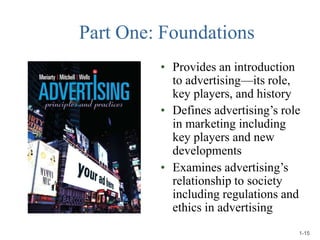
Part One: Foundations
• Provides an introduction
to advertising—its role,
key players, and history
• Defines advertising’s role
in marketing including
key players and new
developments
• Examines advertising’s
relationship to society
including regulations and
ethics in advertising
(Insert new book cover)
1-15
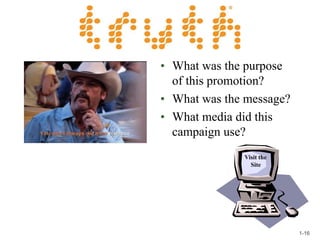
• What was the purpose
of this promotion?
• What was the message?
• What media did this
campaign use?
Visit the
Site
1-16
 A complex form of communication using
objectives and strategies to impact consumer
thoughts, feelings, and actions.
 A form of marketing communication (all the
techniques marketers use to reach their
customers and deliver their messages).
WHAT IS ADVERTISING?
1-18
Prentice Hall, © 2009
1-18
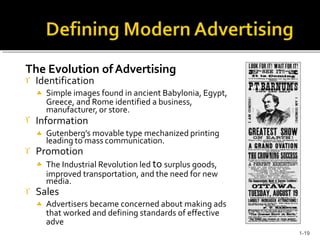
The Evolution ofAdvertising
 Identification
 Simple images found in ancient Babylonia, Egypt,
Greece, and Rome identified a business,
manufacturer, or store.
 Information
 Gutenberg’s movable type mechanized printing
leading to mass communication.
 Promotion
 The Industrial Revolution led to surplus goods,
improved transportation, and the need for new
media.
 Sales
 Advertisers became concerned about making ads
that worked and defining standards of effective
adve
1-19
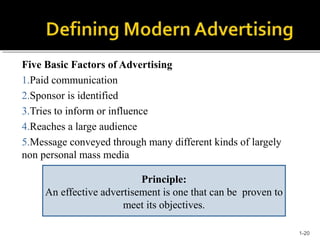
Principle:
An effective advertisement is one that can be proven to
meet its objectives.
Five Basic Factors of Advertising
1.Paid communication
2.Sponsor is identified
3.Tries to inform or influence
4.Reaches a large audience
5.Message conveyed through many different kinds of largely
non personal mass media
1-20
1-21
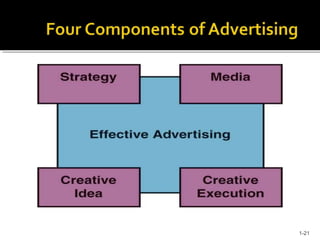
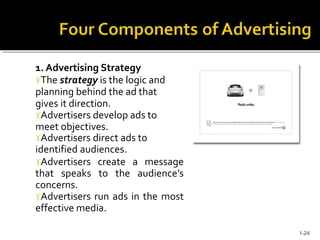
1. Advertising Strategy
The strategy is the logic and
planning behind the ad that
gives it direction.
Advertisers develop ads to
meet objectives.
Advertisers direct ads to
identified audiences.
Advertisers create a message
that speaks to the audience’s
concerns.
Advertisers run ads in the most
effective media.
1-24
Prentice Hall, © 2009
1-23
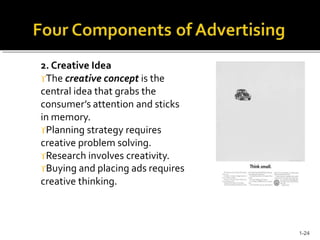
2. Creative Idea
The creative concept is the
central idea that grabs the
consumer’s attention and sticks
in memory.
Planning strategy requires
creative problem solving.
Research involves creativity.
Buying and placing ads requires
creative thinking.
1-24
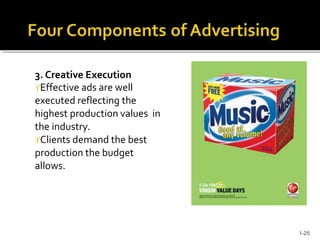
3. Creative Execution
Effective ads are well
executed reflecting the
highest production values in
the industry.
Clients demand the best
production the budget
allows.
1-25
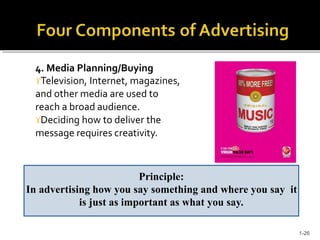
4. Media Planning/Buying
Television, Internet, magazines,
and other media are used to
reach a broad audience.
Deciding how to deliver the
message requires creativity.
Principle:
In advertising how you say something and where you say it
is just as important as what you say.
1-26
1. The Marketing Role
•Marketing is satisfying customer wants and needs by
providing products (goods, services, and ideas).
•The marketing department is responsible for selling the
product using the 4 Ps (product, price, place/distribution,
and promotion) and brand development.
Principle:
A product can be services and ideas as well as goods.
1-27
2. The Communication Role
•Advertising is a message to a consumer about a product,
designed to create a response.
•It is also a form of marketing communication.
•Advertising uses mass communication to transmit product
information to connect buyers and sellers in them marketplace.
Principle:
One of advertising’s most important strengths is its ability
to reach a large audience.
1-28
Prentice Hall, © 2009
1-29
3. The Economic Role
•Because it reaches large groups of people,
advertising makes marketing more cost-efficient
and lowers prices for consumers.
•Advertising creates a demand for a brand using
hard sell (persuading) and soft sell (image
building) techniques.
1-30
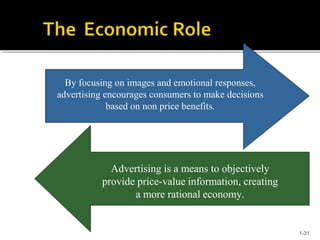
Advertising is a means to objectively
provide price-value information, creating
a more rational economy.
By focusing on images and emotional responses,
advertising encourages consumers to make decisions
based on non price benefits.
1-31
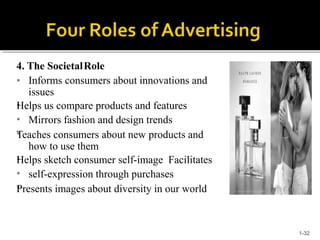
4. The SocietalRole
•
•
•
•
•
•
• Informs consumers about innovations and
issues
Helps us compare products and features
Mirrors fashion and design trends
Teaches consumers about new products and
how to use them
Helps sketch consumer self-image Facilitates
self-expression through purchases
Presents images about diversity in our world
1-32
•
•
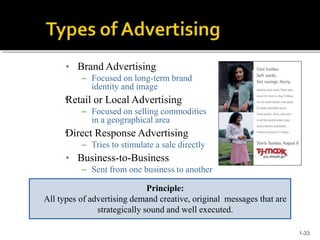
• Brand Advertising
– Focused on long-term brand
identity and image
Retail or Local Advertising
– Focused on selling commodities
in a geographical area
Direct Response Advertising
– Tries to stimulate a sale directly
• Business-to-Business
– Sent from one business to another
Principle:
All types of advertising demand creative, original messages that are
strategically sound and well executed.
1-33
•
•
•
Institutional Advertising
–Focused on establishing a
corporate identity or winning the
public over to the organization’s
point of view
Nonprofit Advertising
–Used by nonprofits like charities,
associations, hospitals, museums,
and churches for customer,
members, volunteers, and donors
Public Service Advertising
–Usually produced and run for free
on behalf of a good cause
1-34
 Wants to send out a message about
its business
Initiates effort by identifying a
problem that advertising can solve
 Selects the target audience, sets the
budget, and approves the ad plan
 Hires the agency
 Agency of record (AOR) does the most
business; manages other agencies
1-35
 Agencies have the strategic and creative expertise,
media knowledge, talent, and negotiating abilities to
operate more efficiently than the advertiser.
 Some large advertisers have in-house departments.
1-36
 Media are channels of communication that carry the
message to the audience
Principle:
Mass media advertising can be cost effective because the costs
are spread over the large number of people the ad reaches.
1-37
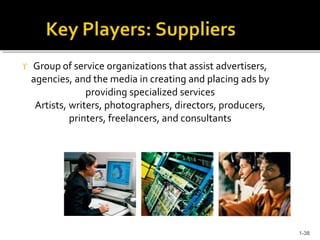
 Group of service organizations that assist advertisers,
agencies, and the media in creating and placing ads by
providing specialized services
Artists, writers, photographers, directors, producers,
printers, freelancers, and consultants
1-38
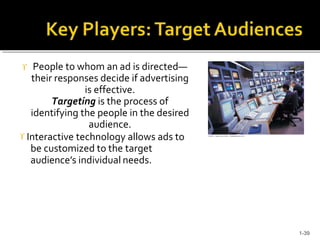
 People to whom an ad is directed—
their responses decide if advertising
is effective.
Targeting is the process of
identifying the people in the desired
audience.
 Interactive technology allows ads to
be customized to the target
audience’s individual needs.
nsert
1-39
The New Advertising
Electronic media are making advertising more
intimate, interactive, and personalized.
Advertising must evolve to keep up with technology.
Creativity involves more than just the ad’s big idea,
but finding new ways to engage consumers beyond
traditional mass media.
1-40
Interactivity
Buzz is getting people to talk about the event, idea
or brand.
People contact companies by phone, the Internet,
and through friends.
Advertising must change to also become more
interactive.
1-41
Integrated Marketing Communication (IMC)
IMC means unifying all marketing communication
messages and tools to send a consistent, persuasive
message promoting the brand’s goals.
Stakeholders are also important in IMC.
Synergy means messages have more impact working
jointly than on their own.
1-42
Globalization
 The elimination of trade barriers in the 1990s opened
huge international markets.
 Agencies are forming multinational operations to to
address these markets.
 Should advertisers practice local or global
advertising?
Video Snippet
Harley-Davidson talks
about the foundation of a
global marketing strategy.
1-43
What makes an ad effective?
 Gets attention
 Creates a positive impression for a brand
 Separates the brand from the competition
 Influences people to respond in the desired way
Principle:
An ad that works—that is effective—is one where the target
audience responds as the advertiser intended.
1-44
Effectiveness and AwardsShows
 EFFIE awards recognize effective advertising.
 Others are advertising and marketing effectiveness
(AME), Canada’s Cassie Awards, and London-based
Institute of Practitioner’s Awards (IPA).
 Clios, the One Show, and the Cannes Lions Awards
recognize creativity.
Visit the Site
1-45
Consumer Advertising
•
•
•
Consumer advertising is advertising that is directed and intended
for domestic markets such as individuals and families. This is in
contrast to industrial advertising, which is specifically directed and
marketed toward businesses.
The goal of consumer advertising is to introduce, or sometimes re-
introduce, products and services to families and private individuals
for daily use and consumption.
These can be automobiles for family use, household appliances,
home electronic devices, clothes, books, movies, and just about
anything else commonly found in an individual or family
household.
1-47
Institutional Advertising
• Institutional advertising is marketing designed to promote
a company rather than a specific good or service. It can be
designed to make the public more aware of a company or
to improve the reputation and image of an existing
company. Depending on the company, this can be a form
of brand advertising.
• Institutional advertising is a form of advertising that
allows a company to promote themselves, rather than an
individual product they offer.
• Some examples might be a beer company that runs
advertisements for safe drinking. Another would be oil
companies that tell you all the good they think they do for
us. 1-48
Retail Advertising
•
•
•
•
The manufacturer has little concern where its product is purchased.
The goal of the retail advertiser differs from that of national
advertiser.
The retailer advertises to encourage patronage by consumers and
build store loyalty among them.
The retailer is not particularly concerned with any specific brand.
In case the retailer shows some concern (the retailer wants to clear
stocks of a particular brand), then the message in effect is “buy
brand ‘B’ at our store.”
General approach in retail advertising is “buy at our store.” The
sale of any specific brand is not the concern of retailer unlike the
national advertiser.
1-49
Trade Advertising
• A Trade advertisement is advertising undertaken
by the manufacturer and directed toward the
wholesaler or retailer
• Consumer-product advertising intended not for the
consumer but for the various entities who
influence consumer availability, such as
distributors, wholesalers, retailers, brokers. Also
called business-to-business advertising.
1-50
Professional Advertising
• Advertising directed toward professionals such as doctors,
dentists, and pharmacists, etc., who are in a position to
promote products to customers.
• It is mostly related to those product which is specially
made for professional work or professional people's like
Ca's, Lawyer's, architect, engineers , Doctor's ,. &
advertisement of these product is called professional
advertising .
• For Eg. kit of necessary equipment of architecture ,or
surgical equipment for doctors .
which the professional person purchase it .
1-51
Thank
You
1-52

Lecture 1-Intro to Advertising.ppt

  • 1.
  • 2.
     Advertising isa message designed to promote a product, a service, or an idea. The purpose of advertising is to sell products or services. 1-2
  • 3.
  • 4.
     Advertising reachespeople through various forms of mass communication.  These media include newspapers, magazines, television, radio, the Internet, direct mail, outdoor signs, transit signs, window displays, point-of-purchase displays, telephone directories, novelties. 1-4
  • 5.
     Advertising isdesigned to inform, influence, or persuade people.  To be effective, an advertisement must first Attract attention and gain a person’s Interest. It may then build Desire for a product and provide a method for them to take Action. 1-5
  • 6.
     Advertisers researchthe unique features of the product to determine the USP (unique selling proposition) and the big idea—the simple message that will be used to communicate the USP to the target audience.  Many firms use a SWOT analysis to help them with their advertising techniques. 1-6
  • 7.
     Strengths  Outstandingfeatures of the brand  Positive consumer perceptions of the brand  Features that are better, different or missing from competitor’s brands 1-7
  • 8.
     Weaknesses  Whatis missing  Negative consumer perceptions  Features of competitor’s brand that are better 1-8
  • 9.
     Opportunities  Whatare the newest trends that have not been addressed  What are the latest developments in technology  Are there gaps in the market 1-9
  • 10.
     Threats  Areconsumers finding replacement products  Is the industry regulated 1-10
  • 11.
  • 12.
     Advertisers usea variety of techniques to create effective advertisements. 1-12
  • 13.
  • 14.
     Biological  Focuson consumer’s basic needs for health and security  Emotional  Focus on the consumers’ feelings (love, romance, pride)  Rational  Focus on the consumer’s reasoning abilities (cost, safety, convenience)  Social  Focus on the way that social pressures influence consumer behaviour (odour, weight, acne, fashion) 1-14
  • 15.
    Part One: Foundations •Provides an introduction to advertising—its role, key players, and history • Defines advertising’s role in marketing including key players and new developments • Examines advertising’s relationship to society including regulations and ethics in advertising (Insert new book cover) 1-15
  • 16.
    • What wasthe purpose of this promotion? • What was the message? • What media did this campaign use? Visit the Site 1-16
  • 17.
     A complexform of communication using objectives and strategies to impact consumer thoughts, feelings, and actions.  A form of marketing communication (all the techniques marketers use to reach their customers and deliver their messages). WHAT IS ADVERTISING? 1-18
  • 18.
  • 19.
    The Evolution ofAdvertising Identification  Simple images found in ancient Babylonia, Egypt, Greece, and Rome identified a business, manufacturer, or store.  Information  Gutenberg’s movable type mechanized printing leading to mass communication.  Promotion  The Industrial Revolution led to surplus goods, improved transportation, and the need for new media.  Sales  Advertisers became concerned about making ads that worked and defining standards of effective adve 1-19
  • 20.
    Principle: An effective advertisementis one that can be proven to meet its objectives. Five Basic Factors of Advertising 1.Paid communication 2.Sponsor is identified 3.Tries to inform or influence 4.Reaches a large audience 5.Message conveyed through many different kinds of largely non personal mass media 1-20
  • 21.
  • 22.
    1. Advertising Strategy Thestrategy is the logic and planning behind the ad that gives it direction. Advertisers develop ads to meet objectives. Advertisers direct ads to identified audiences. Advertisers create a message that speaks to the audience’s concerns. Advertisers run ads in the most effective media. 1-24
  • 23.
  • 24.
    2. Creative Idea Thecreative concept is the central idea that grabs the consumer’s attention and sticks in memory. Planning strategy requires creative problem solving. Research involves creativity. Buying and placing ads requires creative thinking. 1-24
  • 25.
    3. Creative Execution Effectiveads are well executed reflecting the highest production values in the industry. Clients demand the best production the budget allows. 1-25
  • 26.
    4. Media Planning/Buying Television,Internet, magazines, and other media are used to reach a broad audience. Deciding how to deliver the message requires creativity. Principle: In advertising how you say something and where you say it is just as important as what you say. 1-26
  • 27.
    1. The MarketingRole •Marketing is satisfying customer wants and needs by providing products (goods, services, and ideas). •The marketing department is responsible for selling the product using the 4 Ps (product, price, place/distribution, and promotion) and brand development. Principle: A product can be services and ideas as well as goods. 1-27
  • 28.
    2. The CommunicationRole •Advertising is a message to a consumer about a product, designed to create a response. •It is also a form of marketing communication. •Advertising uses mass communication to transmit product information to connect buyers and sellers in them marketplace. Principle: One of advertising’s most important strengths is its ability to reach a large audience. 1-28
  • 29.
  • 30.
    3. The EconomicRole •Because it reaches large groups of people, advertising makes marketing more cost-efficient and lowers prices for consumers. •Advertising creates a demand for a brand using hard sell (persuading) and soft sell (image building) techniques. 1-30
  • 31.
    Advertising is ameans to objectively provide price-value information, creating a more rational economy. By focusing on images and emotional responses, advertising encourages consumers to make decisions based on non price benefits. 1-31
  • 32.
    4. The SocietalRole • • • • • • •Informs consumers about innovations and issues Helps us compare products and features Mirrors fashion and design trends Teaches consumers about new products and how to use them Helps sketch consumer self-image Facilitates self-expression through purchases Presents images about diversity in our world 1-32
  • 33.
    • • • Brand Advertising –Focused on long-term brand identity and image Retail or Local Advertising – Focused on selling commodities in a geographical area Direct Response Advertising – Tries to stimulate a sale directly • Business-to-Business – Sent from one business to another Principle: All types of advertising demand creative, original messages that are strategically sound and well executed. 1-33
  • 34.
    • • • Institutional Advertising –Focused onestablishing a corporate identity or winning the public over to the organization’s point of view Nonprofit Advertising –Used by nonprofits like charities, associations, hospitals, museums, and churches for customer, members, volunteers, and donors Public Service Advertising –Usually produced and run for free on behalf of a good cause 1-34
  • 35.
     Wants tosend out a message about its business Initiates effort by identifying a problem that advertising can solve  Selects the target audience, sets the budget, and approves the ad plan  Hires the agency  Agency of record (AOR) does the most business; manages other agencies 1-35
  • 36.
     Agencies havethe strategic and creative expertise, media knowledge, talent, and negotiating abilities to operate more efficiently than the advertiser.  Some large advertisers have in-house departments. 1-36
  • 37.
     Media arechannels of communication that carry the message to the audience Principle: Mass media advertising can be cost effective because the costs are spread over the large number of people the ad reaches. 1-37
  • 38.
     Group ofservice organizations that assist advertisers, agencies, and the media in creating and placing ads by providing specialized services Artists, writers, photographers, directors, producers, printers, freelancers, and consultants 1-38
  • 39.
     People towhom an ad is directed— their responses decide if advertising is effective. Targeting is the process of identifying the people in the desired audience.  Interactive technology allows ads to be customized to the target audience’s individual needs. nsert 1-39
  • 40.
    The New Advertising Electronicmedia are making advertising more intimate, interactive, and personalized. Advertising must evolve to keep up with technology. Creativity involves more than just the ad’s big idea, but finding new ways to engage consumers beyond traditional mass media. 1-40
  • 41.
    Interactivity Buzz is gettingpeople to talk about the event, idea or brand. People contact companies by phone, the Internet, and through friends. Advertising must change to also become more interactive. 1-41
  • 42.
    Integrated Marketing Communication(IMC) IMC means unifying all marketing communication messages and tools to send a consistent, persuasive message promoting the brand’s goals. Stakeholders are also important in IMC. Synergy means messages have more impact working jointly than on their own. 1-42
  • 43.
    Globalization  The eliminationof trade barriers in the 1990s opened huge international markets.  Agencies are forming multinational operations to to address these markets.  Should advertisers practice local or global advertising? Video Snippet Harley-Davidson talks about the foundation of a global marketing strategy. 1-43
  • 44.
    What makes anad effective?  Gets attention  Creates a positive impression for a brand  Separates the brand from the competition  Influences people to respond in the desired way Principle: An ad that works—that is effective—is one where the target audience responds as the advertiser intended. 1-44
  • 45.
    Effectiveness and AwardsShows EFFIE awards recognize effective advertising.  Others are advertising and marketing effectiveness (AME), Canada’s Cassie Awards, and London-based Institute of Practitioner’s Awards (IPA).  Clios, the One Show, and the Cannes Lions Awards recognize creativity. Visit the Site 1-45
  • 46.
    Consumer Advertising • • • Consumer advertisingis advertising that is directed and intended for domestic markets such as individuals and families. This is in contrast to industrial advertising, which is specifically directed and marketed toward businesses. The goal of consumer advertising is to introduce, or sometimes re- introduce, products and services to families and private individuals for daily use and consumption. These can be automobiles for family use, household appliances, home electronic devices, clothes, books, movies, and just about anything else commonly found in an individual or family household. 1-47
  • 47.
    Institutional Advertising • Institutionaladvertising is marketing designed to promote a company rather than a specific good or service. It can be designed to make the public more aware of a company or to improve the reputation and image of an existing company. Depending on the company, this can be a form of brand advertising. • Institutional advertising is a form of advertising that allows a company to promote themselves, rather than an individual product they offer. • Some examples might be a beer company that runs advertisements for safe drinking. Another would be oil companies that tell you all the good they think they do for us. 1-48
  • 48.
    Retail Advertising • • • • The manufacturerhas little concern where its product is purchased. The goal of the retail advertiser differs from that of national advertiser. The retailer advertises to encourage patronage by consumers and build store loyalty among them. The retailer is not particularly concerned with any specific brand. In case the retailer shows some concern (the retailer wants to clear stocks of a particular brand), then the message in effect is “buy brand ‘B’ at our store.” General approach in retail advertising is “buy at our store.” The sale of any specific brand is not the concern of retailer unlike the national advertiser. 1-49
  • 49.
    Trade Advertising • ATrade advertisement is advertising undertaken by the manufacturer and directed toward the wholesaler or retailer • Consumer-product advertising intended not for the consumer but for the various entities who influence consumer availability, such as distributors, wholesalers, retailers, brokers. Also called business-to-business advertising. 1-50
  • 50.
    Professional Advertising • Advertisingdirected toward professionals such as doctors, dentists, and pharmacists, etc., who are in a position to promote products to customers. • It is mostly related to those product which is specially made for professional work or professional people's like Ca's, Lawyer's, architect, engineers , Doctor's ,. & advertisement of these product is called professional advertising . • For Eg. kit of necessary equipment of architecture ,or surgical equipment for doctors . which the professional person purchase it . 1-51
  • 51.