IT’S ALL ABOUT THE SALE!
Definition
 American Marketing Association
 The process of planning and executing the pricing,
promotion and distribution of ideas, goods, and services
to create exchanges that satisfy individual and
organizations.
 Marketing – develops and maintains satisfying
exchange relationships between business and
consumers.
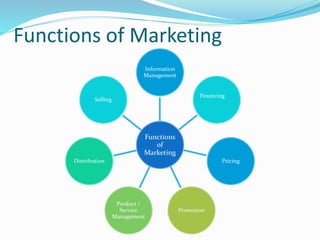
Functions of Marketing
Functions
of
Marketing
Information
Management
Selling
Distribution
Product /
Service
Management
Promotion
Pricing
Financing
Target Market & Call to Action
 Target market - customers are those who are most likely to buy
from you.
 male or female?
 How old are they?
 Where do they live? Is geography a limiting factor for any reason?
 What do they do for a living?
 How much money do they make? This is most significant if you're
selling relatively expensive or luxury items.
 A call-to-action (usually abbreviated as CTA) prompts your
target market to take action. It is, quite literally, a "call" to take
an "action."
 The action could be anything
 download an ebook
 sign up for a webinar,
 attend an event
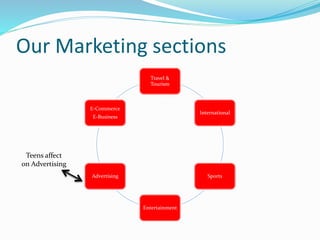
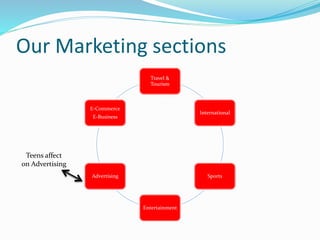
Our Marketing sections
Travel &
Tourism
International
Sports
Entertainment
Advertising
E-Commerce
E-Business
Teens affect
on Advertising
Travel and Tourism Marketing
 Consumers demand the best of luxury products and
services - from hotels and destinations to resort
developments and cruise lines.
 Their choices are emotionally charged with the
promise, anticipation, delight and gratification that
come from exclusive experiences and high - end
services.
 T & T Marketing identifies the benefits and will trigger
the customer’s emotions
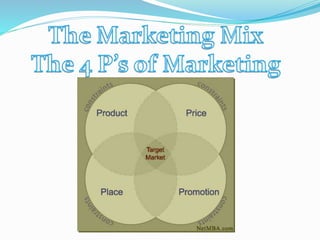
 The 4 P’s of Marketing apply to T & T.
Product
 The tourism product differs from other products due to
the wide range it covers, including such areas as
accommodations, transportation, food, recreation and
attractions.
 Often the product includes intangibles such as history,
culture and natural beauty.
 Many times the hospitality or tourism product is
viewed as more of a “service” in the customer’s eyes.
 The closer we can determine how to satisfy the
customer’s needs, the more successful the destination
will be
Price
 This refers to the amount customers pay for the
product or service provided.
 A quality tourism experience at a fair price is what the
customer is looking for in most cases.
 Pricing should be based upon clear-cut goals and
objectives: survival, profit maximization, market
share, competition or positioning.
Place
 The place where the customer buys the tourism
product
 Travel agents, tour operators and tour wholesalers are a
few examples of the distribution points for tourism
products.
 For example: web sites like
 http://www.jamaicatoursltd.com/item_list.php?com=s
how&type=tours&cat=1&affiliateid=
Promotion
 A range of activities can be used to convince customers
to buy the product, including information kits, web
sites, advertising, personal selling, sales promotion,
travel shows, and public relations.
 Utilize tourist information centers, such as welcome
centers.
 Participation with your state, regional and local
tourism offices and associations.
Entertainment Marketing
 Influencing how people choose to spend their time
and money on entertainment
 Entertainment as the product
 Using entertainment to attract attention to other
products
 Television, movies, theater, music (concerts),
amusement parks, circus, etc…
 Professional Wrestling?
 Sports or Entertainment?
Sports Marketing
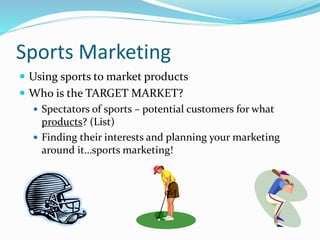
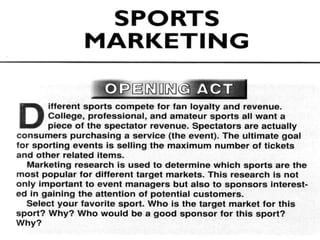
 Using sports to market products
 Who is the TARGET MARKET?
 Spectators of sports – potential customers for what
products? (List)
 Finding their interests and planning your marketing
around it…sports marketing!
Financial Impact of
Professional Sports
How much did the Great Recession impact pro sports? Many
teams have suffered downturns in revenue and valuation, but
for the richest franchises, life is still good.
Activity
 Economist believe the economic value (how much it
costs) of a professional sports team does not measure
up to the social and psychological significance the
team brings to that city.
Brainstorm and list benefits, including financial
that might come to a community acquiring a
professional sports team.
 Group of two or three
E-Commerce
 A business model, or segment of a larger business model,
that enables a firm or an individual to conduct business
over an electronic network, typically the internet.
 E-commerce operates in all four of the major market
segments:
 business to business,
 business to consumer,
 consumer to consumer
 consumer to business.
 It can be thought of as a more advanced form of mail-
order purchasing through a catalog. Almost any product
or service can be offered via ecommerce, from books and
music to financial services and plane tickets.
E-Business
 E-Business (electronic business) is using technology to
improve your business processes.
 managing internal processes
 human resources
 financial and administration systems
 external processes
 sales and marketing, supply of goods and services, and
customer relationships
Internet Businesses - a Marketing Tool
 Selling Goods and services “ONLY” On-line –
examples?
 Proving access for others to advertise –examples?
 Selling subscriptions to a website–
 Selling admissions to a website-
Activities using E-Business
 trading of goods or services online
 electronic retailing (eTailing)
 website marketing
 online communications, such as email
 online training for staff (eLearning).
Advantages
 quicker and easier communications
 strengthened marketing capabilities and reach
 increased hours of operation (a website provides 24
hour 7 day information to existing and potential
customers)
 access to broader information through research
 reducing the cost of doing business by lowering
transaction costs and increasing efficient methods for
payment, such as using online banking and reducing
stationery and postage costs
 the opportunities to adopt new business models and
develop tailored customer support.
Our Marketing sections
Travel &
Tourism
International
Sports
Entertainment
Advertising
E-Commerce
E-Business
Teens affect
on Advertising
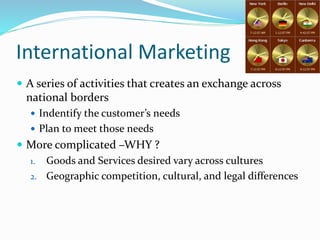
International Marketing
 A series of activities that creates an exchange across
national borders
 Indentify the customer’s needs
 Plan to meet those needs
 More complicated –WHY ?
1. Goods and Services desired vary across cultures
2. Geographic competition, cultural, and legal differences
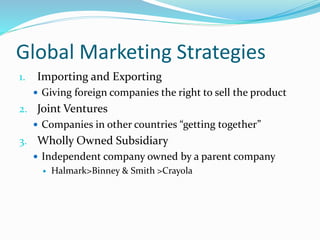
Global Marketing Strategies
1. Importing and Exporting
 Giving foreign companies the right to sell the product
2. Joint Ventures
 Companies in other countries “getting together”
3. Wholly Owned Subsidiary
 Independent company owned by a parent company
 Halmark>Binney & Smith >Crayola
What is making International
Marketing easier these days?
 The World is getting smaller. Meaning?
 Jet Travel
 Advances in Technology
 Internet
 New Transportation Systems
 Shipping
 New Market Opportunities
 Fall of Iron Curtain – opening trade in China
 Economic Development of new markets
 South America, Africa, Southeast Asia
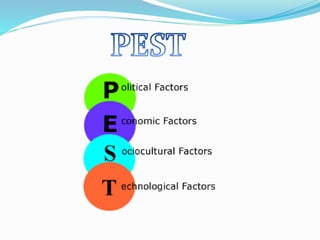
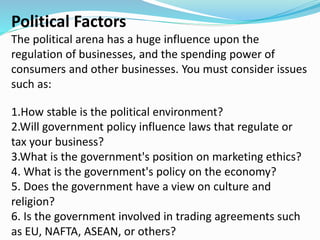
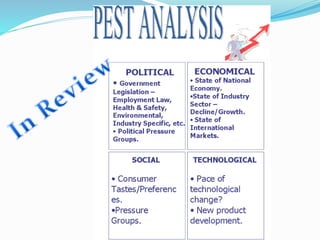
Political Factors
The political arena has a huge influence upon the
regulation of businesses, and the spending power of
consumers and other businesses. You must consider issues
such as:
1.How stable is the political environment?
2.Will government policy influence laws that regulate or
tax your business?
3.What is the government's position on marketing ethics?
4. What is the government's policy on the economy?
5. Does the government have a view on culture and
religion?
6. Is the government involved in trading agreements such
as EU, NAFTA, ASEAN, or others?
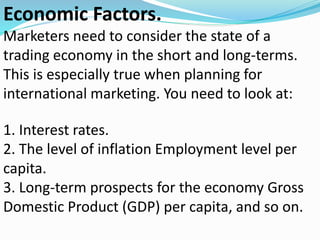
Economic Factors.
Marketers need to consider the state of a
trading economy in the short and long-terms.
This is especially true when planning for
international marketing. You need to look at:
1. Interest rates.
2. The level of inflation Employment level per
capita.
3. Long-term prospects for the economy Gross
Domestic Product (GDP) per capita, and so on.
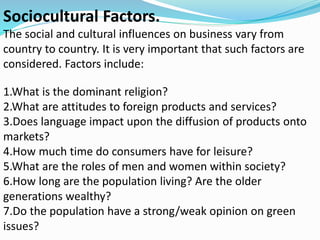
Sociocultural Factors.
The social and cultural influences on business vary from
country to country. It is very important that such factors are
considered. Factors include:
1.What is the dominant religion?
2.What are attitudes to foreign products and services?
3.Does language impact upon the diffusion of products onto
markets?
4.How much time do consumers have for leisure?
5.What are the roles of men and women within society?
6.How long are the population living? Are the older
generations wealthy?
7.Do the population have a strong/weak opinion on green
issues?
Technological Factors.
Technology is vital for competitive advantage, and is a major driver of
globalization. Consider the following points:
1. Does technology allow for products and services to be made more
cheaply and to a better standard of quality?
2.Do the technologies offer consumers and businesses more
innovative products and services such as Internet banking, new
generation mobile telephones, etc?
3.How is distribution changed by new technologies e.g. books via the
Internet, flight tickets, auctions, etc?
4.Does technology offer companies a new way to communicate with
consumers e.g. banners, Customer Relationship Management (CRM),
etc?
Marketing Class Overview

Marketing Class Overview

  • 1.
  • 2.
    Definition  American MarketingAssociation  The process of planning and executing the pricing, promotion and distribution of ideas, goods, and services to create exchanges that satisfy individual and organizations.  Marketing – develops and maintains satisfying exchange relationships between business and consumers.
  • 3.
  • 4.
    Target Market &Call to Action  Target market - customers are those who are most likely to buy from you.  male or female?  How old are they?  Where do they live? Is geography a limiting factor for any reason?  What do they do for a living?  How much money do they make? This is most significant if you're selling relatively expensive or luxury items.  A call-to-action (usually abbreviated as CTA) prompts your target market to take action. It is, quite literally, a "call" to take an "action."  The action could be anything  download an ebook  sign up for a webinar,  attend an event
  • 10.
    Our Marketing sections Travel& Tourism International Sports Entertainment Advertising E-Commerce E-Business Teens affect on Advertising
  • 11.
    Travel and TourismMarketing  Consumers demand the best of luxury products and services - from hotels and destinations to resort developments and cruise lines.  Their choices are emotionally charged with the promise, anticipation, delight and gratification that come from exclusive experiences and high - end services.  T & T Marketing identifies the benefits and will trigger the customer’s emotions  The 4 P’s of Marketing apply to T & T.
  • 12.
    Product  The tourismproduct differs from other products due to the wide range it covers, including such areas as accommodations, transportation, food, recreation and attractions.  Often the product includes intangibles such as history, culture and natural beauty.  Many times the hospitality or tourism product is viewed as more of a “service” in the customer’s eyes.  The closer we can determine how to satisfy the customer’s needs, the more successful the destination will be
  • 13.
    Price  This refersto the amount customers pay for the product or service provided.  A quality tourism experience at a fair price is what the customer is looking for in most cases.  Pricing should be based upon clear-cut goals and objectives: survival, profit maximization, market share, competition or positioning.
  • 14.
    Place  The placewhere the customer buys the tourism product  Travel agents, tour operators and tour wholesalers are a few examples of the distribution points for tourism products.  For example: web sites like  http://www.jamaicatoursltd.com/item_list.php?com=s how&type=tours&cat=1&affiliateid=
  • 15.
    Promotion  A rangeof activities can be used to convince customers to buy the product, including information kits, web sites, advertising, personal selling, sales promotion, travel shows, and public relations.  Utilize tourist information centers, such as welcome centers.  Participation with your state, regional and local tourism offices and associations.
  • 17.
    Entertainment Marketing  Influencinghow people choose to spend their time and money on entertainment  Entertainment as the product  Using entertainment to attract attention to other products  Television, movies, theater, music (concerts), amusement parks, circus, etc…  Professional Wrestling?  Sports or Entertainment?
  • 18.
    Sports Marketing  Usingsports to market products  Who is the TARGET MARKET?  Spectators of sports – potential customers for what products? (List)  Finding their interests and planning your marketing around it…sports marketing!
  • 20.
    Financial Impact of ProfessionalSports How much did the Great Recession impact pro sports? Many teams have suffered downturns in revenue and valuation, but for the richest franchises, life is still good.
  • 21.
    Activity  Economist believethe economic value (how much it costs) of a professional sports team does not measure up to the social and psychological significance the team brings to that city. Brainstorm and list benefits, including financial that might come to a community acquiring a professional sports team.  Group of two or three
  • 22.
    E-Commerce  A businessmodel, or segment of a larger business model, that enables a firm or an individual to conduct business over an electronic network, typically the internet.  E-commerce operates in all four of the major market segments:  business to business,  business to consumer,  consumer to consumer  consumer to business.  It can be thought of as a more advanced form of mail- order purchasing through a catalog. Almost any product or service can be offered via ecommerce, from books and music to financial services and plane tickets.
  • 23.
    E-Business  E-Business (electronicbusiness) is using technology to improve your business processes.  managing internal processes  human resources  financial and administration systems  external processes  sales and marketing, supply of goods and services, and customer relationships
  • 24.
    Internet Businesses -a Marketing Tool  Selling Goods and services “ONLY” On-line – examples?  Proving access for others to advertise –examples?  Selling subscriptions to a website–  Selling admissions to a website-
  • 25.
    Activities using E-Business trading of goods or services online  electronic retailing (eTailing)  website marketing  online communications, such as email  online training for staff (eLearning).
  • 26.
    Advantages  quicker andeasier communications  strengthened marketing capabilities and reach  increased hours of operation (a website provides 24 hour 7 day information to existing and potential customers)  access to broader information through research  reducing the cost of doing business by lowering transaction costs and increasing efficient methods for payment, such as using online banking and reducing stationery and postage costs  the opportunities to adopt new business models and develop tailored customer support.
  • 27.
    Our Marketing sections Travel& Tourism International Sports Entertainment Advertising E-Commerce E-Business Teens affect on Advertising
  • 28.
    International Marketing  Aseries of activities that creates an exchange across national borders  Indentify the customer’s needs  Plan to meet those needs  More complicated –WHY ? 1. Goods and Services desired vary across cultures 2. Geographic competition, cultural, and legal differences
  • 29.
    Global Marketing Strategies 1.Importing and Exporting  Giving foreign companies the right to sell the product 2. Joint Ventures  Companies in other countries “getting together” 3. Wholly Owned Subsidiary  Independent company owned by a parent company  Halmark>Binney & Smith >Crayola
  • 30.
    What is makingInternational Marketing easier these days?  The World is getting smaller. Meaning?  Jet Travel  Advances in Technology  Internet  New Transportation Systems  Shipping  New Market Opportunities  Fall of Iron Curtain – opening trade in China  Economic Development of new markets  South America, Africa, Southeast Asia
  • 32.
    Political Factors The politicalarena has a huge influence upon the regulation of businesses, and the spending power of consumers and other businesses. You must consider issues such as: 1.How stable is the political environment? 2.Will government policy influence laws that regulate or tax your business? 3.What is the government's position on marketing ethics? 4. What is the government's policy on the economy? 5. Does the government have a view on culture and religion? 6. Is the government involved in trading agreements such as EU, NAFTA, ASEAN, or others?
  • 33.
    Economic Factors. Marketers needto consider the state of a trading economy in the short and long-terms. This is especially true when planning for international marketing. You need to look at: 1. Interest rates. 2. The level of inflation Employment level per capita. 3. Long-term prospects for the economy Gross Domestic Product (GDP) per capita, and so on.
  • 34.
    Sociocultural Factors. The socialand cultural influences on business vary from country to country. It is very important that such factors are considered. Factors include: 1.What is the dominant religion? 2.What are attitudes to foreign products and services? 3.Does language impact upon the diffusion of products onto markets? 4.How much time do consumers have for leisure? 5.What are the roles of men and women within society? 6.How long are the population living? Are the older generations wealthy? 7.Do the population have a strong/weak opinion on green issues?
  • 35.
    Technological Factors. Technology isvital for competitive advantage, and is a major driver of globalization. Consider the following points: 1. Does technology allow for products and services to be made more cheaply and to a better standard of quality? 2.Do the technologies offer consumers and businesses more innovative products and services such as Internet banking, new generation mobile telephones, etc? 3.How is distribution changed by new technologies e.g. books via the Internet, flight tickets, auctions, etc? 4.Does technology offer companies a new way to communicate with consumers e.g. banners, Customer Relationship Management (CRM), etc?