MARKETING
TGTA
Marketing
Is ‘Marketing’ just a fancy word for ‘Selling’, or is it
perhaps a clever way of describing ‘Advertising’, or ‘Sales
Promotion’ or ‘Packaging’? Is it none of these things, or all
of these things? Is there more to it or less to it?
The Oxford dictionary defines the words as: “The act or
practice of buying and selling in the market”.
The definition that many marketers learn as they start out
in the industry is: Putting the right product in the right
place, at the right price, at the right time to the right
customers.
It's simple! You just need to create a product that a particularly group of
people want, put it on sale some place that those same people visit
regularly, and price it at a level which matches the value they feel they get
out of it; and do all that at a time they want to buy. Then you've got it made!
There's a lot of truth in this idea. However, a lot of hard work needs to go
into finding out what customers want, and identifying where they do their
shopping. Then you need to figure out how to produce the item at a price
that represents value to them, and get it all to come together at the critical
time.
Marketing is not a simple, one activity process. The marketing chain has
many links and below is several definitions, which attempts to reduce a
number of complex steps into one-sentence definitions.
Marketing is commercial discipline, which have developed while trying to
identify and to the needs and demands of consumers.
Marketing
Marketing Environment
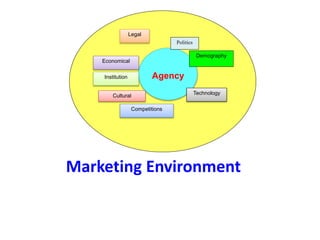
Agency
Politics
Demography
Technology
Competitions
Cultural
Institution
Economical
Legal
Marketing Environment
 Economical: Uncertainty may cause purchasers to postpone buying
certain products. It certain reduces capital investment in new equipment
and plant. High inflation rates and high interest rates also hamper
investment. High cost living and low cost living is financially attractive,
and if they are also physically attractive they are usually of interest to
tourists.
 Legal: Laws affecting business. Income Tax, VAT, Supply of Goods Act.
Health & Safety, Office business plan, BTT (Business Turn over Tax).
 Political: Many governments have strict control over economic activities.
There are also political environment factors over which business have no
controls. War or threats of war can affect business, as can sanctions.
Marketing Environment
 Demography: Is the study of the statistics of birth, deaths, etc, and it's concerned with
population trends and charming population characteristics.
 Competitions: Travel agency, Tour Operator office and also National Tourism Organization
create some competition to the other organisation.
 Institutions: Local tour operators, Franchising is also very popular. Multi National
enterprise are often more powerful than some governments. Name like MACDONALDS,
COCA COLA, PEPSI COLA are seen world wide and great influence.
 Technology: Technology is often seen to be the great break through, but it often creates as
many problems as it solves. As new and better methods are incorporated into the
marketplace many old businesses dies and hopefully, new ones appear.
 Cultural & Social: People of different cultures and backgrounds have different tastes on
religious taboos and consequently have different demands. Younger people have greater
spending power than ever before and they create new demands.
The Marketing Mix
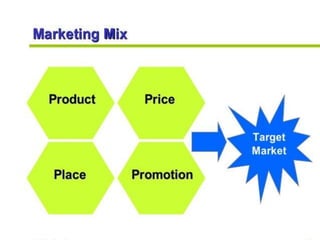
Marketing mix" is a general phrase used to
describe the different kinds of choices
organizations have to make in the whole
process of bringing a product or service to
market.
 A good way to understand the 4 Ps is by the questions that
you need to ask to define you marketing mix.
PRODUCT
In tourism sense product means attractive place, area and geographical
location or resort area, as well as locals area and Shrine, hill area and
attraction placement.
 What does the customer want from the product/service? What needs
does it satisfy?
 What features does it have to meet these needs?
 Are there any features you've missed out?
 Are you including costly features that the customer won't actually use?
 How and where will the customer use it?
 What does it look like? How will customers experience it?
 What size(s), color(s), and so on, should it be?
 What is it to be called?
 How is it branded?
 How is it differentiated versus your competitors?
 What is the most it can cost to provide, and still be sold sufficiently
profitably?
PRICE
Price is basically what the customer exchanges in return for the
product or service he / she obtain.
 Is the price right for the target market?
 Will the price give on adequate profit?
 How does the price compare with competitor’s charges?
 What is the value of the product or service to the buyer?
 Are there established price points for products or services in this
area?
 Is the customer price sensitive? Will a small decrease in price gain
you extra market share? Or will a small increase be indiscernible,
and so gain you extra profit margin?
 What discounts should be offered to trade customers, or to other
specific segments of your market?
PLACE
Business place and official place is very important to achieved
Profit margin.
 Where do buyers look for your product or service?
 If they look in a store, what kind? A specialist boutique or in a
supermarket, or both? Or online? Or direct, via a catalogue?
 How can you access the right distribution channels?
 Do you need to use a sales force? Or attend trade fairs? Or make
online submissions? Or send samples to catalogue companies?
 What do you competitors do, and how can you learn from that
and/or differentiate?
PROMOTION
This is the activity of communication of your customers the
fact that you have products available. It covers area such as:
 Where and when can you get across your marketing messages
to your target market?
 Will you reach your audience by advertising in the press, or on
TV, or radio, or on billboards? By using direct marketing mail
shot? Through PR? On the Internet?
 When is the best time to promote? Is there seasonality in the
market? Are there any wider environmental issues that
suggest or dictate the timing of your market launch, or the
timing of subsequent promotions?
Using the 4Ps Marketing Mix Model
The marketing mix model can be used to help you decide
how to take a new offer to market. It can also be used to test
your existing marketing strategy. Whether you are
considering a new or existing offer, follow the steps below
help you define and improve your marketing mix.
 Start by identifying the product or service that you want to
analyze.
 Now go through and answer the 4Ps questions – as defined
in detail above.
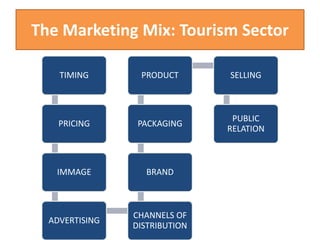
The Marketing Mix: Tourism Sector
TIMING
PRICING
IMMAGE
ADVERTISING
CHANNELS OF
DISTRIBUTION
BRAND
PACKAGING
PRODUCT SELLING
PUBLIC
RELATION
Tip:
Check through your answers to make sure they are based on
sound knowledge and facts. If there are doubts about your
assumptions, identify any market research, or facts and
figures that you may need to gather.
• Does it meet their needs? (Product)
• Will they find it where they shop? (Place)
• Will they consider it's priced favorably? (Price)
• And will the marketing communications reach them?
(Promotion)
Key Points:
 The marketing mix helps you define the marketing
elements for successfully positioning your market offer. One
of the best-known models is the Four Ps, which helps you
define your marketing options in terms of product, place,
price and promotion. Use the model when you are planning
a new venture, or evaluating an existing offer, to optimize
the impact with your target market.
MARKETING INSTRUMENTS
• Mailing
• Direct Sales
• Advertising
• Public relations
• Trade Shows / Exhibitions / fairs
• Word of Mouth
• Sponsoring
MARKETING TOOLS
• Brochures / flyers
• Magazines / Newspapers
• Periodicals / Books
• Statistics
• News / News Releases
• Video
• Slide Shows
• Radio & TV
• Performances / Shows
• Other Visual Aida
• Invitations / Contests
• Other Promotions
• Campaigns
TOUR OPERATION/ ADMINISTRATION/ MARKETING
 RESEARCH & PLANNING
 NEGOTIATION
 ADMINISTRATION
 MARKETING
RESEARCH & PLANNING
 Look at economic factors influencing the future
development of package tours identify likely selection
of destinations.
 Second stages of research in-depth comparison of
alternative destinations.
 Determine destinations hotels and capacity, duration of
tours, departure dates. Make policy decision on size and
design of brochure, number of brochures to print, date
of completion of print.
NEGOTIATION
 Tenders put out of design, production and printing of
brochures, negotiate with the airlines, hotels, transfer
services, optional excursion operators.
 Typesetting and printing of the copy and illustrations
commissioned. Early artwork and text under
development at design studio, with layout suggestions.
Contracts completed with hotels and airlines, transfer
services etc.
 Production of brochure starts
ADMINISTRATION
 Determine exchange rates, estimate selling prices based on
inflation etc, Galley proofs from printer, connectors made. Any
necessary reservations staff recruited and trained.
 Final tour prices to printer, brochures printed and reservations
system established
MARKETING
 Brochure on market distribution on agents, initial
agency sales and promotional operation launch. First
public media, advertising and trade publicity through
press etc.
 Peak advertising and public relation activities to be
completed
 Recruitment and training of the personnel’s
 First tour departures.

Marketing

  • 1.
  • 2.
    Marketing Is ‘Marketing’ justa fancy word for ‘Selling’, or is it perhaps a clever way of describing ‘Advertising’, or ‘Sales Promotion’ or ‘Packaging’? Is it none of these things, or all of these things? Is there more to it or less to it? The Oxford dictionary defines the words as: “The act or practice of buying and selling in the market”. The definition that many marketers learn as they start out in the industry is: Putting the right product in the right place, at the right price, at the right time to the right customers.
  • 3.
    It's simple! Youjust need to create a product that a particularly group of people want, put it on sale some place that those same people visit regularly, and price it at a level which matches the value they feel they get out of it; and do all that at a time they want to buy. Then you've got it made! There's a lot of truth in this idea. However, a lot of hard work needs to go into finding out what customers want, and identifying where they do their shopping. Then you need to figure out how to produce the item at a price that represents value to them, and get it all to come together at the critical time. Marketing is not a simple, one activity process. The marketing chain has many links and below is several definitions, which attempts to reduce a number of complex steps into one-sentence definitions. Marketing is commercial discipline, which have developed while trying to identify and to the needs and demands of consumers. Marketing
  • 4.
  • 5.
    Marketing Environment  Economical:Uncertainty may cause purchasers to postpone buying certain products. It certain reduces capital investment in new equipment and plant. High inflation rates and high interest rates also hamper investment. High cost living and low cost living is financially attractive, and if they are also physically attractive they are usually of interest to tourists.  Legal: Laws affecting business. Income Tax, VAT, Supply of Goods Act. Health & Safety, Office business plan, BTT (Business Turn over Tax).  Political: Many governments have strict control over economic activities. There are also political environment factors over which business have no controls. War or threats of war can affect business, as can sanctions.
  • 6.
    Marketing Environment  Demography:Is the study of the statistics of birth, deaths, etc, and it's concerned with population trends and charming population characteristics.  Competitions: Travel agency, Tour Operator office and also National Tourism Organization create some competition to the other organisation.  Institutions: Local tour operators, Franchising is also very popular. Multi National enterprise are often more powerful than some governments. Name like MACDONALDS, COCA COLA, PEPSI COLA are seen world wide and great influence.  Technology: Technology is often seen to be the great break through, but it often creates as many problems as it solves. As new and better methods are incorporated into the marketplace many old businesses dies and hopefully, new ones appear.  Cultural & Social: People of different cultures and backgrounds have different tastes on religious taboos and consequently have different demands. Younger people have greater spending power than ever before and they create new demands.
  • 8.
    The Marketing Mix Marketingmix" is a general phrase used to describe the different kinds of choices organizations have to make in the whole process of bringing a product or service to market.  A good way to understand the 4 Ps is by the questions that you need to ask to define you marketing mix.
  • 9.
    PRODUCT In tourism senseproduct means attractive place, area and geographical location or resort area, as well as locals area and Shrine, hill area and attraction placement.  What does the customer want from the product/service? What needs does it satisfy?  What features does it have to meet these needs?  Are there any features you've missed out?  Are you including costly features that the customer won't actually use?  How and where will the customer use it?  What does it look like? How will customers experience it?  What size(s), color(s), and so on, should it be?  What is it to be called?  How is it branded?  How is it differentiated versus your competitors?  What is the most it can cost to provide, and still be sold sufficiently profitably?
  • 10.
    PRICE Price is basicallywhat the customer exchanges in return for the product or service he / she obtain.  Is the price right for the target market?  Will the price give on adequate profit?  How does the price compare with competitor’s charges?  What is the value of the product or service to the buyer?  Are there established price points for products or services in this area?  Is the customer price sensitive? Will a small decrease in price gain you extra market share? Or will a small increase be indiscernible, and so gain you extra profit margin?  What discounts should be offered to trade customers, or to other specific segments of your market?
  • 11.
    PLACE Business place andofficial place is very important to achieved Profit margin.  Where do buyers look for your product or service?  If they look in a store, what kind? A specialist boutique or in a supermarket, or both? Or online? Or direct, via a catalogue?  How can you access the right distribution channels?  Do you need to use a sales force? Or attend trade fairs? Or make online submissions? Or send samples to catalogue companies?  What do you competitors do, and how can you learn from that and/or differentiate?
  • 12.
    PROMOTION This is theactivity of communication of your customers the fact that you have products available. It covers area such as:  Where and when can you get across your marketing messages to your target market?  Will you reach your audience by advertising in the press, or on TV, or radio, or on billboards? By using direct marketing mail shot? Through PR? On the Internet?  When is the best time to promote? Is there seasonality in the market? Are there any wider environmental issues that suggest or dictate the timing of your market launch, or the timing of subsequent promotions?
  • 13.
    Using the 4PsMarketing Mix Model The marketing mix model can be used to help you decide how to take a new offer to market. It can also be used to test your existing marketing strategy. Whether you are considering a new or existing offer, follow the steps below help you define and improve your marketing mix.  Start by identifying the product or service that you want to analyze.  Now go through and answer the 4Ps questions – as defined in detail above.
  • 14.
    The Marketing Mix:Tourism Sector TIMING PRICING IMMAGE ADVERTISING CHANNELS OF DISTRIBUTION BRAND PACKAGING PRODUCT SELLING PUBLIC RELATION
  • 15.
    Tip: Check through youranswers to make sure they are based on sound knowledge and facts. If there are doubts about your assumptions, identify any market research, or facts and figures that you may need to gather. • Does it meet their needs? (Product) • Will they find it where they shop? (Place) • Will they consider it's priced favorably? (Price) • And will the marketing communications reach them? (Promotion)
  • 16.
    Key Points:  Themarketing mix helps you define the marketing elements for successfully positioning your market offer. One of the best-known models is the Four Ps, which helps you define your marketing options in terms of product, place, price and promotion. Use the model when you are planning a new venture, or evaluating an existing offer, to optimize the impact with your target market.
  • 17.
    MARKETING INSTRUMENTS • Mailing •Direct Sales • Advertising • Public relations • Trade Shows / Exhibitions / fairs • Word of Mouth • Sponsoring
  • 18.
    MARKETING TOOLS • Brochures/ flyers • Magazines / Newspapers • Periodicals / Books • Statistics • News / News Releases • Video • Slide Shows • Radio & TV • Performances / Shows • Other Visual Aida • Invitations / Contests • Other Promotions • Campaigns
  • 19.
    TOUR OPERATION/ ADMINISTRATION/MARKETING  RESEARCH & PLANNING  NEGOTIATION  ADMINISTRATION  MARKETING
  • 20.
    RESEARCH & PLANNING Look at economic factors influencing the future development of package tours identify likely selection of destinations.  Second stages of research in-depth comparison of alternative destinations.  Determine destinations hotels and capacity, duration of tours, departure dates. Make policy decision on size and design of brochure, number of brochures to print, date of completion of print.
  • 21.
    NEGOTIATION  Tenders putout of design, production and printing of brochures, negotiate with the airlines, hotels, transfer services, optional excursion operators.  Typesetting and printing of the copy and illustrations commissioned. Early artwork and text under development at design studio, with layout suggestions. Contracts completed with hotels and airlines, transfer services etc.  Production of brochure starts
  • 22.
    ADMINISTRATION  Determine exchangerates, estimate selling prices based on inflation etc, Galley proofs from printer, connectors made. Any necessary reservations staff recruited and trained.  Final tour prices to printer, brochures printed and reservations system established
  • 23.
    MARKETING  Brochure onmarket distribution on agents, initial agency sales and promotional operation launch. First public media, advertising and trade publicity through press etc.  Peak advertising and public relation activities to be completed  Recruitment and training of the personnel’s  First tour departures.