







Perfect Market Competition
Introduction
In the previous chapter we have examined the production and
the cost of producing goods and services.n But a firm’s decision
on production depends on the characteristics of the service
industry in whichthe firm is operating.
In this chapter and next chapter, we will define different types of
markets, their characteristics, their determination of equilibrium
in the short run and long run and some of their unique
charactristics.
We will explain the meaning of a firm and its objectives.
Theory of a Firm
• Definiton of a firm
– Is an institution that buys or hires factors of
production and organizes them to produce and
sell goods and services
– An independent unit which produces goods and
services for sale.
– A unit engaged in production with the objective of
maximizing profits.
Objective of a firm
– The main goal or abjective is profit maximization.
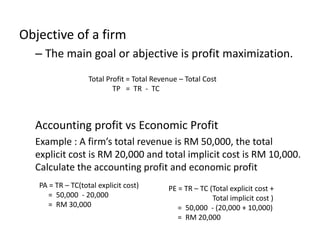
Accounting profit vs Economic Profit
Example : A firm’s total revenue is RM 50,000, the total
explicit cost is RM 20,000 and total implicit cost is RM 10,000.
Calculate the accounting profit and economic profit
Total Profit = Total Revenue – Total Cost
TP = TR - TC
PA = TR – TC(total explicit cost)
= 50,000 - 20,000
= RM 30,000
PE = TR – TC (Total explicit cost +
Total implicit cost )
= 50,000 - (20,000 + 10,000)
= RM 20,000
Equilibrium of a firm
- Definition
Implies the desirable level to attain under
given condition
A firm is in equilibrium when it earns
maximum profit or minimum loses.
has no tendency to increase or decrease
output.
Equilibrium output is the output level
which gives maximum profit.
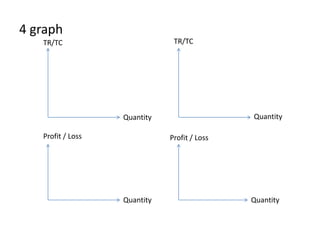
4 graph
TR/TC TR/TC
Profit / Loss Profit / Loss
Quantity
Quantity Quantity
Quantity
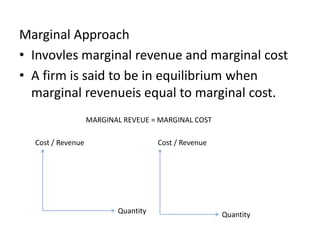
Marginal Approach
• Invovles marginal revenue and marginal cost
• A firm is said to be in equilibrium when
marginal revenueis equal to marginal cost.
MARGINAL REVEUE = MARGINAL COST
Cost / Revenue Cost / Revenue
Quantity Quantity
• Both the perfect competition and imperfect
competition markets give the same
explanation on maximizing profit. The only
difference in both market is the MR curve.
• The relationship between MR and MC is as
follows :
i. MR > MC – A firm can increase its profits by
increasing output
ii. MR < MC – A firm can reduce its loses by
decreasing output
iii. MR = MC – Profit are at maximum
Market Structure
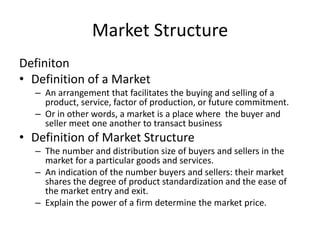
Definiton
• Definition of a Market
– An arrangement that facilitates the buying and selling of a
product, service, factor of production, or future commitment.
– Or in other words, a market is a place where the buyer and
seller meet one another to transact business
• Definition of Market Structure
– The number and distribution size of buyers and sellers in the
market for a particular goods and services.
– An indication of the number buyers and sellers: their market
shares the degree of product standardization and the ease of
the market entry and exit.
– Explain the power of a firm determine the market price.
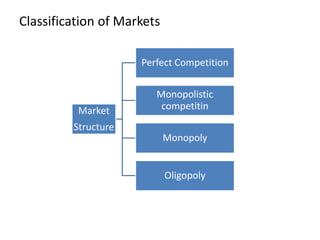
Market
Structure
Perfect Competition
Monopolistic
competitin
Monopoly
Oligopoly
Classification of Markets
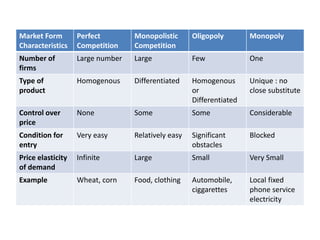
Market Form
Characteristics
Perfect
Competition
Monopolistic
Competition
Oligopoly Monopoly
Number of
firms
Large number Large Few One
Type of
product
Homogenous Differentiated Homogenous
or
Differentiated
Unique : no
close substitute
Control over
price
None Some Some Considerable
Condition for
entry
Very easy Relatively easy Significant
obstacles
Blocked
Price elasticity
of demand
Infinite Large Small Very Small
Example Wheat, corn Food, clothing Automobile,
ciggarettes
Local fixed
phone service
electricity
Perfect Competition
• Perfect competition is a market in which there
are a large number of buyers and sellers,
buying and selling identical products etc
• Example of products in a perfect competition
market are agricultural goods such as
vegetable, fruits and others.
• Characteristics
1. Large number of buyers and sellers
• An important featur of perfect competition is the
existence of alarge number of buyers and sellers
• The quantity of a single seller sells in a market so small
compared to the overall industry.
• Therefore no one can influence the market price of
goods.
• Thus, in perfect competition, firms are price takers
because the individual sales volume is realtively small
compared to market volume.
2. Free entry and exit
– There are no restriction on the entry of new firms to
the industry or the exit of firms.
– A new firm can easily enter into perfect competition
market and exit it at any time it chooses.
3. Non-Price Competition
– Sellers practice non-price competition such as
advertising, free gifts, discount, after sales service
and promotions when these sellers cannot compete
among themselves using pricing strategies
– The role of non-price competition is insignificant as
many sellers sell the products at fixed price and
furthermore the product is identical
4. Homogenous
– All the firms will sell identical or homogenous
products
– Buyers cannot differentiate products in the term
of quality, packaging, colour and design
– Hence, the firm cannot charge different prices for
the same products in the market
– Product which are similar in nature but different
in terms of quality and packaging are not
homogenous products.
5. Perfect knowledge of the market
– All the sellers and buyers will have perfect
knowledge of the market.
– Sellers cannot influence buyers and similarly
buyers cannot influence sellers.
– Sellers must know the price charge by other
sellers in the market and the buyers must know
the price being charged by another sellers.
– If any seller charges a higher price, the buyer will
buy from different sellers
6. Perfect mobility of factors of production
– Factors of production can freely move from one
occupation to another from one place to another.
– There is no barrier of movement.
– The existence of perfect mobility will lead to
existence of large sellers in the market.
7. Absence of transport cost
– There should not be any transport costs between
sellers.
– It is assumed that various firms will work closely
with each other so that transport costs are not
incurred
– If two identical products are at two different
places, their prices will be different because of
transport costs
– Therfeore there will no transport cost.
• Price determination in Perfect Competition
• Graph
Short run Equilibrium
• The
• Two Types
– Total Approach
– Marginal Approach
Total Approach
Marginal Approach
The three
Shut-down Point
• Graph
Short-run Supply Curve
Long run- Equilibrium
Effect of Entry
Effect of Exit

Bab7 perfect competition market

  • 1.
  • 2.
    Introduction In the previouschapter we have examined the production and the cost of producing goods and services.n But a firm’s decision on production depends on the characteristics of the service industry in whichthe firm is operating. In this chapter and next chapter, we will define different types of markets, their characteristics, their determination of equilibrium in the short run and long run and some of their unique charactristics. We will explain the meaning of a firm and its objectives.
  • 3.
    Theory of aFirm • Definiton of a firm – Is an institution that buys or hires factors of production and organizes them to produce and sell goods and services – An independent unit which produces goods and services for sale. – A unit engaged in production with the objective of maximizing profits.
  • 4.
    Objective of afirm – The main goal or abjective is profit maximization. Accounting profit vs Economic Profit Example : A firm’s total revenue is RM 50,000, the total explicit cost is RM 20,000 and total implicit cost is RM 10,000. Calculate the accounting profit and economic profit Total Profit = Total Revenue – Total Cost TP = TR - TC PA = TR – TC(total explicit cost) = 50,000 - 20,000 = RM 30,000 PE = TR – TC (Total explicit cost + Total implicit cost ) = 50,000 - (20,000 + 10,000) = RM 20,000
  • 5.
    Equilibrium of afirm - Definition Implies the desirable level to attain under given condition A firm is in equilibrium when it earns maximum profit or minimum loses. has no tendency to increase or decrease output. Equilibrium output is the output level which gives maximum profit.
  • 6.
    4 graph TR/TC TR/TC Profit/ Loss Profit / Loss Quantity Quantity Quantity Quantity
  • 7.
    Marginal Approach • Invovlesmarginal revenue and marginal cost • A firm is said to be in equilibrium when marginal revenueis equal to marginal cost. MARGINAL REVEUE = MARGINAL COST Cost / Revenue Cost / Revenue Quantity Quantity
  • 8.
    • Both theperfect competition and imperfect competition markets give the same explanation on maximizing profit. The only difference in both market is the MR curve. • The relationship between MR and MC is as follows : i. MR > MC – A firm can increase its profits by increasing output ii. MR < MC – A firm can reduce its loses by decreasing output iii. MR = MC – Profit are at maximum
  • 9.
    Market Structure Definiton • Definitionof a Market – An arrangement that facilitates the buying and selling of a product, service, factor of production, or future commitment. – Or in other words, a market is a place where the buyer and seller meet one another to transact business • Definition of Market Structure – The number and distribution size of buyers and sellers in the market for a particular goods and services. – An indication of the number buyers and sellers: their market shares the degree of product standardization and the ease of the market entry and exit. – Explain the power of a firm determine the market price.
  • 10.
  • 11.
    Market Form Characteristics Perfect Competition Monopolistic Competition Oligopoly Monopoly Numberof firms Large number Large Few One Type of product Homogenous Differentiated Homogenous or Differentiated Unique : no close substitute Control over price None Some Some Considerable Condition for entry Very easy Relatively easy Significant obstacles Blocked Price elasticity of demand Infinite Large Small Very Small Example Wheat, corn Food, clothing Automobile, ciggarettes Local fixed phone service electricity
  • 12.
    Perfect Competition • Perfectcompetition is a market in which there are a large number of buyers and sellers, buying and selling identical products etc • Example of products in a perfect competition market are agricultural goods such as vegetable, fruits and others.
  • 13.
    • Characteristics 1. Largenumber of buyers and sellers • An important featur of perfect competition is the existence of alarge number of buyers and sellers • The quantity of a single seller sells in a market so small compared to the overall industry. • Therefore no one can influence the market price of goods. • Thus, in perfect competition, firms are price takers because the individual sales volume is realtively small compared to market volume.
  • 14.
    2. Free entryand exit – There are no restriction on the entry of new firms to the industry or the exit of firms. – A new firm can easily enter into perfect competition market and exit it at any time it chooses. 3. Non-Price Competition – Sellers practice non-price competition such as advertising, free gifts, discount, after sales service and promotions when these sellers cannot compete among themselves using pricing strategies – The role of non-price competition is insignificant as many sellers sell the products at fixed price and furthermore the product is identical
  • 15.
    4. Homogenous – Allthe firms will sell identical or homogenous products – Buyers cannot differentiate products in the term of quality, packaging, colour and design – Hence, the firm cannot charge different prices for the same products in the market – Product which are similar in nature but different in terms of quality and packaging are not homogenous products.
  • 16.
    5. Perfect knowledgeof the market – All the sellers and buyers will have perfect knowledge of the market. – Sellers cannot influence buyers and similarly buyers cannot influence sellers. – Sellers must know the price charge by other sellers in the market and the buyers must know the price being charged by another sellers. – If any seller charges a higher price, the buyer will buy from different sellers
  • 17.
    6. Perfect mobilityof factors of production – Factors of production can freely move from one occupation to another from one place to another. – There is no barrier of movement. – The existence of perfect mobility will lead to existence of large sellers in the market.
  • 18.
    7. Absence oftransport cost – There should not be any transport costs between sellers. – It is assumed that various firms will work closely with each other so that transport costs are not incurred – If two identical products are at two different places, their prices will be different because of transport costs – Therfeore there will no transport cost.
  • 19.
    • Price determinationin Perfect Competition
  • 20.
  • 21.
    Short run Equilibrium •The • Two Types – Total Approach – Marginal Approach
  • 22.
  • 24.
  • 27.
  • 28.
  • 29.
  • 30.
  • 31.
  • 32.
  • 33.