Perfect Competition
Presented by
Shoaib Raza
A Perfectly Competitive
Market
A perfectly competitive market is one in
which economic forces operate
unimpeded.
A Perfectly Competitive
Market
A perfectly competitive market must meet
the following requirements:
 Both buyers and sellers are price takers.
 The number of buyers & firms is large.
 There are no barriers to entry.
 The firms’ products are homogeneous.
 There is complete information.
 Firms are profit maximizers.
The Necessary Conditions for
Perfect Competition
Both buyers and sellers are price takers.
 A pricetakeris a firm or individual who takes
the market price as given.
 In most markets, households are price takers –
they accept the price offered in stores.
The Necessary Conditions for
Perfect Competition
Both buyers and sellers are price takers.
 The retailer is not perfectly competitive.
 A retail store is not a price taker but a price
maker.
The Necessary Conditions for
Perfect Competition
The number of firms is large.
 Large means that what one firm does has no
bearing on what other firms do.
 Any one firm's output is small when
compared with the total market.
The Necessary Conditions for
Perfect Competition
There are no barriers to entry.
 Barrierstoentryare social, political, or
economic impediments that prevent other
firms from entering the market.
 Barriers sometimes take the form of patents
granted to produce a certain good.
The Necessary Conditions for
Perfect Competition
There are no barriers to entry.
 Technology may prevent some firms from
entering the market.
 Social forces such as bankers only lending to
certain people may create barriers.
The Necessary Conditions for
Perfect Competition
The firms' products are identical.
 This requirement means that each firm's
output is indistinguishable from any
competitor's product.
The Necessary Conditions for
Perfect Competition
There is complete information.
 Firms and consumers know all there is to
know about the market –prices, products,
and available technology.
 Any technological breakthrough would be
instantly known to all in the market.

The Necessary Conditions for
Perfect Competition
Firms are profit maximizers.
 The goal of all firms in a perfectly competitive
market is profit and only profit.
 The only compensation firm owners receive is
profit, not salaries.
The Definition of Supplyand Perfect
Competition
If all the necessary conditions for perfect
competition exist, we can talk formally
about the supply of a produced good.
The Definition of Supplyand Perfect
Competition
Supply is a schedule of quantities of
goods that will be offered to the market at
various prices.
The Definition of Supply and
Perfect Competition
 When a firm operates in a perfectly
competitive market, it’s supply curve is that
portion of its short-run marginal cost curve
above average variable cost.
Demand Curves for the Firm
and the Industry
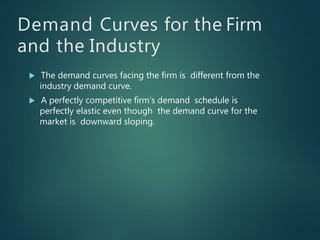
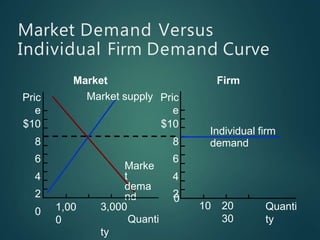
 The demand curves facing the firm is different from the
industry demand curve.
 A perfectly competitive firm’s demand schedule is
perfectly elastic even though the demand curve for the
market is downward sloping.
Marke
t
dema
nd
1,00
0
Pric
e
$10
8
6
4
2
0 3,000
Quanti
ty
Market Firm
Market supply
Market Demand Versus
Individual Firm Demand Curve
10 20
30
Pric
e
$10
8
6
4
20
Quanti
ty
Individual firm
demand
Profit-Maximizing Level of
Output
The goal of the firm is to maximize profits.
Profit is the difference between total
revenue and total cost.
Profit-Maximizing Level of
Output
What happens to profit in response to a
change in output is determined by
marginal revenue (MR) and marginal cost
(MC) maximizes profit when MC = MR.
Short-Run Market Supply
and Demand
 While the firm's demand curve is perfectly
elastic, the industry's is downward sloping.
 For the industry's supply curve we use a
market supply curve.
Short-Run Market Supply
and Demand
 The market supply curve is the horizontal sum
of all the firms' marginal cost curves, taking
account of any changes in input prices that
might occur.
Long-Run Competitive
Equilibrium
 Profits and losses are inconsistent with long-run
equilibrium.
 Profits create incentives for new firms
to enter, output will increase, and the
price will fall until zero profits are
made.
 The existence of losses will cause
firms to leave the industry.
Long-Run Competitive
Equilibrium
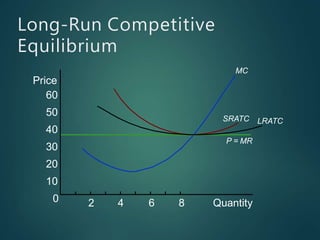
Only at zero profit will entry and exit stop.
The zero profit condition defines the long-
run equilibrium of a competitive industry.
Long-Run Competitive
Equilibrium
MC
P = MR
Price
60
50
40
30
20
10
0 2 4 6 8 Quantity
SRATC LRATC
Long-Run Competitive
Equilibrium
Zero profit does not mean that the
entrepreneur does not get anything for his
efforts.
Normal profit – the amount the owners of
business would have received in the next-
best alternative.
Long-Run Market Supply
In the long run firms earn zero profits.
If the long-run industry supply curve is
perfectly elastic, the market is a constant-
cost industry.
Long-Run Market Supply
Two other possibilities exist:
 Increasing-cost industry – factor prices rise
as new firms enter the market and existing
firms expand capacity.
 Decreasing-cost industry – factor prices fall
as industry output expands.
Perfectcompetition 090813075712.ppt-converted (1)

Perfectcompetition 090813075712.ppt-converted (1)

  • 2.
  • 3.
  • 4.
    A Perfectly Competitive Market Aperfectly competitive market is one in which economic forces operate unimpeded.
  • 5.
    A Perfectly Competitive Market Aperfectly competitive market must meet the following requirements:  Both buyers and sellers are price takers.  The number of buyers & firms is large.  There are no barriers to entry.  The firms’ products are homogeneous.  There is complete information.  Firms are profit maximizers.
  • 6.
    The Necessary Conditionsfor Perfect Competition Both buyers and sellers are price takers.  A pricetakeris a firm or individual who takes the market price as given.  In most markets, households are price takers – they accept the price offered in stores.
  • 7.
    The Necessary Conditionsfor Perfect Competition Both buyers and sellers are price takers.  The retailer is not perfectly competitive.  A retail store is not a price taker but a price maker.
  • 8.
    The Necessary Conditionsfor Perfect Competition The number of firms is large.  Large means that what one firm does has no bearing on what other firms do.  Any one firm's output is small when compared with the total market.
  • 9.
    The Necessary Conditionsfor Perfect Competition There are no barriers to entry.  Barrierstoentryare social, political, or economic impediments that prevent other firms from entering the market.  Barriers sometimes take the form of patents granted to produce a certain good.
  • 10.
    The Necessary Conditionsfor Perfect Competition There are no barriers to entry.  Technology may prevent some firms from entering the market.  Social forces such as bankers only lending to certain people may create barriers.
  • 11.
    The Necessary Conditionsfor Perfect Competition The firms' products are identical.  This requirement means that each firm's output is indistinguishable from any competitor's product.
  • 12.
    The Necessary Conditionsfor Perfect Competition There is complete information.  Firms and consumers know all there is to know about the market –prices, products, and available technology.  Any technological breakthrough would be instantly known to all in the market.
  • 13.
    The Necessary Conditionsfor Perfect Competition Firms are profit maximizers.  The goal of all firms in a perfectly competitive market is profit and only profit.  The only compensation firm owners receive is profit, not salaries.
  • 14.
    The Definition ofSupplyand Perfect Competition If all the necessary conditions for perfect competition exist, we can talk formally about the supply of a produced good.
  • 15.
    The Definition ofSupplyand Perfect Competition Supply is a schedule of quantities of goods that will be offered to the market at various prices.
  • 16.
    The Definition ofSupply and Perfect Competition  When a firm operates in a perfectly competitive market, it’s supply curve is that portion of its short-run marginal cost curve above average variable cost.
  • 17.
    Demand Curves forthe Firm and the Industry  The demand curves facing the firm is different from the industry demand curve.  A perfectly competitive firm’s demand schedule is perfectly elastic even though the demand curve for the market is downward sloping.
  • 18.
    Marke t dema nd 1,00 0 Pric e $10 8 6 4 2 0 3,000 Quanti ty Market Firm Marketsupply Market Demand Versus Individual Firm Demand Curve 10 20 30 Pric e $10 8 6 4 20 Quanti ty Individual firm demand
  • 19.
    Profit-Maximizing Level of Output Thegoal of the firm is to maximize profits. Profit is the difference between total revenue and total cost.
  • 20.
    Profit-Maximizing Level of Output Whathappens to profit in response to a change in output is determined by marginal revenue (MR) and marginal cost (MC) maximizes profit when MC = MR.
  • 21.
    Short-Run Market Supply andDemand  While the firm's demand curve is perfectly elastic, the industry's is downward sloping.  For the industry's supply curve we use a market supply curve.
  • 22.
    Short-Run Market Supply andDemand  The market supply curve is the horizontal sum of all the firms' marginal cost curves, taking account of any changes in input prices that might occur.
  • 23.
    Long-Run Competitive Equilibrium  Profitsand losses are inconsistent with long-run equilibrium.  Profits create incentives for new firms to enter, output will increase, and the price will fall until zero profits are made.  The existence of losses will cause firms to leave the industry.
  • 24.
    Long-Run Competitive Equilibrium Only atzero profit will entry and exit stop. The zero profit condition defines the long- run equilibrium of a competitive industry.
  • 25.
    Long-Run Competitive Equilibrium MC P =MR Price 60 50 40 30 20 10 0 2 4 6 8 Quantity SRATC LRATC
  • 26.
    Long-Run Competitive Equilibrium Zero profitdoes not mean that the entrepreneur does not get anything for his efforts. Normal profit – the amount the owners of business would have received in the next- best alternative.
  • 27.
    Long-Run Market Supply Inthe long run firms earn zero profits. If the long-run industry supply curve is perfectly elastic, the market is a constant- cost industry.
  • 28.
    Long-Run Market Supply Twoother possibilities exist:  Increasing-cost industry – factor prices rise as new firms enter the market and existing firms expand capacity.  Decreasing-cost industry – factor prices fall as industry output expands.