MARKET STRUCTURE
By
Dr. Raksha Singh
Principal
Shri Shankaracharya
Mahavidyalaya
rakshasingh20@hotmail.com
www.ssmv.ac.in
Dr. RAKSHA SINGH
MARKET
 According to Sidgwick,”
 A market is a body of persons in such
commercial relations that each can easily
acquaint himself with the rates at which certain
kinds of exchange of goods or services are from
time to time made by the others.”
Dr. RAKSHA SINGH
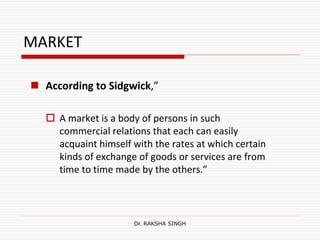
FEATURES OF MARKET
 1. Buyers & Sellers
 A product will be produced and marketed only when there is demand for it .
Without seller demand for any product is worthless
 2. Competition
 Some competition among buyers and sellers are important
 3. Interaction
 Proper interaction is compulsory for to know the terms and conditions of
exchange of the commodity
 4. Existence of Commodity
 There are separate market for separate commodities, Willingness to buy and
sell is possible with existence of a commodity
 5. Price
 Mutual agreement for price
 6. Knowledege
Dr. RAKSHA SINGH
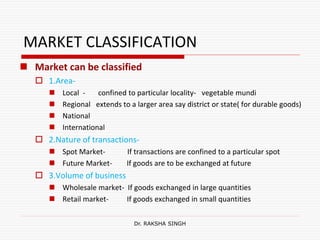
MARKET CLASSIFICATION
 Market can be classified
 1.Area-
 Local - confined to particular locality- vegetable mundi
 Regional extends to a larger area say district or state( for durable goods)
 National
 International
 2.Nature of transactions-
 Spot Market- If transactions are confined to a particular spot
 Future Market- If goods are to be exchanged at future
 3.Volume of business
 Wholesale market- If goods exchanged in large quantities
 Retail market- If goods exchanged in small quantities
Dr. RAKSHA SINGH
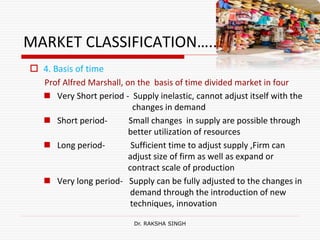
MARKET CLASSIFICATION…..
 4. Basis of time
Prof Alfred Marshall, on the basis of time divided market in four
 Very Short period - Supply inelastic, cannot adjust itself with the
changes in demand
 Short period- Small changes in supply are possible through
better utilization of resources
 Long period- Sufficient time to adjust supply ,Firm can
adjust size of firm as well as expand or
contract scale of production
 Very long period- Supply can be fully adjusted to the changes in
demand through the introduction of new
techniques, innovation
Dr. RAKSHA SINGH
MARKET CLASSIFICATION…..
 5.Basis of Regulation
 Regulated Market- Controlled by appropriate government authorities, to
ensure no unfair practices in the market e.g Stock market
 Unregulated Market- Absolutely free market, market forces decides
everything
 6.Status of sellers
 Primary Market- Manufacturing units or producers sell their goods to the
wholesalers
 Secondary Market- Consists of the middlemen E.g wholesalers, who act as a
link between the producers and the retailers
 Terminal Market- Consist of retailers who directly supply goods to the
ultimate buyers
Dr. RAKSHA SINGH
MARKET STUCTURE
 Market structure refers to the number of firms operating in
the industry, nature of competition between them and the
nature of the product.
 It consists of both goods market and services (factor)
market.
 Determinants of Market Structure
 1. The degree to which the industry is vertically integrated
 2. The number of firms
 3. Nature of Product
 4. Conditions of entry and exit
 5. Economies of Scale
Dr. RAKSHA SINGH
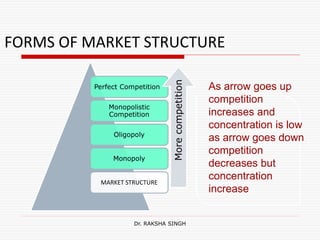
FORMS OF MARKET STRUCTURE
Perfect Competition
Monopolistic
Competition
Oligopoly
Monopoly
MARKET STRUCTURE Morecompetition
Dr. RAKSHA SINGH
As arrow goes up
competition
increases and
concentration is low
as arrow goes down
competition
decreases but
concentration
increase
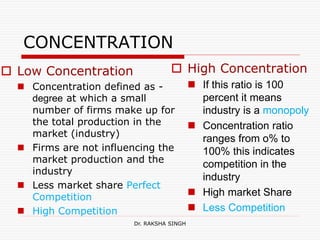
CONCENTRATION
 Low Concentration
 Concentration defined as -
degree at which a small
number of firms make up for
the total production in the
market (industry)
 Firms are not influencing the
market production and the
industry
 Less market share Perfect
Competition
 High Competition
 High Concentration
 If this ratio is 100
percent it means
industry is a monopoly
 Concentration ratio
ranges from o% to
100% this indicates
competition in the
industry
 High market Share
 Less Competition
Dr. RAKSHA SINGH
FORMS OF MARKET STUCTURE..
 Perfect
Competition
 Large Number of
buyers and sellers
 Homogeneous
Product
 Industry
determines the
Price
 One price
 Monopolistic
Competition
 Differentiated
Products
 Many Sellers
Dr. RAKSHA SINGH
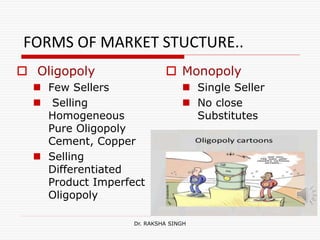
FORMS OF MARKET STUCTURE..
 Oligopoly
 Few Sellers
 Selling
Homogeneous
Pure Oligopoly
Cement, Copper
 Selling
Differentiated
Product Imperfect
Oligopoly
 Monopoly
 Single Seller
 No close
Substitutes
Dr. RAKSHA SINGH
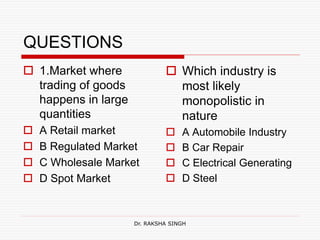
QUESTIONS
 1.Market where
trading of goods
happens in large
quantities
 A Retail market
 B Regulated Market
 C Wholesale Market
 D Spot Market
 Which industry is
most likely
monopolistic in
nature
 A Automobile Industry
 B Car Repair
 C Electrical Generating
 D Steel
Dr. RAKSHA SINGH
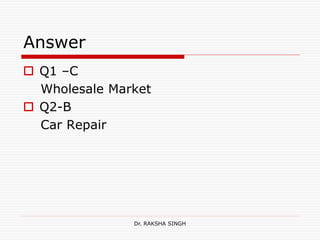
Answer
 Q1 –C
Wholesale Market
 Q2-B
Car Repair
Dr. RAKSHA SINGH
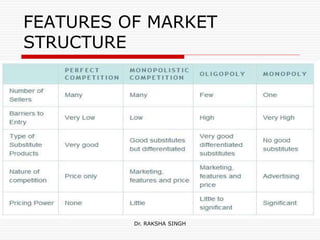
FEATURES OF MARKET
STRUCTURE
Dr. RAKSHA SINGH
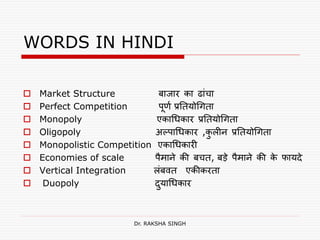
WORDS IN HINDI
 Market Structure बाजार का ढाांचा
 Perfect Competition पूर्ण प्रतियोगििा
 Monopoly एकागिकार प्रतियोगििा
 Oligopoly अल्पागिकार ,कु लीन प्रतियोगििा
 Monopolistic Competition एकागिकारी
 Economies of scale पैमाने की बचि, बडे पैमाने की के फायदे
 Vertical Integration लांबवि एकीकरिा
 Duopoly दुयागिकार
Dr. RAKSHA SINGH
References
 I.C. DIngra, V. (1997). Economics.
Sultan Chand& Sons.
 Kar.lE.case, R. C. (2018). Principles of
Economics. Pearson.
 Sciencebyalok.com. (2020, 30 March).
 SERIES, T. (2017). Economics. DANIKA
publishing COmpany.
 Dreamscom.co
 Alamyphoto
Dr. RAKSHA SINGH
Dr. RAKSHA SINGH
THANK YOU

Market Structure

  • 1.
    MARKET STRUCTURE By Dr. RakshaSingh Principal Shri Shankaracharya Mahavidyalaya rakshasingh20@hotmail.com www.ssmv.ac.in Dr. RAKSHA SINGH
  • 2.
    MARKET  According toSidgwick,”  A market is a body of persons in such commercial relations that each can easily acquaint himself with the rates at which certain kinds of exchange of goods or services are from time to time made by the others.” Dr. RAKSHA SINGH
  • 3.
    FEATURES OF MARKET 1. Buyers & Sellers  A product will be produced and marketed only when there is demand for it . Without seller demand for any product is worthless  2. Competition  Some competition among buyers and sellers are important  3. Interaction  Proper interaction is compulsory for to know the terms and conditions of exchange of the commodity  4. Existence of Commodity  There are separate market for separate commodities, Willingness to buy and sell is possible with existence of a commodity  5. Price  Mutual agreement for price  6. Knowledege Dr. RAKSHA SINGH
  • 4.
    MARKET CLASSIFICATION  Marketcan be classified  1.Area-  Local - confined to particular locality- vegetable mundi  Regional extends to a larger area say district or state( for durable goods)  National  International  2.Nature of transactions-  Spot Market- If transactions are confined to a particular spot  Future Market- If goods are to be exchanged at future  3.Volume of business  Wholesale market- If goods exchanged in large quantities  Retail market- If goods exchanged in small quantities Dr. RAKSHA SINGH
  • 5.
    MARKET CLASSIFICATION…..  4.Basis of time Prof Alfred Marshall, on the basis of time divided market in four  Very Short period - Supply inelastic, cannot adjust itself with the changes in demand  Short period- Small changes in supply are possible through better utilization of resources  Long period- Sufficient time to adjust supply ,Firm can adjust size of firm as well as expand or contract scale of production  Very long period- Supply can be fully adjusted to the changes in demand through the introduction of new techniques, innovation Dr. RAKSHA SINGH
  • 6.
    MARKET CLASSIFICATION…..  5.Basisof Regulation  Regulated Market- Controlled by appropriate government authorities, to ensure no unfair practices in the market e.g Stock market  Unregulated Market- Absolutely free market, market forces decides everything  6.Status of sellers  Primary Market- Manufacturing units or producers sell their goods to the wholesalers  Secondary Market- Consists of the middlemen E.g wholesalers, who act as a link between the producers and the retailers  Terminal Market- Consist of retailers who directly supply goods to the ultimate buyers Dr. RAKSHA SINGH
  • 7.
    MARKET STUCTURE  Marketstructure refers to the number of firms operating in the industry, nature of competition between them and the nature of the product.  It consists of both goods market and services (factor) market.  Determinants of Market Structure  1. The degree to which the industry is vertically integrated  2. The number of firms  3. Nature of Product  4. Conditions of entry and exit  5. Economies of Scale Dr. RAKSHA SINGH
  • 8.
    FORMS OF MARKETSTRUCTURE Perfect Competition Monopolistic Competition Oligopoly Monopoly MARKET STRUCTURE Morecompetition Dr. RAKSHA SINGH As arrow goes up competition increases and concentration is low as arrow goes down competition decreases but concentration increase
  • 9.
    CONCENTRATION  Low Concentration Concentration defined as - degree at which a small number of firms make up for the total production in the market (industry)  Firms are not influencing the market production and the industry  Less market share Perfect Competition  High Competition  High Concentration  If this ratio is 100 percent it means industry is a monopoly  Concentration ratio ranges from o% to 100% this indicates competition in the industry  High market Share  Less Competition Dr. RAKSHA SINGH
  • 10.
    FORMS OF MARKETSTUCTURE..  Perfect Competition  Large Number of buyers and sellers  Homogeneous Product  Industry determines the Price  One price  Monopolistic Competition  Differentiated Products  Many Sellers Dr. RAKSHA SINGH
  • 11.
    FORMS OF MARKETSTUCTURE..  Oligopoly  Few Sellers  Selling Homogeneous Pure Oligopoly Cement, Copper  Selling Differentiated Product Imperfect Oligopoly  Monopoly  Single Seller  No close Substitutes Dr. RAKSHA SINGH
  • 12.
    QUESTIONS  1.Market where tradingof goods happens in large quantities  A Retail market  B Regulated Market  C Wholesale Market  D Spot Market  Which industry is most likely monopolistic in nature  A Automobile Industry  B Car Repair  C Electrical Generating  D Steel Dr. RAKSHA SINGH
  • 13.
    Answer  Q1 –C WholesaleMarket  Q2-B Car Repair Dr. RAKSHA SINGH
  • 14.
  • 15.
    WORDS IN HINDI Market Structure बाजार का ढाांचा  Perfect Competition पूर्ण प्रतियोगििा  Monopoly एकागिकार प्रतियोगििा  Oligopoly अल्पागिकार ,कु लीन प्रतियोगििा  Monopolistic Competition एकागिकारी  Economies of scale पैमाने की बचि, बडे पैमाने की के फायदे  Vertical Integration लांबवि एकीकरिा  Duopoly दुयागिकार Dr. RAKSHA SINGH
  • 16.
    References  I.C. DIngra,V. (1997). Economics. Sultan Chand& Sons.  Kar.lE.case, R. C. (2018). Principles of Economics. Pearson.  Sciencebyalok.com. (2020, 30 March).  SERIES, T. (2017). Economics. DANIKA publishing COmpany.  Dreamscom.co  Alamyphoto Dr. RAKSHA SINGH
  • 17.

Editor's Notes

  • #3  They can do business over a phone , telegram, email ordinary post or whatsapp,On line shopping Market refers to a place or an area where buyers and sellers generally gather in order to buy and sell a particular commodity. Market need not to be located in a particular building, place, or an area but potential buyers and sellers must be contact with each other to conduct exchange transactions
  • #4 In general sense market where buyer and seller come together but in economics we do not refer market as physical place but they must come in contact directly or indirectly, flipkart, amazon virtual market Market for one commodity or sets of commodities. Clothes, Grocery, Jewellery separate market or shops are different where buyers and sellers interact
  • #5  They can do business over a phone , telegram, email ordinary post or whatsapp,On line shopping Market refers to a place or an area where buyers and sellers generally gather in order to buy and sell a particular commodity. Market need not to be located in a particular building, place, or an area but potential buyers and sellers must be contact with each other to conduct exchange transactions
  • #6  They can do business over a phone , telegram, email ordinary post or whatsapp,On line shopping Market refers to a place or an area where buyers and sellers generally gather in order to buy and sell a particular commodity. Market need not to be located in a particular building, place, or an area but potential buyers and sellers must be contact with each other to conduct exchange transactions
  • #7  They can do business over a phone , telegram, email ordinary post or whatsapp,On line shopping Market refers to a place or an area where buyers and sellers generally gather in order to buy and sell a particular commodity. Market need not to be located in a particular building, place, or an area but potential buyers and sellers must be contact with each other to conduct exchange transactions
  • #9 High concentration and low competition towards monopoly, More competition and less concentration towards perfect competition
  • #12 Pure /Homogeneous Oligopoly when sells homogeneous product steel, zinc Imperfect Oligopoly sells differentiated products automobiles,Soaps ,Detergents
  • #13 Q1 A-C ,2-B
  • #15 Table is taken from studypoint.com
  • #17 Thanks to my son Advaya for great help